Ancient Greece vs History of Christianity vs Ancient Rome vs Ancient history
9500 BCE – 9001 BCE
Settlement at Göbekli Tepe Begins
Settlement at Göbekli Tepe in modern-day Turkey began around 9500 BC, making it potentially the world's oldest known temple complex. This site predates many other known monumental structures and suggests organized religious activity among early human communities. Its existence challenges earlier assumptions about the relationship between agriculture and monumental architecture.
9000 BCE – 8501 BCE
Agriculture Emerges in Eastern Turkey
Evidence for agriculture emerges around 9000 BC in what is now eastern Turkey, spreading through the Fertile Crescent. This Neolithic Revolution marked a fundamental shift in human society from nomadic hunter-gatherer lifestyles to settled farming communities. Sheep and goats were also domesticated around this time in the Fertile Crescent.
8000 BCE – 7501 BCE
Sorghum and Millet Cultivation in the Nile River Valley
The Nile River Valley shows evidence of sorghum and millet cultivation starting around 8000 BC. Agricultural use of yams in Western Africa may also date to this same period. These early agricultural developments in Africa were independent of those in the Fertile Crescent.
Halaf Culture Agricultural Communities in Mesopotamia
Agricultural communities emerged in Mesopotamia with the Halaf culture around 8000 BC. These early settlements laid the groundwork for the later urban civilizations that would arise in the region. Mesopotamia would go on to become the cradle of civilization, developing writing, law codes, and centralized government.
7000 BCE – 6501 BCE
Millet, Rice, and Legume Cultivation Begins in China
Cultivation of millet, rice, and legumes began around 7000 BC in China. Taro cultivation in New Guinea and squash cultivation in Mesoamerica also date to approximately this period. These independent agricultural developments across multiple continents demonstrate the widespread nature of the Neolithic Revolution.
Cattle and Water Buffalo Domesticated
Cattle and water buffalo were domesticated around 7000 BC, providing humans with additional food sources and labor animals. Agriculture also began in the Indus Valley around this time. These domesticated animals greatly increased human ability to do agricultural work and transport goods.
6000 BCE – 5501 BCE
Smelting of Copper Ores Begins
Smelting of copper ores began around 6000 BC in western Asia, independently developing in eastern Asia before 2000 BC. This technological breakthrough followed earlier use of hammered copper items and marked the beginning of metallurgy. Gold and silver use also dates to between 6000 and 5000 BC.
Simple Plough Invented
The invention of the simple plough by 6000 BC further increased agricultural efficiency, allowing farmers to cultivate larger areas of land. This technological innovation was a key driver of population growth and the development of surplus food production. Surplus food enabled the specialization of labor and the rise of complex societies.
Ubaid Period in Mesopotamia
Agricultural communities in Mesopotamia continued to expand through the Ubaid period around 6000 BC. This period saw the growth of settlements and the development of more complex social structures. The Ubaid period laid the foundation for the later urban revolution of the Uruk period.
5000 BCE – 4501 BCE
Longshan and Yangshao Neolithic Cultures in China
Neolithic cultures such as the Longshan and Yangshao dating to 5000 BC produced sophisticated pottery, cultivated millet, and likely produced clothes woven from hemp and silk in the Yellow River valley. Rice was also farmed and pigs and water buffalo were kept for food. These cultures preceded the formation of Chinese civilization.

Oracle bone script from the Shang dynasty
Oracle bone script representing early Chinese writing that developed from these Neolithic cultures
Potter's Wheel Invented
Sometime between 5000 and 4000 BC the potter's wheel was invented, revolutionizing the production of ceramic goods. By 3000 BC, the pottery wheel was adapted into wheeled vehicles which could be used to carry loads further and more easily than with human or animal power alone. This invention had profound implications for both craft production and transportation.
4000 BCE – 3501 BCE
Horses, Donkeys, and Camels Domesticated
Horses, donkeys, and camels were domesticated by about 4000 BC, greatly expanding human transportation and military capabilities. These animals were used not only for food but to carry and pull people and loads, greatly increasing human ability to do work. The domestication of horses in particular would have profound military implications in later centuries.
Maize Cultivation Begins in Mesoamerica
Around 4000 BC maize began to be grown in Mesoamerica, soon followed by tomatoes. Agricultural cultivation had begun around 8000 BC in Mesoamerica with avocados, beans, chili peppers, gourds, and squashes. Maize would become the staple crop of Mesoamerican civilizations and a cornerstone of their cultures.
Uruk Period: First Cities in Mesopotamia
Cities began in the Uruk period (4000–3100 BC) in Mesopotamia, representing one of humanity's first urban civilizations. The surplus of storable foodstuffs created by agriculture allowed the population to settle in one place instead of migrating after crops and herds. This organization led to the necessity of record keeping and the development of writing.
3500 BCE – 3001 BCE
Bronze Alloy Metallurgy Begins in Mesopotamia
Alloy metallurgy began with bronze in about 3500 BC in Mesopotamia, marking the beginning of the Bronze Age. Bronze was harder and more durable than copper, enabling the production of better tools and weapons. This technology was developed independently in China by 2000 BC.
Proto-Literate Cuneiform Spreads in the Middle East
By 3400 BC, proto-literate cuneiform spread in the Middle East, representing one of the earliest writing systems in human history. Writing developed separately in five different locations: Mesopotamia, Egypt, India, China, and Mesoamerica. The development of writing was a transformative moment in human history, enabling the recording and transmission of knowledge.
Egyptian Hieroglyphs Developed
Egypt developed its own system of hieroglyphs by about 3200 BC, one of the earliest writing systems in the world. This writing system would later develop into hieratic and other derived scripts. Egyptian hieroglyphs were used to record religious texts, administrative records, and historical accounts for thousands of years.

Egyptian artifact
Egyptian artifact representing the ancient Egyptian civilization that developed hieroglyphic writing
Unification of Egypt Under Menes
Ancient Egypt began with the incipient unification of Nile Valley polities around 3100 BC, traditionally under Menes. The Ta-Seti kingdom in Nubia to the south of Egypt was also conquered by Egyptian rulers around this time. This unification marked the beginning of one of history's longest-lasting civilizations, which would endure for over three millennia.
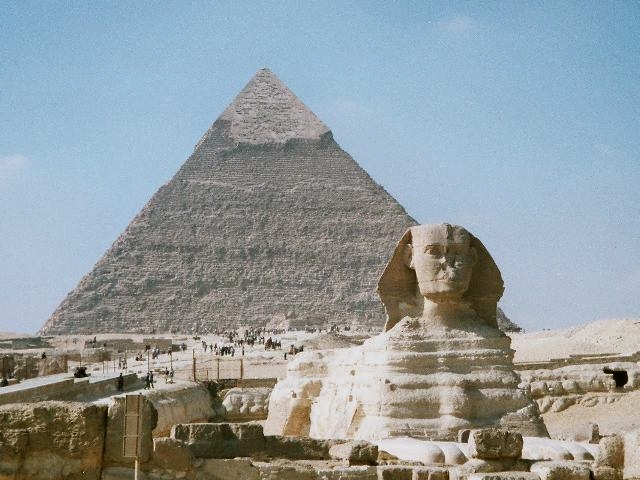
Great Sphinx of Giza
The Great Sphinx of Giza, a symbol of ancient Egyptian civilization that began with unification around 3100 BCE
Jemdet Nasr and Early Dynastic Periods in Mesopotamia
Cities expanded during the Jemdet Nasr (3100–2900 BC) and Early Dynastic (2900–2350 BC) periods in Mesopotamia. These periods saw the growth of urban centers and the development of more complex political and social structures. The Early Dynastic period saw the emergence of city-states with kings and organized armies.
3000 BCE – 2501 BCE
Indus Valley Civilisation Develops
The Indus Valley Civilisation developed around 3000 BC in the Indus and Ghaggar-Hakra river valleys of north-east Afghanistan, Pakistan, and western India. These communities created and traded jewelry, figurines, and seals that appear widely scattered throughout Mesopotamia, Afghanistan, and Iran. They developed their own writing system, the Indus Valley script, which is still mostly undeciphered.
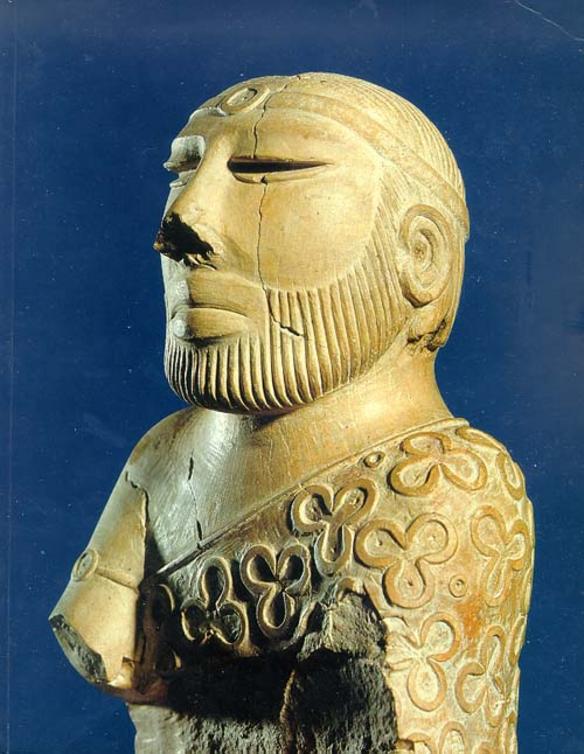
Mohenjo-daro Priest-King
Sculpture from Mohenjo-daro, one of the major cities of the Indus Valley Civilisation
Wheeled Vehicles Developed from Pottery Wheel
By 3000 BC, the pottery wheel was adapted into wheeled vehicles which could be used to carry loads further and easier than with human or animal power alone. This innovation transformed transportation and trade across the ancient world. Wheeled vehicles would later be adapted for military use as chariots.
Austronesian Expansion Begins from Taiwan
Around 3000 to 1500 BC, a large-scale migration of Austronesians known as the Austronesian expansion began from Taiwan, driven primarily by population growth. These first settlers settled in northern Luzon in the Philippines, intermingling with earlier Australo-Melanesian populations. Over the following millennia, Austronesian peoples would spread throughout Southeast Asia, the Pacific, and eventually to Madagascar.

Map showing the migration of the Austronesians from Taiwan
Map showing the chronological dispersal of Austronesian peoples across the Pacific
Indus Script Developed
By 2800 BC the Indus Valley Civilisation had developed its Indus script, which remains undeciphered to this day. This writing system was one of five independently developed writing systems in human history. The inability to decipher it means much about Indus Valley society remains unknown.
Old Kingdom Egypt and Pyramid Building
Ancient Egyptian history began with the Old Kingdom, which saw pyramid building on a large scale. The Great Sphinx of Giza was built during the 4th dynasty around 2500 BC. The Old Kingdom represented a period of great cultural and architectural achievement in ancient Egypt.
Khafre's Pyramid and Great Sphinx of Giza
The Great Sphinx of Giza, built during the Old Kingdom period of ancient Egypt
2500 BCE – 2001 BCE
Kingdom of Kush Founded in Nubia
By 2500 BC the Nubians had created a new kingdom further south, known as the Kingdom of Kush, centred on the upper Nile with a capital at Kerma. The Ta-Seti kingdom in Nubia had been conquered by Egyptian rulers around 3100 BC. The Kingdom of Kush would go on to have a complex relationship with Egypt, sometimes being conquered and sometimes conquering Egypt.

Pharaohs of Nubia
Rulers of Kush from the Kerma Museum, representing the Kingdom of Kush
Akkadian Empire at Height of Power
Akkad reached the height of its power between about 2330 and 2150 BC, following the conquests of King Sargon of Akkad. Through the spread of Sargon's empire, the Akkadian language spread and replaced the Sumerian language in Mesopotamia. By 1450 BC, Akkadian was the main language of diplomacy in the Near East.
Xia Dynasty in China
The Xia dynasty appears to have begun around 2200 BC and may have controlled parts of the Yangtze River valley. Little is yet known about the Xia, which was not considered historical by many scholars until the later 20th century. It was one of three ancient dynasties described in Chinese traditions that predated the unification under the Qin and Han dynasties.
2000 BCE – 1501 BCE
Dhar Tichitt Urban Centres in Mauritania
Dhar Tichitt and Oualata were prominent early urban centres dated to 2000 BC in present-day Mauritania. About 500 stone settlements littered the region in the former savannah of the Sahara, with inhabitants who fished and grew millet. These settlements are believed to have been constructed by the Soninke of the Mandé peoples.
Bantu Expansion Begins in Africa
Peoples speaking precursors to the modern-day Bantu languages began to spread throughout southern Africa, and by 2000 BC they were expanding past the Congo River and into the Great Lakes area. Iron metallurgy and agriculture spread along with these peoples, with the cultivation of millet, oil palms, sorghum, and yams. By AD 1000 these groups had spread throughout all of southern Africa south of the equator.
Maritime Jade Road Established in Southeast Asia
The Maritime Jade Road, a jade trade network in Southeast Asia, existed from 2000 BC to 1000 AD, established by links between the indigenous peoples of Taiwan and the Philippines. This trade network later included parts of Vietnam, Malaysia, Indonesia, Thailand, and other areas in Southeast Asia. It represents one of the earliest long-distance maritime trade networks in human history.
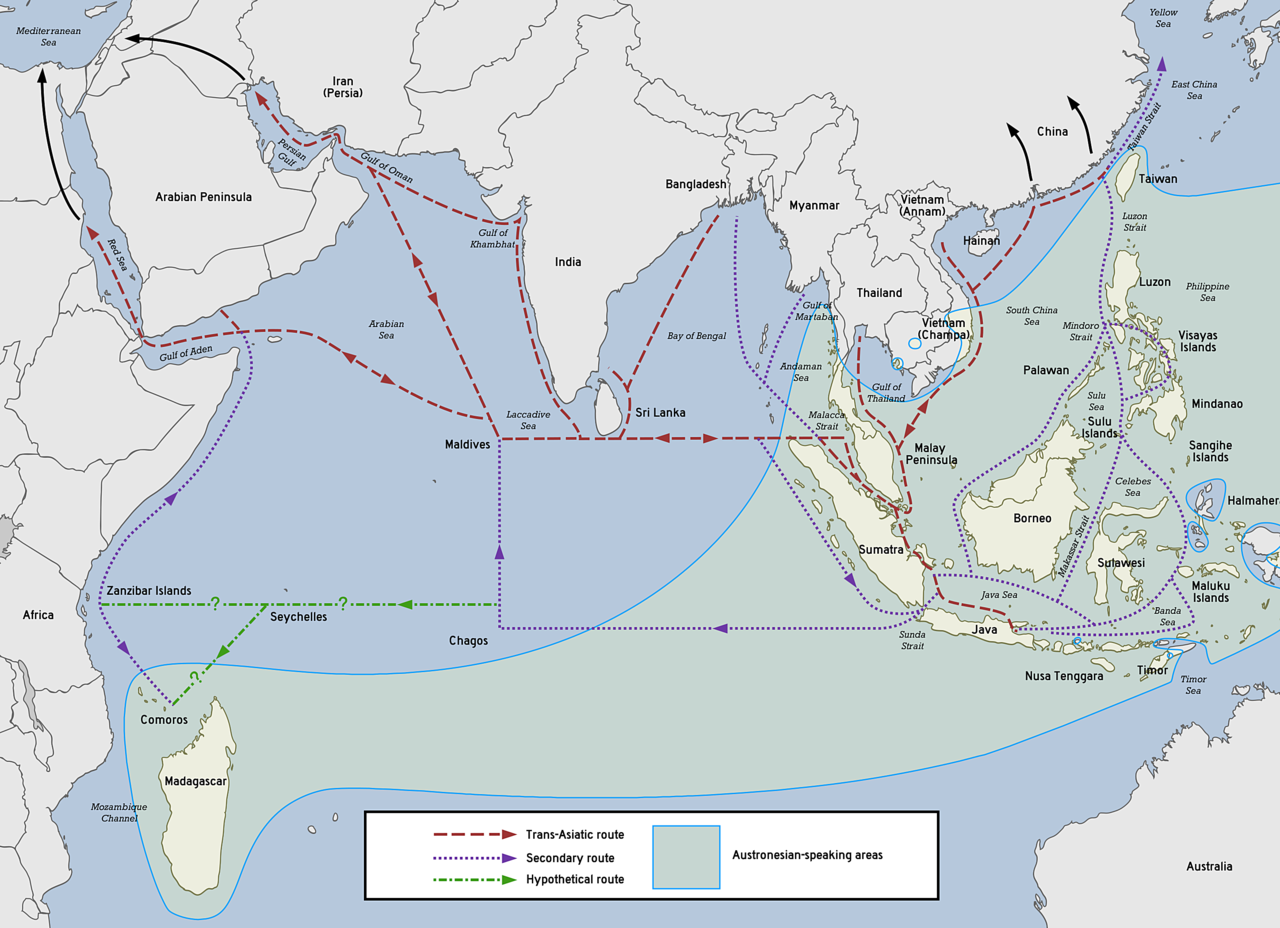
Austronesian maritime trade network in the Indian Ocean
Map of Austronesian maritime trade networks including the Maritime Jade Road
Middle Kingdom of Egypt
The Middle Kingdom began around 2000 BC with the reunification of Egypt under pharaohs ruling from Thebes, following the First Intermediate Period. This period saw Egypt expand its cultural and political influence. The Middle Kingdom ended with the conquest of northern Egypt by the Hyksos around 1650 BC.
Copper and Bronze Production in Southeast Asia
The earliest known evidence of copper and bronze production in Southeast Asia was found at Ban Chiang in north-east Thailand and among the Phùng Nguyên culture of northern Vietnam around 2000 BC. This metallurgical development was independent of Chinese or Indian influence. The Đông Sơn culture would later build on this tradition to create highly sophisticated bronze objects.

Đông Sơn drum
A Đông Sơn bronze drum, representing the sophisticated bronze production tradition of Southeast Asia
Hittites Arrive in Anatolia
The Hittites first came to Anatolia about 1900 BC and during the period 1600–1500 BC they expanded into Mesopotamia where they adopted the cuneiform script to their Indo-European language. By 1200 BC their empire stretched to Phoenicia and eastern Anatolia. The Hittites improved iron working and light chariots with spoked wheels, spreading these technologies widely.
Hyksos Conquer Northern Egypt
The Middle Kingdom ended with the conquest of northern Egypt by the Hyksos around 1650 BC. The Hyksos were eventually expelled from Egypt and the land was reunited in the New Kingdom around 1550 BC. This period of foreign rule had a significant impact on Egyptian military technology and culture.
Decline of Indus Valley Civilisation
By about 1600 BC, the Indus Valley culture had abandoned many of their cities, including Mohenjo-Daro. The exact reason for this decline is not known, though theories include climate change, flooding, and invasion. This marked the end of one of the ancient world's most sophisticated urban civilizations.
Mohenjo-daro Priest-King
Sculpture from Mohenjo-daro, one of the cities abandoned during the decline of the Indus Valley Civilisation
New Kingdom of Egypt
The Hyksos were expelled from Egypt and the land was reunited in the New Kingdom around 1550 BC. This period lasted until about 1000 BC and saw Egypt expand its borders into Palestine and Syria, reaching its greatest extent during the 2nd millennium BC. The New Kingdom is considered the height of ancient Egyptian power and cultural achievement.
Great Sphinx of Giza
Symbol of ancient Egyptian civilization during its New Kingdom period of greatest power
Phoenician Civilisation Flourishes
Phoenician civilisation was an enterprising maritime trading culture that spread across the Mediterranean between the period of 1550 to 300 BC. The Phoenicians invented the Phoenician alphabet, the forerunner of the modern alphabet still in use today. One Phoenician colony, Carthage, ruled an empire in the Western Mediterranean until being defeated by Rome in the Punic Wars.
1500 BCE – 1001 BCE
Mitanni Empire Founded
Mitanni was a Hurrian empire in northern Mesopotamia founded around 1500 BC. The Mitanians conquered and controlled Assyria until the 14th century BC while contending with Egypt for control of parts of modern Syria. Its capital was Washukanni, whose precise location has not been determined by archaeologists.
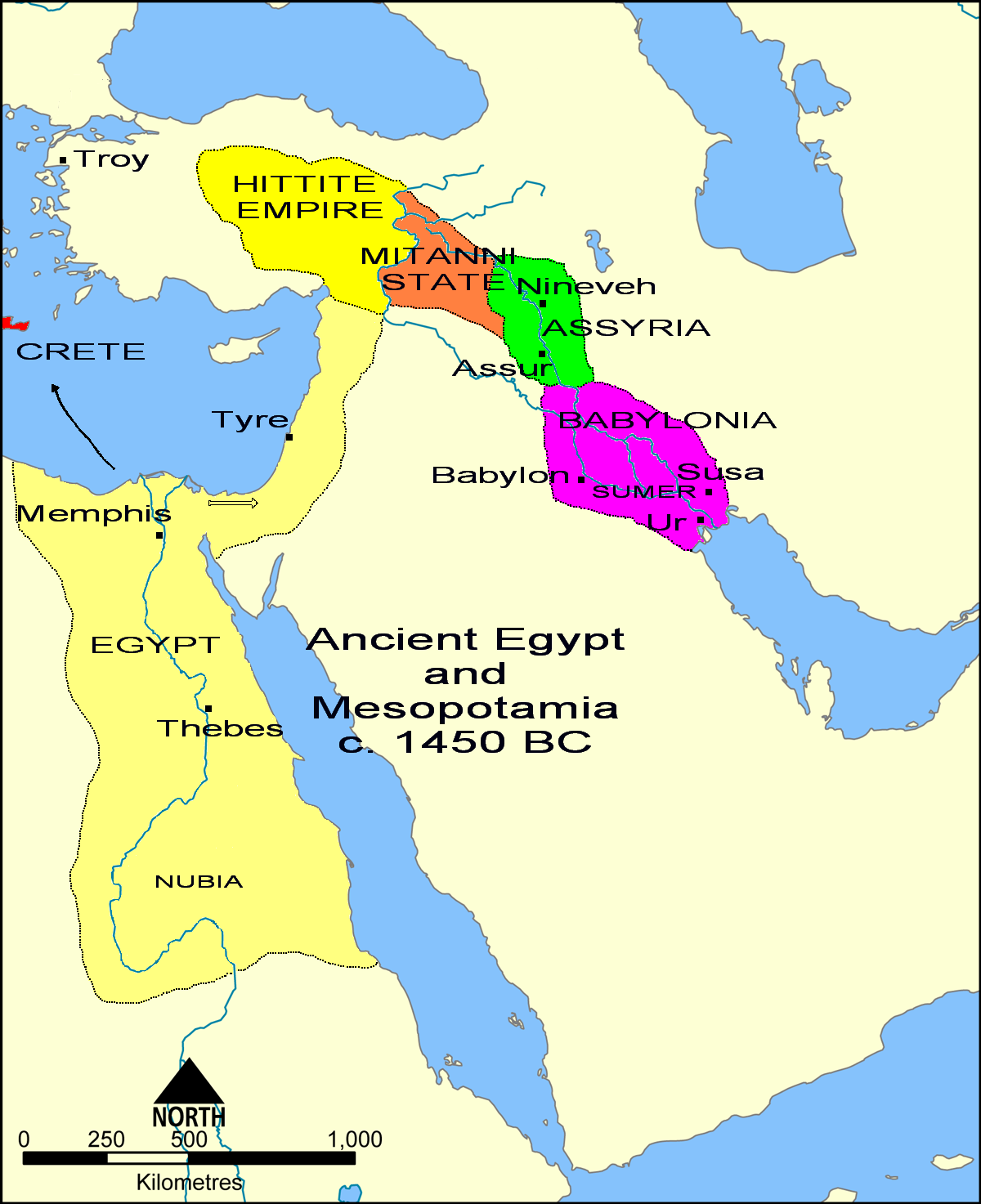
Ancient Egypt and Mesopotamia c. 1450 BC
Map showing the region including Mitanni, Assyria, and Babylonia around 1450 BC
Medes and Persians Appear on Iranian Plateau
The Medes and Persians were peoples who had appeared in the Iranian plateau around 1500 BC. Both peoples spoke Indo-European languages and were mostly pastoralists with a tradition of horse archery. These peoples would later go on to establish major empires that would shape the ancient world.
Indo-European Peoples Spread into India; Vedic Period Begins
Indo-European speaking peoples began to spread into India about 1500 BC, beginning the Vedic period. The Rigveda, in Sanskrit, dates to this period. Between 1500 and 500 BC these peoples spread throughout most of India and had begun to found small cities, with Vedic society characterized by the varna caste system.
Austronesians Colonize Northern Mariana Islands
Austronesians colonised the Northern Mariana Islands by 1500 BC or even earlier, becoming the first humans to reach Remote Oceania. The Chamorro migration was unique in that it was the only Austronesian migration to the Pacific Islands to successfully retain rice cultivation. This marked a major milestone in the human settlement of the Pacific.
Map showing the migration of the Austronesians from Taiwan
Map showing Austronesian migration routes including to the Northern Mariana Islands
Battle of Kadesh: Hittites vs. Egyptians
In 1274 BC the Hittites clashed with the Egyptians at the Battle of Kadesh, where both sides claimed victory. This was one of the largest chariot battles in history and resulted in one of the earliest known peace treaties. The battle demonstrated the military power of both the Hittite and Egyptian empires.
Israel First Mentioned in Merneptah Stele
The name Israel first appears in the stele of the Egyptian pharaoh Merneptah around 1209 BC. This 'Israel' was a cultural and probably political entity of the central highlands, well enough established to be perceived by the Egyptians as a possible challenge to their hegemony. This is the earliest known reference to Israel as a people.

The Iron Age Kingdom of Israel and Kingdom of Judah
Map of the Iron Age kingdoms of Israel and Judah
Hittite Empire Ends; Hattusa Sacked
In 1207 BC the Hittite capital of Hattusa was sacked, ending the Hittite Empire. This collapse was part of the broader Late Bronze Age collapse that affected many civilizations in the eastern Mediterranean around 1200 BC. The Mycenaean civilization also collapsed violently around this time.
Greek Dark Ages Begin
Following the Bronze Age collapse, Mycenaean Greece declined and the Greek Dark Ages began, lasting from approximately the 12th to 9th centuries BC. This period was archaeologically characterized by protogeometric and geometric styles of designs on pottery. The collapse of Mycenaean power left a power vacuum that would eventually give rise to the independent city-states of the Archaic period.
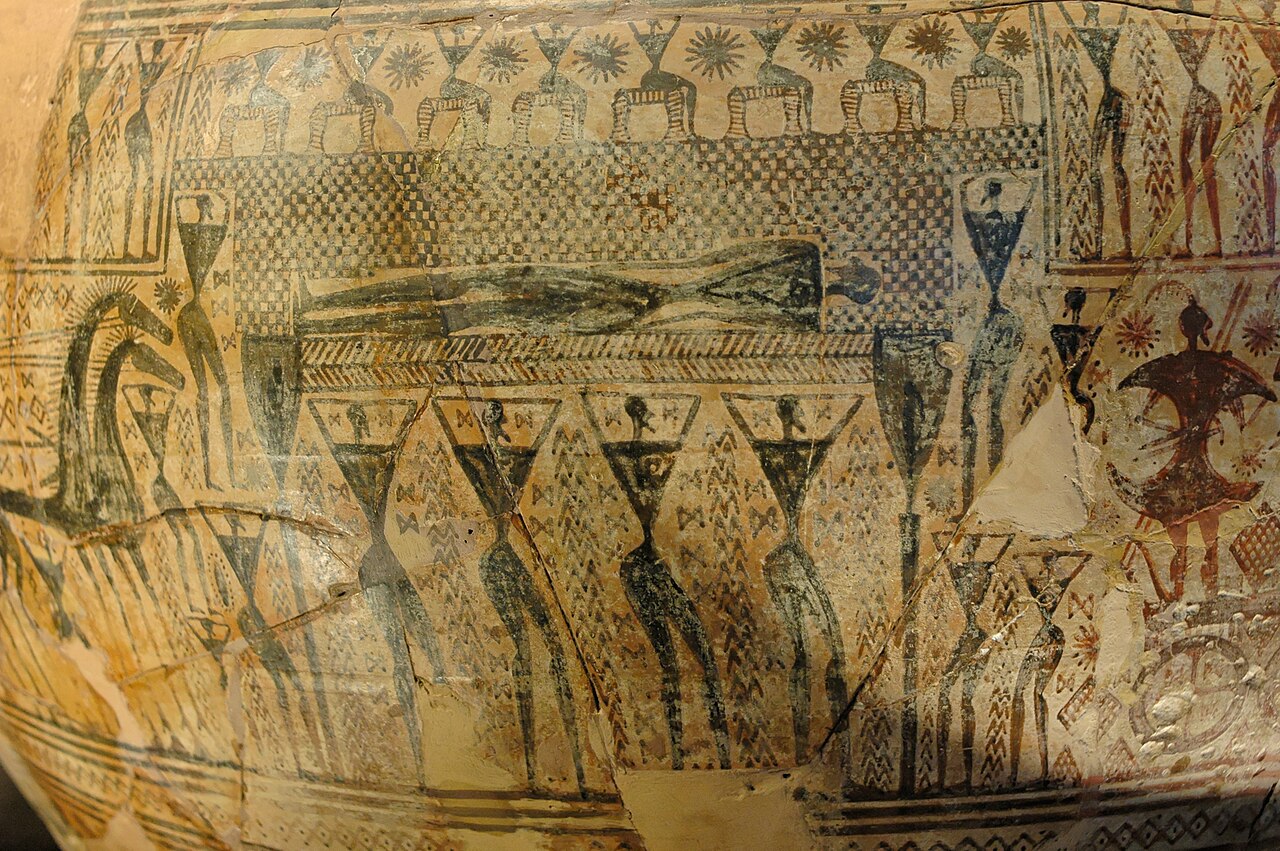
File:Prothesis Dipylon Painter A517.jpg
Dipylon Vase of the late Geometric period, representing the artistic style of the Dark Ages transitioning into the Archaic period.
Lapita Culture Spreads into Melanesia
The Lapita culture rapidly spread into the islands off the coast of northern New Guinea and into the Solomon Islands and other parts of coastal New Guinea and Island Melanesia by 1200 BC. They reached the islands of Fiji, Samoa, and Tonga by around 900 to 800 BC. This represented a major phase of human settlement in the Pacific.
Map showing the migration of the Austronesians from Taiwan
Map showing the spread of Lapita culture and Austronesian peoples through the Pacific
Mycenaean Civilization Collapses
The Mycenaean civilization, the first distinctively Greek civilization, collapsed violently around 1200 BC, along with several other civilizations in the eastern Mediterranean during the Late Bronze Age collapse. This ushered in a period known as the Greek Dark Ages, from which written records are absent. The collapse ended the first phase of Greek civilization.
First Olmec Centre of San Lorenzo Founded
Around 1200 BC the first Olmec centre of San Lorenzo was founded, which remained the centre of Olmec civilisation until around 800 BC when La Venta took over. The Olmecs erected large stone sculptures of human heads and other subjects, and their writing system and calendar influenced later Mesoamerican cultures. Jade jewelry and other Olmec objects are found throughout Mesoamerica, likely having travelled via trade networks.

Olmec colossal head
An Olmec colossal head, representing the monumental sculpture tradition of the Olmec civilization
Zhou Dynasty Overthrows Shang in China
Towards the end of the 2nd millennium BC, the Shang were overrun by the Zhou dynasty from the Wei River valley to the west. The Zhou rulers invoked the concept of the Mandate of Heaven to legitimize their rule, a concept that would be influential for almost every successive dynasty. The Zhou initially established their capital in the west near modern Xi'an.
New Kingdom of Kush with Capital at Napata
By 1100 BC a new kingdom of Kush had formed, with a capital at Napata. This kingdom would later conquer Egypt around 760 BC and retain control for about a century. The Kingdom of Kush represented a significant African civilization that interacted closely with ancient Egypt.
Pharaohs of Nubia
Rulers of Kush, representing the new Kingdom of Kush with its capital at Napata
1000 BCE – 501 BCE
Nok Culture Appears in Nigeria
The Nok culture appeared in Nigeria around 1000 BC and mysteriously vanished around AD 200. The Nok civilisation was considered to be the earliest sub-Saharan producer of life-sized terracotta sculptures discovered by archaeologists. The Nok also used iron smelting that may have been independently developed.

Nok sculpture of a seated person
A Nok terracotta sculpture, representing the earliest sub-Saharan producer of life-sized terracotta
Chavin Culture Emerges in the Andes
The Chavin culture, based around the Chavin cult, emerged around 1000 BC in the Andes and led to large temples and artworks as well as sophisticated textiles. Gold, silver, and copper were worked for jewelry and occasionally for small copper tools. This culture represented one of the earliest complex societies in South America.
Carthage Founded by Phoenician Settlers
Carthage was founded around 814 BC by Phoenician settlers. Ancient Carthage was a city-state that ruled an empire through alliances and trade influence that stretched throughout North Africa and modern Spain. At the height of the city's influence, its empire included most of the western Mediterranean.
Euboean Settlement at Al-Mina
Greek colonists from Euboea established settlements at Al-Mina in the east as early as 800 BC, marking some of the earliest Greek colonial activity. This contact with non-Greek peoples, especially in the Near East, inspired developments in art and architecture, the adoption of coinage, and the development of the Greek alphabet. These early colonies were important trading posts that facilitated cultural exchange.

File:Greek Colonies in the 8th-6th centuries BC.png
Map of ancient Greek colonies in the archaic period, showing the extent of Greek colonization including settlements in the east.
Archaic Period Begins
The Archaic period of ancient Greece began around 800 BC, following the Greek Dark Ages. This era saw the culmination of political and social developments, with the polis (city-state) becoming the most important unit of political organisation in Greece. The period was marked by the founding of Greek colonies around the Mediterranean and increasing contact with non-Greek peoples.
File:Prothesis Dipylon Painter A517.jpg
Dipylon Vase of the late Geometric period, representing the transition into the Archaic period of ancient Greece.
Euboean Settlement at Ischia
Greek colonists from Euboea established a settlement at Ischia in the west by 775 BC, one of the earliest Greek colonies in the western Mediterranean. This was part of a broader wave of Greek colonization that spread Greek culture and influence throughout the Mediterranean basin. These western colonies would eventually develop into important city-states in their own right.
File:Greek Colonies in the 8th-6th centuries BC.png
Map showing ancient Greek colonies in the archaic period, including western settlements.
Spring and Autumn Period in China
In the 8th century BC, power became decentralized during the Spring and Autumn period in China, named after the influential Spring and Autumn Annals. Local military leaders used by the Zhou began to assert their power and vie for hegemony. The Hundred Schools of Thought of Chinese philosophy blossomed during this period, including Confucianism, Taoism, Legalism, and Mohism.
Nubian Rulers Conquer Egypt
Nubian rulers conquered Egypt around 760 BC and retained control for about a century. This period saw Nubian pharaohs ruling over Egypt, representing a reversal of the earlier Egyptian domination of Nubia. The Nubian rulers of the 25th dynasty are sometimes called the 'Black Pharaohs.'
Pharaohs of Nubia
Nubian rulers who conquered and ruled Egypt for about a century
Traditional Founding of Rome
According to Roman tradition, the city of Rome was founded in 753 BC by Romulus, who killed his twin brother Remus after a dispute and became the city's sole founder. The settlement was established on the Palatine Hill beside the River Tiber in the Italian Peninsula. The Roman antiquarian Marcus Terentius Varro placed the city's foundation at this date, which became the basis for Roman dating systems.

Lupa Capitolina
The Capitoline Wolf, symbol of the founding myth of Rome featuring Romulus and Remus
Roman Kingdom Established
Rome was initially governed as a monarchy with seven legendary kings who were largely unrelated by blood. The Romans believed their monarchy was elective, and literary and archaeological evidence confirms the existence of kings in Rome, attested in fragmentary 6th-century BC texts. The kingdom saw early expansion, with Rome controlling a territory of some size with a population perhaps as high as 35,000 by the end of the 6th century BC.

Rome in 753 BC
Map of Rome at its founding in 753 BC
Assyria Conquers Israel
Israel came into conflict with the Assyrians, who conquered Israel in 722 BC. After the conquest, the Assyrian forces deported many of the inhabitants to other regions of their empire. This event is known as the Assyrian captivity and led to the dispersal of the ten northern tribes of Israel.
The Iron Age Kingdom of Israel and Kingdom of Judah
Map of the Iron Age kingdoms of Israel and Judah, showing the territories conquered by Assyria
Numa Pompilius Introduces January and February
Numa Pompilius, the second king of Rome, is credited with introducing the months of January and February to the Roman calendar, creating the 12-month calendar still in use today. Previously, the Roman year had only ten months from Martius (March) to December, with the winter period not included. This calendar reform was a significant cultural and administrative achievement.
Tyranny Established at Corinth
Corinth became one of the most famous examples of tyranny in the Greek world when tyrants rose to power there from 657 BC. This was part of a broader pattern across the Greek world during the Archaic period, where tyrants seized control of city-states, often with populist agendas. The rise of tyrants was frequently a response to social unrest caused by the domination of politics by small groups of aristocratic families.
Failed Coup by Cylon of Athens
Around 636 BC, Cylon of Athens led a failed coup attempt to seize power in Athens. In the aftermath, Draco was appointed to establish a code of laws in 621 BC to address the political tensions that had made such a coup possible. Draco's laws were famously harsh, giving rise to the modern term 'draconian,' but they failed to reduce the political tension between the poor and the elites.
Draco Establishes Code of Laws in Athens
In 621 BC, Draco was appointed to establish a code of laws in Athens following the failed coup by Cylon. This was one of the earliest written legal codes in Athens, and while it established the right of all citizen men to attend the assembly, it was famously harsh. The laws failed to reduce political tension between the poor and the elites, eventually necessitating further reforms.
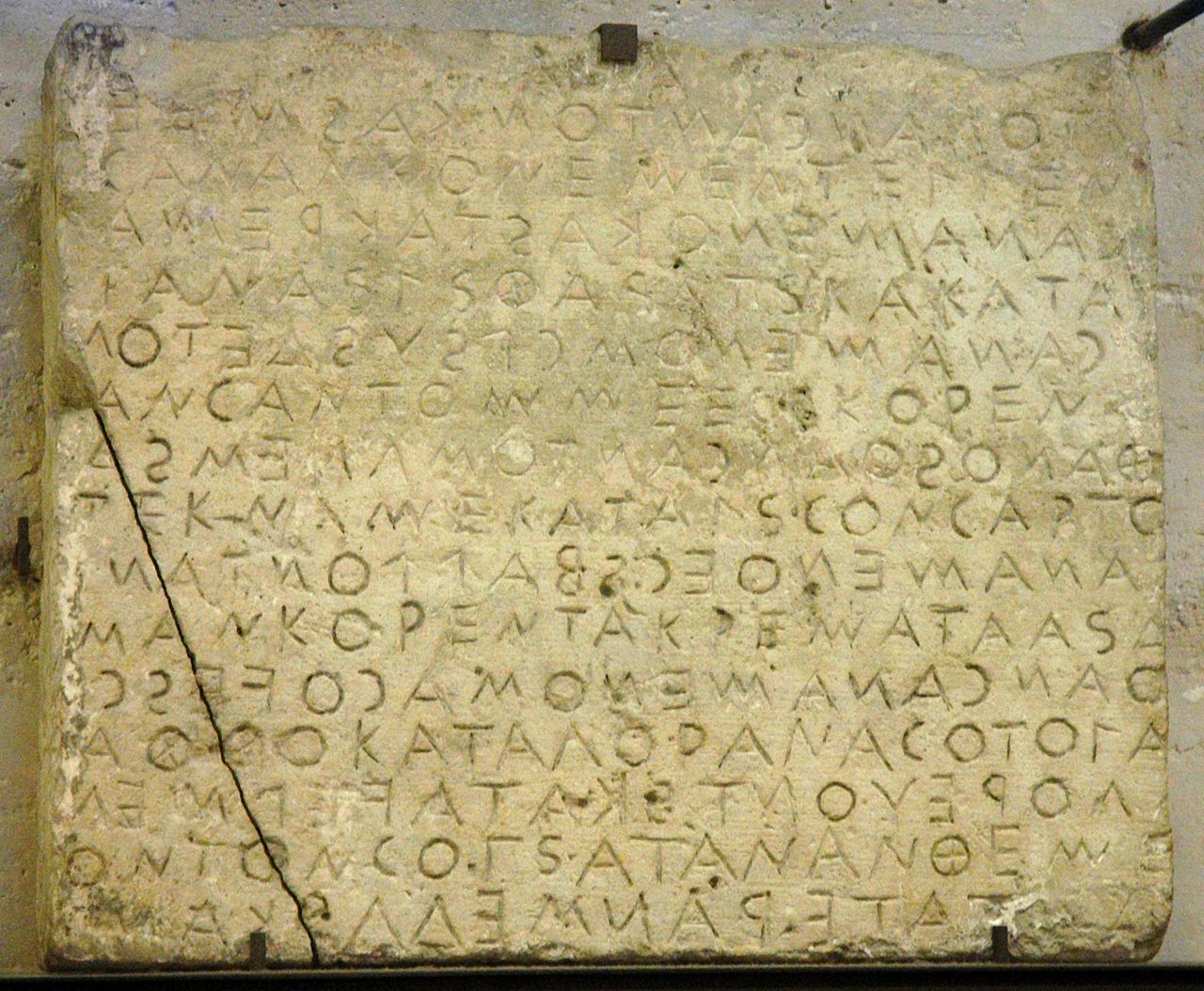
File:Law Code Gortyn Louvre Ma703.jpg
An example of ancient Greek law code, representing the tradition of written legal codes in ancient Greece.
Medes Defeat Neo-Assyrian Empire
The Medes established their own Median Empire by the 6th century BC, having defeated the Neo-Assyrian Empire with the Chaldeans in 614 BC. This marked the end of Assyrian dominance in the Near East. The fall of Assyria opened the way for the rise of the Persian Empire.
Etruscan Cultural Influence on Rome
During the 6th century BC, Rome was significantly influenced by Etruscan culture, as evidenced by Etruscan paintings and artifacts found in the region. The Romans constructed the Temple of Jupiter Optimus Maximus on the Capitoline and expanded to the Forum Boarium. Rome also began assimilating Etruscan cultural practices while extending its control over Latin neighbors.

Etruscan painting from the Tomb of the Leopards
Etruscan painting of dancer and musicians from the Tomb of the Leopards in Tarquinia, illustrating the cultural context of Rome's Etruscan neighbors
Writing in Mesoamerica: Zapotec Civilization
Writing in Mesoamerica dates to 600 BC with the Zapotec civilization. The Zapotecs began around 500 BC in the Oaxaca Valley at the site of Monte Alban. Like the Olmecs, they had a writing system and calendar that influenced later Mesoamerican cultures.
Solon's Reforms in Athens
In 594 BC, Solon was given the authority to enact a set of reforms in Athens that attempted to balance the power of the rich and the poor. These reforms allowed all citizens to attend the assembly, though the poorest citizens could not address the assembly or run for office. Solon's reforms were a crucial step in the development of Athenian democracy, laying the groundwork for later democratic institutions.

File:Bust Pericles Chiaramonti.jpg
Bust of Pericles, a key figure in Athenian democracy, representing the tradition of democratic reform in Athens.
Neo-Babylonian Empire Conquers Judah
The Neo-Babylonian Empire conquered Judah in 586 BC under the reign of Nebuchadnezzar II. After the conquest, the Babylonian forces deported many of the inhabitants to other regions of their empire. This event is known as the Babylonian captivity and had a profound impact on Jewish religion and culture.
Siddhartha Gautama Born; Buddhism Founded
Siddhartha Gautama, born around 560 BC in northern India, went on to found a new religion based on his ascetic life – Buddhism. This faith spread throughout Eastern and Southeastern Asia after his death. Buddhism became one of the world's major religions and had a profound impact on Asian cultures.

Standing Buddha from Gandhara, 1st century AD
A standing Buddha from Gandhara, representing the Buddhist religion founded by Siddhartha Gautama
Pisistratus Establishes Tyranny in Athens
In the middle of the 6th century BC, Pisistratus established himself as tyrant of Athens. His rule represented a period of relative stability and prosperity for Athens, though it was a departure from the democratic reforms of Solon. After his death in 527 BC, his son Hippias inherited his position, continuing the tyranny until it was overthrown by the end of the 6th century.
Cyrus the Great Founds Achaemenid Empire
The Achaemenid Empire was founded by Cyrus the Great, who first became king of the Persians, then conquered the Medes, Lydia, and Babylon by 539 BC. The empire built on earlier Mesopotamian systems of government to govern their large empire. Cyrus allowed the rebuilding of the temple at Jerusalem and permitted exiled peoples to return to their homelands.
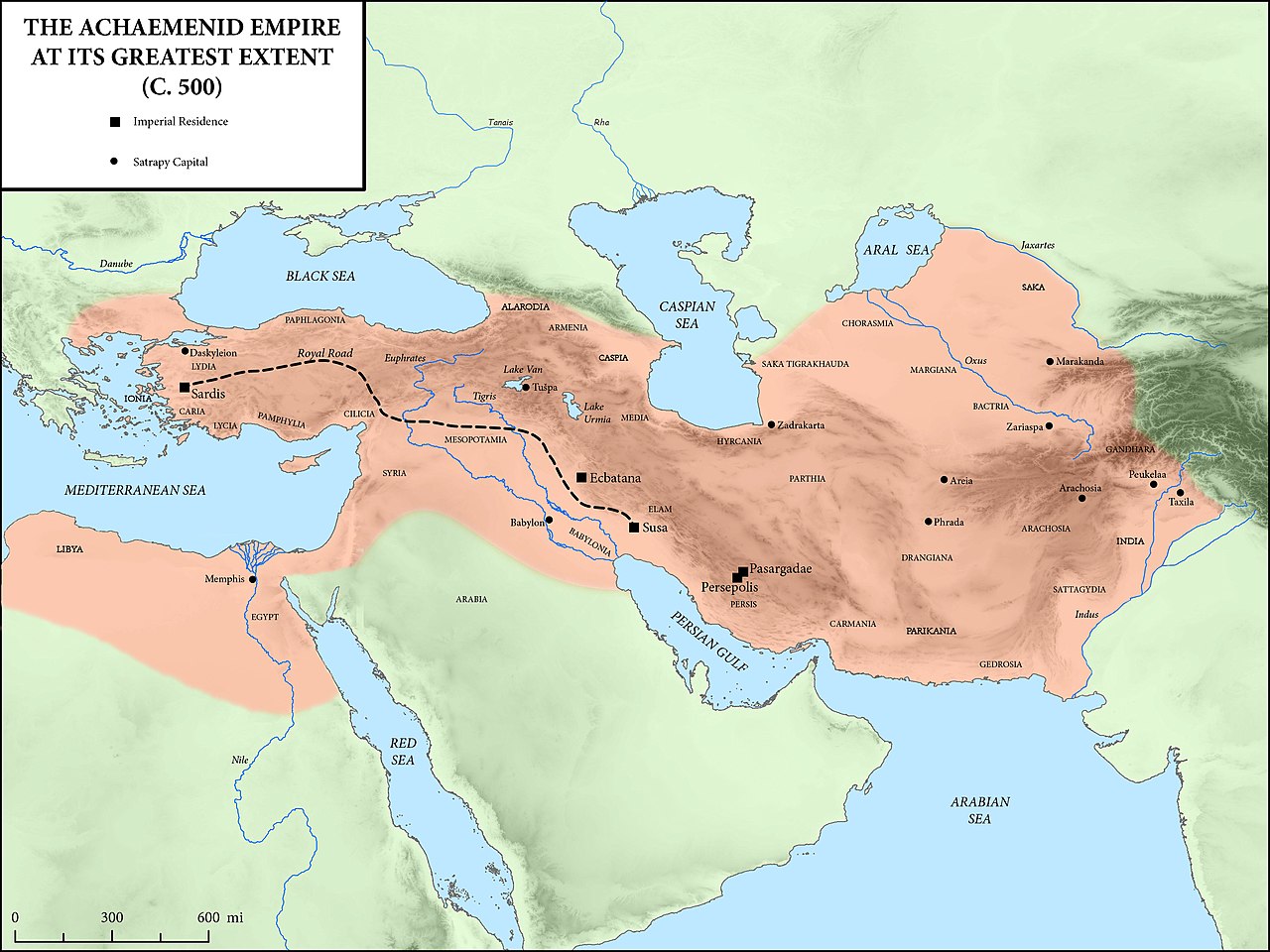
The Persian Achaemenid Empire at its greatest extent
Map of the Achaemenid Empire at its greatest extent, founded by Cyrus the Great
Death of Pisistratus and Succession of Hippias
Pisistratus, the tyrant of Athens, died in 527 BC and was succeeded by his son Hippias. Hippias continued his father's tyrannical rule but was eventually overthrown by the end of the 6th century BC. Following the overthrow of Hippias, Cleisthenes carried out further democratizing reforms that established the foundations of Athenian democracy.
Darius the Great Expands Persian Empire to Indus River
Darius the Great expanded the Achaemenid Empire to the Indus River, creating the largest empire in the world to that date. He also attempted to expand into Greece, with an expedition in 490 BC that ultimately failed at the Battle of Marathon. Darius built roads throughout the empire, improving both communication and military deployment.
The Persian Achaemenid Empire at its greatest extent
Map showing the Achaemenid Empire at its greatest extent under Darius the Great
Founding of the Roman Republic
According to tradition and later writers such as Livy, the Roman Republic was established when the last of the seven kings of Rome, Tarquin the Proud, was deposed. A system based on annually elected magistrates and various representative assemblies was established, with a constitution setting checks and balances and a separation of powers. The most important magistrates were the two consuls, who together exercised executive authority.
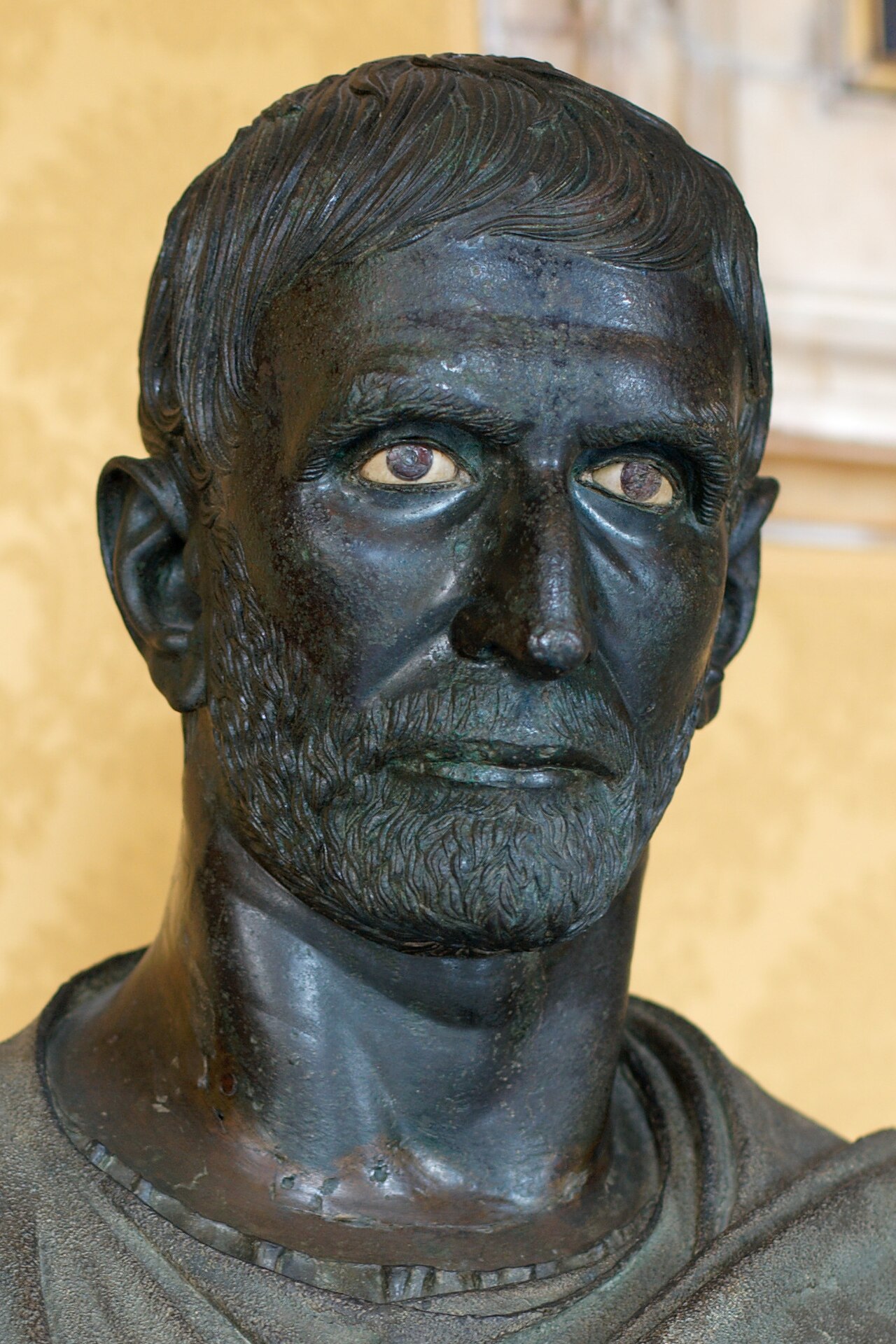
Capitoline Brutus
Bust traditionally identified as Lucius Junius Brutus, who led the overthrow of the last Roman king
Cleisthenes' Democratic Reforms in Athens
Following the overthrow of Hippias, Cleisthenes carried out further democratizing reforms in Athens at the end of the 6th century BC. These reforms established the assembly (Ecclesia) as the de jure mechanism of government, giving all citizens equal privileges. This marked the founding of the world's first democracy, a radical solution to prevent the aristocracy from regaining power.
File:Bust Pericles Chiaramonti.jpg
Bust of Pericles, representing the Athenian democratic tradition that Cleisthenes helped establish.
500 BCE – 1 BCE
Đông Sơn Bronze Drums Produced in Southeast Asia
By about 500 BC, large and delicately decorated bronze drums of remarkable quality, weighing more than 100 kg, were produced in the laborious lost-wax casting process in Southeast Asia. This industry of highly sophisticated metal processing was developed independent of Chinese or Indian influence. The Đông Sơn culture established a tradition of bronze production and the manufacture of refined bronze and iron objects.
Đông Sơn drum
A Đông Sơn bronze drum, representing the sophisticated bronze production of Southeast Asia
Classical Greek Period: Athens and Sparta
The Classical Greek world was dominated throughout the 5th century BC by the major powers of Athens and Sparta. Through the Delian League, Athens was able to convert pan-hellenist sentiment and fear of the Persian threat into a powerful empire. The conflict between Sparta and Athens culminated in the Peloponnesian War.

The Parthenon
The Parthenon, a temple dedicated to Athena on the Acropolis in Athens, built during the Classical period
Zapotecs Build Monte Alban
The Zapotecs began around 500 BC in the Oaxaca Valley at the site of Monte Alban. Monte Alban grew to around 25,000 residents in the period around AD 200, with the city having large stone temples and an expansive stone plaza. By AD 900 Monte Alban was deserted for unknown reasons.
Ionian Revolt Against Persia
In 499 BC, the Ionian city-states under Persian rule rebelled against their Persian-supported tyrant rulers. Supported by troops sent from Athens and Eretria, they advanced as far as Sardis and burnt the city before being driven back by a Persian counterattack. The revolt continued until 494 BC, when the rebelling Ionians were defeated, setting the stage for Persian retaliation against Athens.
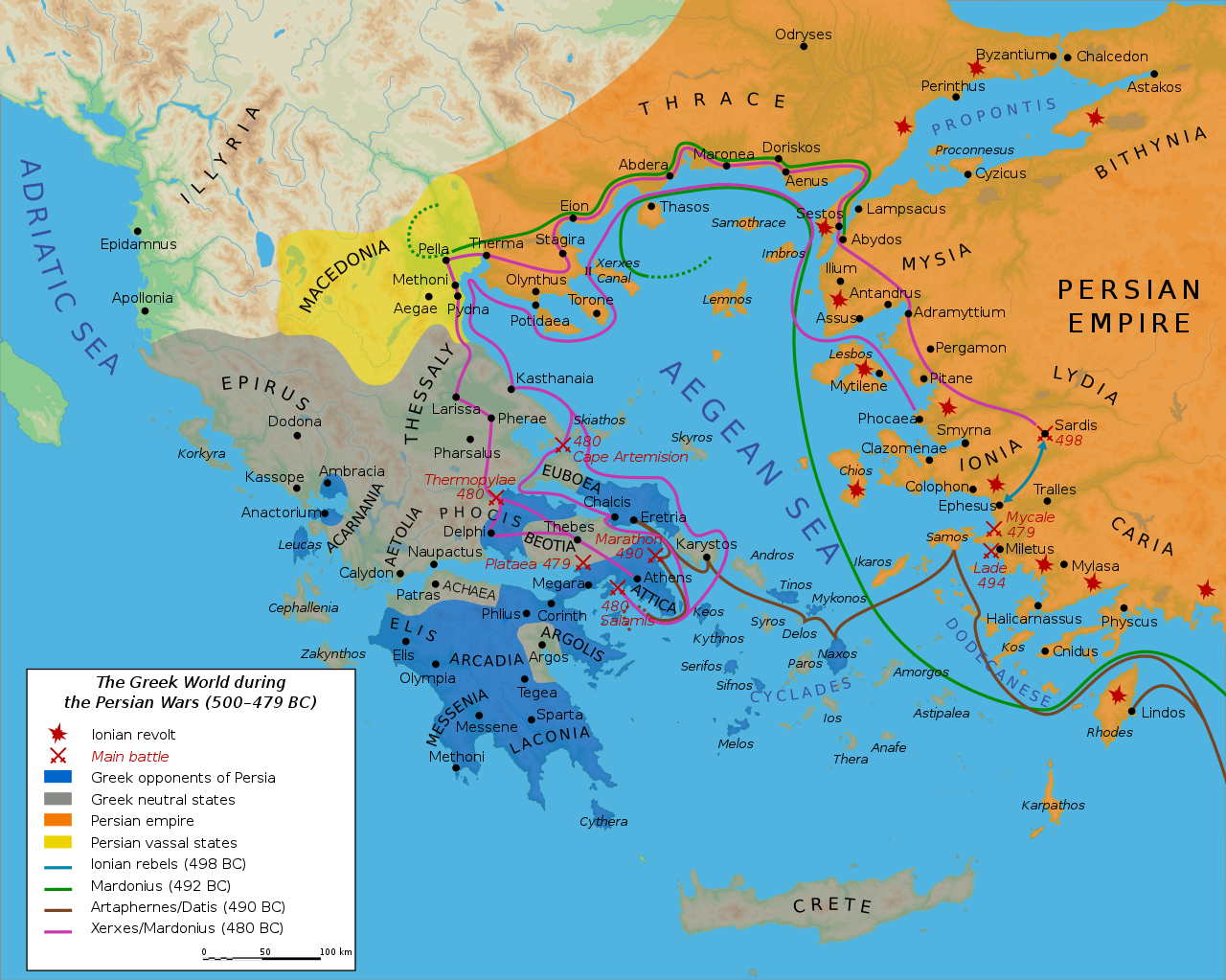
File:Map Greco-Persian Wars-en.svg
Map showing events of the first phases of the Greco-Persian Wars, including the Ionian Revolt.
Battle of Marathon
In 490 BC, Darius I of Persia assembled an armada to retaliate against Athens for its support of the Ionian revolt. Though heavily outnumbered, the Athenians—supported by their Plataean allies—defeated the Persian forces at the Battle of Marathon, and the Persian fleet turned back. This victory was a defining moment for Athens and demonstrated that the Persian Empire could be defeated.
File:Map Greco-Persian Wars-en.svg
Map showing events of the first phases of the Greco-Persian Wars, including the Battle of Marathon.
Battle of Thermopylae and Battle of Himera
In 480 BC, Xerxes launched a second Persian invasion of Greece. At Thermopylae, a small rearguard of Greeks led by three hundred Spartans held a crucial pass for several days against the massive Persian army. Simultaneously, Gelon, tyrant of Syracuse, defeated the Carthaginian invasion of Sicily at the Battle of Himera, securing the western Greek world.
File:Map Greco-Persian Wars-en.svg
Map showing events of the Greco-Persian Wars, including the second Persian invasion.
Battle of Salamis
The Persians were decisively defeated at sea by a primarily Athenian naval force at the Battle of Salamis in 480 BC. This naval victory was a turning point in the Greco-Persian Wars, effectively ending the Persian threat to Greece. The battle demonstrated the power of Athenian naval forces and contributed to Athens' growing dominance in the Greek world.
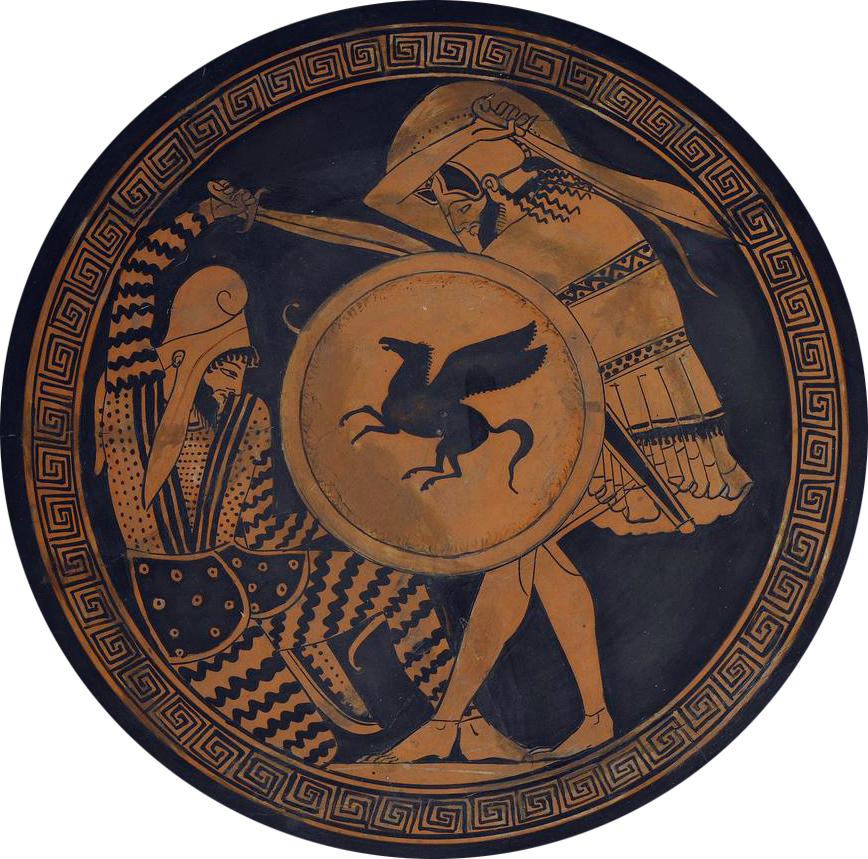
File:Greek-Persian duel.jpg
Greek hoplite and Persian warrior depicted fighting, representing the conflict of the Greco-Persian Wars.
Persian Wars: Xerxes Invades Greece
Xerxes I attempted to expand the Persian Empire into Greece with an expedition in 480 BC that eventually failed. The Archaic Period in Greece is generally considered to have ended with the invasion by Xerxes in 480 BC. The Greek victory over Persia marked a turning point in Western history.
Battle of Plataea
In 479 BC, the Greek alliance decisively defeated the Persian land forces at the Battle of Plataea, effectively ending the Persian invasion of Greece. This victory, combined with the naval victory at Salamis, secured Greek independence from Persian domination. The alliance against Persia continued, initially led by the Spartan Pausanias but from 477 BC by Athens.
File:Greek-Persian duel.jpg
Greek hoplite and Persian warrior depicted fighting, representing the battles of the Greco-Persian Wars.
Formation of the Delian League
From 477 BC, Athens took leadership of the alliance against Persia, which gradually transformed into the Delian League. Over time, this defensive alliance of Greek states transformed into an Athenian empire, as Athens' growing naval power intimidated the other league states. The Delian League became the foundation of Athenian imperial power during the Classical period.
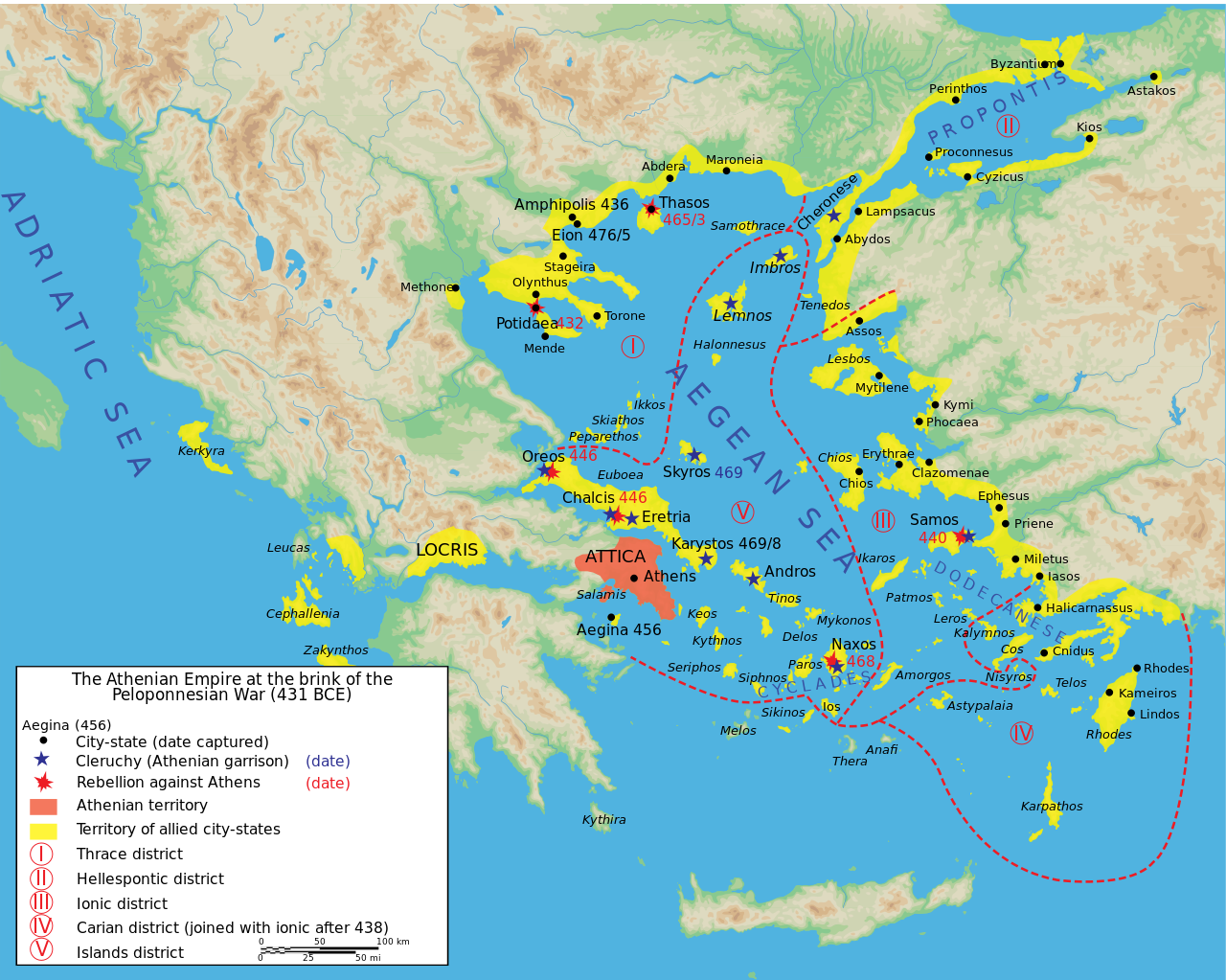
File:Map athenian empire 431 BC-en.svg
Map of the Delian League immediately before the Peloponnesian War, showing the extent of Athenian imperial power.
Warring States Period in China
After further political consolidation, seven prominent states remained by the end of the 5th century BC, and the years in which these few states battled each other is known as the Warring States period. Though there remained a nominal Zhou king until 256 BC, he was largely a figurehead. This period of conflict ultimately led to the unification of China under the Qin dynasty.
Athens Rejected Spartan Aid Request
In 462 BC, Athens sent a force to aid Sparta in overcoming a helot revolt, but this aid was rejected by the Spartans. This rejection exacerbated tensions between Athens and Sparta, contributing to the growing rivalry between the two city-states. The incident marked a significant deterioration in Athenian-Spartan relations that would eventually lead to the Peloponnesian War.
Athens Ends Campaigns Against Persia
Athens ended its campaigns against Persia in 450 BC, following a disastrous defeat in Egypt in 454 BC and the death of Cimon in action against the Persians on Cyprus in 450 BC. This marked the effective end of the Greco-Persian Wars and allowed Athens to focus on its growing rivalry with Sparta. The Peace of Callias, reportedly negotiated around this time, formalized the end of hostilities with Persia.
Law of the Twelve Tables Promulgated
The Law of the Twelve Tables was promulgated in 449 BC, forming the roots of Roman legal principles and practices. This codification of law was a foundational document of the Roman Republic, establishing written laws accessible to all citizens. Roman law as preserved in later codes continued into the Byzantine Roman Empire and formed the basis of similar codifications in continental Western Europe.
Thirty Years' Peace Between Athens and Sparta
Athens and Sparta signed the Thirty Years' Peace in the winter of 446/445 BC, ending a period of conflict between the two powers. Despite the treaty, Athenian relations with Sparta declined again in the 430s, and the peace ultimately lasted only about fifteen years. The treaty represented a temporary resolution of the tensions that had been building between the two dominant Greek city-states.
Peloponnesian War Begins
In 431 BC, the Peloponnesian War began between Athens and Sparta, representing one of the most destructive conflicts in ancient Greek history. The first phase saw a series of fruitless annual invasions of Attica by Sparta, while Athens successfully fought the Corinthian empire in northwest Greece. A plague struck Athens during this period, killing the leading Athenian statesman Pericles.
File:Map athenian empire 431 BC-en.svg
Map of the Delian League immediately before the Peloponnesian War in 431 BC.
Peace of Nicias
After the deaths of Cleon and Brasidas, the strongest proponents of war on each side, a peace treaty was negotiated in 421 BC by the Athenian general Nicias. This peace was intended to end the first phase of the Peloponnesian War, but it proved short-lived. The peace did not last, as in 418 BC allied forces of Athens and Argos were defeated by Sparta at Mantinea.
Athenian Expedition to Sicily
In 415 BC, Athens launched an ambitious naval expedition to dominate Sicily. The expedition ended in complete disaster at the harbor of Syracuse, with almost the entire army killed and the ships destroyed. This catastrophic defeat severely weakened Athens and emboldened its enemies, marking a turning point in the Peloponnesian War.
Battle of Aegospotami and Athenian Surrender
In 405 BC, the Spartan Lysander defeated Athens in the Battle of Aegospotami and began to blockade Athens' harbour. Driven by hunger, Athens sued for peace, agreeing to surrender their fleet and join the Spartan-led Peloponnesian League. Following the Athenian surrender, Sparta installed an oligarchic regime, the Thirty Tyrants, in Athens.
Overthrow of the Thirty Tyrants
Following the Athenian surrender, Sparta installed an oligarchic regime known as the Thirty Tyrants in Athens. However, after only a year, the Thirty had been overthrown, and Athens restored its democratic government. This episode demonstrated the resilience of Athenian democracy and the limits of Spartan power to impose lasting political change.
Battle of the Allia and Gallic Sack of Rome
On 16 July 390 BC, a Gallic army under the tribal chieftain Brennus defeated the Romans at the Battle of the Allia and marched to Rome. The Gauls looted and burned the city, then laid siege to the Capitoline Hill for seven months. The Romans eventually paid 1,000 pounds of gold for peace, though later legend claimed the Roman general Camillus defeated the Gauls militarily, declaring 'With iron, not with gold, Rome buys her freedom.'

Italy 400 BC
Map of Italy around 400 BC showing the political landscape during the Gallic invasions
Battle of Leuctra
By 371 BC, Thebes was in the ascendancy, defeating Sparta at the Battle of Leuctra, killing the Spartan king Cleombrotus I, and invading Laconia. This battle marked the end of Spartan military dominance in Greece and shifted the balance of power to Thebes. Further Theban successes against Sparta in 369 BC led to Messenia gaining independence, from which Sparta never fully recovered.
Messenia Gains Independence from Sparta
In 369 BC, following further Theban successes against Sparta, Messenia gained independence from Spartan control. Sparta never recovered from the loss of Messenia's fertile land and the helot workforce it provided. This marked the effective end of Spartan hegemony in Greece and the liberation of the Messenian helots who had been enslaved for centuries.
Battle of Mantinea (362 BC)
In 362 BC, Thebes defeated a combined force of Sparta and Athens at the Battle of Mantinea. Though Thebes won the battle, their general Epaminondas was killed, and in the aftermath none of the major Greek states were able to dominate. This power vacuum would eventually be filled by Macedon under Philip II.
Philip II Defeats Greek Alliance at Chaeronea
In 338 BC, Philip II of Macedon defeated a Greek alliance at the Battle of Chaeronea, effectively ending Greek independence. He subsequently formed the League of Corinth, unifying most of the Greek city-states under Macedonian leadership. This was the only time prior to the Roman period that most Greek regions were officially unified under a single power.
Assassination of Philip II of Macedon
Philip II of Macedon was murdered in 336 BC, leaving his ambitious plans to invade Persia unfulfilled. His son Alexander the Great inherited the throne and was left to fulfill his father's ambitions. Philip's assassination was a pivotal moment that set the stage for Alexander's extraordinary conquests.
Alexander the Great Begins Persian Campaign
In 334 BC, Alexander the Great began his campaign against Persia after consolidating his power in Macedonia and Greece. He conquered Persia, defeating Darius III at the Battle of Issus in 333 BC, and after the Battle of Gaugamela in 331 BC proclaimed himself king of Asia. His conquests spread Hellenistic civilization across the Middle East and as far as India.

File:Alexander the Great mosaic.jpg
Alexander Mosaic from the National Archaeological Museum, Naples, depicting Alexander the Great in battle.
Alexander the Great Conquers Achaemenid Empire
The Achaemenid dynasty and empire fell to Alexander the Great by 330 BC. After Alexander's death, much of the area previously ruled by Cyrus and his successors was ruled by the Seleucid dynasty. Alexander's conquests spread Greek culture and philosophy throughout a vast area from Greece to India.
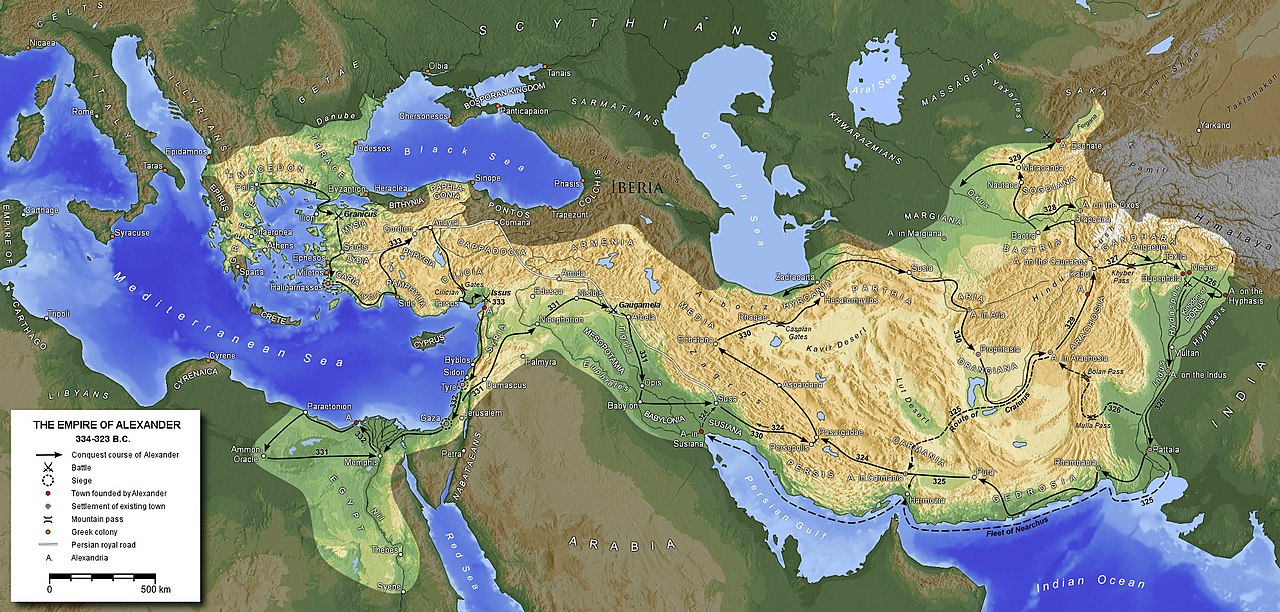
Map of Alexander's short-lived empire (334–323 BC)
Map of Alexander the Great's empire, showing his conquests including the Achaemenid Empire
Battle of Issus
In 333 BC, Alexander the Great defeated Darius III of Persia at the Battle of Issus, a decisive victory that opened the way for the conquest of the Persian Empire. This battle demonstrated Alexander's military genius and the superiority of the Macedonian phalanx. The victory allowed Alexander to proceed to conquer Egypt and the rest of the Persian Empire.
File:Alexander the Great mosaic.jpg
Alexander Mosaic depicting the Battle of Issus between Alexander the Great and Darius III.
Battle of Gaugamela and Alexander Proclaimed King of Asia
After the Battle of Gaugamela in 331 BC, Alexander the Great proclaimed himself king of Asia, completing his conquest of the Persian Empire. This victory effectively ended the Achaemenid Empire and established Macedonian dominance over the entire Near East. The spread of Hellenistic civilization that followed would transform the cultural landscape of the ancient world.
File:Alexander the Great mosaic.jpg
Alexander Mosaic representing Alexander's conquests and proclamation as King of Asia.
Death of Alexander the Great
Alexander the Great died in 323 BC, ending his extraordinary campaign of conquest that had stretched from Greece to India. His death marked the end of the Classical period and the beginning of the Hellenistic period. Without a clear successor, his empire was divided among his generals, the Diadochi, leading to the formation of the Hellenistic kingdoms.
File:Alexander the Great mosaic.jpg
Alexander Mosaic, representing the legacy of Alexander the Great whose death marked the transition to the Hellenistic period.
Hellenistic Period Begins
The period in Greek history from the death of Alexander the Great until the rise of the Roman empire and its conquest of Egypt in 30 BC is known as the Hellenistic period. After Alexander's death, a series of wars between his successors eventually led to three large states: the Antigonids, the Seleucids, and the Ptolemies. These kingdoms spread Greek culture and lifestyles into Asia and Egypt.
Battle of Ipsus and Death of Antigonus I
Antigonus I attempted to expand his territory by attacking the other successor kingdoms until they joined against him, and he was killed at the Battle of Ipsus in 301 BC. This battle was a decisive moment in the Wars of the Diadochi, settling the division of Alexander's empire among his successors. The battle established the major Hellenistic kingdoms that would dominate the eastern Mediterranean for the next two centuries.

File:Diadochen1.png
Map of the major Hellenistic realms including the Diadochi kingdoms after the Wars of the Successors.
Pyrrhus of Epirus Aids Tarentum Against Rome
In 281 BC, Tarentum, a major Greek colony in southern Italy, enlisted the aid of Pyrrhus of Epirus in resisting Roman expansion. This was the last major threat to Roman hegemony in Italy, but the effort ultimately failed. Following this victory, the Romans secured their conquests by founding Roman colonies in strategic areas, establishing stable control over the entire Italian peninsula.
Antigonus II Reclaims Macedonian Throne
Around 276 BC, Antigonus II reclaimed the Macedonian throne after his father Demetrius had spent many years in Seleucid captivity. This stabilized the Macedonian kingdom and established the Antigonid dynasty that would rule Macedonia until the Roman conquest. By the mid-3rd century, the kingdoms of Alexander's successors were mostly stable.
File:Diadochen1.png
Map of the major Hellenistic realms including the Antigonid Kingdom of Macedonia.
Aristarchus Proposes Heliocentric System
In the 3rd century BC, Aristarchus of Samos was the first to suggest a heliocentric system, proposing that the Earth revolves around the Sun. This revolutionary idea was far ahead of its time and was not widely accepted in antiquity. Archimedes later revived Aristarchus' hypothesis in his treatise The Sand Reckoner.

File:0142 - Archaeological Museum, Athens - Antikythera mechanism
The Antikythera mechanism, representing the advanced astronomical knowledge of ancient Greece.
First Punic War Begins
The First Punic War began in 264 BC when the city of Messana asked for Carthage's help in conflicts with Hiero II of Syracuse, and then asked Rome to expel the Carthaginians. Rome entered the war to prevent Carthage from gaining a foothold too close to its newly conquered Greek cities of Southern Italy. Despite Rome's lack of naval experience, after more than 20 years of war, Rome defeated Carthage and a peace treaty was signed.

Territorial changes during the Punic Wars
Map showing territorial changes over the course of the Punic Wars between Rome and Carthage
Djenné-Djenno Occupied in Mali
The civilisation of Djenné-Djenno in the Niger River Valley in Mali is known to have been occupied from 250 BC to AD 900. It is considered to be among the oldest urbanised centres and the best-known archaeology site in sub-Saharan Africa. The site disproves earlier assumptions that advanced trade networks and complex societies did not exist in the region until the arrival of traders from Southwest Asia.
Ardiani Wars with Rome
The Ardiani Illyrian tribe were infamous for their piracy and wars against the Roman Empire, fighting Rome for the first time between 229–228 BC, then again during 220–219 BC, and for a third time during 168 BC. These conflicts were part of Rome's broader expansion into the Balkans. The Illyrian tribes were eventually subdued by Roman power.
Qin Shi Huangdi Unifies China
Ying Zheng, the king of Qin, unified the other six powers and further annexed territories to the south and southeast by 213 BC, enabling him to proclaim himself the First Emperor (Qin Shi Huangdi). In his reign, unified China created the first continuous Great Wall with the use of forced labour. The Qin period also saw the standardisation of the Chinese writing system and unified legal systems and units of measurement.
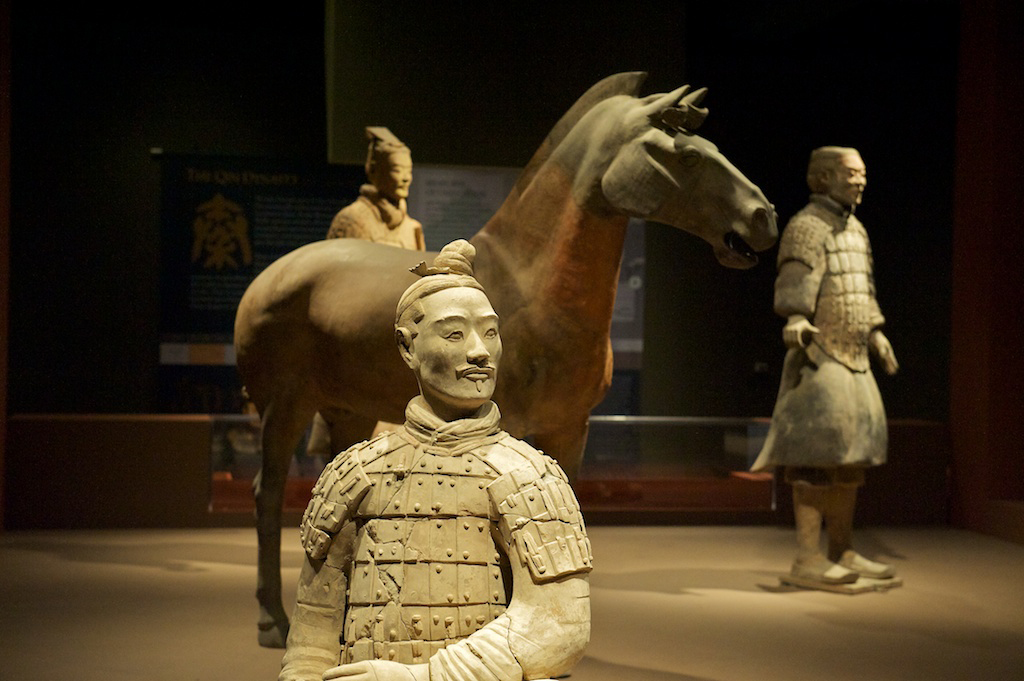
Terracotta Warriors from the time of Qin Shi Huang
The Terracotta Warriors, buried with Qin Shi Huangdi, the first emperor of unified China
Second Punic War: Hannibal Invades Italy
The Second Punic War began with Hannibal's audacious invasion of Hispania and march through the Italian Alps into Italy. Hannibal's invasion lasted over 16 years, ravaging Italy, but ultimately Carthage was defeated in the decisive Battle of Zama in October 202 BC. The war resulted from Carthage's resentment over war reparations imposed after the First Punic War.
Territorial changes during the Punic Wars
Map showing territorial changes over the course of the Punic Wars
First Macedonian War with Rome
The Antigonid Kingdom became involved in a war with the Roman Republic in the late 3rd century BC. Although the First Macedonian War was inconclusive, it marked the beginning of Roman involvement in Greek affairs. The Romans would continue to fight Macedon until it was completely absorbed into the Roman Republic by 149 BC.
Han Dynasty Rules China
The Han dynasty took power after the Qin period and ruled China for over four centuries with a brief interruption from AD 9 to 23. The Han dynasty promoted the spread of iron agricultural tools, which helped create a food surplus that led to large population growth. Silk production also increased and the manufacture of paper was invented during this period.
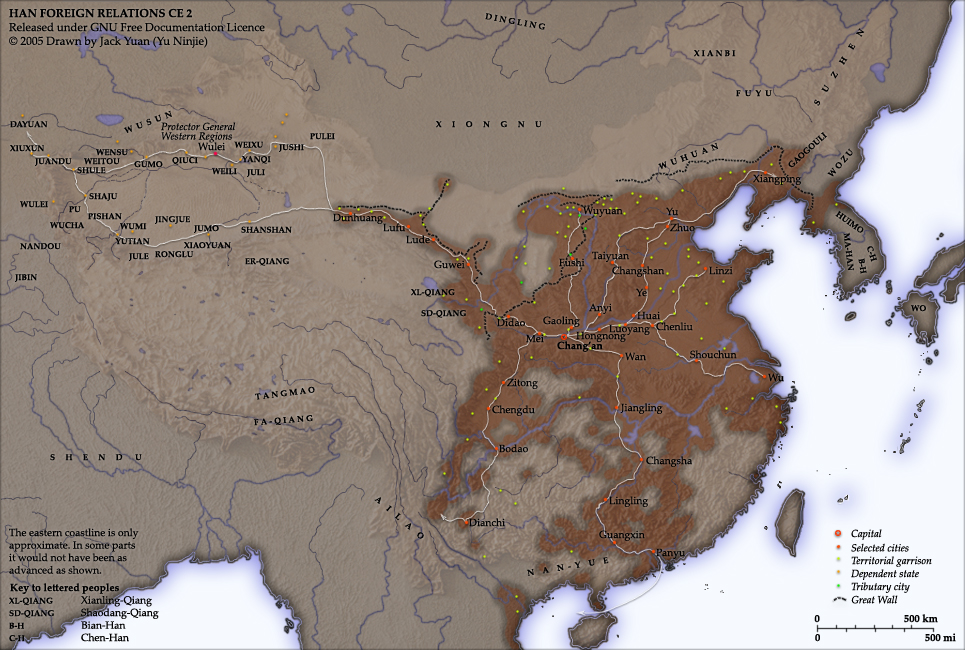
The Chinese Han dynasty dominated the East Asia region
Map of the Han dynasty's dominance in East Asia at the beginning of the first millennium AD
Battle of Zama: Rome Defeats Carthage
In October 202 BC, the decisive Battle of Zama ended the Second Punic War with a Roman victory over Carthage. Scipio Africanus defeated Hannibal's forces, ending Carthage's status as a major Mediterranean power. This victory established Rome as the dominant power in the western Mediterranean and led to significant war reparations being imposed on Carthage.
Rome Defeats Macedonian and Seleucid Empires
After defeating the Macedonian and Seleucid Empires in the 2nd century BC, the Romans became the dominant people of the Mediterranean Sea. The conquest of the Hellenistic kingdoms brought Roman and Greek cultures into closer contact, and the Roman elite, once rural, became cosmopolitan. This expansion marked Rome's transformation into a true Mediterranean superpower.
Austronesian Spice Trade Networks Established with India and Sri Lanka
The Austronesian spice trade networks were established by Islander Southeast Asians with Sri Lanka and Southern India by around 1000 to 600 BC. By around the 2nd century BC, these Neolithic Austronesian jade and spice trade networks connected with the maritime trade routes of South Asia, the Middle East, eastern Africa, and the Mediterranean, becoming what is now known as the Maritime Silk Road. This network allowed the exchange of goods from East and Southeast Asia all the way to Europe and eastern Africa.
Austronesian maritime trade network in the Indian Ocean
Map of Austronesian maritime trade networks in the Indian Ocean, including the Maritime Silk Road
Mithradates I Conquers Seleucid Empire; Parthian Empire Rises
The Parthian Empire was led by the Arsacid dynasty, which by around 155 BC under Mithradates I had mostly conquered the Seleucid Empire. Parthia's power was based on a combination of heavy cavalry and a decentralised governing structure. Parthia had many wars with the Romans, but it was rebellions within the empire that ended it in the 3rd century AD.
Third Punic War and Destruction of Carthage
The Third Punic War began when Rome declared war against Carthage in 149 BC. Carthage resisted initially but could not withstand the attack of Scipio Aemilianus, who entirely destroyed the city, enslaved all the citizens, and gained control of the region, which became the province of Africa. This marked the end of Carthage as a civilization and Rome's acquisition of its first overseas provinces.
Territorial changes during the Punic Wars
Map showing the final territorial changes after the Third Punic War
Battle of Corinth and Roman Conquest of Greece
In 146 BC, Rome achieved a decisive victory over the Corinthians at the Battle of Corinth, marking the effective end of Greek independence. The Achaean League was defeated and absorbed by the Romans, and Macedonia became a Roman province. This event marked the beginning of the Roman Greece period and the end of the Hellenistic era in mainland Greece.
Rome Destroys Carthage; End of Punic Wars
After the third and final Punic War, Carthage was destroyed and then occupied by Roman forces in 146 BC. Nearly all of the territory held by Carthage fell into Roman hands. This marked the end of Carthaginian power and the beginning of Roman dominance in the western Mediterranean.
Siege of Numantia
In 133 BC, Rome besieged the Celtiberian stronghold of Numantia in Spain, marking a significant episode in Rome's conquest of Hispania. The siege was part of Rome's broader effort to consolidate control over the Iberian Peninsula following the Punic Wars. The fall of Numantia effectively ended organized resistance to Roman rule in much of Hispania.

Siege of Numantia
Illustration of the Roman siege of the Celtiberian stronghold of Numantia in Spain in 133 BC
Gracchi Brothers' Land Reform Attempts
In the late 2nd century BC, the Gracchi brothers, a pair of tribunes, attempted to pass land reform legislation that would redistribute major patrician landholdings among the plebeians. Both brothers were killed and the Senate passed reforms reversing their actions. This led to a growing divide between plebeian groups and equestrian classes, marking the beginning of the late Republic's political instability.
Han Dynasty Conquers Northern Korea
In 108 BC, the Han dynasty of China conquered much of northern Korea. This rule led to cultural influences on Korea for many centuries to come. When Han China began its decline, three kingdoms in Korea – Baekje, Goguryeo, and Silla – emerged and expelled the Chinese.
Gaius Marius Holds First Consulship and Military Reforms
Gaius Marius became a leader of the Republic, holding the first of his seven consulships in 107 BC by arguing his patron could not defeat the Numidian king Jugurtha. Marius then started significant military reforms, levying the very poor and allowing landless men to enter the army. He was elected for five consecutive consulships from 104 to 100 BC as Rome needed military leadership against the Cimbri and Teutones.

Marius and the Ambassadors of the Cimbri
Painting depicting Gaius Marius and the Cimbri ambassadors, illustrating his military campaigns
Antikythera Mechanism Created
The Antikythera mechanism, a device for calculating the movements of planets, dates from about 80 BC and was the first ancestor of the astronomical computer. It was discovered in an ancient shipwreck off the Greek island of Antikythera. The device became famous for its use of a differential gear and the miniaturization and complexity of its parts, comparable to a clock made in the 18th century.
File:0142 - Archaeological Museum, Athens - Antikythera mechanism
The Antikythera mechanism, an analog computer from 150 to 100 BC designed to calculate the positions of astronomical objects.
Social War: Italian Allies Revolt
After Marius's retirement, Rome had a brief peace during which Italian allies requested Roman citizenship and voting rights. The reformist Marcus Livius Drusus supported their legal process but was assassinated, and the allies revolted against the Romans in the Social War. At one point both consuls were killed, and Marius was appointed to command the army together with Lucius Julius Caesar and Lucius Cornelius Sulla.
Athens and Greek Cities Revolt Against Rome
In 88 BC, Athens and other Greek cities revolted against Roman rule. The revolt was crushed by the Roman general Sulla, who devastated the peninsula. The Roman civil wars that followed further devastated the land, until Augustus organized the peninsula as the province of Achaea in 27 BC.
Sulla's First March on Rome
In 88 BC, Sulla was elected for his first consulship and assigned to defeat Mithridates VI of Pontus. When Marius's partisans managed his installation to the military command, Sulla conducted a surprising and illegal action: he marched to Rome with his legions, killing all those who showed support to Marius's cause. This was the first time a Roman general had marched his army against Rome itself.

Coin depicting Sulla
Roman denarius depicting Sulla, who marched on Rome in 88 BC
Marius Seizes Power and Achieves Seventh Consulship
In 87 BC, Marius returned to Rome while Sulla was campaigning in Greece, seized power along with the consul Lucius Cornelius Cinna, and killed the other consul Gnaeus Octavius, achieving his seventh consulship. Marius and Cinna revenged their partisans by conducting a massacre. Marius died in 86 BC due to age and poor health, just a few months after seizing power.
Sulla's Second March on Rome and Dictatorship
In 83 BC, Sulla made his second march on Rome and began a time of terror in which thousands of nobles, knights, and senators were executed. Sulla held two dictatorships and one more consulship, which began the crisis and decline of the Roman Republic. His constitutional reforms removed powers that had supported populist approaches, including those of the tribune of the plebs.
Seleucid Empire Ends
The unwieldy Seleucid Empire gradually disintegrated, with a rump surviving until 64 BC when it was finally absorbed by Rome. The Seleucid Empire had been one of the major Hellenistic kingdoms founded by Alexander's successors, controlling Syria and the former Persian empire. Its end marked the final dissolution of the major Hellenistic kingdoms in the east.
Formation of the First Triumvirate
Julius Caesar reconciled the two most powerful men in Rome: Marcus Licinius Crassus and Gnaeus Pompeius Magnus (Pompey), forming them into a new informal alliance including himself, the First Triumvirate. Caesar's daughter died in childbirth in 54 BC, and in 53 BC Crassus was killed in the Battle of Carrhae, causing the Triumvirate to disintegrate. Caesar had meanwhile conquered Gaul, obtaining immense wealth and the loyalty of battle-hardened legions.
Caesar's Invasion of Britain
In 55 BC, Julius Caesar with 100 ships and two legions made an opposed landing in Britain, probably near Deal. After pressing a little way inland against fierce opposition and losing ships in a storm, he retired back across the English Channel to Gaul from what was a reconnaissance in force. He returned the following year for a more serious invasion, marking the first Roman contact with Britain.

Landing of the Romans in Kent
Painting depicting Caesar's landing in Kent, 55 BC
Caesar Crosses the Rubicon
To avoid being stripped of his legions and facing trial, impoverishment, and exile, Caesar crossed the Rubicon River and invaded Rome in 49 BC. The Battle of Pharsalus was a brilliant victory for Caesar, and in this and other campaigns he destroyed all of the optimates leaders including Metellus Scipio, Cato the Younger, and Pompey's son. Pompey was murdered in Egypt in 48 BC.
Month of July Named After Julius Caesar
In 44 BC, the month Quintilis was renamed to Julius (July) in honor of Julius Caesar. This was one of Caesar's lasting cultural legacies, as he had also continued reforms to the calendar. The renaming reflected Caesar's enormous influence on Roman culture and politics even after his death.
Assassination of Julius Caesar
Julius Caesar was murdered on the Ides of March (March 15) in 44 BC by the Liberatores, a group of senators who feared his growing power. In five years he had held four consulships, two ordinary dictatorships, and two special dictatorships, one for perpetuity. His assassination caused political and social turmoil in Rome and set off a new round of civil wars.
Formation of the Second Triumvirate
In 43 BC, Octavian, along with Mark Antony and Marcus Aemilius Lepidus, legally established the Second Triumvirate. Upon its formation, 130–300 senators were executed and their property confiscated due to their supposed support for the Liberatores. In 42 BC, the Senate deified Caesar as Divus Iulius, making Octavian the son of the deified.
Battle of Philippi: Defeat of Caesar's Assassins
In 42 BC, Octavian and Antony defeated both Caesar's assassins and the leaders of the Liberatores, Marcus Junius Brutus and Gaius Cassius Longinus, in the Battle of Philippi. The Second Triumvirate was marked by the proscriptions of many senators and equites. The Triumvirate then divided the Empire among the triumvirs: Lepidus was given Africa, Antony the eastern provinces, and Octavian controlled Italia, Hispania, and Gaul.
Battle of Actium: Octavian Defeats Antony and Cleopatra
Octavian annihilated Egyptian forces in the Battle of Actium in 31 BC, ending the conflict with Mark Antony and Cleopatra VII. Antony and Cleopatra committed suicide following their defeat, and Egypt was conquered by the Roman Empire. This victory left Octavian as the sole ruler of the Roman world.
Ptolemaic Egypt Annexed by Rome
In 30 BC, the last Hellenistic kingdom, Ptolemaic Egypt, was annexed by the Roman Republic following the death of Cleopatra, the last Macedonian ruler of Egypt. This event is considered to mark the end of the Hellenistic period. With the annexation of Egypt, Rome had absorbed all of the successor kingdoms of Alexander the Great.
Augustus Organizes Greece as Province of Achaea
In 27 BC, Augustus organized the Greek peninsula as the Roman province of Achaea, following the devastation caused by the Roman civil wars. This formalized Roman control over Greece and integrated it into the Roman imperial system. Greece remained a key eastern province of the Roman Empire, with Greek culture and language serving as a lingua franca in the East.
Augustus Becomes First Roman Emperor
In 27 BC, at the age of 36, Octavian was the sole Roman leader and took the name Augustus, marking the beginning of the Roman Empire. Officially the government remained republican, but Augustus assumed absolute powers. His reform of the government brought about a two-century period colloquially referred to by Romans as the Pax Romana.

Augustus of Prima Porta
The Augustus of Prima Porta, 1st century AD, depicting Augustus, the first Roman emperor
Extent of Roman Empire Under Augustus
Under Augustus, Rome conquered Cantabria, Aquitania, Raetia, Dalmatia, Illyricum, and Pannonia, extending the empire significantly. Augustus intended to extend the Roman Empire to the whole known world, and his generals gained much respect from the populace and legions. Roman literature also grew in what is known as the Golden Age of Latin Literature, with poets like Virgil, Horace, and Ovid.
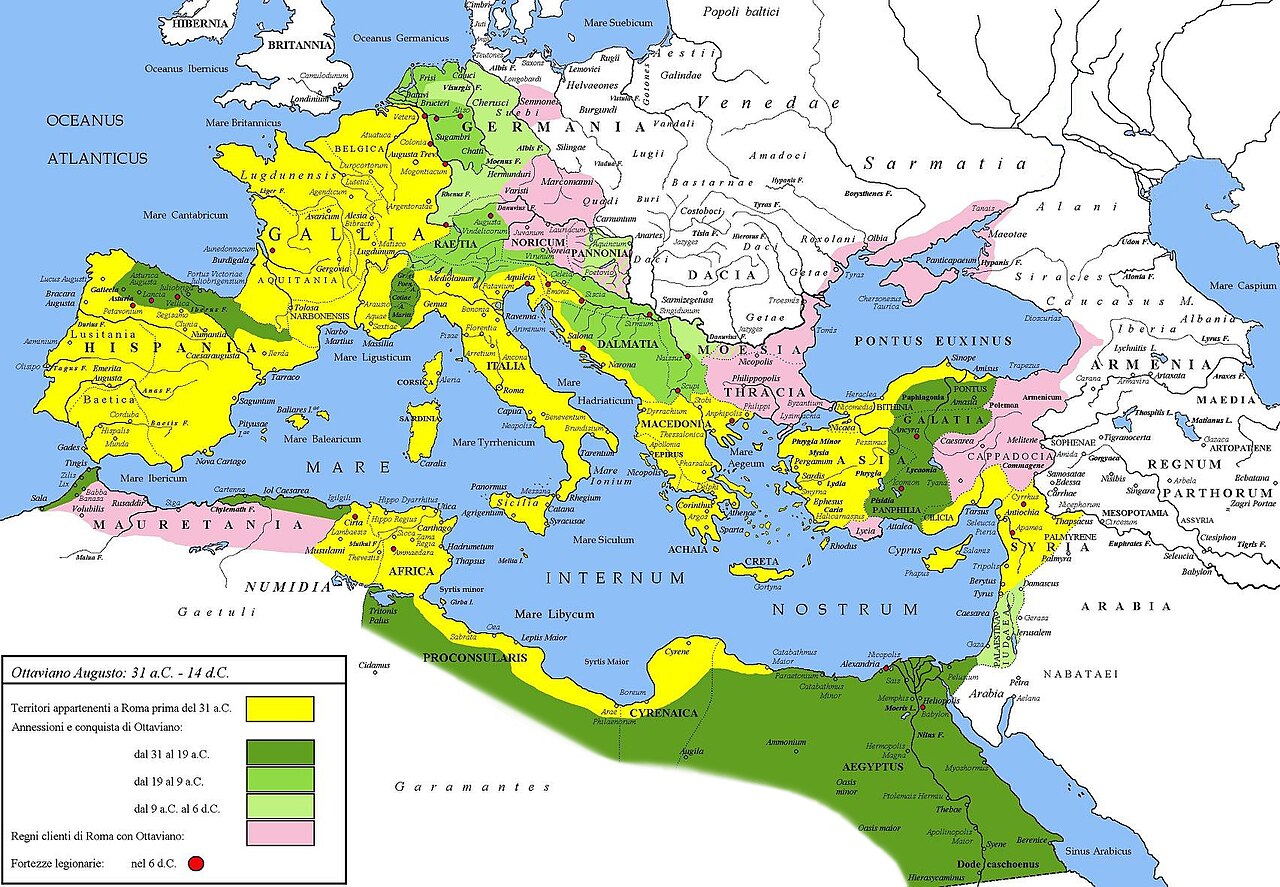
Extent of the Roman Empire under Augustus
Map showing the extent of the Roman Empire under Augustus, with territories gradually conquered during his reign
Roman Empire Established
A series of internal conflicts led the Roman republic to become an empire ruled by an emperor by the first century AD. Throughout the first and second centuries AD, the Empire grew slightly while spreading Roman culture throughout its boundaries. The Roman Empire became one of the most influential political entities in Western history.

Roman Empire AD 117
Map of the Roman Empire at its greatest extent in AD 117
Month of August Named After Augustus
In 8 BC, the month Sextilis was renamed to Augustus (August) in honor of the first Roman emperor. Augustus had continued the calendar changes promoted by Caesar, and this renaming was part of his broader cultural legacy. The month names July and August remain in use today as lasting reminders of Caesar and Augustus.
0 CE – 499 CE
Death of Augustus and Succession of Tiberius
Augustus died in 14 AD, and the Julio-Claudian dynasty continued under Tiberius, his stepson whom he had appointed as heir under the influence of his wife Livia Drusilla. The Senate agreed with the succession and granted Tiberius the same titles and honors once granted to Augustus. However, Tiberius was not enthusiastic for political affairs and eventually retired to Capri in 26 AD.
Tiberius Retires to Capri
After agreement with the Senate, Tiberius retired to Capri in 26 AD and left control of the city of Rome in the hands of the praetorian prefect Sejanus until 31 AD, and then Macro from 31 to 37 AD. This effectively left Rome without direct imperial oversight for over a decade. Tiberius died or was killed in 37 AD.
Ministry and Crucifixion of Jesus
Jesus of Nazareth, a Jewish itinerant preacher in Galilee and the Roman province of Judea, began his public ministry. His followers proclaimed him the Messiah and the incarnation of God. His crucifixion in Jerusalem is well attested historically and marks the founding moment of Christianity. His disciples believed he rose from the dead, forming the core of Christian faith.
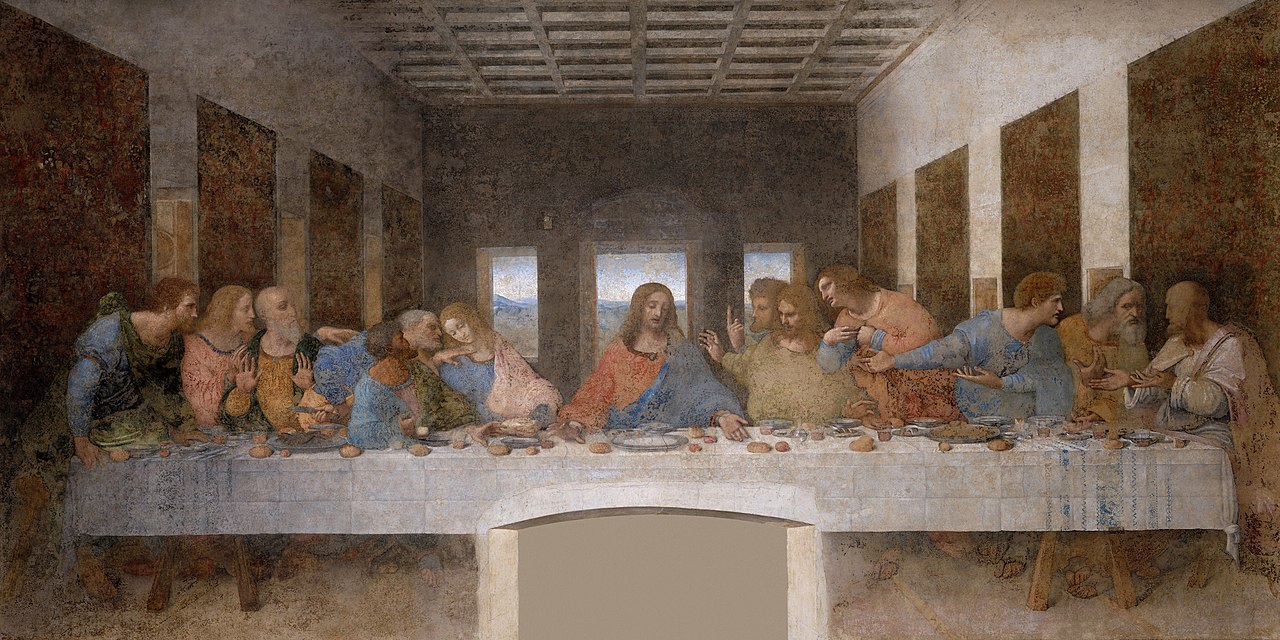
The Last Supper by Leonardo da Vinci
Depicts the final meal before Jesus' crucifixion and death.
Caligula Becomes Emperor
After Tiberius died in 37 AD, Caligula was chosen to rule the empire as the male line of the Julio-Claudians was limited. He was a popular leader in the first half of his reign but became a crude and insane tyrant in his later years. The Praetorian Guard murdered Caligula four years after the death of Tiberius, and proclaimed his uncle Claudius as the new emperor.
Claudius Begins Conquest of Britain
Emperor Claudius was not as authoritarian as Tiberius and Caligula, and his most important deed was beginning the conquest of Britannia. He also conquered Lycia and Thrace. Claudius was poisoned by his wife Agrippina the Younger in 54 AD, and his heir was Nero, son of Agrippina and her former husband.
Council of Jerusalem
James, brother of Jesus, called the Council of Jerusalem to address disputes over whether Gentile converts needed to follow Jewish Law including circumcision. The council determined that converts should avoid idols, fornication, things strangled, and blood, but were not required to follow other aspects of Jewish Law. This decision was pivotal in separating Christianity from Judaism and enabling its spread among non-Jewish peoples.
Boudica's Revolt in Britain
In 60 AD, while Roman general Suetonius Paulinus was massacring druids on the island of Mona (Anglesey), the tribes of modern-day East Anglia staged a revolt led by Queen Boudica of the Iceni. The rebels sacked and burned Camulodunum, Londinium, and Verulamium before being crushed by Paulinus. Boudica committed suicide to avoid the disgrace of being paraded in triumph in Rome.
Nero's Persecution of Christians
Emperor Nero conducted a persecution of Christians confined to the city of Rome during the mid-first century. This was among the earliest recorded state persecutions of Christians. While local and limited, it established a precedent of Roman hostility toward the new faith and produced early Christian martyrs.
Great Fire of Rome
The Great Fire of Rome occurred during the reign of Nero, who is widely known as the first persecutor of Christians and for the fire, which was rumoured to have been started by the emperor himself. Buildings destroyed by the fire were later rebuilt under Vespasian, who also revitalised the Capitol. The fire became one of the most infamous events of Nero's reign.
Death of Nero and Year of the Four Emperors
In 68 AD, armies under Julius Vindex in Gaul and Servius Sulpicius Galba in Spain revolted against Nero. Deserted by the Praetorian Guards and condemned to death by the Senate, Nero killed himself. The following year, 69 AD, saw four emperors enthroned in turn: Galba, Otho, Vitellius, and finally Vespasian, who crushed Vitellius' forces and became emperor.
Vespasian Founds Flavian Dynasty and Begins Colosseum
Vespasian took control of the empire in 69 AD and established the Flavian dynasty, the second dynasty to rule Rome. He reconstructed many buildings, reformed the tax system, and started the construction of the Flavian Amphitheater, commonly known as the Colosseum. He also sent legions to defend the eastern frontier in Cappadocia and extended the occupation in Britannia.
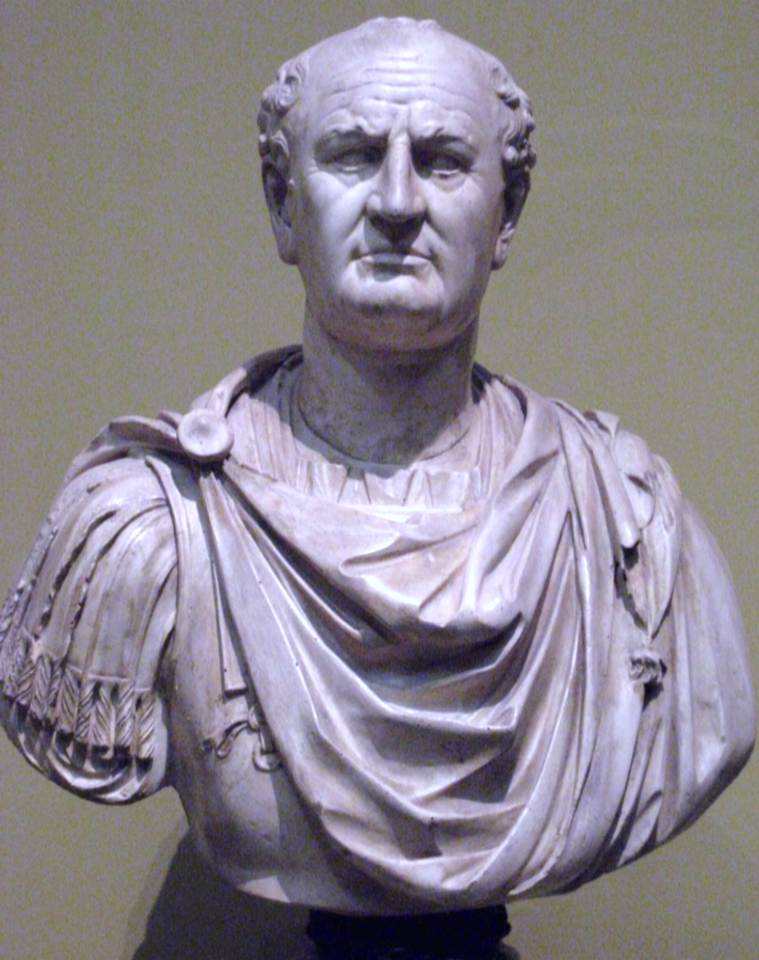
Bust of Vespasian
Bust of Vespasian, founder of the Flavian dynasty
Siege and Destruction of Jerusalem
The most significant military campaign of the Flavian period was the siege and destruction of Jerusalem in 70 AD by Titus, culminating the Roman campaign in Judea following the Jewish uprising of 66 AD. The Second Temple was completely demolished, and Titus' soldiers proclaimed him imperator in honor of the victory. Josephus claims that 1,100,000 people were killed during the siege, with 97,000 captured and enslaved.
Titus Completes the Colosseum
Titus became emperor in 79 AD and finished the Flavian Amphitheater (Colosseum), using war spoils from the First Jewish-Roman War, and hosted victory games that lasted for a hundred days. These games included gladiatorial combats, horse races, and a sensational mock naval battle on the flooded grounds of the Colosseum. Titus died of fever in 81 AD and was succeeded by his brother Domitian.
Nerva-Antonine Dynasty Begins
Following Domitian's murder, the Senate rapidly appointed Nerva as Emperor, beginning the Nerva-Antonine dynasty from 96 AD to 192 AD. This dynasty included the 'five good emperors': Nerva, Trajan, Hadrian, Antoninus Pius, and Marcus Aurelius. Gibbon declared the rule of these emperors the golden era of the Empire, during which Rome reached its greatest territorial extent.
Trajan's Reign and Maximum Territorial Expansion
Trajan succeeded Nerva in 98 AD and is credited with the restoration of traditional privileges and rights of commoner and senatorial classes. He fought three Dacian wars, winning territories roughly equivalent to modern-day Romania and Moldova, and undertook an ambitious public building program including Trajan's Forum, Market, and Column. In 117 AD, the Roman Empire reached the peak of its territorial expansion under Trajan.
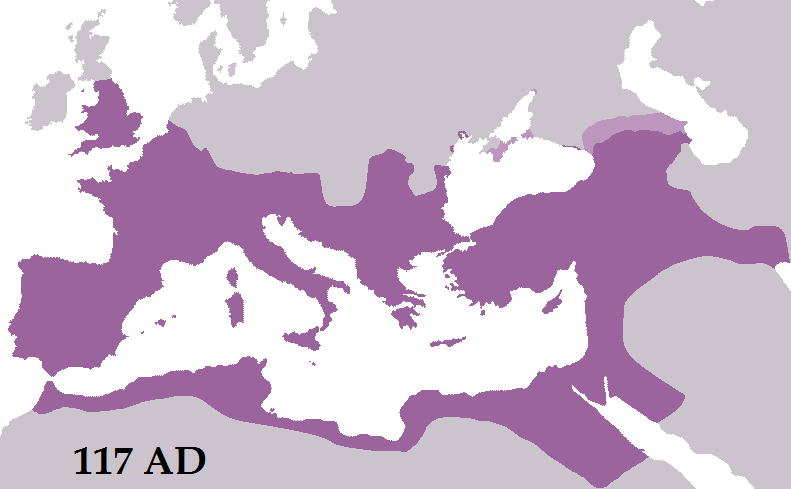
Roman Empire under Trajan in AD 117
Map showing the Roman Empire at its greatest extent under Trajan in AD 117
Pauline Epistles Circulated
Letters sent by Paul the Apostle to Christian communities were circulating in collected form by the end of the first century. Paul, a Jewish Pharisee who had experienced a vision of Christ on the road to Damascus, became one of Christianity's most influential missionaries. His epistles formed a significant portion of what would become the New Testament and shaped Christian theology profoundly.
Kingdom of Aksum Rises in Northeast Africa
The Kingdom of Aksum was an important trading nation in northeastern Africa centred in present-day Eritrea and northern Ethiopia, existing from approximately AD 100 to 940. It grew from the Iron Age proto-Aksumite period around the 4th century BC to achieve prominence by the 1st century AD. At its height by the early 6th century AD, Aksum extended through much of modern Ethiopia and across the Red Sea to Arabia.

The Ezana Stone
The Ezana Stone records negus Ezana's conversion to Christianity and conquests, representing the Kingdom of Aksum
Trajan Captures Ctesiphon and Mesopotamia
In 115 AD, Trajan took the Northern Mesopotamian cities of Nisibis and Batnae, organized a province of Mesopotamia in 116, and issued coins claiming Armenia and Mesopotamia were under Roman authority. In that same year he captured Seleucia and the Parthian capital Ctesiphon near modern Baghdad. After defeating a Parthian revolt and a Jewish revolt, he withdrew due to health issues and died in 117 AD.
Hadrian's Reign and Construction of Hadrian's Wall
Trajan's successor Hadrian withdrew all troops from Parthia, Armenia, and Mesopotamia, abandoning Trajan's conquests. He constructed fortifications and walls, including the celebrated Hadrian's Wall which separated Roman Britannia from the tribes of modern-day Scotland. Hadrian promoted culture, especially Greek, forbade torture, humanised the laws, and travelled nearly every province in the Empire.
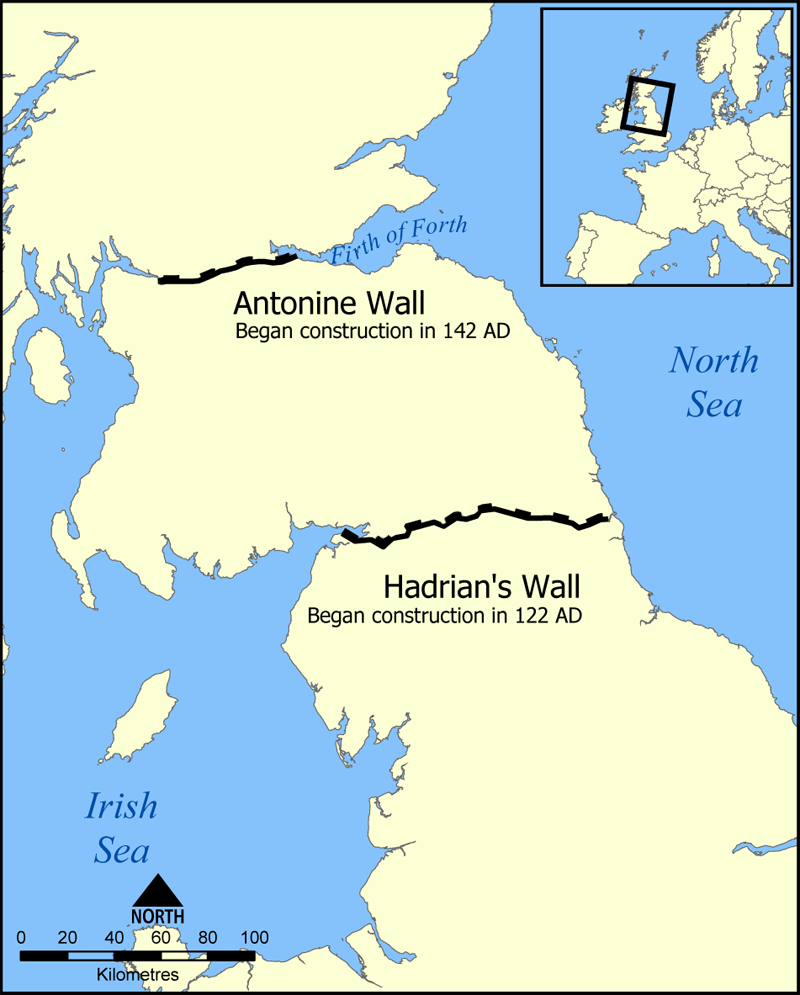
Hadrian's Wall map
Map showing the location of Hadrian's Wall and the Antonine Wall in Scotland and Northern England
Construction of the Pantheon
The Pantheon in Rome was built during the reign of Hadrian, and still contains the largest unreinforced concrete dome in the world. It stands as one of the best-preserved ancient Roman buildings and a testament to Roman engineering and architectural achievement. The building has been in continuous use throughout its history.

The Pantheon, Rome
The Pantheon, Rome, built during the reign of Hadrian, which still contains the largest unreinforced concrete dome in the world
Antoninus Pius Builds Antonine Wall
Following Hadrian's death in 138 AD, his successor Antoninus Pius built temples, theatres, and mausoleums, promoted the arts and sciences, and expanded Roman Britannia by invading what is now southern Scotland and building the Antonine Wall. His reign was the most peaceful in the entire history of the Roman Empire. He died in 161 AD, leaving 'an empire in very fine shape.'
Hadrian's Wall and Antonine Wall map
Map showing the location of both Hadrian's Wall and the Antonine Wall in Scotland and Northern England
Christianity Reaches North Africa
By the second century, Christianity had spread to North Africa, establishing communities in major cities. The faith spread along trade and travel routes into the Jewish diaspora and beyond. North Africa would become a major center of Christian theology, producing influential Church Fathers such as Tertullian, Origen, and Augustine of Hippo.
Marcus Aurelius and the Antonine Plague
Marcus Aurelius, known as the Philosopher, was the last of the Five Good Emperors and a stoic philosopher who wrote the Meditations. His co-emperor Lucius Verus died in 169 AD, probably from the Antonine Plague, a pandemic that killed nearly five million people through the Empire in 165–180 AD. Marcus Aurelius also defeated barbarian tribes in the Marcomannic Wars and the Parthian Empire.
Commodus Becomes Emperor: Beginning of Decline
Commodus, son of Marcus Aurelius, became emperor after his father's death and is not counted as one of the Five Good Emperors due to his direct kinship and military passivity. Cassius Dio identifies his reign as the beginning of Roman decadence, describing Rome's transformation 'from a kingdom of gold to one of iron and rust.' He was killed by a conspiracy involving Quintus Aemilius Laetus and his wife Marcia in late 192 AD.
Year of the Five Emperors and Severan Dynasty
Following Commodus's assassination in 192 AD, the following year saw five emperors hold the imperial dignity: Pertinax, Didius Julianus, Pescennius Niger, Clodius Albinus, and Septimius Severus. Lucius Septimius Severus bribed opposing forces, pardoned the Praetorian Guards, and installed himself as emperor, founding the Severan dynasty. The changes in coinage and military expenditures were the root of the financial crisis that marked the Crisis of the Third Century.

The Severan Tondo
Portrait of Severus, Julia Domna, Caracalla and Geta, c. 199 CE
Christianity Grows to Over 200,000 Adherents
By 200 CE, Christian numbers had grown to over 200,000 people, with communities averaging 500–1,000 people existing in approximately 200–400 towns. House churches were succeeded by buildings designed specifically as churches, complete with assembly rooms, classrooms, and dining rooms. A more formal church government developed, with bishops rising in power and influence.

Portrait from Die Malereien der Katakomben Roms
Early Christian art from the Roman catacombs, reflecting the growing Christian community.
Teotihuacan Develops in Mesoamerica
Teotihuacan developed around AD 200 and centred on the city of Teotihuacan, which grew to perhaps as many as 200,000 inhabitants at its height. Teotihuacan lasted until around AD 700, when it was burned and vandalised. It was one of the largest cities in the ancient world.

The ruins of Mesoamerican city Teotihuacan
The Avenue of the Dead and Pyramid of the Sun at Teotihuacan
Caracalla Issues Edict of Caracalla
In 212 AD, Emperor Caracalla issued the Edict of Caracalla, giving full Roman citizenship to all free men living in the Empire, with the exception of the dediticii and freed slaves. Mary Beard points to the edict as a fundamental turning point, after which Rome was 'effectively a new state masquerading under an old name.' This was one of the most significant expansions of Roman citizenship in history.

Bust of Caracalla
Bust of Caracalla from the Capitoline Museums, Rome
Assassination of Caracalla
Macrinus conspired to have Caracalla assassinated by one of his soldiers during a pilgrimage to the Temple of the Moon in Carrhae in 217 AD. Macrinus assumed power but soon removed himself from Rome to the east and Antioch. His brief reign ended in 218 when the youngster Bassianus, supposedly an illegitimate son of Caracalla, was declared Emperor by disaffected soldiers.
Sasanian Empire Founded
The Sasanian Empire began when the Parthian Empire ended in AD 224. Their rulers claimed the Achaemenids as ancestors and set up their capital at Ctesiphon in Mesopotamia. Their period of greatest military expansion occurred under Shapur I, who by the time of his death in AD 272 had defeated Roman imperial armies.
Crisis of the Third Century Begins
After the death of Alexander Severus in 235 AD, the Roman state was plagued by civil wars, external invasions, political chaos, pandemics, and economic depression. There were 26 emperors in a 49-year period, signaling extreme political instability. The Plague of Cyprian broke out in 250 and killed a huge portion of the population, while hyperinflation and economic collapse further destabilized the empire.

Map of Ancient Rome 271 AD
Map showing the Roman Empire suffering internal schisms, forming the Palmyrene Empire and the Gallic Empire
Shapur I Defeats Roman Imperial Armies
The Sasanian Empire's period of greatest military expansion occurred under Shapur I, who by the time of his death in AD 272 had defeated Roman imperial armies and set up buffer states between the Sasanians and Roman Empires. This represented a significant challenge to Roman power in the east. After Shapur, the Sasanians were under more pressure from the Kushans to their east as well as the Roman then Byzantine Empire to its west.
Formation of the Palmyrene and Gallic Empires
In 260 AD, the provinces of Syria Palaestina, Asia Minor, and Egypt separated from the rest of the Roman state to form the Palmyrene Empire, ruled by Queen Zenobia and centered on Palmyra. In that same year the Gallic Empire was created by Postumus, retaining Britannia and Gaul. These separations followed the humiliating capture of Emperor Valerian by the Sassanids of Persia, the first Roman ruler to be captured by his enemies.
Map of Ancient Rome 271 AD
Map showing the Roman Empire's internal schisms, including the Palmyrene Empire and the Gallic Empire
Diocletian Establishes the Tetrarchy
In 284 AD, Diocletian was hailed as Imperator by the eastern army and healed the empire from the crisis through political and economic shifts. He established a new form of government called the Tetrarchy, dividing the Empire among four emperors: two in the West and two in the East. Diocletian also made several tax reforms and did not use a disguised form of Republic as previous emperors had done since Augustus.

Roman follis depicting Diocletian
A Roman follis coin depicting the profile of Diocletian, who established the Tetrarchy
Mochica Culture Arises in the Andes
From about AD 300, the Mochica culture arose along the Moche River in the Andes. These people left painted pottery depicting their society and culture with a wide range of varied subjects. Besides the Mochica, there were a number of other large states in the Andes after about AD 100, including the Nazca culture.
Maya Classical Period
Maya culture began to emerge around AD 300 in the Yucatan Peninsula and modern-day Guatemala. During the 600 years of the Classical Maya period, more than 80 Mayan sites were built, with temples, pyramids, and palaces the focal point of each centre. The Mayan civilisation began to decline about AD 800, and most of its cities were deserted soon afterwards.
Kingdom of Armenia Adopts Christianity as State Religion
In 301 CE, the Kingdom of Armenia became the first nation in the world to adopt Christianity as its official state religion. This was a landmark moment in Christian history, predating the Roman Empire's embrace of Christianity. Armenia was soon followed by Caucasian Albania and the East African Kingdom of Aksum.
Diocletian's Persecution of Christians
Official Roman persecution of Christians reached its height under Emperor Diocletian from 303 to 311 CE. This was the most severe and systematic empire-wide persecution of Christians, targeting churches, scriptures, and clergy. The persecution ultimately failed to suppress Christianity and contributed to the religion's eventual legalization under Constantine.
Diocletian Persecutes Christians
In 303 AD, Diocletian and Galerius started the persecution of Christians and ordered the destruction of all Christian churches and scripts, forbidding Christian worship. This was the peak of Roman persecution of Christians under Emperor Diocletian. Diocletian abdicated in 305 AD together with Maximian, becoming the first Roman emperor to resign.
Constantine the Great Christianizes Roman Empire
Constantine the Great initiated the process of Christianisation of the Roman Empire and established a new capital at Constantinople. This transformation had profound and lasting effects on Western civilization. The resultant cultural fusion of Greco-Roman, Germanic and Christian traditions formed the cultural foundations of Europe.
Edict of Milan: Christianity Legalized
Emperor Constantine, a self-declared Christian, issued the Edict of Milan in 313 CE, expressing tolerance for all religions including Christianity. This ended the era of Roman persecution and marked a turning point in Christian history. Constantine subsequently supported Christianity by giving bishops judicial power, establishing them as legally equal to polytheistic priests, and funding church construction.
Constantine Issues Edict of Milan
In 313 AD, Constantine issued the Edict of Milan, which granted liberty for Christians to profess their religion. Constantine had been converted to Christianity and began the Christianization of the Empire and of Europe. He had previously defeated Maxentius in 312 and would go on to defeat the tetrarch Licinius in 324, controlling all the empire.
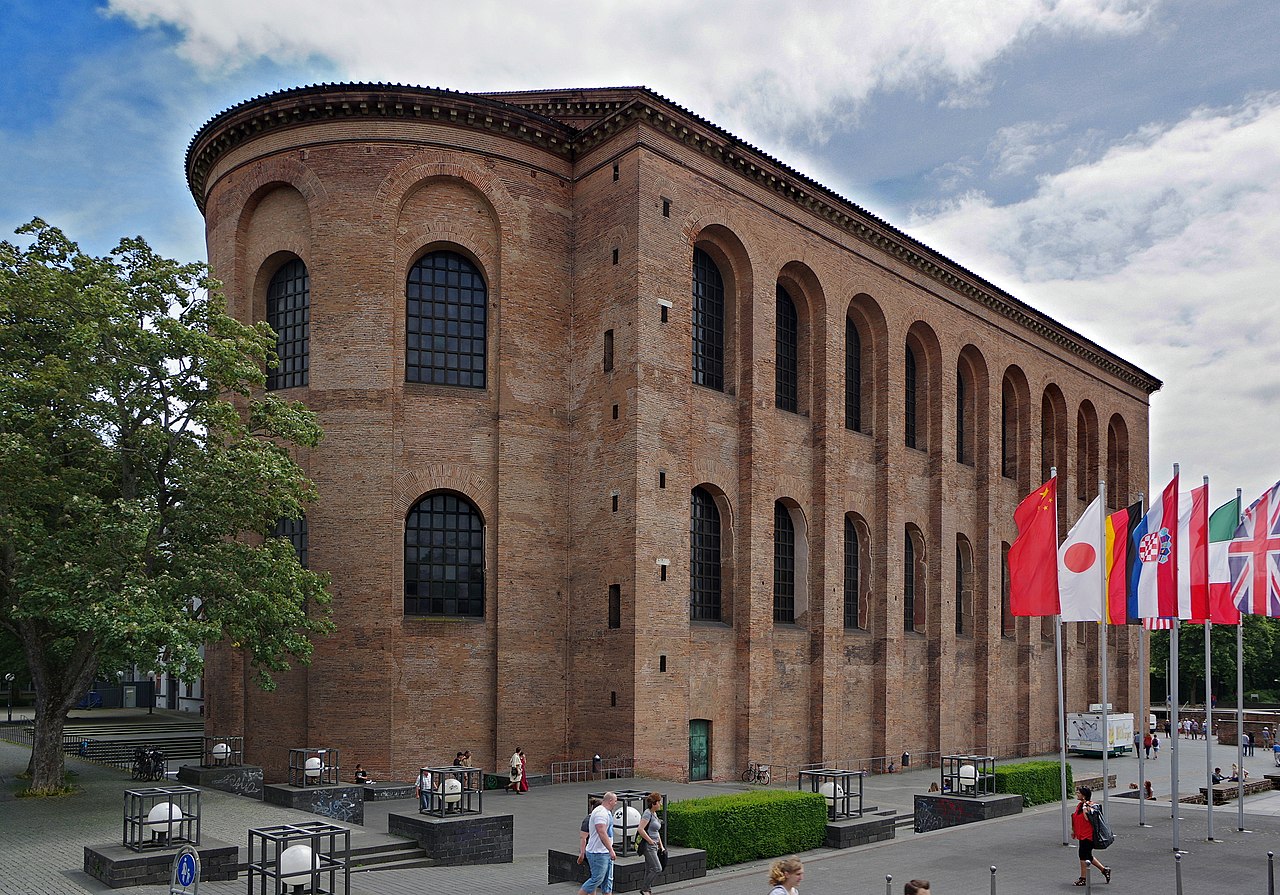
Aula Palatina of Trier
Christian basilica built during the reign of Constantine I, representing the Christianization of the Roman Empire
Gupta Empire Unifies North India
Most of North India was reunited under the Gupta Empire beginning under Chandragupta I around AD 320. Under his successors the empire spread to include much of India except for the Deccan Plateau and the very south of the peninsula. This was a period of relative peace often called the Golden Age of India.

Mauryan Empire network model
Map of the Mauryan Empire, predecessor to the Gupta Empire in India
Constantine Rebuilds Byzantium as Constantinople
In 324 AD, Constantine defeated the tetrarch Licinius and controlled all the empire. To celebrate his victories and Christianity's relevance, he rebuilt Byzantium and renamed it Nova Roma ('New Rome'), though the city soon gained the informal name of Constantinople ('City of Constantine'). Constantinople served as a new capital for the Empire, as Rome had lost its central importance since the Crisis of the Third Century.
First Council of Nicaea and the Nicene Creed
The First Council of Nicaea in 325 CE attempted to resolve the Arian controversy over whether Jesus' divinity was equal to the Father's. The council produced the Nicene Creed, a foundational statement of Christian belief. While most accepted it, some refused, and the controversy continued to embroil the church for decades, weakening Christian communities along the Eastern Mediterranean.

First Council of Nicaea icon from Protatos Church, 1770
Icon depicting the First Council of Nicaea, where the Nicene Creed was formulated.
Constantine Establishes Byzantium as Capital
In 330 AD, Constantine established Byzantium (Constantinople) as the capital of the Roman Empire, marking a significant shift in the center of power. This event is considered the end of the Roman Greece period and the beginning of the Byzantine era. The Byzantine Empire would go on to inherit Classical Greek-Hellenistic culture directly, preserving it through the medieval period.
Basil the Great Founds the Basileias
In the 370s, Basil the Great founded the Basileias, a monastic community in Caesarea (Mazaca) which developed the first health care system for the poor. This institution is considered a forerunner of modern public hospitals. It represented the integration of Christian charity with organized social services, a model that would shape Western civilization.
Jerome Translates the Bible into Latin (Vulgate)
In the late fourth century, Jerome was commissioned to translate the Greek biblical texts into Latin, producing what became known as the Vulgate. This translation became the standard Bible of the Western Church for over a millennium. It made scripture accessible to the Latin-speaking world and had an enormous influence on Western Christianity, culture, and literature.
Theodosius I Prohibits All Non-Christian Religions
All religions except Christianity were prohibited in 391 AD by an edict of Emperor Theodosius I, completing the Christianization of the Roman Empire. Theodosius also gave even more force to the Christian faith after the Battle of Adrianople. After his death, the Empire was divided into the Eastern Roman Empire ruled by Arcadius and the Western Roman Empire commanded by Honorius, both his sons.
Division of the Roman Empire
After the death of Theodosius I in 395 AD, the Roman Empire was permanently divided into the Eastern Roman Empire ruled by Arcadius and the Western Roman Empire commanded by Honorius, both of Theodosius' sons. This division marked a fundamental turning point in Roman history, as the two halves would follow very different trajectories. The Eastern Empire would survive for nearly a thousand more years.
Huns Form Large State in Eastern Europe
The Huns were a nomadic people who formed a large state in Eastern Europe by about AD 400, and under their leader Attila, they fought against both sections of the Roman Empire. However, after Attila's death, the state fell apart and the Huns' influence in history disappeared. The Huns contributed to the destabilization of the Roman Empire.
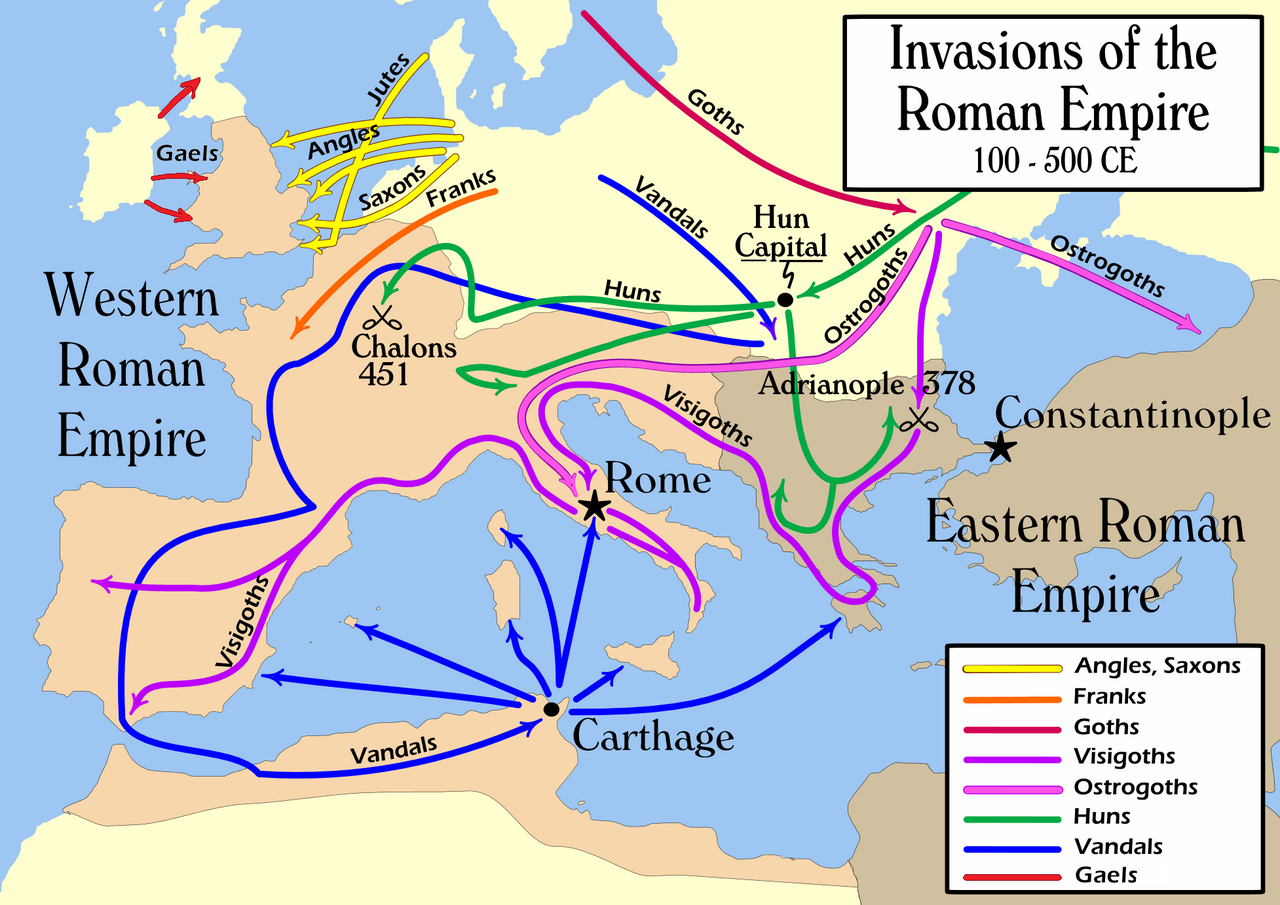
Age of Migrations in Europe
Map showing the invasions of the Roman Empire including by the Huns
Visigoths Sack Rome
In 410 AD, the Theodosian dynasty saw the Visigoths sack Rome, a shocking event that reverberated throughout the Roman world. The professional field army had collapsed following the death of the general Stilicho in 408, who had tried to reunite the Empire and repel barbarian invasion. This was the first time Rome had been sacked in 800 years and symbolized the vulnerability of the Western Empire.
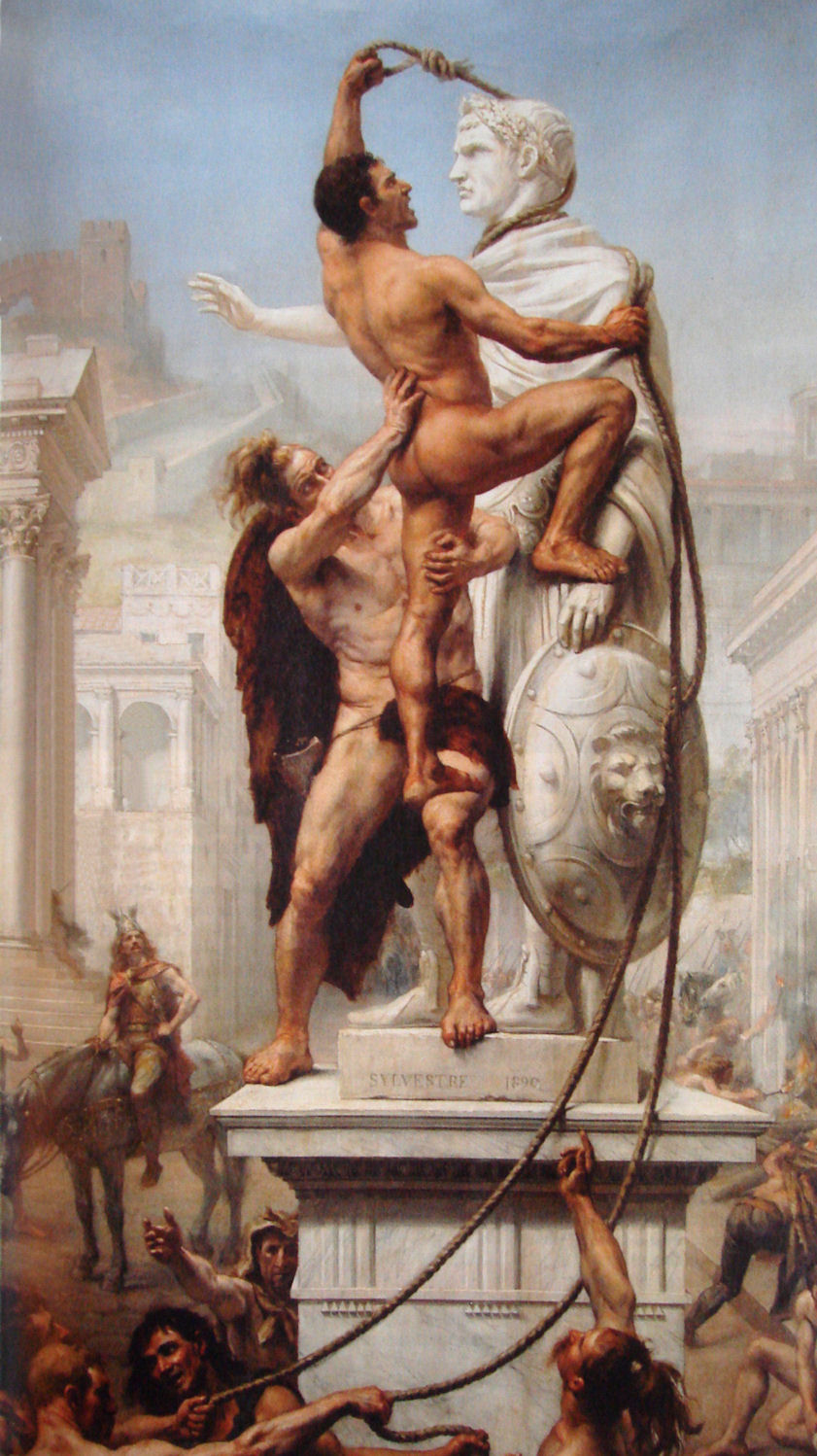
Sack of Rome by the Visigoths
Painting depicting the Sack of Rome by the Visigoths on 24 August 410
Visigoths Settle in Spain
Groups of Goths migrated into western Europe, with the Visigoths settling in Spain and founding a kingdom that lasted until it was conquered by Islamic rulers in the AD 700s. The Ostrogoths eventually settled in Italy before being conquered by the Lombards. These Germanic migrations fundamentally transformed the former western Roman Empire.
Age of Migrations in Europe
Map showing the Germanic migrations including the Visigoths into Spain
Council of Ephesus Condemns Nestorius
The Council of Ephesus, the church's third ecumenical council held in 431 CE, condemned Nestorius who had declared Mary as the mother of Jesus' humanity but not his divinity. The Persian church refused to recognize the council's authority, leading to the first major East-West separation. This resulted in the formation of the Church of the East (Nestorian/Assyrian Church) and the Syrian Orthodox Church.
Council of Chalcedon
The fourth ecumenical council, the Council of Chalcedon in 451 CE, produced the Chalcedonian Definition emphasizing that the Son is 'one person in two natures.' While most of Christianity accepted this definition, those who found it too close to Nestorianism separated after 484 CE into Oriental Orthodoxy, which sees only 'One Nature of God the Incarnate Logos.' This created a lasting division in Eastern Christianity.
Fall of the Western Roman Empire
The Western Roman Empire ended in 476 CE, but its successor states and the Eastern Byzantine Empire remained Christian. For five centuries after the fall, Western culture and civilization were primarily preserved and passed on by monks. The church became the primary institution maintaining social order, literacy, and cultural continuity in the fragmented West.
Fall of the Western Roman Empire
In 476 AD, the barbarian chieftain Odoacer defeated and killed the general Orestes, invaded Ravenna, and dethroned Romulus Augustus, son of Orestes. This event usually marks the end of Classical antiquity and the beginning of the Middle Ages. After 1,200 years of independence and nearly 700 years as a great power, the rule of Rome in the West ended.
Invasions of the Roman Empire
Map showing the barbarian invasions that contributed to the fall of the Western Roman Empire
Fall of Western Roman Empire
The western half of the Roman Empire, including Hispania, Gaul, and Italy, eventually broke into independent kingdoms in the 5th century AD. The Eastern Roman Empire, governed from Constantinople, is referred to as the Byzantine Empire after AD 476, the traditional date for the 'fall of Rome.' This event marked the end of ancient history and the beginning of the Middle Ages in Europe.
Age of Migrations in Europe
Map showing the Germanic migrations that contributed to the fall of the Western Roman Empire
Gupta Empire Weakened by Huna Raids
The Gupta Empire was weakened and ultimately ruined by the raids of Hunas (a branch of the Hephthalites emanating from Central Asia), and the empire broke up into smaller regional kingdoms by the end of the fifth century AD. India would remain fragmented into smaller states until the rise of the Mughal Empire in the 1500s. This marked the end of the classical period of Indian history.
500 CE – 999 CE
Clovis I Converts to Catholicism
The Frankish king Clovis I converted to Catholicism, and his kingdom became the dominant polity in the West in 507 CE. His conversion was a pivotal moment in European history, as the Frankish kingdom gradually converted into a Christian kingdom over the following centuries. This laid the foundation for the eventual Carolingian Empire and the Christianization of Western Europe.
Justinian I Closes the Academy of Athens
In 529 AD, the Byzantine Emperor Justinian I ordered the closure of the Academy of Athens, the famous philosophical school founded by Plato. This event is considered to mark the end of Late Antiquity and the classical tradition in Greece. The closure symbolized the triumph of Christianity over pagan philosophy and the end of the ancient Greek intellectual tradition.

File:Plato's Academy mosaic from Pompeii.jpg
Mosaic from Pompeii depicting Plato's Academy, the institution that Justinian I ordered closed in 529 CE.
Justinian Codifies Roman Law
Emperor Justinian I ordered the codification of law around 530 AD, creating the Corpus Juris Civilis which preserved Roman legal principles. Roman law as preserved in Justinian's codes continued into the Byzantine Roman Empire and formed the basis of similar codifications in continental Western Europe. Roman law continued to be applied throughout most of Europe until the end of the 17th century.
Justinian Reconquers Italy and North Africa
During the 6th century, the Eastern Emperor Justinian reconquered the Italian peninsula from the Ostrogoths, North Africa from the Vandals, and southern Hispania from the Visigoths. However, within a few years of Justinian's death, Byzantine possessions in Italy were greatly reduced by the Lombards who settled in the peninsula. The Plague of Justinian also weakened the Byzantine Empire significantly.
Pope Gregory I Reforms the Papacy
Pope Gregory I gained prestige and power for the papacy by leading the response to the Lombard invasion in 592–593 CE, reforming the clergy, standardizing music in worship, sending out missionaries, and founding new monasteries. His actions significantly expanded papal influence and authority. Until 751, the Pope remained a subject of the Byzantine emperor, but Gregory's reforms laid the groundwork for greater papal independence.
Islamic Conquests Devastate Christian Communities
Between 632 and 750 CE, Islamic caliphates conquered the Middle East, North Africa, and the Iberian Peninsula, devastating many Christian communities. Most urban Asian churches disappeared, though some Christian communities in remote areas survived. Christians in conquered territories were designated as dhimmi, a status guaranteeing protection but enforcing legal inferiority.
Church of the East Brings Christianity to China
In 635 CE, the Church of the East brought Christianity into China. Emperor Taizong decreed that the Christian faith was allowed, and its license was copied onto the Sianfu stele. Christianity spread into northwestern China, Khotan, Turfan, and south of Lake Balkash in southeastern Kazakhstan, though its growth was later halted in 845 by Emperor Wuzong of Tang.
Last Sassanid Emperor Killed; Islamic Conquest of Persia
In AD 651, the last Sassanid emperor was killed by the expanding Islamic Arabs, ending the Sasanian Empire. The Sasanians had rebuilt and founded numerous cities and their merchants had introduced crops such as sugar, rice, and cotton into the Iranian plateau. This marked the end of pre-Islamic Persian civilization and the beginning of Islamic rule in Persia.
Silla Controls Korean Peninsula
Goguryeo and Baekje were eventually destroyed by a Tang dynasty and Silla alliance. Silla then drove out the Tang dynasty in 676 to control most of the Korean peninsula undisputed. This marked the unification of Korea under a single kingdom for the first time.
Srivijaya Empire Founded at Palembang
Srivijaya, an Austronesian polity founded at Palembang in 682 AD, rose to dominate the trade in the region around the straits of Malacca and Sunda and the South China Sea. It emerged through the conquest and subjugation of neighbouring thalassocracies including Melayu, Kedah, Tarumanagara, and Mataram. Srivijaya controlled the sea lanes in Southeast Asia and exploited the spice trade of the Spice Islands.

The thalassocratic Srivijaya empire
Map of the Srivijaya empire at its maximum extent, showing control of the straits of Malacca and Sunda
Austronesian Surge of Island Colonisation in Polynesia
Around 700 AD, there was another surge of Austronesian island colonisation in Polynesia. It reached the Cook Islands, Tahiti, and the Marquesas by 700 AD; Hawaii by 900 AD; Rapa Nui by 1000 AD; and New Zealand by 1200 AD. This represented the final phase of human settlement of the Pacific.
Map showing the migration of the Austronesians from Taiwan
Map showing the chronological dispersal of Austronesian peoples across the Pacific including the final colonisation of Polynesia
Charlemagne Crowned Emperor by Pope Leo III
In 800 CE, Pope Leo III crowned Charlemagne emperor, establishing the precedent that only a pope could crown a Western emperor. This enabled popes to claim that emperors derived their power from God through them. Charlemagne engaged in reforms that began the Carolingian Renaissance, a period of intellectual and cultural revival, and the Papacy became free from Byzantine control.
Cyril and Methodius Evangelize Eastern Europe
The ninth-century saints Cyril and Methodius brought Byzantine Christianity to Eastern Europe, which was integral to the formation of its modern states. The brothers developed the Glagolitic alphabet to translate the Bible into local languages, and their disciples developed the Cyrillic script. This spread literacy and became the cultural and religious foundation for all Slavic nations.

St. Cyril and St. Methodius monument on Mt. Radhošť
Monument commemorating Saints Cyril and Methodius, who evangelized Eastern Europe and created the Glagolitic alphabet.
Baptism of Vladimir of Kiev
The baptism of Vladimir of Kiev in 989 CE is traditionally associated with the conversion of the Kievan Rus'. This event marked the beginning of Orthodox Christianity in Russia and shaped the religious and cultural identity of the Russian people for centuries. The new religious structure included dukes maintaining control of a financially-dependent church.
1000 CE – 1499 CE
East-West Schism
In 1054 CE, the church within the Byzantine Empire formally separated from the Western Catholic Church, forming Byzantine Eastern Orthodoxy. This schism had been building for centuries due to cultural differences, geopolitical disagreements, and theological disputes over papal authority. The Eastern church remained in communion with the Ecumenical Patriarchate of Constantinople rather than the Pope.
Pope Nicholas II Establishes College of Cardinals
In 1061, Pope Nicholas II moved to protect the papacy from secular control by establishing that popes could only be elected by a College of Cardinals. This was a significant step in asserting papal independence from secular rulers. However, both nobles and the church still claimed the right to appoint bishops, leading to the Investiture Controversy.
Battle of Manzikert: Byzantine Defeat
In 1071 AD, the Byzantine Empire suffered a decisive defeat at the Battle of Manzikert, which abruptly stopped its expansion and sent the empire into a protracted period of decline. Two decades of internal strife and Turkic invasions ultimately led Emperor Alexios I Komnenos to send a call for help to the Western European kingdoms in 1095. The West responded with the Crusades.
Gregorian Reform and Investiture Controversy
The reform of Pope Gregory VII (1073–1085) began a new period in church history by pressing for an end to simony, enforcement of clerical celibacy, and establishment of papal supremacy. The Investiture Controversy pitted Holy Roman Emperor Henry IV against Pope Gregory VII over the secular appointment of bishops. When Henry IV rejected papal decrees, he was excommunicated, contributing to a civil war.
First Crusade
In 1095, Pope Urban II asked European Christians to go to the aid of their brethren in counterattack against Islamic inroads, following a request from Byzantine Emperor Alexios I Komnenos. Tens of thousands answered the call. Peter the Hermit led the People's Crusade to a disastrous end in 1096, while the main crusading army captured Jerusalem in 1099. Eight Crusades lasting from 1096 to 1272 had little overall military success.
Cistercian Movement and Monastic Reform
The Cistercian movement, beginning after 1098, was a wave of monastic reform that had significant technological and economic impact. Cistercians were among the best industrialists of the Middle Ages; nearly all of the 740 twelfth-century Cistercian monasteries possessed a water wheel used for innovative hydraulic engineering. They also taught advanced farming techniques and were skilled metallurgists.
Renaissance of the Twelfth Century
Between 1150 and 1200, monks searched the libraries left behind by fleeing Muslims in Sicily and Spain and found the works of Aristotle, Euclid, and other ancient writers. The West's rediscovery of the complete works of Aristotle led to the Renaissance of the twelfth century and created conflict between faith and reason, resolved by scholasticism. The scholastic writings of Thomas Aquinas impacted Catholic theology and influenced secular philosophy and law.

Gothic architecture of the Lady Chapel of Wells Cathedral
Gothic architecture, which began in the twelfth and thirteenth centuries, was intended to inspire contemplation of the divine.
Medieval Inquisition Established
The Medieval Inquisition, lasting from 1184 to the 1230s, was initiated by Pope Innocent III in response to increasing concerns over heresy and public disorder. Between 8,000 and 40,000 people were brought to interrogation and sentencing, with death sentences being relatively rare. The Dominican Order held primary responsibility for conducting inquisitions, and the penalty imposed most often was an act of penance.
Sack of Constantinople by the Fourth Crusade
The conquest of Constantinople in 1204 by participants of the Fourth Crusade fragmented what remained of the Byzantine Empire into successor states, with the ultimate victor being the Empire of Nicaea. After the recapture of Constantinople by Imperial forces, the Empire was little more than a Greek state confined to the Aegean coast. This event marked a catastrophic blow to the Eastern Roman Empire.
Albigensian Crusade Against Catharism
In 1209, Pope Innocent III and King Philip II of France initiated the Albigensian Crusade against Catharism in southern France. The campaign took a political turn when the king's army seized strategic lands of nobles. It ended in 1229 with a treaty bringing the region under French rule, creating southern France, while Catharism continued until 1350.
Fourth Lateran Council
The Fourth Lateran Council of 1215 made confession required for all Christians and empowered inquisitors to search out moral and religious crimes even without an accuser. It also formalized several fundamental doctrines including the seven sacraments. This council represented the height of medieval papal authority and had lasting impact on Catholic practice and doctrine.
Talmud Put on Trial
A turning point in Jewish-Christian relations occurred in 1239 when the Talmud was put 'on trial' by French King Louis IX and Pope Gregory IX because of contents that allegedly mocked central figures of Christianity. Talmudic Judaism came to be seen as so different from biblical Judaism that old Augustinian obligations to leave Jews alone no longer applied. This contributed to increasing anti-Jewish rhetoric and violence in medieval Europe.
Church of the East at Height of Expansion
At the height of its expansion in the thirteenth century, the Church of the East stretched from Syria to eastern China and from Siberia to southern India and southern Asia. It had become the principal Church in Asia in the Middle Ages, having evangelized all along the Silk Road and been instrumental in converting some Mongolic and Turkic peoples. This represented the greatest geographical extent of any Christian church in history.
Avignon Papacy Begins
In 1309, Pope Clement V fled Rome's factional politics by moving to Avignon in southern France. This Avignon Papacy, consisting of seven successive popes, unintentionally diminished papal prestige and power by leaving Rome and the 'seat of Peter' behind. The papacy remained in Avignon until Pope Gregory XI returned to Rome in 1377.
Gregory Palamas Defends Hesychasm
In 1341, St. Gregory Palamas defended hesychast spirituality and the Orthodox understanding of God against the criticisms of Barlaam, a Calabrian humanist philosopher, by writing his most influential work 'Triads.' This theological controversy was significant for Eastern Orthodox theology and its understanding of the nature of God and divine light. Palamas' victory in this debate shaped Orthodox theology for centuries.
Western Schism
After Pope Gregory XI returned to Rome and died in 1378, the papal conclave elected Urban VI, but French cardinals disapproved and elected Robert of Geneva instead. This began the Western Schism, during which there was more than one pope. In 1409, the Council of Pisa's attempted resolution resulted in a third pope, and the schism was finally resolved in 1417 with the election of Pope Martin V.
Wycliffe's Bible Published
In 1382, the first English translation of the Bible, known as Wycliffe's Bible, was published. John Wycliffe (1320–1384) had urged the church to embrace its original simplicity, give up its property and wealth, and deny papal authority. Though his teachings were condemned as heresy, he was allowed to live out his last years in his home parish, and his work influenced Jan Hus and later Protestant reformers.
Jan Hus Burned at the Stake
Czech theologian Jan Hus (1369–1415), influenced by Wycliffe's teachings, spoke out against corruption in the church and was convicted of heresy and burned at the stake. His execution was the impetus for the Bohemian Reformation and led to the Hussite Wars. Hus became a martyr figure and his death demonstrated the church's willingness to use extreme measures against reformers.
Fall of Constantinople to the Ottoman Empire
The Fall of Constantinople to the Ottoman Empire in 1453 negated a reunion agreement between the Orthodox and Catholic churches signed in 1452 and sealed off Orthodoxy from the West for more than a century. Islamic law did not acknowledge the Byzantine church as an institution, but societal stability concerns allowed it to survive. The flight of Eastern Christians and the manuscripts they carried were important factors in stimulating literary renaissance in the West.
Fall of Constantinople to the Ottomans
The Eastern Roman (Byzantine) Empire collapsed when Mehmed the Conqueror conquered Constantinople on 29 May 1453. This event marked the definitive end of the Roman Empire, which had lasted in various forms for over 2,200 years since the founding of the Republic. The fall of Constantinople is often used as a marker for the end of the Middle Ages and the beginning of the Early Modern period.
Spanish Inquisition Established
Authorized by Pope Sixtus IV in 1478, the Spanish Inquisition was established to combat fears that Jewish converts were conspiring with Muslims to sabotage the new Spanish state. Five years later, a papal bull conceded control to Spanish monarchs, making it the first national, unified, centralized institution of the nascent Spanish state. The monarchy centralized state power by absorbing and adapting military orders, inquisitorial courts, and police organizations for political purposes.
1500 CE – 1999 CE
Protestant Reformation Begins
The Protestant Reformation began in 1517 when Catholic monk Martin Luther nailed his Ninety-five Theses to the church door in Wittenberg, challenging the church's role in society and its authority. Luther asserted there were two realms of human existence, the secular and the sacred, and that only secular authority had the right to use force. Edicts issued at the Diet of Worms in 1521 condemned Luther, but the Reformation spread rapidly across Europe.
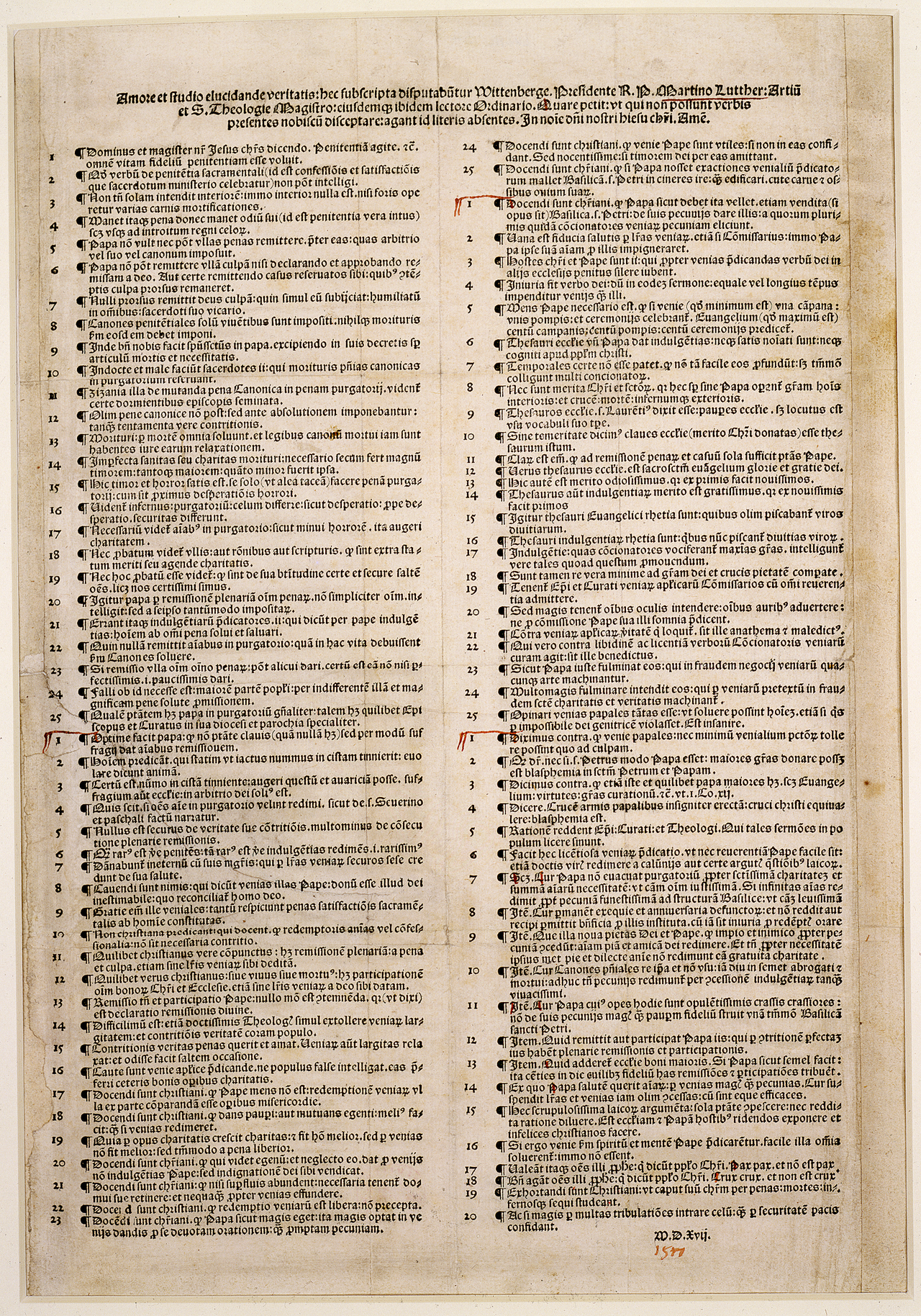
Luther's 95 Theses
Luther's 95 Theses, the document that sparked the Protestant Reformation.
Tyndale Bible Created
Between 1525 and 1534, William Tyndale used the Vulgate and Greek texts from Erasmus to create the Tyndale Bible, one of the first printed English translations of the Bible. This translation was significant for making scripture accessible to ordinary English speakers and influenced subsequent English Bible translations. It was later used as a source for the King James Version.
Council of Trent
The Council of Trent (1545–1563) was the Catholic Church's response to the Protestant Reformation, answering each Protestant claim and laying the foundation of modern Catholic policies. New monastic orders were formed, including the Society of Jesus (Jesuits), who adopted military-style discipline and strict loyalty to the Pope. The council defined Catholic doctrine on scripture, tradition, original sin, justification, and the sacraments.
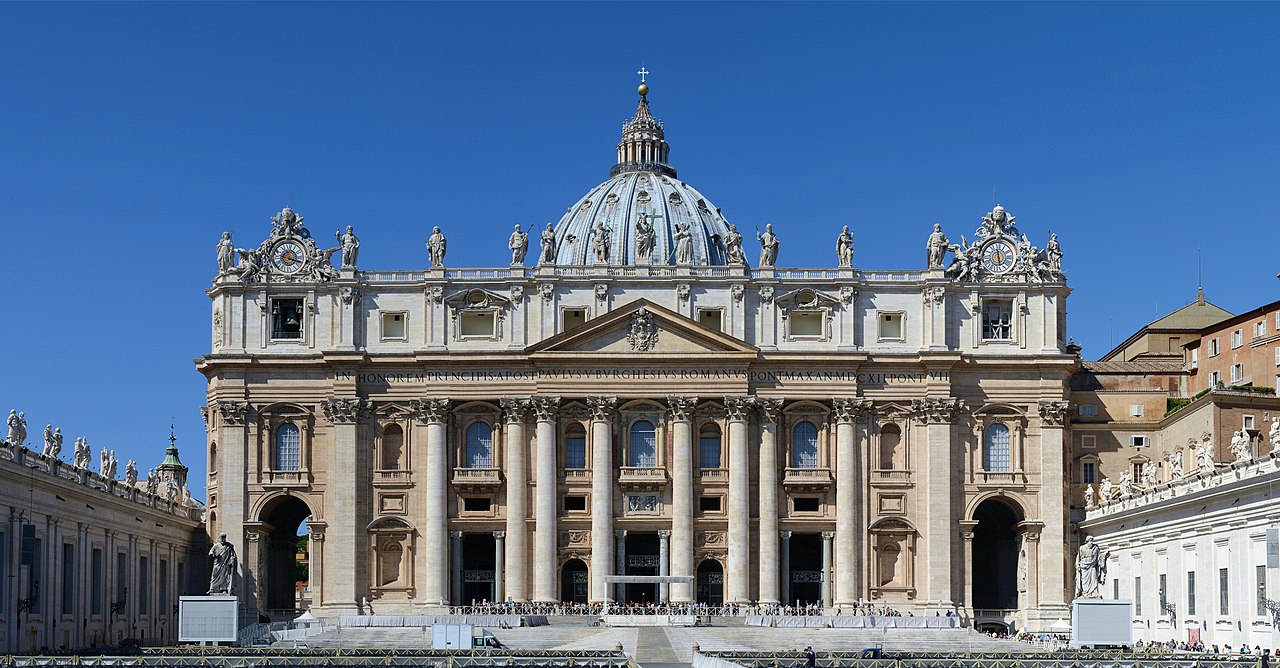
St. Peter's Basilica in the Vatican City
The Vatican, center of Catholic authority during the Counter-Reformation.
King James Bible Published
King James commissioned the King James Version of the Bible in 1604, using all previous versions in Latin, Greek, and English as sources. It was published in 1611 and became one of the most influential books in the English language. The King James Bible shaped English literature, culture, and Protestant Christianity for centuries.
Thirty Years' War
The Thirty Years' War (1618–1648) was the largest and most destructive of the European wars of religion, centered in France and the Holy Roman Empire. While some scholars argue these wars were about religious liberty, most historians argue they were also about nationalistic state-building and economics. The war devastated Central Europe and reshaped the political and religious map of the continent.
First Great Awakening
In reaction to rationalism, pietism began in Europe and spread to the Thirteen Colonies where it contributed to the First Great Awakening, a religious revival of the 1700s. Pietist Moravians came to Georgia in 1732 where they influenced John Wesley, an Anglican missionary. After returning to England, Wesley began preaching in open-air meetings, leading to the creation of the Methodist church.
Second Great Awakening
The Second Great Awakening, a religious revival of the 1800s–1830s, produced Mormonism, Restorationism, and the Holiness movement. This revival focused on evidencing conversion through active moral reform in areas such as women's rights, temperance, literacy, and the abolition of slavery. It had profound social and political consequences in America, contributing to the abolitionist movement and women's rights.
Third Great Awakening and Missionary Zeal
The Third Great Awakening began in 1857 and took root throughout the world, especially in English-speaking countries, contributing to a surge of missionary zeal. Nineteenth-century Protestant missionaries, many of them women, played a significant role in shaping nations and societies by translating the Bible into local languages and establishing schools. According to historian Lamin Sanneh, Protestant missionaries stimulated the 'largest, most diverse and most vigorous movement of cultural renewal' in African history.
Woman's Christian Temperance Union Founded
The Woman's Christian Temperance Union (WCTU) was founded in 1874, with many supporters going on to contribute to the women's rights movement. Women had been involved in temperance reform from the early 1800s, and the WCTU became one of the largest women's organizations in the United States. It used moral persuasion and political activism to effect social change.
Azusa Street Revival and Pentecostalism
The 1906 Azusa Street Revival typified the Pentecostal movement, which combined Restorationism with the goal of sanctification defined as a deeper spiritual experience. Pentecostalism grew to become one of the most significant movements in twentieth-century Christianity. By 2000, approximately one-quarter of all Christians worldwide were part of Pentecostalism and its associated movements.
Nazi Rise to Power and German Church Response
Most leaders and members of the largest Protestant church in Germany, the German Evangelical Church, supported the Nazi Party when they came to power in 1933. About a third of German Protestants formed the Confessing Church which opposed Nazism; its members were harassed, arrested, and otherwise targeted. Pope Pius XI declared the irreconcilability of the Catholic position with totalitarian fascist states that placed the nation above God.
World Council of Churches Formed
In response to the profound impact of World War I on Christianity, the World Council of Churches (WCC) formed in 1938 to address social issues, create cooperation, and open a dialogue among Christians on a global scale. The WCC played an important role in the Universal Declaration of Human Rights in 1948. It represented a major step toward Christian ecumenism and global cooperation.
Christianity Declines in the West, Grows in Global South
In the twentieth century, Christianity declined in most of the Western world but grew dramatically in the Global South, particularly Southeast Asia and Sub-Saharan Africa. In 1900, about 6.5% of Africa's population were Christian; by 2005, this had grown to about half the continent's population. By 2060, more than forty percent of the world's Christians are projected to live in sub-Saharan Africa.

Global distribution of Christians based on 2011 Pew Research Center data
Map showing the worldwide distribution of Christians, illustrating the shift toward the Global South.
Second Vatican Council
The Second Vatican Council (Vatican II), from 1962–1965, brought about numerous reforms, liturgical changes, promoted the involvement of laypeople, and improved relations with other Christian denominations. It represented the most significant reform of the Catholic Church in centuries and opened the church to dialogue with the modern world. Vatican II's reforms reshaped Catholic practice and theology globally.
St. Peter's Basilica in the Vatican City
The Vatican, where the Second Vatican Council was held.
Joint Declaration on the Doctrine of Justification
In 1992, the Catholic Church and the Lutheran World Federation signed the Joint Declaration on the Doctrine of Justification, resolving one of the central theological disputes of the Protestant Reformation. This represented a major step in Catholic-Lutheran ecumenism and acknowledged significant common ground on the doctrine of salvation. It was a landmark achievement in Christian reconciliation.
2000 CE – 2499 CE
Christianity Becomes World's Largest Religion
In 2017, PEW reported that Christianity is the world's largest religion with roughly 2.4 billion followers, equal to 31.2% of the world's population. In the twenty-first century, Christianity has become the most diverse and pluralistic of the world's religions, embracing over 3,000 of the world's languages. Most Christians now live outside North America and Western Europe.
Global distribution of Christians
Map showing the worldwide distribution of Christians, reflecting Christianity's status as the world's largest religion.