European renaissance -- north vs south
Northern European Renaissance
1400 CE – 1600 CE
Italian Renaissance
1250 CE – 1648 CE
1250 CE – 1274 CE
Proto-Renaissance Begins
Around 1250, a Proto-Renaissance period began in Italy, marked by early stirrings of cultural and artistic renewal. This period saw Italian authors beginning to write in their native language rather than Latin, French, or Provençal. The Dolce Stil Novo poetic movement emerged, pioneered by poets like Guittone d'Arezzo and Guido Guinizelli, emphasizing Platonic rather than courtly love.
1275 CE – 1299 CE
Ordinances of Justice Enacted in Florence
In 1293, the Ordinances of Justice were enacted in Florence, effectively becoming the constitution of the Republic of Florence throughout the Italian Renaissance. This legal framework shaped the political structure of the city-state and governed its republican institutions for centuries. The ordinances helped define the balance of power among Florence's merchant and noble classes.
Bonsignori Bank Collapses, Florence Becomes Banking Center
In 1298, the Bonsignori family, one of the leading banking families of Europe, went bankrupt, causing Siena to lose its status as the banking center of Europe to Florence. This shift in financial power helped elevate Florence to a position of economic dominance in Italy and Europe. The city's banking prowess would become a cornerstone of its ability to fund the arts and culture of the Renaissance.
1300 CE – 1324 CE
Dante Alighieri Active as Author
Dante Alighieri, one of the three great Italian writers of the 14th century, lived and wrote during this period of instability. His masterwork, the Divine Comedy, reflects a distinctly medieval world view while also embodying early Renaissance literary ideals. Dante is considered one of the founders of Proto-Renaissance literature and helped establish the Tuscan dialect as the literary language of Italy.

Portrait of Dante Alighieri by Cristofano dell'Altissimo
Portrait of Dante Alighieri by Cristofano dell'Altissimo, Uffizi Gallery Florence, 1552–1568
Giotto Shapes Renaissance Artistic Concepts
The late medieval painter Giotto di Bondone helped shape the artistic concepts that would later define much of Renaissance art. His key ideas—classicism, the illusion of three-dimensional space, and realistic emotional context—inspired later artists such as Masaccio, Michelangelo, and Leonardo da Vinci. Giotto's innovations marked a turning point in Western art history, bridging the medieval and Renaissance periods.
1325 CE – 1349 CE
King Edward III Repudiates Debts, Florentine Banks Collapse
In 1345, King Edward III of England repudiated his debts, contributing to the collapse of the two largest Florentine banks, those of the Bardi and Peruzzi. This financial catastrophe was part of a broader 14th-century economic crisis that sent the European economy into recession. The collapse of these banks would eventually open the way for the Medici family to rise to prominence in Florence.
Black Death Devastates Northern Italy
The Black Death decimated the populations of the densely populated cities of Northern Italy and returned at intervals thereafter. Florence, for instance, which had a pre-plague population of 45,000, decreased over the next 47 years by 25–50%. The resulting labor shortage increased wages, made the remaining population wealthier, and contributed to a decline in Church influence, all of which helped set the stage for the Renaissance.
1350 CE – 1374 CE
Boccaccio Writes the Decameron
Giovanni Boccaccio, a disciple of Petrarch, wrote the Decameron, a collection of 100 stories told by ten storytellers who fled to the outskirts of Florence to escape the Black Death. The Decameron was a major source of inspiration and plots for many English authors in the Renaissance, including Geoffrey Chaucer and William Shakespeare. Boccaccio is considered one of the three great Italian writers of the 14th century alongside Dante and Petrarch.
1375 CE – 1399 CE
Ciompi Revolt in Florence
In 1378, a revolt of Florentine textile workers known as the ciompi broke out, reflecting the widespread disorder that followed the Black Death and economic collapse. This uprising was part of the broader social upheaval caused by the catastrophes of the 14th century. The revolt highlighted the tensions between the emerging merchant class and the laboring poor in Renaissance Florence.
Giangaleazzo Visconti Rules Milan
Giangaleazzo Visconti ruled Milan from 1378 to 1402, renowned both for his cruelty and his abilities. He set about building an empire in Northern Italy, launching a long series of wars in which Milan steadily conquered neighboring states and defeated various coalitions led by Florence. His ambitions culminated in the 1402 siege of Florence, which threatened the city's independence and galvanized Florentine republican ideology.
1400 CE – 1424 CE
Siege of Florence and Death of Giangaleazzo Visconti
In 1402, Milan besieged Florence, and it appeared the city was doomed to fall to Giangaleazzo Visconti's expanding empire. However, Giangaleazzo suddenly died, and his empire collapsed, saving Florence's independence. This crisis is argued by historian Hans Baron to have been a crucial catalyst for the development of Florentine republican ideology and the early Renaissance, as leading figures rallied the people by presenting the war as a struggle between free republic and despotic monarchy.
Florence Takes Pisa
In 1406, Florence captured the city of Pisa, expanding its territorial control in Tuscany. This was part of a broader trend in the 15th century in which the most powerful Italian city-states annexed their smaller neighbors. Florence's growing power and wealth helped fund the cultural and artistic achievements of the Renaissance.
1425 CE – 1449 CE
Byzantine Emperor Attends Council in Florence
In 1439, Byzantine Emperor John VIII Palaiologos attended a council in Florence in an attempt to unify the Eastern and Western Churches. This brought books and scholars to the city, greatly stimulating the study of ancient Greek texts. The council helped spark renewed interest in ancient Greek culture and Neoplatonic philosophy, which became the subject of an academy established by the Medici.
Donatello Creates First Free-Standing Bronze Nude Since Roman Empire
In the 1440s, the Florentine sculptor Donatello created his second sculpture of David, the first free-standing bronze nude created in Europe since the Roman Empire. Donatello was among the earliest sculptors to translate classical references into marble and bronze, and his work had a profound influence on Renaissance sculpture. This landmark work exemplified the Renaissance revival of classical antiquity.

David by Donatello
David by Donatello, 1440s — the first free-standing bronze nude created in Europe since the Roman Empire
Alfonso I Brings Renaissance to Naples
Alfonso I conquered Naples in 1443 and ushered in the Renaissance there through his patronage of artists like Francesco Laurana and Antonello da Messina, and writers like the poet Jacopo Sannazaro and the humanist scholar Angelo Poliziano. His patronage helped spread Renaissance culture to southern Italy. Naples became an important center of Renaissance art and learning under his rule.
Pope Nicholas V Begins Rebuilding Rome
Pope Nicholas V became pontiff in 1447 and launched a dramatic rebuilding effort that would eventually see much of Rome renewed. This marked the beginning of the great transformation of Rome from a city of ancient ruins into a center of Renaissance art and architecture. The papacy's embrace of Renaissance ideals under Nicholas V and his successors would make Rome one of the most important centers of Renaissance culture.
Francesco Sforza Transforms Milan into Renaissance Center
In 1447, Francesco Sforza came to power in Milan and rapidly transformed that still medieval city into a major center of art and learning, drawing figures like Leone Battista Alberti. Sforza's patronage helped spread Renaissance culture beyond Florence to other Italian city-states. Milan under Sforza became one of the key centers of the Italian Renaissance.
1450 CE – 1474 CE
Northern Renaissance Begins
The Northern European Renaissance emerged as Italian Renaissance ideas spread northward into Germany, the Netherlands, France, and England. This cultural movement blended Italian humanist thought with northern European traditions, producing distinctive artistic and intellectual achievements. The movement transformed art, literature, and philosophy across the region.
Fall of the Byzantine Empire
The fall of the Byzantine Empire in 1453 led to an influx of Greek scholars and manuscripts into Italy, particularly Florence. This brought ancient Greek works back into Western Europe for the first time since late antiquity, greatly stimulating Renaissance scholarship and humanist studies. The migration of Byzantine scholars was crucial in sparking new linguistic studies and the recovery of lost Greek classics.
Peace of Lodi Brings Stability to Italy
In 1454, Florence, Milan, and Venice set aside their differences and agreed to the Peace of Lodi, which brought relative calm to the region for the first time in centuries. This peace would hold for the next forty years, creating the conditions under which the Italian Renaissance flourished. The era of the Peace of Lodi (1454–1494) saw Italy become the recognized European leader in painting, architecture, sculpture, literature, music, philosophy, science, technology, and exploration.
Pandolfo Malatesta Hired by Venice to Fight Turks
In 1465, Pandolfo Malatesta, lord of Rimini and a capable condottiere, was hired by the Venetians to fight against the Turks, though unsuccessfully. Malatesta was also the patron of Leone Battista Alberti, whose Tempio Malatestiano at Rimini is considered one of the first entirely classical buildings of the Renaissance. His career exemplified the intertwining of military, political, and cultural patronage in Renaissance Italy.

Pandolfo Malatesta by Piero della Francesca
Portrait of Pandolfo Malatesta (1417–1468), lord of Rimini, by Piero della Francesca
Lorenzo de' Medici Takes Power in Florence
In 1469, the reins of power in Florence passed to Cosimo de' Medici's 21-year-old grandson Lorenzo, who would become known as 'Lorenzo the Magnificent.' Lorenzo was the first of the Medici family to be educated from an early age in the humanist tradition and is best known as one of the Renaissance's most important patrons of the arts. He reformed Florence's ruling council and, though less successful in business than his forebears, made Florence the cultural capital of the Renaissance world.

Portrait of Cosimo de' Medici by Jacopo Pontormo
Portrait of Cosimo de' Medici by Jacopo Pontormo (c. 1518–1520), representing the Medici family's central role in the Florentine Renaissance
Alberti's Sant'Andrea Begun in Mantua
In 1472, construction began on Alberti's culminating architectural work, Sant'Andrea in Mantua, after the architect's death. Alberti had ushered in the new antique style in Mantua, and Sant'Andrea became one of the most important examples of Renaissance architecture. The building exemplified the Renaissance revival of classical architectural principles.
1475 CE – 1499 CE
Pazzi Conspiracy and Assassination of Giuliano de' Medici
In 1478, Papal agents allied with the Pazzi family in an attempt to assassinate Lorenzo de' Medici. Although the conspiracy failed to kill Lorenzo, his young brother Giuliano was killed at Easter Sunday mass in Florence's cathedral. The failed assassination led to a war with the Papacy and was used as justification to further centralize power in Lorenzo's hands.
Aldine Press Founded in Venice
In 1494, the Aldine Press was founded by the printer Aldo Manuzio in Venice. The press developed Italic type and pocket editions, and became the first to publish printed editions of books in Ancient Greek. The Aldine Press played a crucial role in democratizing learning and spreading Renaissance ideas throughout Europe by making classical texts widely available.
French Invasion of Italy Begins Italian Wars
In 1494, France invaded Italy, wreaking widespread devastation on Northern Italy and ending the independence of many of the city-states. This marked the beginning of the Italian Wars (1494–1559), which plunged the region into turmoil and signaled the beginning of the end of the Italian Renaissance. The invasion also marked the rise to power of the austere monk Girolamo Savonarola in Florence (1494–1498), whose rule saw many works of art destroyed in the 'Bonfire of the Vanities.'
Savonarola's Rule and Bonfire of the Vanities
From 1494 to 1498, the austere monk Girolamo Savonarola rose to power in Florence on a widespread backlash over the secularism and indulgence of the Renaissance. His brief rule saw many works of art destroyed in the 'Bonfire of the Vanities' in the center of Florence. For many historians, Savonarola's rise marks the end of Florence's cultural flourishing during the Renaissance.
Italian Wars End
The Italian Wars, which had begun with the French invasion of 1494, finally ended in 1559. These decades of conflict had plunged Italy into turmoil, ended the independence of many city-states, and contributed significantly to the decline of the Italian Renaissance. The wars marked the transition of Italy from a collection of independent city-states to a region dominated by foreign powers, particularly Spain.
Copernicus Studies in Italian Universities
Copernicus studied in Bologna from 1496 to 1501 and in Padua from 1501 to 1503, benefiting from the scientific centers of renown at Italian universities. His time in Italy exposed him to the latest developments in astronomy and mathematics, which would later inform his heliocentric theory. Italian universities such as Padua, Bologna, and Pisa were key conduits for spreading Renaissance science to Northern Europe.
Vasco da Gama Reaches India, Shifting Trade Routes
In 1498, Vasco da Gama reached India, fundamentally shifting the primary route of goods from the Orient away from the Mediterranean and through the Atlantic ports of Lisbon, Seville, Nantes, Bristol, and London. This development undermined the economic foundations of the Italian city-states, which had prospered as intermediaries in Mediterranean trade. The shift in trade routes contributed to the decline of Italian economic and cultural dominance.
1500 CE – 1524 CE
Bramante's Tempietto Introduces High Renaissance Architecture
In 1502, Donato Bramante completed the Tempietto at San Pietro in Montorio in Rome, introducing the High Renaissance architectural style to the city. This small but perfectly proportioned building became a landmark of Renaissance architecture and influenced generations of architects. Bramante's work in Rome, including his original centrally planned St. Peter's Basilica begun in 1506, represented the pinnacle of Renaissance architectural achievement.

Bramante's Tempietto in San Pietro in Montorio, Rome
Bramante's Tempietto in San Pietro in Montorio, Rome, 1502 — a landmark of High Renaissance architecture
Bramante Begins St. Peter's Basilica
In 1506, Bramante began his original centrally planned design for St. Peter's Basilica in Rome, the most notable architectural commission of the Renaissance era. The project was influenced by almost all notable Renaissance artists, including Michelangelo and Giacomo della Porta. St. Peter's Basilica became one of the greatest architectural achievements of the Renaissance and remains one of the most famous buildings in the world.
Michelangelo Paints the Sistine Chapel Ceiling
Michelangelo painted the Sistine Chapel Ceiling, one of the most widely known works of art in the world and a masterpiece of the High Renaissance. The work exemplified the High Renaissance ideals of compositional order, balance, and harmony, as well as the realistic depiction of physical and psychological features. Pope Sixtus IV had famously ordered the construction of the Sistine Chapel, and Michelangelo's ceiling became its crowning glory.
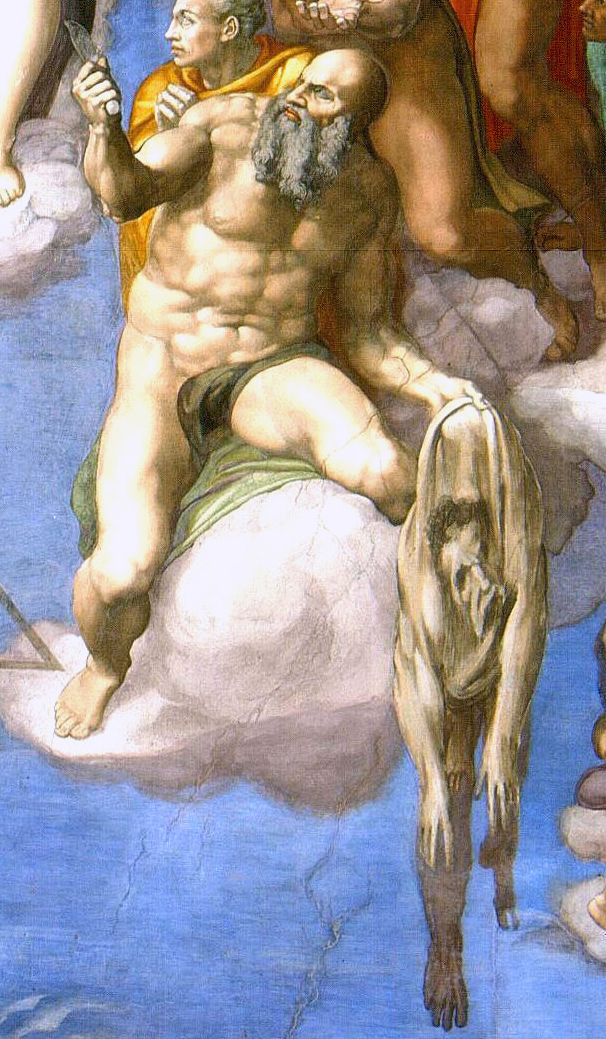
The Last Judgment by Michelangelo
Detail of The Last Judgment by Michelangelo, 1536–1541, one of Michelangelo's greatest works in the Sistine Chapel
Medici Return to Power in Florence
In 1512, the Medici family triumphantly returned to power in Florence, marking for many historians the beginning of the late phase in the Renaissance arts called Mannerism. The Medici would eventually become Grand Dukes of Tuscany, consolidating their rule over the city. This period saw the continuation of Renaissance patronage under Medici auspices, though the character of the art and culture began to shift.
Portrait of Cosimo de' Medici by Jacopo Pontormo
Portrait of Cosimo de' Medici by Jacopo Pontormo, representing the Medici family's return to power in Florence
Leonardo da Vinci Leaves for France
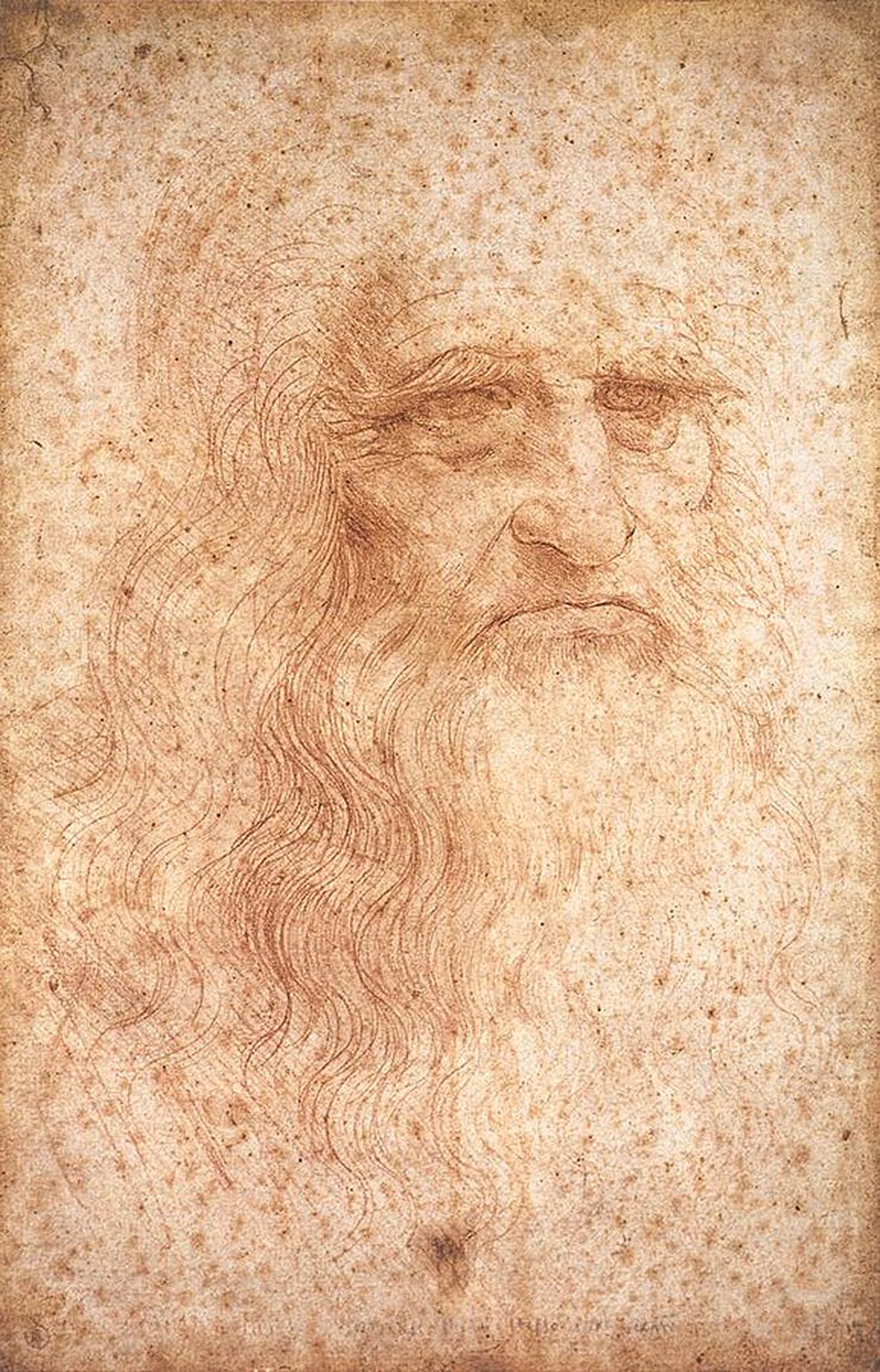
In 1516, Leonardo da Vinci, the most notable example of Italian Renaissance artists emigrating, left Italy for France. His departure symbolized the waning of the Italian Renaissance and the beginning of its influence on Northern Europe. Teams of lesser Italian artists invited to transform the Château de Fontainebleau created the School of Fontainebleau, which infused the style of the Italian Renaissance in France.
Leonardo da Vinci - presumed self-portrait
Leonardo da Vinci, Italian Renaissance Man, 1512 — the most notable example of a Renaissance artist emigrating to France
1525 CE – 1549 CE
Sack of Rome by Spanish and German Troops
On 6 May 1527, Spanish and German troops sacked Rome, an event that for two decades all but ended the role of the Papacy as the largest patron of Renaissance art and architecture. This catastrophic event is considered one of the most damaging blows to the Italian Renaissance. The sack of Rome marked a decisive turning point in the decline of the Italian Renaissance.
Florence Becomes a Duchy
In 1532, Florence ceased to be a republic and became the Duchy of Florence, traditionally marking the end of the High Renaissance in Florence. The Medici, who had long controlled the city's republican institutions, now formally became its rulers. This transition from republic to duchy represented the final consolidation of Medici power and the end of the Florentine republican tradition that had been so important to the Renaissance.
Michelangelo Paints The Last Judgment
Between 1536 and 1541, Michelangelo painted The Last Judgment on the altar wall of the Sistine Chapel, one of the greatest works of the High Renaissance and early Mannerist period. The monumental fresco depicts the Second Coming of Christ and the final and eternal judgment by God of all humanity. It remains one of the most celebrated and studied works of art in the world.
The Last Judgment by Michelangelo
Detail of The Last Judgment by Michelangelo, 1536–1541
Sacred Congregation of the Inquisition Formed
In 1542, the Sacred Congregation of the Inquisition was formed by the Catholic Church, and a few years later the Index Librorum Prohibitorum banned a wide array of Renaissance works of literature. This marked the end of the illuminated manuscript tradition, with Giulio Clovio considered the last very notable artist in this long tradition. Under the suppression of the Catholic Church and the ravages of war, humanism became 'akin to heresy.'
Giulio Clovio Creates the Farnese Hours
In 1546, Giulio Clovio completed the Farnese Hours, a masterpiece of illuminated manuscript art. Clovio is considered the greatest illuminator of the Italian High Renaissance and arguably the last very notable artist in the long tradition of the illuminated manuscript before some modern revivals. His work represents the culmination and conclusion of a centuries-long artistic tradition.
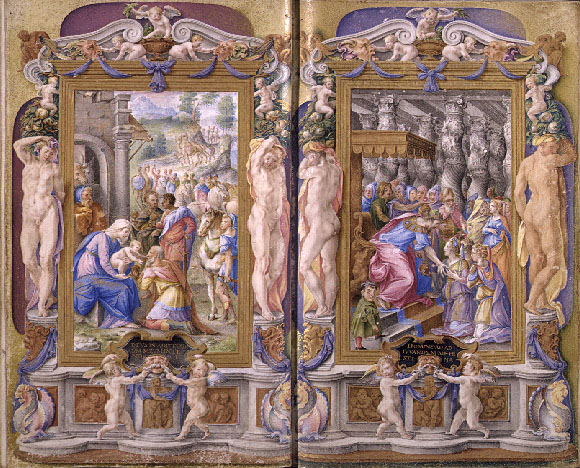
Giulio Clovio, Adoration of the Magi from the Farnese Hours
Giulio Clovio, Adoration of the Magi and Solomon Adored by the Queen of Sheba from the Farnese Hours, 1546
1550 CE – 1574 CE
Giorgio Vasari Publishes Lives of the Artists
In 1550, Giorgio Vasari published his Lives of the Most Excellent Painters, Sculptors, and Architects, in which he used the term 'rinascita' (rebirth) to describe the cultural revival he was documenting. This work became the foundational text of Renaissance art history and established the concept of the Renaissance as a distinct historical period. Vasari's book also marked the beginning of the late Renaissance period, coinciding with Andrea Palladio's development of a new column order.
Violin Invented in Renaissance Italy
In the 1550s, the earliest forms of the violin came into use in Renaissance Italy, representing one of many familiar instruments invented and perfected in late Renaissance Italy. Italy was a center of innovation in instrumental music during this period, with keyboard improvisation also coming to be greatly valued in the early 16th century. The violin would go on to become one of the most important instruments in Western classical music.
1600 CE – 1624 CE
Opera Emerges in Florence
Around 1600, opera first appeared as an art form, emerging from the work of the Florentine Camerata, which had developed monody as an important precursor to opera. Figures like Claudio Monteverdi were central to the birth of opera, which became one of Italy's most enduring cultural contributions to the world. The emergence of opera marked the transition from the Renaissance to the Baroque period in music.

Claudio Monteverdi by Bernardo Strozzi
Claudio Monteverdi, a central figure in the birth of opera, painted by Bernardo Strozzi (c. 1630)
1625 CE – 1649 CE
End of European Wars of Religion
In 1648, the conclusion of the European wars of religion is proposed by some historiographers as marking the end of the Renaissance. This date represents one of several proposed endpoints for the Renaissance period, reflecting the difficulty of precisely defining when the cultural movement ended. The Peace of Westphalia in 1648 marked a new era in European political and religious history.