Comparing Timelines
Exploring the overlapping histories of "American Revolution" and "French Revolution".
American Revolution
1763 - 1791

French Revolution
1789 - 1799
1763 CE
End of French and Indian War
The French and Indian War concluded, leaving Britain with massive debt and new territorial responsibilities. This war's aftermath led to increased British taxation and control over the American colonies, setting the stage for colonial discontent and eventual revolution.
Royal Proclamation of 1763
The British government issued the Royal Proclamation designating territory between the Appalachian Mountains and Mississippi River as an Indian Reserve closed to settlement. This angered colonists who wanted to expand westward and failed to stop their migration.

File:Map_of_territorial_growth_1775.svg
A 1775 map of Eastern North America, including the Province of Quebec, the Thirteen Colonies on the Atlantic Coast, and the Indian Reserve as defined by the Royal Proclamation of 1763.
1764 CE
Sugar Act Passed
Parliament passed the Sugar Act, decreasing existing customs duties on sugar and molasses but providing stricter enforcement measures. This was part of Britain's effort to raise revenue from the colonies to help pay for the costs of maintaining troops in North America.
1765 CE
Stamp Act Passed
Parliament passed the Stamp Act, imposing direct taxes on the colonies for the first time. All official documents, newspapers, and pamphlets required stamps. Colonists objected not to the tax amount but to taxation without representation in Parliament, leading to the formation of the Sons of Liberty.

File:Parliament_Stamp_Act1765.jpg
Notice of the Stamp Act 1765 in a colonial newspaper
Stamp Act Congress
Representatives from nine colonies convened in New York City for the Stamp Act Congress. They issued a Declaration of Rights and Grievances arguing that taxation without representation violated their rights as Englishmen, establishing the principle of colonial unity against British policies.
1766 CE
Stamp Act Repealed
Parliament repealed the Stamp Act after colonial resistance and Benjamin Franklin's testimony about colonial contributions to the empire. However, they simultaneously passed the Declaratory Act asserting their right to make laws for the colonies 'in all cases whatsoever.'
1767 CE
Townshend Acts Passed
Parliament passed the Townshend Acts, placing duties on paper, glass, and tea, and establishing a Board of Customs in Boston. The goal was to assert British authority over the colonies rather than simply collect revenue, leading to renewed colonial resistance and boycotts.

File:Dickinson's_Letter_III_in_The_Pennsylvania_Chronicle.jpg
Letter III of John Dickinson's Letters from a Farmer in Pennsylvania, published in the Pennsylvania Chronicle, December 1767
1770 CE
Boston Massacre
British soldiers fired into a threatening crowd on a Boston street, killing five civilians including Crispus Attucks. Though the soldiers were acquitted, the event was used as propaganda against British rule and accelerated the deterioration of British-colonial relations.
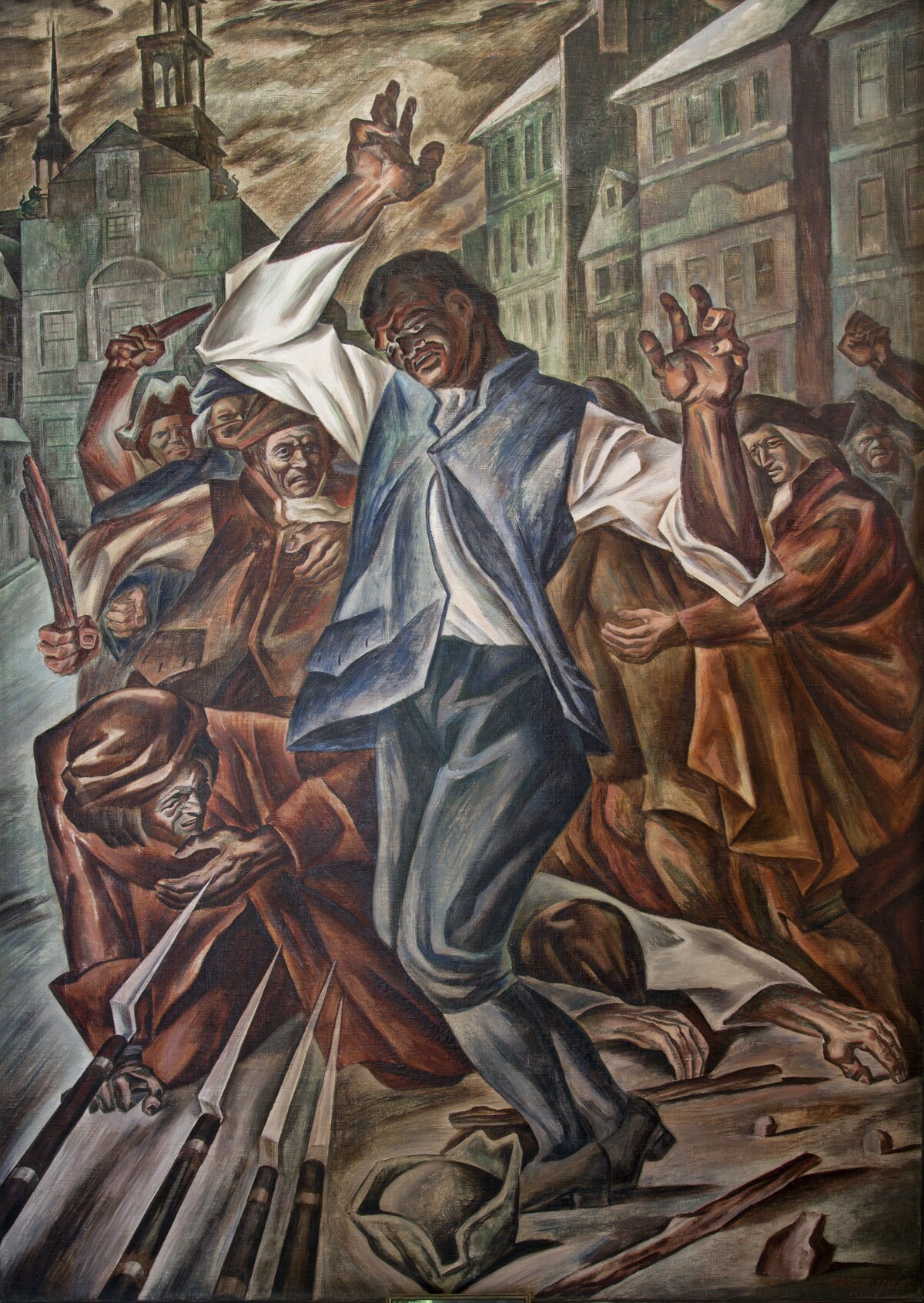
"Crispus_Attucks,"_by_Herschel_Levit
Crispus Attucks, a portrait by Herschel Levit depicts Attucks, who is considered to be the first American to die for the cause of independence in the Revolution.
1772 CE
Gaspee Affair
American patriots including John Brown burned HMS Gaspee, a British customs schooner that had been vigorously enforcing unpopular trade regulations in Narragansett Bay. The affair was investigated for possible treason but no action was taken, showing colonial willingness to use violence against British authority.

File:Destruction_of_the_schooner_Gaspé
On June 9, 1772, the Sons of Liberty burned HMS Gaspee, a British customs schooner in Narragansett Bay.
1773 CE
Tea Act Passed
Parliament passed the Tea Act to help the struggling British East India Company by allowing it to sell tea directly to colonists at reduced prices, bypassing colonial merchants. This threatened colonial merchants and was seen as another attempt to assert British control over colonial trade.
Boston Tea Party
Led by Samuel Adams, a group of men disguised as Indigenous people boarded East India Company ships and dumped £10,000 worth of tea into Boston Harbor. This act of defiance against the Tea Act became a symbol of American resistance to British taxation and authority.

File:Boston_Tea_Party_w.jpg
The December 16, 1773 Boston Tea Party, led by Samuel Adams and Sons of Liberty, has become a mainstay of American patriotic lore.
1774 CE
Intolerable Acts Passed
Parliament responded to the Boston Tea Party by passing four punitive laws: the Massachusetts Government Act, Administration of Justice Act, Boston Port Act, and Quartering Act. These acts further darkened colonial opinion toward Britain and united the colonies in opposition.
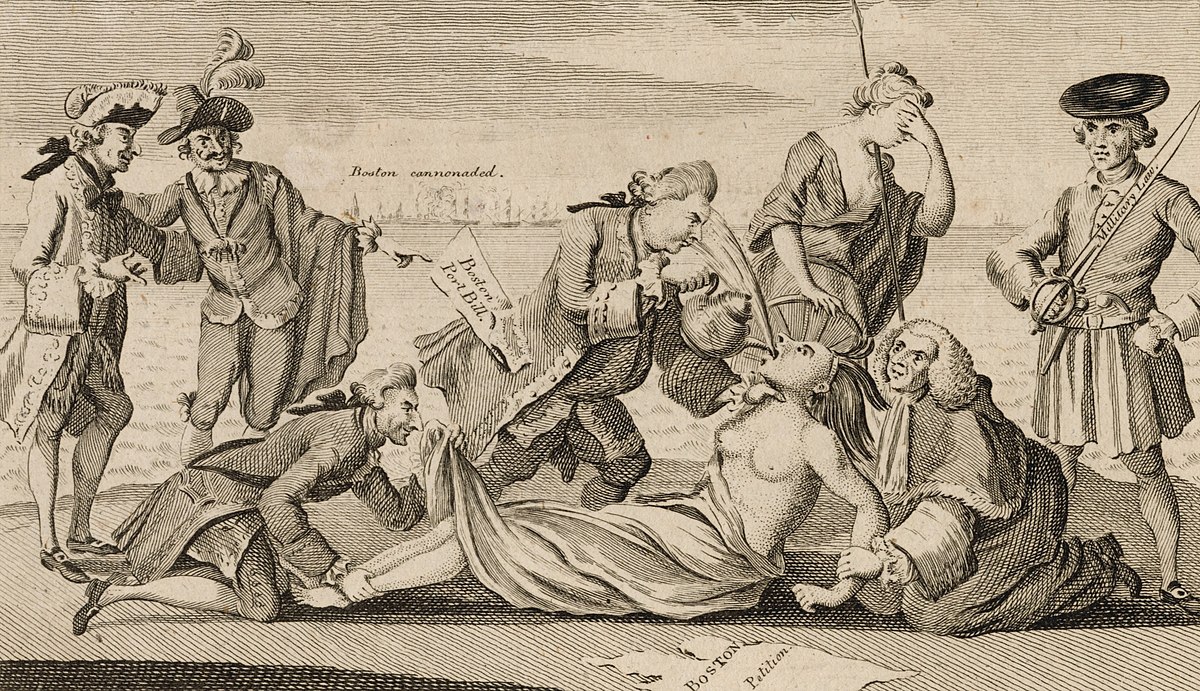
File:The_able_doctor
A 1774 illustration from The London Magazine depicts Prime Minister Lord North, author of the Boston Port Act, forcing the Intolerable Acts down the throat of America.
First Continental Congress
Representatives from twelve colonies convened in Philadelphia to coordinate resistance to British policies. They called for a boycott of British goods and began organizing Patriot resistance through local committees, marking the first unified colonial response to British authority.
1775 CE
King George III Declares Massachusetts in Rebellion
King George III officially declared Massachusetts to be in a state of rebellion, escalating the conflict between Britain and the colonies. This declaration marked the transition from political protest to open confrontation and set the stage for military action.
Battles of Lexington and Concord
British attempts to seize colonial weapons and arrest Patriot leaders resulted in the first military engagements of the Revolutionary War. The 'shot heard 'round the world' marked the beginning of armed conflict between Britain and the American colonies.

File:Prince_Estabrook_memorial_close_up.jpg
A Lexington, Massachusetts memorial to Prince Estabrook, who was wounded in the Battle of Lexington and Concord and was the first Black casualty of the Revolutionary War
Second Continental Congress Convenes
The Second Continental Congress convened in Philadelphia to manage the colonial war effort. They authorized the formation of the Continental Army and appointed George Washington as commander-in-chief, while also attempting reconciliation through the Olive Branch Petition.
Battle of Bunker Hill
British forces achieved a costly victory against entrenched American forces, suffering about 1,000 casualties from a garrison of 6,000 compared to 500 American casualties. The heavy British losses demonstrated that colonial forces could inflict serious damage on professional troops.

File:00SalemPoor.jpg
A postage stamp, created at the time of the bicentennial, honors Salem Poor, who was an enslaved African American man who purchased his freedom, became a soldier, and rose to fame as a war hero during the Battle of Bunker Hill.
Dunmore's Proclamation
Virginia's royal governor Lord Dunmore issued a proclamation offering freedom to slaves who would join British forces. This recruitment of Black soldiers angered Southern Patriots and played a major role in Southern support for independence, as colonists feared slave rebellions.
1776 CE
New Hampshire Ratifies First State Constitution
New Hampshire became the first colony to ratify a state constitution, beginning the process of creating new republican governments to replace royal authority. This marked the transition from colonial governments to independent state governments.
British Evacuate Boston
George Washington's Continental Army, aided by cannons from Fort Ticonderoga, forced British forces to evacuate Boston by sea. This victory gave Patriots control of all thirteen colonies and demonstrated the effectiveness of the Continental Army under Washington's leadership.
Congress Votes to Suppress Crown Authority
The Continental Congress voted to suppress all forms of Crown authority in the colonies, to be replaced by locally created authority. This decisive step toward independence encouraged colonies to create their own state constitutions and governments.
Lee Resolution Passed
The Continental Congress passed the Lee Resolution affirming their support for joint independence from Britain. This resolution set the stage for the formal Declaration of Independence and represented the colonies' commitment to complete separation from British rule.
Declaration of Independence Adopted
The Continental Congress unanimously adopted the Declaration of Independence, drafted largely by Thomas Jefferson. The document proclaimed that 'all men are created equal' and established the philosophical foundation for American independence based on natural rights and consent of the governed.

File:William_Walcutt_statue_George_III.png
Pulling Down the Statue of King George III, N.Y.C., depicting American patriots tearing down a statue of King George III in New York City on July 9, 1776, five days after the adoption of the Declaration of Independence.
Battle of Brooklyn
British forces defeated Washington's Continental Army in the largest battle of the Revolutionary War. The British victory nearly captured Washington's army and demonstrated British military superiority, but Washington's successful retreat prevented total disaster.

File:The British fleet in the lower bay 1876.jpg
The British fleet amassed off Staten Island in New York Harbor in the summer of 1776, as depicted in Harper's Magazine in 1876
Staten Island Peace Conference
A delegation including John Adams and Benjamin Franklin met with British Admiral Richard Howe to negotiate an end to hostilities. The British demanded retraction of the Declaration of Independence, which the Americans refused, ending hopes for peaceful resolution.
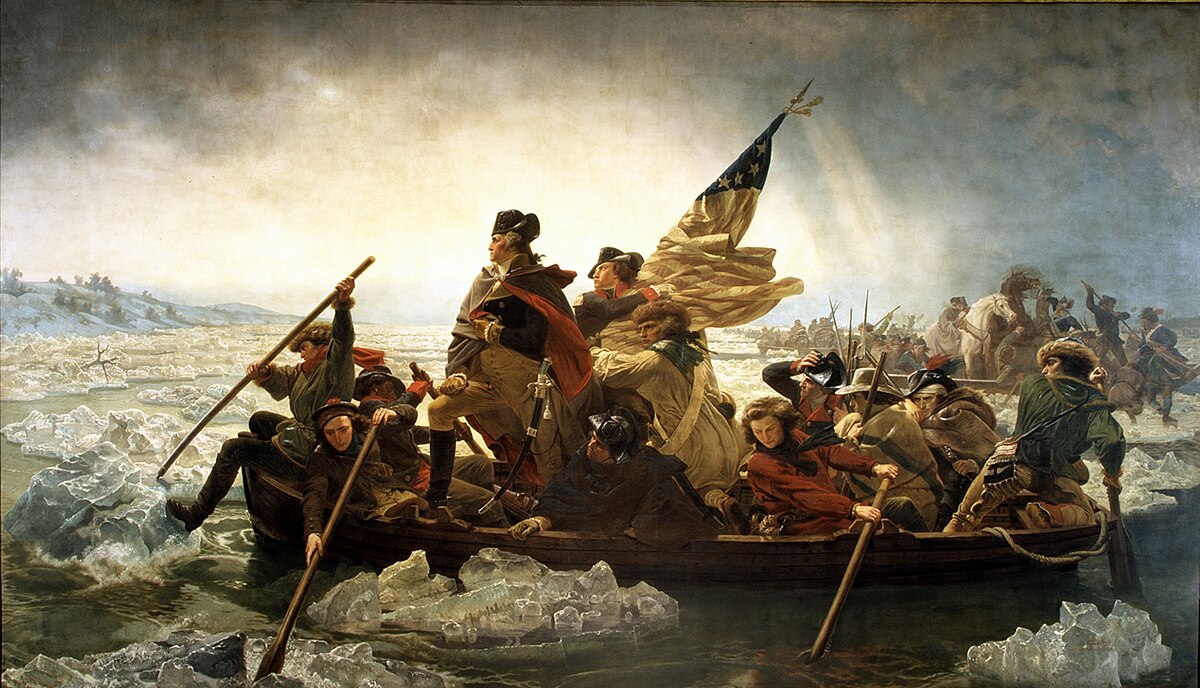
Washington Crosses the Delaware
Washington led a surprise attack across the Delaware River, defeating Hessian and British troops at Trenton and Princeton. These victories regained control of most of New Jersey and provided a crucial morale boost to the Patriot cause during a dark period of the war.
File:Washington Crossing the Delaware by Emanuel Leutze, MMA-NYC, 1851.jpg
Washington crossing the Delaware on December 25–26, 1776, depicted in Emanuel Leutze's 1851 painting
1777 CE
Battles of Saratoga
American forces defeated British General Burgoyne's invasion army, forcing its surrender. This decisive victory convinced France to formally enter the war as an American ally, transforming the conflict into a global war and providing crucial support for American independence.
Articles of Confederation Approved
Congress approved the Articles of Confederation and Perpetual Union, creating the first constitution for the United States. The Articles established a confederation of sovereign states with a weak central government, providing structure during the Revolutionary War.
1778 CE
Treaty of Alliance with France
The United States and France signed the Treaty of Amity and Commerce and the Treaty of Alliance, making France the first foreign nation to officially recognize American independence. This alliance provided crucial military and financial support for the American war effort.

File:LouisXVI-France1.jpg
Louis XVI, King of France and Navarre
1779 CE
Philipsburg Proclamation
British forces expanded their promise of freedom to all enslaved people in rebellious colonies who enlisted in British military service. This proclamation significantly increased the number of Black Loyalists and further angered Southern Patriots who feared losing their enslaved workforce.
Spain Declares War on Britain
Spain formally declared war on Britain as a French ally, opening new fronts in the global conflict. Spanish forces under Bernardo de Gálvez captured Florida from the British and kept vital supply lines open to the Americans.
1780 CE
British Capture Charleston
British forces captured Charleston, South Carolina, in their largest victory of the southern campaign. This success gave Britain control of most of Georgia and South Carolina and marked the height of British military success in the South.
1781 CE
Articles of Confederation Ratified
The Articles of Confederation were fully ratified by all thirteen states, officially establishing the United States government. The Continental Congress was dissolved and replaced by the United States in Congress Assembled under the new constitution.
Siege of Yorktown
Combined French and American forces under Washington besieged British General Cornwallis at Yorktown. The French naval victory in the Battle of the Chesapeake trapped Cornwallis, leading to his surrender and effectively ending major combat operations in the Revolutionary War.
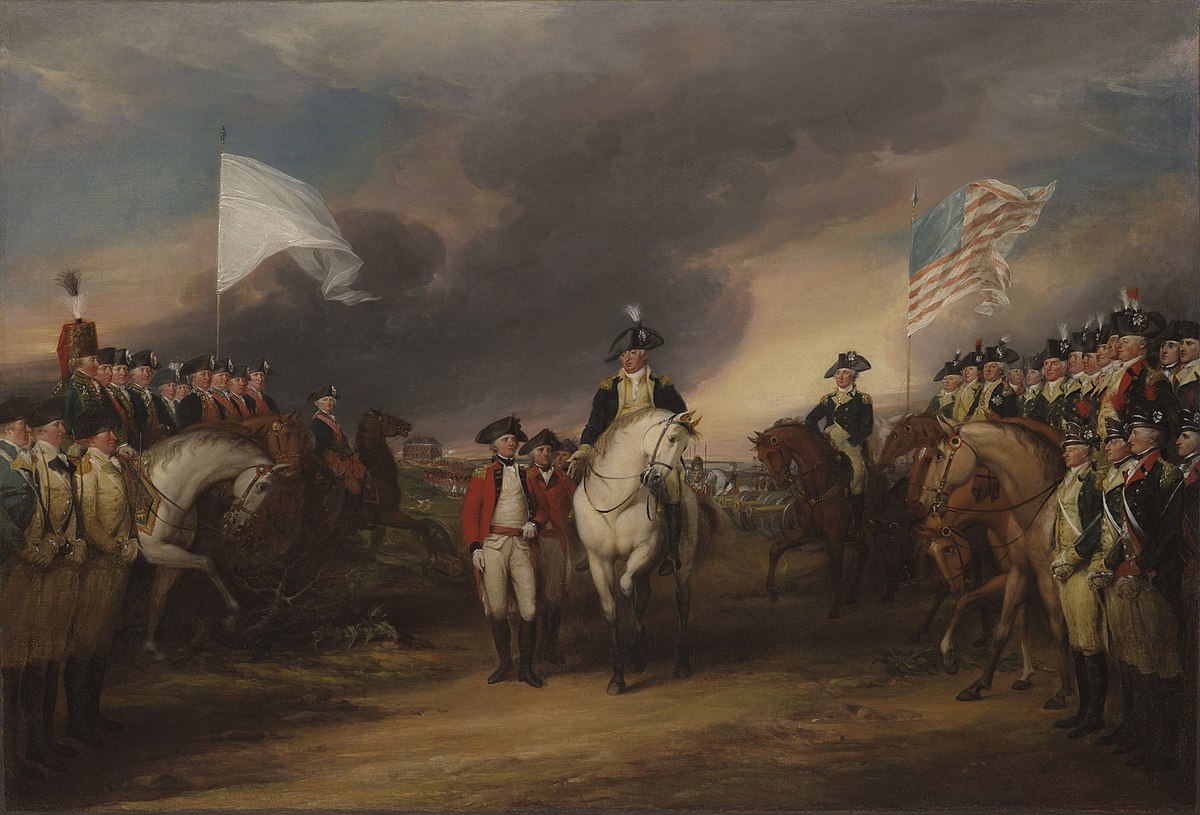
File:John_Trumbull_-_The_Surrender_of_Lord_Cornwallis_at_Yorktown
The 1781 siege of Yorktown ended with the surrender of a second British army, marking effective British defeat.
1783 CE
Treaty of Paris Signed
Britain signed the Treaty of Paris, formally ending the Revolutionary War and recognizing American independence. The treaty granted the United States all territory east of the Mississippi River and south of the Great Lakes, establishing the new nation's borders.

File:Treaty of Paris by Benjamin West 1783.jpg
Treaty of Paris by Benjamin West portrays the American delegation about to sign the 1783 Treaty of Paris (John Jay, John Adams, Benjamin Franklin, Henry Laurens, W.T. Franklin). The British delegation refused to pose and the painting was never completed.
1787 CE
Constitutional Convention
Delegates from twelve states convened in Philadelphia to address the weaknesses of the Articles of Confederation. Instead of revising the Articles, they drafted an entirely new Constitution creating a stronger federal government with executive, legislative, and judicial branches.

File:Scene_at_the_Signing_of_the_Constitution_of_the_United_States.jpg
The September 17, 1787 signing of the United States Constitution at Independence Hall in Philadelphia depicted in Howard Chandler Christy's 1940 painting, Scene at the Signing of the Constitution of the United States
1788 CE
Constitution Ratified
The new Constitution was ratified by the required nine states, replacing the Articles of Confederation. The Constitution established a federal republic with a strong national government while preserving state rights, creating the framework for modern American government.
1789 CE
George Washington Inaugurated
George Washington was inaugurated as the first President of the United States under the new Constitution. His presidency established important precedents for the executive branch and demonstrated the peaceful transfer of power in the new republic.
Convocation of the Estates General
The Estates General was convened for the first time since 1614 due to France's financial crisis. This assembly of representatives from the three estates (clergy, nobility, and commoners) marked the beginning of the revolutionary process that would transform France.
Formation of the National Assembly
The Third Estate declared itself the National Assembly of France, breaking away from the traditional Estates General structure. This act represented a fundamental shift in political authority from the monarchy to representatives of the people.
Tennis Court Oath
Members of the National Assembly took an oath not to disperse until a new constitution had been established. This pivotal moment demonstrated their commitment to constitutional government and marked a point of no return in the revolutionary process.

Le Serment du Jeu de paume by Jacques-Louis David
Depicting the Tennis Court Oath
Dismissal of Jacques Necker
King Louis XVI dismissed the popular finance minister Jacques Necker, sparking public outrage and demonstrations in Paris. This decision was seen as a rejection of reform and helped precipitate the storming of the Bastille.
Storming of the Bastille
Parisian revolutionaries stormed the Bastille fortress, a symbol of royal authority and oppression. This dramatic event marked the beginning of popular participation in the Revolution and became its most iconic moment, later celebrated as Bastille Day.
The Storming of the Bastille on 14 July 1789
The iconic event of the Revolution, still commemorated each year as Bastille Day
Abolition of Feudalism
The National Assembly published the August Decrees, formally abolishing feudalism in France. This sweeping reform eliminated feudal dues, church tithes, and special privileges, fundamentally transforming French society and economy.
Declaration of the Rights of Man and of the Citizen
The National Assembly adopted this fundamental document establishing individual rights and freedoms. The Declaration became a cornerstone of liberal democracy and influenced constitutional developments worldwide.
Women's March on Versailles
Thousands of Parisian women marched to Versailles demanding bread and political reforms. They forced the royal family to return to Paris, effectively ending the independence of the monarchy and bringing it under popular control.
Nationalization of Church Property
The National Assembly confiscated all church property to back a new paper currency called assignats. This radical measure fundamentally altered the relationship between church and state while attempting to solve France's financial crisis.
1790 CE
Dissolution of Religious Orders
The National Assembly dissolved all religious orders and monasteries in France, encouraging monks and nuns to return to private life. This marked a significant step in the secularization of French society.

Monks and nuns enjoy their new freedom
Caricature showing monks and nuns enjoying their new freedom after the decree of 16 February 1790
Civil Constitution of the Clergy
The Assembly made clergy employees of the state, establishing rates of pay and a system for electing priests and bishops. This controversial measure split the French Catholic Church and created lasting religious divisions.
Fête de la Fédération
A massive celebration was held throughout France commemorating the fall of the Bastille and the establishment of constitutional monarchy. The festival demonstrated national unity but also revealed growing political divisions.

The Fête de la Fédération on 14 July 1790
Celebrated the establishment of the constitutional monarchy
1791 CE
Bill of Rights Ratified
The first ten amendments to the Constitution, known as the Bill of Rights, were ratified. These amendments guaranteed fundamental individual rights and freedoms, addressing concerns about federal power and fulfilling promises made during the ratification debates.
Flight to Varennes
King Louis XVI and his family attempted to flee France but were captured at Varennes and returned to Paris. This failed escape attempt destroyed remaining trust in the monarchy and accelerated the move toward republicanism.

After the Flight to Varennes
The royal family are escorted back to Paris
Massacre of the Champ de Mars
The National Guard fired on protesters demanding the king's abdication, killing between 13 and 50 people. This event marked a turning point in the Revolution, demonstrating the willingness of moderate revolutionaries to use force against radicals.
Declaration of Pillnitz
Emperor Leopold II and King Frederick William II of Prussia declared their support for Louis XVI and hinted at military intervention. Though largely symbolic, this declaration increased revolutionary fears of foreign invasion and counter-revolution.
1792 CE
Beginning of French Revolutionary Wars
France declared war on Austria, beginning a series of conflicts that would last until 1815. The war was intended to unite the country and spread revolutionary ideals, but initially brought military defeats and internal crisis.
Insurrection of 10 August
A combined force of Parisian National Guard and provincial revolutionaries attacked the Tuileries Palace, effectively ending the monarchy. This popular uprising led to the suspension of the king and paved the way for the First Republic.

The insurrection of 10 August 1792
The attack on the Tuileries Palace that ended the monarchy
September Massacres
Between 1,100 and 1,600 prisoners in Parisian jails were summarily executed by mobs. These killings, largely of common criminals, reflected the paranoia and violence that characterized this period of the Revolution.
Battle of Valmy
French forces defeated the Prussians in the first major victory of the Revolutionary Wars. This unexpected triumph boosted revolutionary morale and validated the concept of citizen armies fighting for the nation.

The Battle of Valmy by Horace Vernet, 1826
French victory at the Battle of Valmy validated the Revolutionary idea of armies composed of citizens
Proclamation of the First Republic
The National Convention formally abolished the monarchy and established the French First Republic. This marked the definitive end of royal rule and the beginning of republican government in France.
1793 CE
Execution of Louis XVI
Former King Louis XVI was executed by guillotine for 'conspiracy against public liberty and general safety.' His death shocked European monarchies and intensified the war against revolutionary France.

Execution of Louis XVI in the Place de la Concorde
Facing the empty pedestal where the statue of his grandfather Louis XV previously stood
War of the First Coalition Begins
Following Louis XVI's execution, Britain and the Dutch Republic joined Austria and Prussia in declaring war on France. This expanded conflict would dominate European politics for over two decades.
Vendée Rebellion Begins
The traditionally conservative Vendée region rose in revolt against the Republic, beginning a brutal civil war. This counter-revolutionary uprising was fueled by opposition to religious changes and military conscription.
Creation of Committee of Public Safety
The Convention established this executive committee to deal with the mounting crisis facing the Republic. The Committee would become the de facto government during the Terror, wielding unprecedented power.
Fall of the Girondins
The moderate Girondin faction was purged from the Convention following popular pressure and political maneuvering by the Montagnards. This marked the beginning of radical Jacobin control and the intensification of the Terror.
Assassination of Marat
Jean-Paul Marat, radical journalist and politician, was assassinated by Charlotte Corday, a Girondin sympathizer. His death made him a martyr for the radical cause and intensified the persecution of political opponents.

The Death of Marat by Jacques-Louis David (1793)
Iconic painting depicting the assassination of the radical journalist
Levée en Masse Decree
The Convention ordered mass conscription, mobilizing the entire nation for war. This revolutionary concept of total war would transform military strategy and enable France to field massive armies against the European coalition.
Law of Suspects
This law authorized the arrest of suspected 'enemies of freedom,' greatly expanding the scope of the Terror. It marked the beginning of systematic persecution based on political suspicion rather than specific crimes.
Execution of Marie Antoinette
The former queen was executed after being convicted of treason and conspiracy. Her death symbolized the complete rejection of the old regime and intensified international opposition to the Revolution.
1794 CE
Abolition of Slavery in French Colonies
The Convention voted to abolish slavery in all French colonies and granted full citizenship rights to all residents regardless of color. This radical measure was partly motivated by the need to maintain control over rebellious colonies.
Execution of Hébert and Followers
Jacques Hébert and 19 of his radical followers were executed, marking Robespierre's move against the ultra-revolutionary faction. This demonstrated that even supporters of the Terror were not safe from its reach.
Execution of Danton
Georges Danton, former ally of Robespierre and moderate revolutionary leader, was executed along with Camille Desmoulins. This event shocked many and marked the Terror's turn against its own architects.

Georges Danton
Robespierre's close friend and Montagnard leader, executed 5 April 1794
Festival of the Supreme Being
Robespierre organized this elaborate ceremony to promote his deistic Cult of the Supreme Being. The expensive and grandiose festival was widely ridiculed and contributed to growing opposition against Robespierre.
Law of 22 Prairial
This law denied 'enemies of the people' the right to defend themselves and accelerated the pace of executions. It represented the Terror at its most extreme and arbitrary, leading to widespread fear even among revolutionaries.
Fall of Robespierre (9 Thermidor)
Maximilien Robespierre was arrested and executed along with his supporters, ending the Reign of Terror. This dramatic reversal, known as the Thermidorian Reaction, marked the beginning of a more moderate phase of the Revolution.

The execution of Robespierre on 28 July 1794
Marked the end of the Reign of Terror
Treaty of La Jaunaye
This treaty ended the Chouannerie rebellion in western France by allowing freedom of worship and the return of non-juring priests. It marked a significant step toward religious reconciliation and internal peace.
1795 CE
Peace of Basel with Prussia
Prussia made peace with France, becoming the first major power to leave the First Coalition. This diplomatic victory strengthened France's position and began the collapse of the anti-French alliance.
13 Vendémiaire Uprising
Napoleon Bonaparte used artillery to suppress a royalist uprising in Paris, earning him recognition and advancement. This 'whiff of grapeshot' demonstrated the Directory's reliance on military force to maintain power.

Troops under Napoleon fire on Royalist insurgents in Paris, 5 October 1795
Napoleon's first major political intervention
Establishment of the Directory
The Constitution of the Year III established the Directory, a five-man executive body that would govern France until 1799. This new system attempted to balance power and prevent both monarchy and radical democracy.
1796 CE
Conspiracy of the Equals
François-Noël Babeuf led this failed communist uprising demanding immediate implementation of the 1793 Constitution and wealth redistribution. Though unsuccessful, it represented the first modern socialist revolutionary movement.
1797 CE
Coup of 18 Fructidor
Republican directors used military force to purge royalist deputies and directors, annulling election results. This coup demonstrated the Directory's instability and dependence on the army for survival.
Treaty of Campo Formio
Napoleon's victories in Italy forced Austria to make peace, formally ceding the Austrian Netherlands and recognizing French satellite republics. This treaty established Napoleon as a major political figure and reshaped the European map.
1798 CE
Napoleon's Egyptian Campaign Begins
Napoleon launched his invasion of Egypt, seeking to strike at British interests and establish his own glory. Though ultimately unsuccessful, this campaign enhanced his reputation and removed him from French politics temporarily.
War of the Second Coalition Begins
A new coalition of European powers formed against France, beginning another major phase of the Revolutionary Wars. This conflict would provide the context for Napoleon's eventual rise to power.
1799 CE
Coup of 18 Brumaire
Napoleon Bonaparte overthrew the Directory and established the Consulate with himself as First Consul. This coup effectively ended the French Revolution and began Napoleon's path to imperial power.

Napoléon Bonaparte in the Council of 500 during 18 Brumaire, 9 November 1799
The coup that ended the Directory and the Revolution