From the Bodhi Tree to Medina
1000 BCE – 501 BCE
Birth of Siddhartha Gautama
Siddhartha Gautama, who would later become the Buddha, was born in Lumbini (in present-day Nepal) around 563 BCE. He was born into the Shakya clan as a prince. His birth is considered one of the most significant events in the history of world religion.
Enlightenment of Gautama Buddha
After years of ascetic practice and meditation, Siddhartha Gautama attained enlightenment (Bodhi) under the Bodhi tree in Bodh Gaya, India, around 528 BCE. This event marks the founding moment of Buddhism. He became known as the Buddha, meaning 'the Awakened One'.
500 BCE – 1 BCE
Birth and Life of Siddhārtha Gautama
Siddhārtha Gautama, the historical founder of Buddhism, was born in the small Shakya Republic in what is now modern-day Nepal. He renounced the householder life, studied under various teachers as a sramana ascetic, and attained nirvana and bodhi through meditation. For the remaining 45 years of his life he traveled the Gangetic Plains teaching his doctrine and initiating monks and nuns into his order. By the time of his death at age 80, he had thousands of followers.
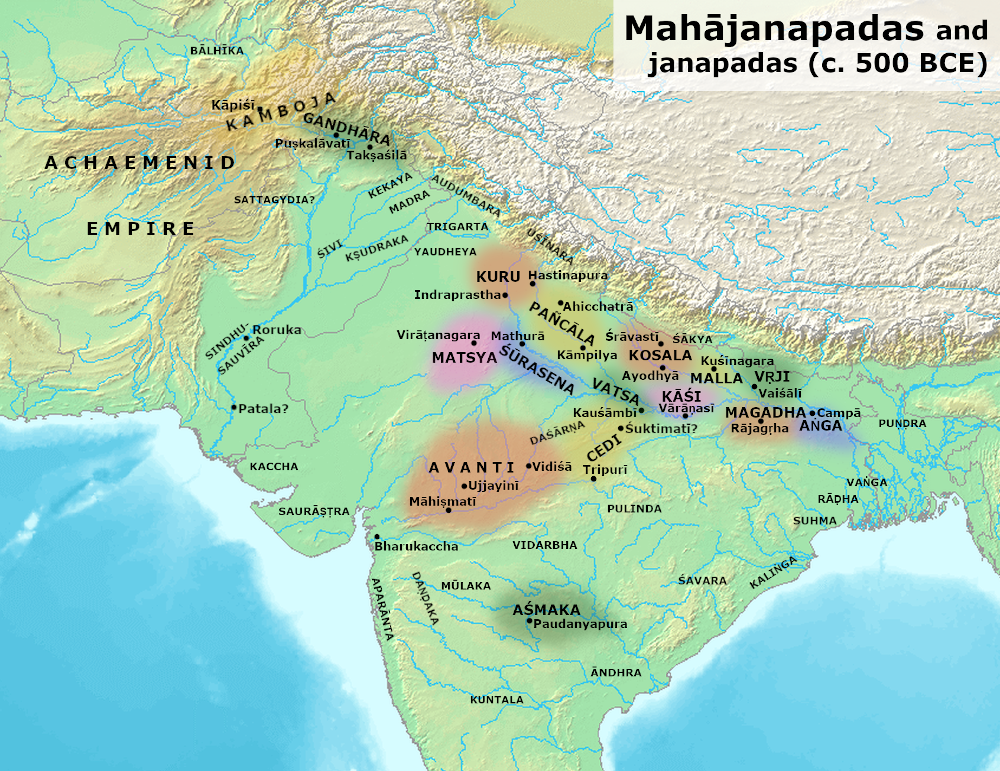
File:Mahajanapadas (c. 500 BCE).png
The sixteen most powerful kingdoms and republics around the lifetime of Gautama Buddha, showing the political landscape of ancient India during his life.
Death (Parinirvana) of Gautama Buddha
Gautama Buddha passed away (attained Parinirvana) around 483 BCE in Kushinagar, India, at approximately 80 years of age. His death is commemorated as Parinirvana Day by Buddhists worldwide. His teachings, known as the Dharma, continued to spread across Asia and eventually the world.
First Buddhist Council at Rājagṛha
Just after the Buddha's Parinirvana, the first Buddhist council was traditionally held at Rājagṛha (today's Rajgir), presided over by Mahākāśyapa with the support of king Ajātasattu. The council aimed to recite and organize the orally transmitted collections of the Buddha's teachings. Almost all modern scholars have questioned the historicity of this first council.
Second Buddhist Council and First Schism
The Second Buddhist Council took place at Vaishali approximately one hundred years after Gautama Buddha's parinirvāṇa, resulting in the first major schism of the Buddhist sangha. The community split into the Sthavira (Elders) and Mahasamghika (Great Sangha) factions, primarily over disagreements about monastic discipline (vinaya). These two groups would further divide into the various Early Buddhist Schools over subsequent centuries.

File:War over the Buddha's Relics, South Gate, Stupa no. 1, Sanchi.jpg
Relief from Sanchi depicting early Buddhist community events, illustrative of the early Buddhist sangha period.
Founding of the Mauryan Empire
The Mauryan Empire was founded by Chandragupta Maurya around 322 BCE and became the world's first major Buddhist state under Emperor Ashoka. The empire established free hospitals and free education and promoted human rights. It encompassed most of the Indian subcontinent and provided the political framework for Buddhism's first major expansion.

File:Maurya Empire, c.250 BCE.png
Map showing the extent of the Maurya Empire, the world's first major Buddhist state.
Introduction of Abhidharma Literature
In the third century BCE, some Buddhists began introducing new systematized teachings called Abhidharma, based on previous lists or tables of main doctrinal topics. Unlike the Nikayas, the Abhidharma literature consisted of systematic doctrinal exposition and often differed across Buddhist schools. These texts further contributed to the development of sectarian identities and sought to analyze all experience into its ultimate constituents called dharmas.
Reign of Emperor Ashoka and Buddhist Expansion
During the reign of the Mauryan Emperor Ashoka (268–232 BCE), Buddhism gained royal support and began to spread more widely, reaching most of the Indian subcontinent. After his invasion of Kalinga, Ashoka experienced remorse and began working to improve the lives of his subjects, building wells, rest-houses and hospitals. He propagated religion by building stupas and pillars urging respect for all animal life, and sent emissaries to spread Buddhism as far as Sri Lanka and the Greek kingdoms.

File:Ashokan Buddhist Missions.png
Map of the Buddhist missions during the reign of Ashoka, showing the spread of Buddhism across the known world.
Ashoka's Proselytism in the Hellenistic World
Ashoka's edicts describe efforts to propagate the Buddhist faith throughout the Hellenistic world, identifying Greek monarchs including Antiochus II Theos, Ptolemy II Philadelphos, Antigonus Gonatas, Magas, and Alexander II as recipients of Buddhist proselytism. Emissaries including Greek monks like Dhammarakkhita were sent to spread Buddhism. This represents one of the earliest known instances of Buddhist missionary activity in the Western world.
File:Ashokan Buddhist Missions.png
Map showing the extent of Ashoka's Buddhist missions, including to the Hellenistic world.
Third Buddhist Council at Pataliputra
Ashoka convened the third Buddhist council around 250 BCE at Pataliputra (today's Patna) with the elder Moggaliputtatissa. The objective was to purify the Saṅgha, particularly from non-Buddhist ascetics attracted by royal patronage. Following the council, Buddhist missionaries were dispatched throughout the known world as recorded in some of the edicts of Ashoka.

File:6thPillarOfAshoka.JPG
One of the pillars of Ashoka, which recorded his edicts and missionary activities.
Buddhism Established in Sri Lanka
Sri Lankan chronicles state that Ashoka's son Mahinda brought Buddhism to the island during the 2nd century BCE, converting King Devanampiya Tissa and many of the nobility. Ashoka's daughter Saṅghamitta also established the bhikkhunī (order for nuns) in Sri Lanka, bringing a sapling of the sacred bodhi tree that was planted in Anuradhapura. These two figures are seen as the mythical founders of Sri Lankan Theravada Buddhism.

File:Jetavanaramaya Stupa.jpg
The Jetavanaramaya in Anuradhapura, Sri Lanka, one of the great Buddhist monuments built in the early centuries of Sri Lankan Buddhism.
Greco-Bactrian Invasion and Indo-Greek Kingdom
The Greco-Bactrian king Demetrius I invaded the Indian Subcontinent around 200 BCE, establishing an Indo-Greek kingdom that lasted in parts of Northwest South Asia until the end of the 1st century CE. Buddhism flourished under the Indo-Greek and Greco-Bactrian kings, leading to a unique synthesis of Greek and Buddhist art and culture known as Greco-Buddhism.

File:Gandhara Buddha (tnm).jpeg
A Greco-Buddhist statue from Gandhara, one of the first representations of the Buddha, showing the synthesis of Greek and Buddhist artistic traditions.
Shunga Dynasty and Decline of Mauryan Buddhism
The Shunga dynasty (185–73 BCE) was established after military commander Pushyamitra Shunga assassinated the last Mauryan king. Buddhist scriptures allege that Pushyamitra persecuted Buddhists, destroying monasteries and offering rewards for killing monks, though modern historians dispute this based on archaeological evidence. Buddhist monks deserted the Ganges valley and artistic creation shifted to Gandhāra, Mathura, and Amaravati.
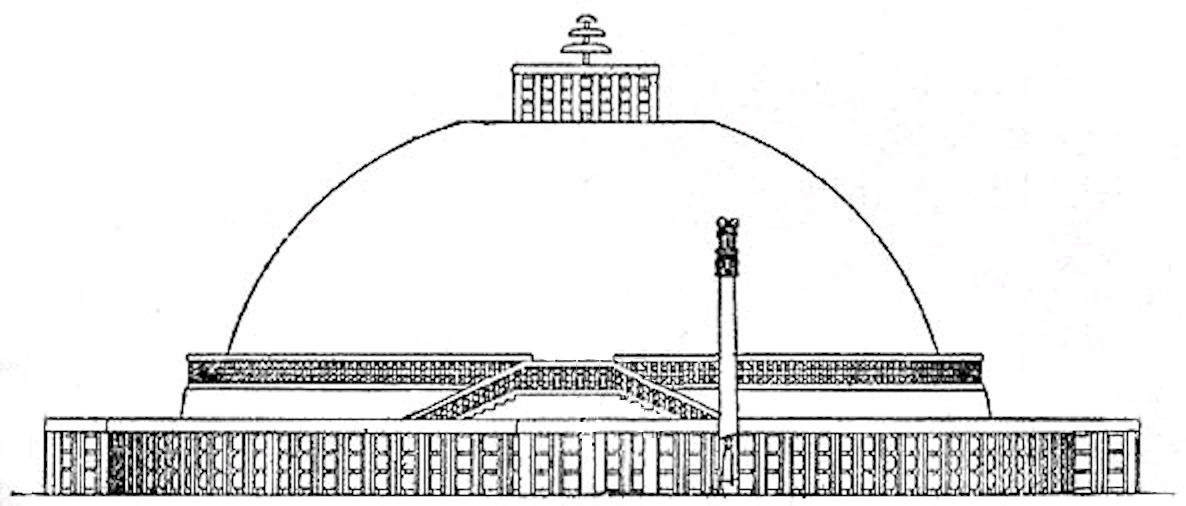
File:Sanchi Great Stupa under the Sungas.jpg
The Great Stupa at Sanchi as it appeared under the Shunga dynasty, showing continued Buddhist architectural activity despite alleged persecution.
Reign of King Menander I and Greco-Buddhism
Menander (reigned c. 160–135 BCE) was one of the most famous Indo-Greek kings and may have converted to Buddhism. He is presented in the Mahāyāna tradition as one of the great benefactors of the faith, on a par with Ashoka. The Milinda Pañha records a famous dialogue between Menander and the Buddhist monk Nāgasena, and upon Menander's death his remains were enshrined in stupas in a parallel with the historic Buddha.
File:Gandhara Buddha (tnm).jpeg
Greco-Buddhist art from the period of Indo-Greek rule, reflecting the cultural synthesis promoted by kings like Menander.
Origins of Mahayana Buddhism
The Buddhist movement that became known as Mahayana (Great Vehicle) began sometime between 150 BCE and 100 CE, drawing on both Mahasamghika and Sarvastivada trends. It emphasized the Bodhisattva path to full Buddhahood and emerged as a set of loose groups associated with new texts called the Mahayana sutras. The earliest inscription recognizably Mahayana dates from 180 CE and is found in Mathura.

File:Amaravati Stupa relief at Museum.jpg
Relief from the Amarāvatī Stupa in Andhra Pradesh, a major site associated with the origins of Mahayana Buddhism.
Pāli Canon Written Down in Sri Lanka
The Pāli canon was written down during the 1st century BCE to preserve the teaching in a time of war and famine. It is the only complete collection of Buddhist texts to survive in a Middle Indo-Aryan language and reflects the tradition of the Mahavihara school. This event was crucial for the preservation and transmission of Theravada Buddhism.
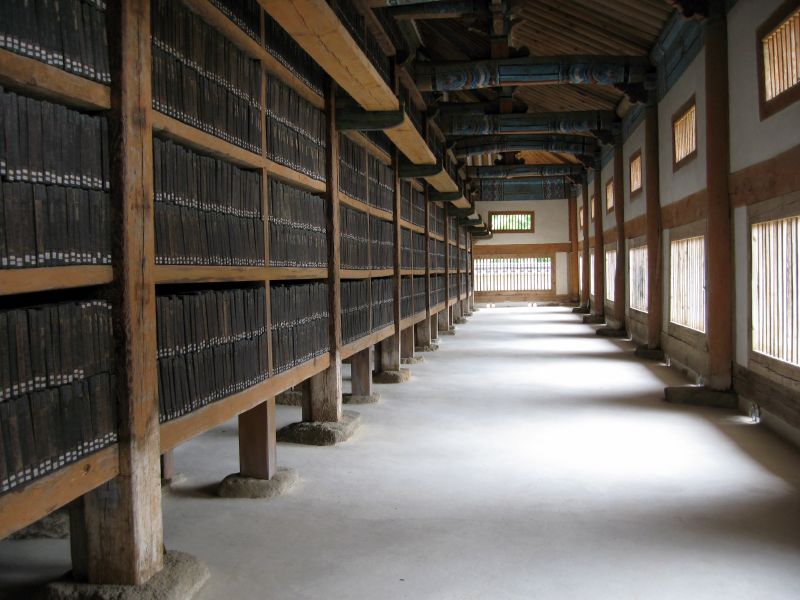
File:Korea-Haeinsa-Tripitaka_Koreana-01.jpg
The Tripitaka Koreana, a later example of the Buddhist canon being preserved in written form, illustrating the tradition of canonizing Buddhist texts.
0 CE – 499 CE
Ministry and Crucifixion of Jesus
Jesus of Nazareth, a Jewish itinerant preacher in Galilee and the Roman province of Judea, began his public ministry. His followers proclaimed him the Messiah and the incarnation of God. His crucifixion in Jerusalem is well attested historically and marks the founding moment of Christianity. His disciples believed he rose from the dead, forming the core of Christian faith.
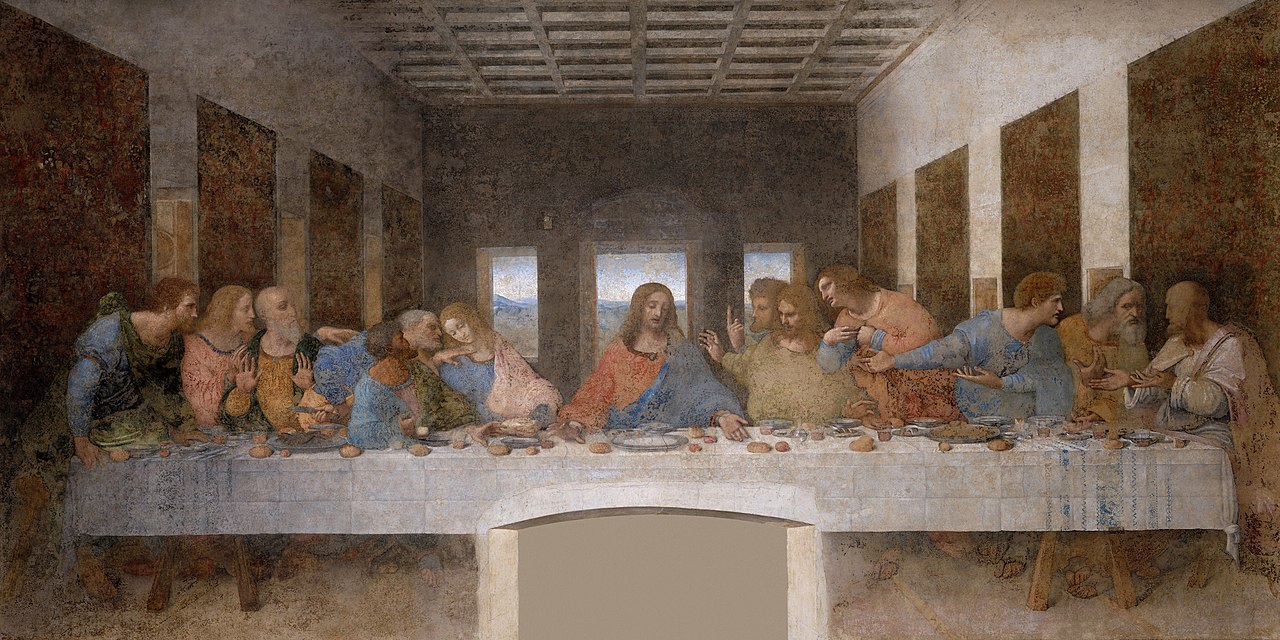
The Last Supper by Leonardo da Vinci
Depicts the final meal before Jesus' crucifixion and death.
Kushan Empire and Height of Gandharan Buddhism
The Kushan empire (30–375 CE) was formed by the invading Yuezhi nomads and eventually encompassed much of northern India, Pakistan and Afghanistan. During Kushan rule, Gandharan Buddhism was at the height of its influence and a significant number of Buddhist centers were built or renovated. The Buddhist art of Kushan Gandhara was a synthesis of Greco-Roman, Iranian and Indian elements.

File:Map of the Kushan Empire.png
Map showing the Kushan territories and the maximum extent of Kushan dominions under Kanishka the Great, the height of Gandhāran Buddhist expansion.
Buddhism Introduced to China During Han Dynasty
Buddhism was introduced in China during the Han dynasty (206 BCE–220 CE) and was present by around 50 CE. The first documented Buddhist texts translated into Chinese are those of the Parthian An Shigao (148–180 CE). Early translators faced the difficulty of communicating foreign Buddhist concepts to the Chinese and often used Taoist terminology, a practice called 'concept-matching'.
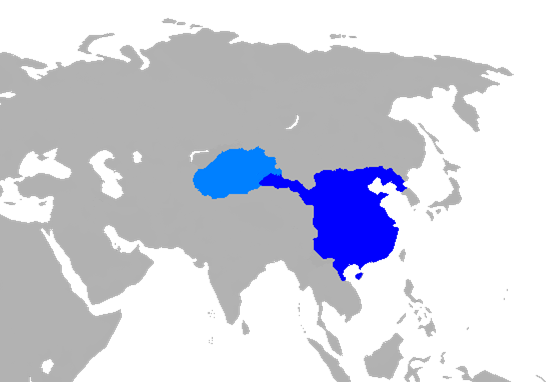
File:Han Dynasty map 2CE.png
Map of the Han Empire, showing the political context in which Buddhism was first introduced to China.
Council of Jerusalem
James, brother of Jesus, called the Council of Jerusalem to address disputes over whether Gentile converts needed to follow Jewish Law including circumcision. The council determined that converts should avoid idols, fornication, things strangled, and blood, but were not required to follow other aspects of Jewish Law. This decision was pivotal in separating Christianity from Judaism and enabling its spread among non-Jewish peoples.
Nero's Persecution of Christians
Emperor Nero conducted a persecution of Christians confined to the city of Rome during the mid-first century. This was among the earliest recorded state persecutions of Christians. While local and limited, it established a precedent of Roman hostility toward the new faith and produced early Christian martyrs.
Buddhism Spreads Along the Silk Road to Central Asia
Buddhism was present in Central Asia from about the second century BCE, but expanded significantly during the 1st century CE under the Kushans. The Sarvastivada school flourished in this region, and monks also brought Mahayana teachings. Buddhism eventually reached modern-day Pakistan, Kashmir, Afghanistan, Uzbekistan, Turkmenistan and Tajikistan, with Buddhists translating texts into local languages.
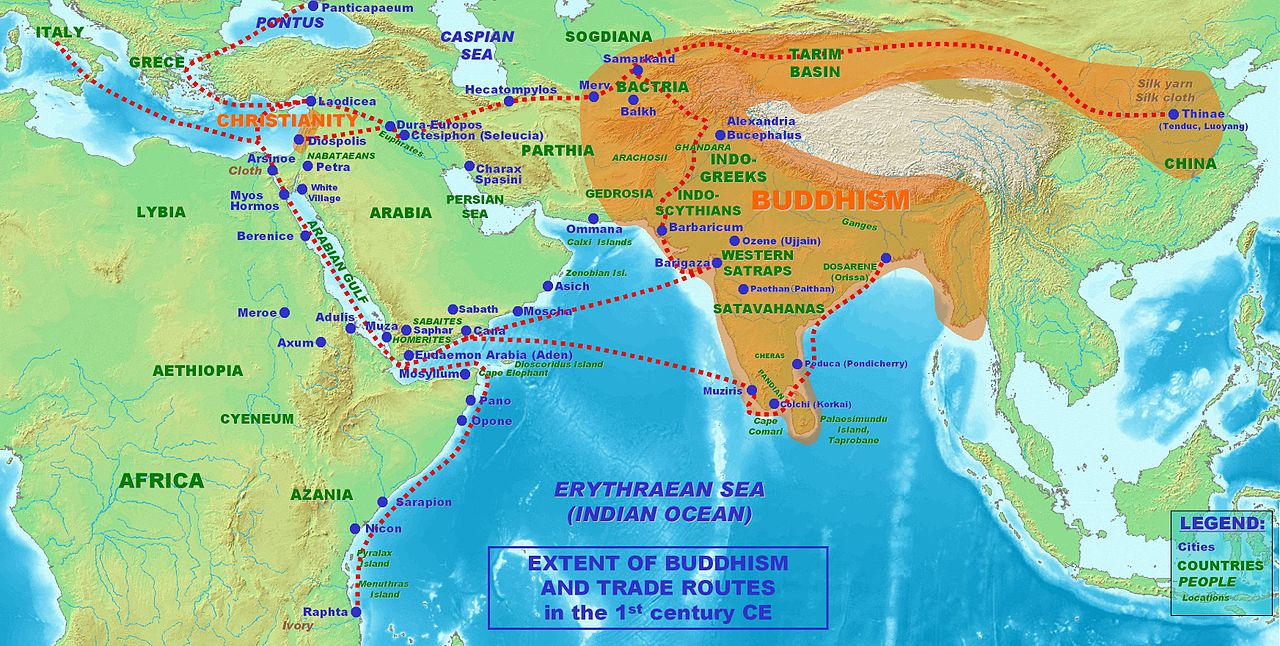
File:ExtentOfBuddhismAndTrade.jpg
Map showing the extent of Buddhism and trade routes in the 1st century CE, illustrating the Silk Road transmission of Buddhism.
Pauline Epistles Circulated
Letters sent by Paul the Apostle to Christian communities were circulating in collected form by the end of the first century. Paul, a Jewish Pharisee who had experienced a vision of Christ on the road to Damascus, became one of Christianity's most influential missionaries. His epistles formed a significant portion of what would become the New Testament and shaped Christian theology profoundly.
Emperor Kanishka's Support of Buddhism and Buddhist Council
Emperor Kanishka (128–151 CE) is particularly known for his support of Buddhism, building stupas and monasteries in Peshawar. He convened a major Buddhist council for the Sarvastivada tradition, gathering 500 learned monks to compile extensive commentaries on the Abhidharma. The main fruit of this council was the compilation of the vast Mahā-Vibhāshā commentary, and Kushan royal support allowed Gandharan Buddhism to spread along the Silk Road to Central Asia and China.
File:Map of the Kushan Empire.png
Map of the Kushan Empire under Kanishka, showing the extent of his realm and the spread of Gandharan Buddhism.
Parthian An Shigao Translates Buddhist Texts into Chinese
The Parthian monk An Shigao (c. 148 CE) was among the first translators of Buddhist scriptures into Chinese, playing a key role in the transmission of Buddhism to China. Central Asians, particularly Iranians, played a crucial role in this transmission, with thirty-seven early translators of Buddhist texts identified, the majority from the Iranian cultural sphere.
Christianity Reaches North Africa
By the second century, Christianity had spread to North Africa, establishing communities in major cities. The faith spread along trade and travel routes into the Jewish diaspora and beyond. North Africa would become a major center of Christian theology, producing influential Church Fathers such as Tertullian, Origen, and Augustine of Hippo.
First Mahayana Scriptural Texts Translated into Chinese
The first known Mahāyāna scriptural texts were translations into Chinese by the Kushan monk Lokakṣema in Luoyang, between 178 and 189 CE. This marked a crucial step in the transmission of Mahayana Buddhism to East Asia. These translations helped establish Mahayana as a major tradition in China.
Christianity Grows to Over 200,000 Adherents
By 200 CE, Christian numbers had grown to over 200,000 people, with communities averaging 500–1,000 people existing in approximately 200–400 towns. House churches were succeeded by buildings designed specifically as churches, complete with assembly rooms, classrooms, and dining rooms. A more formal church government developed, with bishops rising in power and influence.

Portrait from Die Malereien der Katakomben Roms
Early Christian art from the Roman catacombs, reflecting the growing Christian community.
Kingdom of Armenia Adopts Christianity as State Religion
In 301 CE, the Kingdom of Armenia became the first nation in the world to adopt Christianity as its official state religion. This was a landmark moment in Christian history, predating the Roman Empire's embrace of Christianity. Armenia was soon followed by Caucasian Albania and the East African Kingdom of Aksum.
Diocletian's Persecution of Christians
Official Roman persecution of Christians reached its height under Emperor Diocletian from 303 to 311 CE. This was the most severe and systematic empire-wide persecution of Christians, targeting churches, scriptures, and clergy. The persecution ultimately failed to suppress Christianity and contributed to the religion's eventual legalization under Constantine.
Edict of Milan: Christianity Legalized
Emperor Constantine, a self-declared Christian, issued the Edict of Milan in 313 CE, expressing tolerance for all religions including Christianity. This ended the era of Roman persecution and marked a turning point in Christian history. Constantine subsequently supported Christianity by giving bishops judicial power, establishing them as legally equal to polytheistic priests, and funding church construction.
Buddhism Flourishes During the Gupta Empire
Buddhism continued to flourish in India during the Gupta Empire (4th–6th centuries), which brought order to much of north India. Gupta rulers such as Kumaragupta I enlarged Nālandā university, which became the largest and most influential Buddhist university in India for many centuries. Great Buddhist philosophers like Dignaga and Dharmakirti taught philosophy there, and the influence of the Gupta style of Buddhist art spread across Asia.
First Council of Nicaea and the Nicene Creed
The First Council of Nicaea in 325 CE attempted to resolve the Arian controversy over whether Jesus' divinity was equal to the Father's. The council produced the Nicene Creed, a foundational statement of Christian belief. While most accepted it, some refused, and the controversy continued to embroil the church for decades, weakening Christian communities along the Eastern Mediterranean.

First Council of Nicaea icon from Protatos Church, 1770
Icon depicting the First Council of Nicaea, where the Nicene Creed was formulated.
Basil the Great Founds the Basileias
In the 370s, Basil the Great founded the Basileias, a monastic community in Caesarea (Mazaca) which developed the first health care system for the poor. This institution is considered a forerunner of modern public hospitals. It represented the integration of Christian charity with organized social services, a model that would shape Western civilization.
Buddhism Introduced to Korea
Buddhism was introduced to the Three Kingdoms of Korea beginning around 372 CE. During the 6th century, many Korean monks traveled to China and India to study Buddhism and various Korean Buddhist schools developed. Buddhism prospered in Korea during the North–South States Period (688–926) when it became a dominant force in society.
File:Korea-Haeinsa-Tripitaka_Koreana-01.jpg
The Tripitaka Koreana at Haeinsa, South Korea, representing the deep Buddhist heritage of Korea.
Jerome Translates the Bible into Latin (Vulgate)
In the late fourth century, Jerome was commissioned to translate the Greek biblical texts into Latin, producing what became known as the Vulgate. This translation became the standard Bible of the Western Church for over a millennium. It made scripture accessible to the Latin-speaking world and had an enormous influence on Western Christianity, culture, and literature.
Chinese Monk Faxian Visits India
The Chinese pilgrim Faxian visited India during the reign of the Gupta emperor Chandragupta II in 405 CE, commenting on the prosperity and mild administration of the Gupta empire. His visit is an important record of Buddhism in India during the Gupta period. Chinese pilgrims like Faxian played a key role in transmitting Buddhist knowledge between India and China.
Council of Ephesus Condemns Nestorius
The Council of Ephesus, the church's third ecumenical council held in 431 CE, condemned Nestorius who had declared Mary as the mother of Jesus' humanity but not his divinity. The Persian church refused to recognize the council's authority, leading to the first major East-West separation. This resulted in the formation of the Church of the East (Nestorian/Assyrian Church) and the Syrian Orthodox Church.
Council of Chalcedon
The fourth ecumenical council, the Council of Chalcedon in 451 CE, produced the Chalcedonian Definition emphasizing that the Son is 'one person in two natures.' While most of Christianity accepted this definition, those who found it too close to Nestorianism separated after 484 CE into Oriental Orthodoxy, which sees only 'One Nature of God the Incarnate Logos.' This created a lasting division in Eastern Christianity.
Fall of the Western Roman Empire
The Western Roman Empire ended in 476 CE, but its successor states and the Eastern Byzantine Empire remained Christian. For five centuries after the fall, Western culture and civilization were primarily preserved and passed on by monks. The church became the primary institution maintaining social order, literacy, and cultural continuity in the fragmented West.
500 CE – 999 CE
Clovis I Converts to Catholicism
The Frankish king Clovis I converted to Catholicism, and his kingdom became the dominant polity in the West in 507 CE. His conversion was a pivotal moment in European history, as the Frankish kingdom gradually converted into a Christian kingdom over the following centuries. This laid the foundation for the eventual Carolingian Empire and the Christianization of Western Europe.
Buddhism Introduced to Japan
Buddhism was introduced to Japan in the 6th century by Korean monks bearing sutras and an image of the Buddha. During the Nara Period (710–794), Emperor Shōmu ordered the building of temples throughout his realm, and numerous temples and monasteries were built in the capital city of Nara. There was also a proliferation of Buddhist sects known as the Nanto Rokushū (the Six Nara Sects).

File:Kamakura Budda Daibutsu front 1885.jpg
The Great Buddha of Kamakura, representing the deep Buddhist heritage of Japan.
Birth of Muhammad
Muhammad, the founder of Islam, was born in Mecca around 570 CE into the Arab clan of Quraysh, the chief tribe of Mecca. His family was part of a dominant force in the Hejaz region. Mecca was an important caravan trading center, and the Quraysh supported sacred months to sustain the Hajj trade.
Birth of Muhammad
Muhammad ibn Abdullah was born in Mecca, belonging to the Banu Hashim clan of the Quraysh tribe. His birth year is traditionally associated with the Year of the Elephant, when Abraha allegedly attempted to conquer Mecca. His father Abdullah had died around the time of his birth, making him an orphan from the start.

The birth of Muhammad
A 16th-century illustration depicting the birth of Muhammad from the Siyer-i Nebi.
Death of Muhammad's Mother Amina
Muhammad's mother Amina died of illness when he was six years old, leaving him an orphan. He was then placed under the guardianship of his paternal grandfather, Abd al-Muttalib. This early loss shaped his upbringing and reliance on extended family.
Death of Grandfather Abd al-Muttalib
Muhammad's grandfather and guardian Abd al-Muttalib died when Muhammad was about eight years old. Muhammad then came under the care of his uncle Abu Talib, the new leader of the Banu Hashim clan. Abu Talib would remain a key protector of Muhammad for decades.
Muhammad Meets the Monk Bahira
As a child, Muhammad accompanied his uncle Abu Talib on a trading trip to Syria, where he reportedly met a monk named Bahira who foretold his prophethood. Multiple versions of this story exist with contradictory details, and modern historians consider all accounts of this meeting to be fictitious.
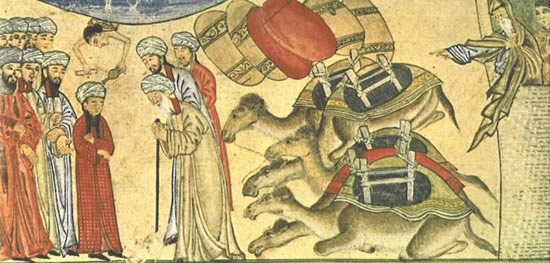
Young Muhammad meets the monk Bahira
A 1315 illustration from Jami' al-Tawarikh depicting the young Muhammad meeting the monk Bahira.
Pope Gregory I Reforms the Papacy
Pope Gregory I gained prestige and power for the papacy by leading the response to the Lombard invasion in 592–593 CE, reforming the clergy, standardizing music in worship, sending out missionaries, and founding new monasteries. His actions significantly expanded papal influence and authority. Until 751, the Pope remained a subject of the Byzantine emperor, but Gregory's reforms laid the groundwork for greater papal independence.
Muhammad Marries Khadija
At the age of 25, Muhammad married Khadija, a wealthy 40-year-old businesswoman who had been impressed by his competence in leading one of her caravans to Syria. The marriage lasted 25 years and was described as a happy one; Muhammad remained monogamous with Khadija until her death. Khadija would later become the first person to believe in his prophethood.
Muhammad Arbitrates the Black Stone Dispute
In 605, the Quraysh decided to rebuild the Kaaba and a dispute arose over which clan should have the privilege of replacing the Black Stone. Muhammad resolved the conflict by placing the stone on a cloak and having representatives of each clan jointly lift it into position, then personally securing it in the wall. This event demonstrated his reputation as a wise and trusted mediator.

Muhammad's role in re-setting the Black Stone
A miniature from Rashid al-Din Hamadani's work illustrating Muhammad's role in re-setting the Black Stone in 605 CE.
Muhammad Receives First Divine Revelations
Around 610 CE, Muhammad began receiving what Muslims consider to be divine revelations delivered through the angel Gabriel at Mount Hira on the Laylat al-Qadr. These revelations called for submission to the one God, preparation for the Last Judgement, and charity for the poor. These inspirations would later form the Quran.

Sanaa manuscript
A page from the Sanaa manuscript, one of the oldest Quranic manuscripts
First Revelation in the Cave of Hira
In 610, at the age of 40, Muhammad reported being visited by the angel Gabriel in the cave of Hira on Mount Jabal al-Nour, receiving his first revelation from God. Gabriel instructed him to read, and after Muhammad confessed his illiteracy, Gabriel recited verses that Muhammad memorized, later constituting Quran 96:1-5. This event marks the beginning of Muhammad's prophethood and the revelation of the Quran.
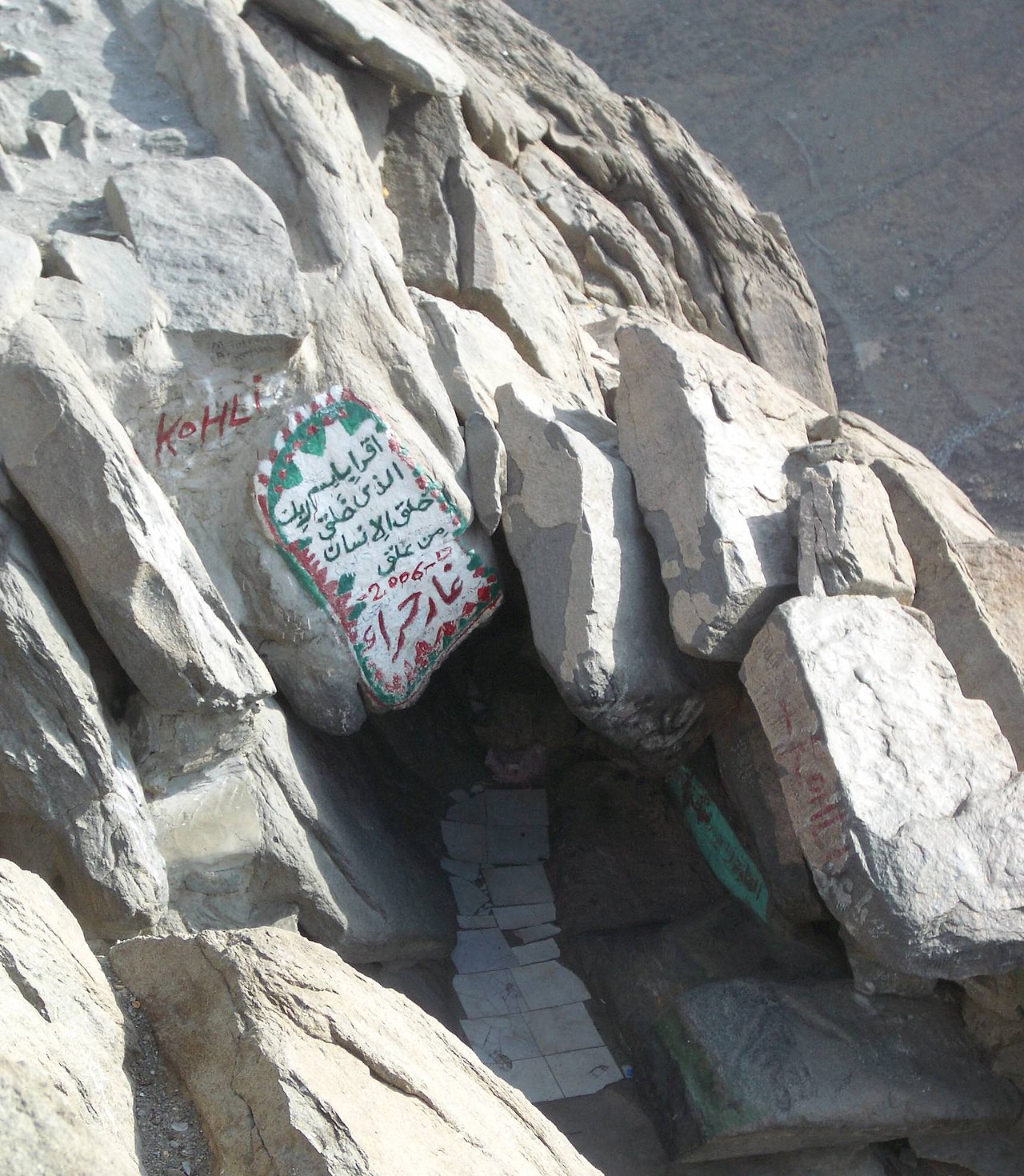
Cave Hira
The cave Hira in the mountain Jabal al-Nour where Muhammad received his first revelation.
Muhammad Begins Public Preaching
Around 613, Muhammad began preaching publicly in Mecca, proclaiming the oneness of God and his role as a prophet. His early followers included women, freedmen, servants, slaves, and members of the lower social class. He introduced rituals including prayer with physical postures and almsgiving as requirements of the Muslim community.
Sahaba Flee to Zeila, Abyssinia
Early Islamic disciples fled to the port city of Zeila in modern-day northern Somalia to seek protection from the Quraysh at the court of the Emperor of Aksum. Some of the Muslims granted protection settled in parts of the Horn region to promote the religion. This migration helped spread Islam to the Horn of Africa.

Ruins of Zeila (Saylac), Somalia
Ruins of the ancient port city of Zeila where early Muslims sought refuge
Migration to Abyssinia
In 615, Muhammad sent some of his followers to emigrate to the Abyssinian Kingdom of Aksum, where they found protection under the Christian Ethiopian emperor Aṣḥama ibn Abjar. This was done to escape ongoing persecution by Meccan polytheists. According to Ibn Sa'd, there were two separate migrations to Abyssinia.
Sahabas Preach in China
Four Sahabas (Sa'ad ibn abi Waqqas, Wahb Abu Kabcha, Jafar ibn Abu Talib and Jahsh ibn Riyab) preached in China in 616/17 CE after sailing from Abyssinia. This represents one of the earliest introductions of Islam to China. Sa'ad ibn abi Waqqas would later return to China multiple times, including leading an embassy in 650-51 CE at the request of Caliph Uthman.

The Huaisheng Mosque of China
The Huaisheng Mosque of China, built by Sa'd ibn Abi Waqqas
Social Exclusion of the Banu Hashim
In 616, an agreement was established among Quraysh clans to enforce a ban on the Banu Hashim, prohibiting trade and marriage with them. This was intended to pressure Muhammad and his clan into abandoning his religious mission. The ban was eventually lifted in 619 following a general consensus among sympathetic Quraysh factions.
Death of Khadija and Abu Talib
In 619, Muhammad suffered the loss of both his wife Khadija, his primary source of financial and emotional support, and his uncle and protector Abu Talib. This year became known as the 'Year of Sorrow.' Without Abu Talib's protection, Muhammad became increasingly vulnerable to Quraysh hostility.
Muhammad's Visit to Ta'if
In 619, Muhammad traveled to Ta'if to seek aid and protection against the Meccans, but was rejected and pelted with stones by the inhabitants. He sought refuge in the garden of Utbah ibn Rabi'ah, where he was offered grapes by a Christian slave named Addas. This episode marked a low point in Muhammad's mission before his eventual return to Mecca under the protection of Mut'im ibn 'Adiy.
Buddhism Introduced to Tibet
Buddhism arrived in Tibet during the 7th century, primarily as a blend of Mahāyāna and Vajrayāna from the universities of the Pāla empire. From the outset, Buddhism was opposed by the native shamanistic Bon religion, but with royal patronage it thrived to a peak under King Rälpachän (817–836). Terminology in translation was standardized around 825, enabling a highly literal translation methodology.
Isra and Mi'raj — Night Journey
Islamic tradition places the Isra and Mi'raj, Muhammad's miraculous night journey, at a low point in his life around 619–620. The Isra is believed to be Muhammad's journey from Mecca to Jerusalem, and the Mi'raj his ascent from Jerusalem to heaven. The event is referenced in Quran 17:1 and is commemorated annually by Muslims.

Dome of the Rock
The Dome of the Rock in Jerusalem, anachronistically associated with the Isra and Mi'raj, marking the place where Muhammad is believed to have ascended to heaven.
Pledges at Aqaba
In 621 and 622, delegations from Medina (Yathrib) met Muhammad at Aqaba near Mecca and pledged their loyalty to him. The second pledge in June 622 involved seventy-five individuals, including two women, who promised to protect Muhammad as they would their own families. These pledges paved the way for the migration to Medina.
The Hijra: Muhammad Migrates to Medina
In 622 CE, Muhammad migrated from Mecca to the city of Yathrib (subsequently called Medina), an event known as the Hijra. He was joined by his followers and began to unify the tribes of Arabia under Islam. Later generations counted this event as the start of the Islamic era, and it marked a turning point in the development of the Muslim community.

Hijra Abyssinia (Rashid ad-Din)
1314 Illustration by Rashid ad-Din depicting early Muslim migration
Constitution of Medina
Muhammad drafted the Constitution of Medina, a legal covenant between Medina's Arab and Jewish tribes and the Muslim community. The document promised peaceful coexistence, freedom of religion for Jews, and mutual defense of the oasis. It helped Muhammad consolidate political authority in Medina.
Hijra — Migration to Medina
In 622, Muhammad and his followers migrated from Mecca to Medina (then known as Yathrib), an event known as the Hijra. Muhammad and Abu Bakr arrived in Medina on 4 September 622 after evading a Quraysh assassination plot. This event marks the beginning of the Islamic calendar, also known as the Hijri calendar.
Construction of the First Mosque in Medina
A few days after settling in Medina, Muhammad negotiated for land and began constructing a building that would serve as his residence and a community gathering place for prayer. The structure was completed after about seven months in April 623, becoming the first Muslim mosque. Its northern wall had a stone marking the direction of prayer toward Jerusalem.
Expulsion of the Banu Qaynuqa
Following the Battle of Badr, Muhammad besieged the Banu Qaynuqa, one of the three main Jewish tribes of Medina, regarded as the weakest and wealthiest. After roughly two weeks, the tribe surrendered without combat and was expelled from Medina, relinquishing their property to the Muslims. This was the first of three major Jewish tribes to be expelled from Medina.
Assassination of Ka'b ibn al-Ashraf
Ka'b ibn al-Ashraf, a wealthy half-Jewish man from Banu Nadir and critic of Muhammad, was assassinated by a group including his own foster brother after producing poetry mourning Quraysh deaths at Badr. Muhammad had asked his followers who would kill Ka'b, and Ibn Maslamah volunteered, using deception to carry out the act. This event marked an escalation in Muhammad's conflict with the Jewish tribes of Medina.
Change of Prayer Direction to Mecca
On 11 February 624, while praying in the Masjid al-Qiblatayn in Medina, Muhammad received a revelation that Muslims should face Mecca rather than Jerusalem during prayer. This change, known as the change of the Qibla, established Mecca as the spiritual center of Islam. Muhammad and his companions immediately adjusted their prayer direction.

The Kaaba in Mecca
The Kaaba in Mecca, which became the Muslim direction of prayer after the revelation of February 624 CE.
Battle of Badr
In March 624, Muhammad led approximately 300 warriors in a raid on a Meccan merchant caravan, resulting in the Battle of Badr. Despite being outnumbered more than three to one, the Muslims won, killing at least forty-five Meccans including Abu Jahl, with fourteen Muslim casualties. The victory significantly strengthened Muhammad's position in Medina and was seen as divine confirmation of his mission.
Battle of Uhud
In 625, the Quraysh, led by Abu Sufyan, assembled an army to retaliate against Muhammad's attacks on their caravans. The Muslims initially held their ground at Mount Uhud but lost advantage when some archers disobeyed orders, and Muhammad was injured. The battle resulted in mass Muslim casualties, after which Muhammad received a revelation allowing Muslim men to have up to four wives, marking the beginning of polygyny in Islam.

The Prophet Muhammad and the Muslim Army at the Battle of Uhud
A 1595 illustration from the Siyer-i Nebi depicting Muhammad and the Muslim army at the Battle of Uhud.
Expulsion of the Banu Nadir
Muhammad besieged the Jewish tribe of Banu Nadir after claiming to have received a divine revelation of a planned assassination attempt against him by the tribe. After a fortnight, the Banu Nadir capitulated and were directed to vacate their land, permitted to carry only one camel-load of goods per three people. Muhammad claimed a fertile piece of land from the spoils.
Massacre of the Banu Qurayza
Following the Battle of the Trench, Muhammad besieged the Jewish tribe of Banu Qurayza for 25 days, accusing them of treachery for negotiating with Meccan forces. After their surrender, Sa'd ibn Mu'adh pronounced that all the men should be executed, their possessions distributed among Muslims, and their women and children taken as captives. According to Ibn Ishaq, 600–900 men of Banu Qurayza were executed.
Battle of the Trench
The siege of Medina began on 31 March 627, when Quraysh military leader Abu Sufyan mustered a force of 10,000 men with help from the exiled Banu Nadir. Muhammad adopted an innovative defense strategy by digging a trench wherever Medina lay open to cavalry attack, an idea credited to Salman the Persian. After two weeks, the coalition retreated, marking a significant loss of prestige for the Meccans.
Treaty of Hudaybiyya
Early in 628, Muhammad led a group of followers toward Mecca for pilgrimage but was stopped at Hudaybiyya by Quraysh emissaries. After lengthy negotiations, a ten-year truce was established, allowing Muslims to make the Umrah pilgrimage the following year. The treaty was seen as a significant diplomatic achievement that ultimately facilitated the eventual conquest of Mecca.
The Kaaba in Mecca
The Kaaba in Mecca, the destination of Muhammad's pilgrimage attempt that led to the Treaty of Hudaybiyya.
Invasion of Khaybar
Roughly ten weeks after returning from Hudaybiyya, Muhammad led an invasion of Khaybar, a flourishing oasis populated by Jews including those from the expelled Banu Nadir. After a strenuous battle lasting more than a month, the Muslims captured the city and distributed the spoils. The Jewish inhabitants were allowed to remain as tenant farmers, giving half their annual produce to the Muslims.
Xuanzang Travels to India
The Chinese monk Xuanzang traveled to India during the Tang dynasty, bringing back 657 Buddhist texts along with relics and statues. He established a famed translation school in the Tang capital of Chang'an, focusing on Yogacara school texts. His travels provided invaluable records of Buddhism across India and Central Asia in the 7th century.

File:SectarianBuddhistschools.png
Map of major Buddhist schools in South Asia at around the time of Xuanzang's visit in the seventh century.
First Mosque Built in India
According to historical records, the Cheraman Perumal Mosque was built in around 629 CE, said to be the first mosque in India. Native legends say a group of Sahaba under Malik Ibn Deenar arrived on the Malabar Coast and preached Islam. The Second Chera King Cheraman Perumal accepted Islam and received the name Tajudheen.
Muhammad Secures Control of Mecca
After a series of military confrontations and political manoeuvres, Muhammad secured control of Mecca and the allegiance of the Quraysh in 629 CE. He returned to Mecca and ordered the destruction of all pagan idols. This marked the culmination of his mission to unite Arabia under Islam.

Map of Arabia 600 AD
Map of the tribes of Arabia in late antiquity
Conquest of Mecca
In 630, Muhammad marched on Mecca with 10,000 Muslim converts after the Quraysh violated the Treaty of Hudaybiyya. The conquest went largely uncontested, and Muhammad seized the city with minimal casualties. He declared an amnesty for past offences, destroyed the statues of Arabian gods in and around the Kaaba, and most Meccans converted to Islam.

Muhammad advancing on Mecca
A depiction from the Siyer-i Nebi of Muhammad advancing on Mecca, with his face veiled, accompanied by angels.
Battle of Hunayn
After the fall of Mecca, the Banu Hawazin gathered their entire tribe to fight the Muslims. Muhammad led 12,000 soldiers but was surprised at the valley of Hunayn. The Muslims ultimately overpowered the Hawazin, taking their women, children, and animals as spoils. The victory led to the eventual conversion of the Hawazin and the submission of Taif.
Expedition to Tabuk
Roughly 10 months after capturing Mecca, Muhammad led his army to attack the wealthy border provinces of Byzantine Syria in the Expedition to Tabuk. When they arrived at Tabuk, there were no hostile forces present, but Muhammad was able to force some local chiefs to accept his rule and pay tribute. This expedition demonstrated the expanding reach of the Muslim state.

Conquests of Muhammad
Map showing the conquests of Muhammad (green lines) and the Rashidun caliphs (black lines).
Islamic Conquests Devastate Christian Communities
Between 632 and 750 CE, Islamic caliphates conquered the Middle East, North Africa, and the Iberian Peninsula, devastating many Christian communities. Most urban Asian churches disappeared, though some Christian communities in remote areas survived. Christians in conquered territories were designated as dhimmi, a status guaranteeing protection but enforcing legal inferiority.
Death of Muhammad
Muhammad died in 632 CE, by which time almost all the tribes of the Arabian Peninsula had converted to Islam. His death triggered a succession crisis, as disagreement broke out over who would lead the Muslim community. This dispute would eventually lead to the major sectarian split between Sunni and Shia Islam.
Abu Bakr Becomes First Caliph
After Muhammad's death, Abu Bakr, one of his closest associates, was chosen as the first caliph ('successor'). He asserted his authority in the Ridda wars against tribal leaders who refused to extend agreements made with Muhammad. The momentum of these campaigns carried into the lands of the Byzantine and Sasanian empires.
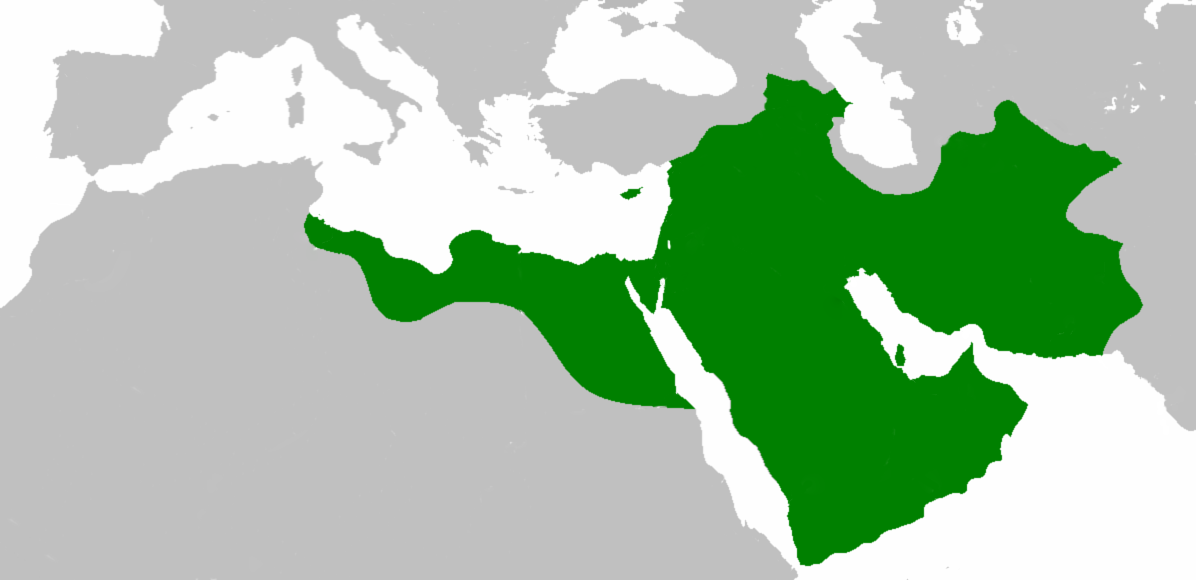
Rashidun Caliphate
Map of the Rashidun Caliphate at its peak
Farewell Pilgrimage
During the 632 pilgrimage season, Muhammad personally led the ceremonies and gave a sermon that became known as the Farewell Sermon. Key points included the prohibition of usury and vendettas from the pre-Islamic era, the brotherhood of all Muslims, and the adoption of twelve lunar months without intercalation. This was Muhammad's final pilgrimage before his death.
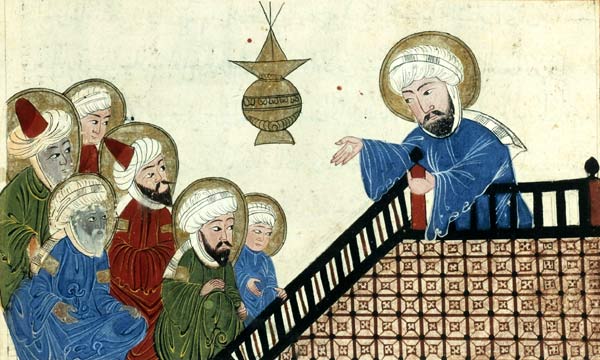
Muhammad prohibiting Nasī' during the Farewell Pilgrimage
An anonymous illustration from al-Biruni's The Remaining Signs of Past Centuries, depicting Muhammad prohibiting Nasī' during the Farewell Pilgrimage.
Succession Dispute and Abu Bakr Becomes First Caliph
Following Muhammad's death, a disagreement broke out over his successor. Umar ibn al-Khattab nominated Abu Bakr, Muhammad's close friend, who was confirmed as the first caliph. Some companions disputed this, holding that Ali ibn Abi Talib had been designated the successor by Muhammad at Ghadir Khumm, a dispute that would eventually lead to the Sunni-Shia split.

Expansion of the Caliphate
Map showing the expansion of the caliphate from 622 to 750 CE, beginning with the succession after Muhammad's death.
Death of Muhammad
On 8 June 632, Muhammad died after suffering a severe headache and illness, reportedly linked to the poisoned meal he had consumed at Khaybar. He spent his final days in the hut of his wife Aisha, unable to walk without assistance. By the time of his death, most of the Arabian Peninsula had converted to Islam.

The death of Muhammad
A depiction of the death of Muhammad from the Siyer-i Nebi.
Umar ibn al-Khattab Becomes Second Caliph
Umar ibn al-Khattab became the second caliph in 634 CE and significantly expanded the Islamic empire. He improved administration, ordered improvement of irrigation networks, and established the Bayt al-mal welfare institution for the poor. By the end of his reign, Syria, Egypt, Mesopotamia, and much of Persia were incorporated into the Islamic empire.
Rashidun Caliphate
Map of the Rashidun Caliphate at its peak under Uthman
Church of the East Brings Christianity to China
In 635 CE, the Church of the East brought Christianity into China. Emperor Taizong decreed that the Christian faith was allowed, and its license was copied onto the Sianfu stele. Christianity spread into northwestern China, Khotan, Turfan, and south of Lake Balkash in southeastern Kazakhstan, though its growth was later halted in 845 by Emperor Wuzong of Tang.
Arab Muslim Conquest of Egypt Completed
By the end of 641 CE, all of Egypt was in Arab hands following the Muslim conquests. The Arab armies had also controlled Mesopotamia and invaded Armenia. A subsequent attempt to conquer the Nubian kingdom of Makuria was repelled. Egypt's conquest was a major strategic and economic gain for the early Islamic empire.

Byzantine territories invaded by Arab Muslims
Eastern territories of the Byzantine Empire invaded by the Arab Muslims during the Arab–Byzantine wars (650 CE)
Uthman ibn Affan Becomes Third Caliph and Standardizes the Quran
Uthman ibn Affan became the third caliph in 644 CE and ordered a standard copy of the Quran to be prepared to address phonetic variations in recitation. The compilation was finished between 650 and 656 CE, and copies were sent to different centers of the expanding Islamic empire. This standardization was a pivotal moment in Islamic religious history.

First Islamic coins by caliph Uthman
Sasanid style coins during the Rashidun period
Muawiyah Sets Up Muslim Navy
In 649 CE, Muawiyah ibn Abi Sufyan, governor of Syria, established a navy to stop Byzantine harassment from the sea during the Arab-Byzantine wars. The ships were crewed by Monophysite Christians, Egyptian Coptic Christians, and Jacobite Syrian Christians alongside Muslim troops. This navy defeated the Byzantine navy at the Battle of the Masts in 655 CE, opening the Mediterranean Sea to Muslim ships.
Srivijaya Empire Adopts and Spreads Buddhism
The Malay Srivijaya (650–1377), a maritime empire centered on the island of Sumatra, adopted Mahāyāna and Vajrayāna Buddhism and spread Buddhism to Java, Malaya and other regions they conquered. The Chinese Buddhist Yijing described their capital at Palembang as a great center of Buddhist learning where the emperor supported over a thousand monks. Atiśa studied there before travelling to Tibet as a missionary.
Battle of the Masts
In 655 CE, the Muslim navy defeated the Byzantine navy at the Battle of the Masts, opening up the Mediterranean Sea to Muslim ships. This was a decisive naval victory that shifted the balance of power in the Mediterranean. The Muslim fleet was crewed by Christian sailors and Muslim troops under Muawiyah's command.
Ali ibn Abi Talib Becomes Fourth Caliph and First Fitna
When Uthman was assassinated in 656 CE, Ali ibn Abi Talib, cousin and son-in-law of Muhammad, assumed the position of caliph and moved the capital to Kufa in Iraq. This triggered the first Muslim civil war (the 'First Fitna') as Muawiyah I, governor of Syria, demanded arrest of the culprits. Ali was assassinated by the Kharijites in 661 CE.
Umayyad Caliphate Established
Muawiyah I established the Umayyad dynasty with a capital in Damascus after the Hasan-Muawiya treaty in 661 CE. Hasan ibn Ali handed over power to Muawiyah on the condition that he would be just and not establish a dynasty, but Muawiyah broke these conditions. The Umayyad dynasty would rule from 661 to 750 CE and become one of the largest empires the world had seen.

Territories of the Umayyad Caliphate
Map showing the vast extent of the Umayyad Caliphate
Battle of Karbala and Death of Husayn ibn Ali
Husayn ibn Ali, Muhammad's only surviving grandson, refused to swear allegiance to the Umayyads and was killed in the Battle of Karbala in 661 CE. This event is still mourned by Shia Muslims on the Day of Ashura and represents the foundational tragedy of Shia Islam. The battle deepened the sectarian divide between Sunni and Shia Muslims.
Arab Muslim Armies Conquer Kabul
In 664 CE, Arab Muslim armies conquered Kabul, extending Islamic rule into Central Asia. In 665 CE they pushed further into the Maghreb. These conquests were part of the broader expansion of the Umayyad Caliphate under Muawiyah I, who also extended Muslim rule to Rhodes, Crete, Bukhara, and Samarkand.
Founding of the Great Mosque of Kairouan
Arab general Uqba ibn Nafi erected the city of Kairouan in Tunisia in 670 CE and simultaneously built the Great Mosque of Kairouan, considered the oldest and most prestigious sanctuary in the western Islamic world. Kairouan was the first city founded by Muslims in the Maghreb. The mosque's present form dates from the 9th century.
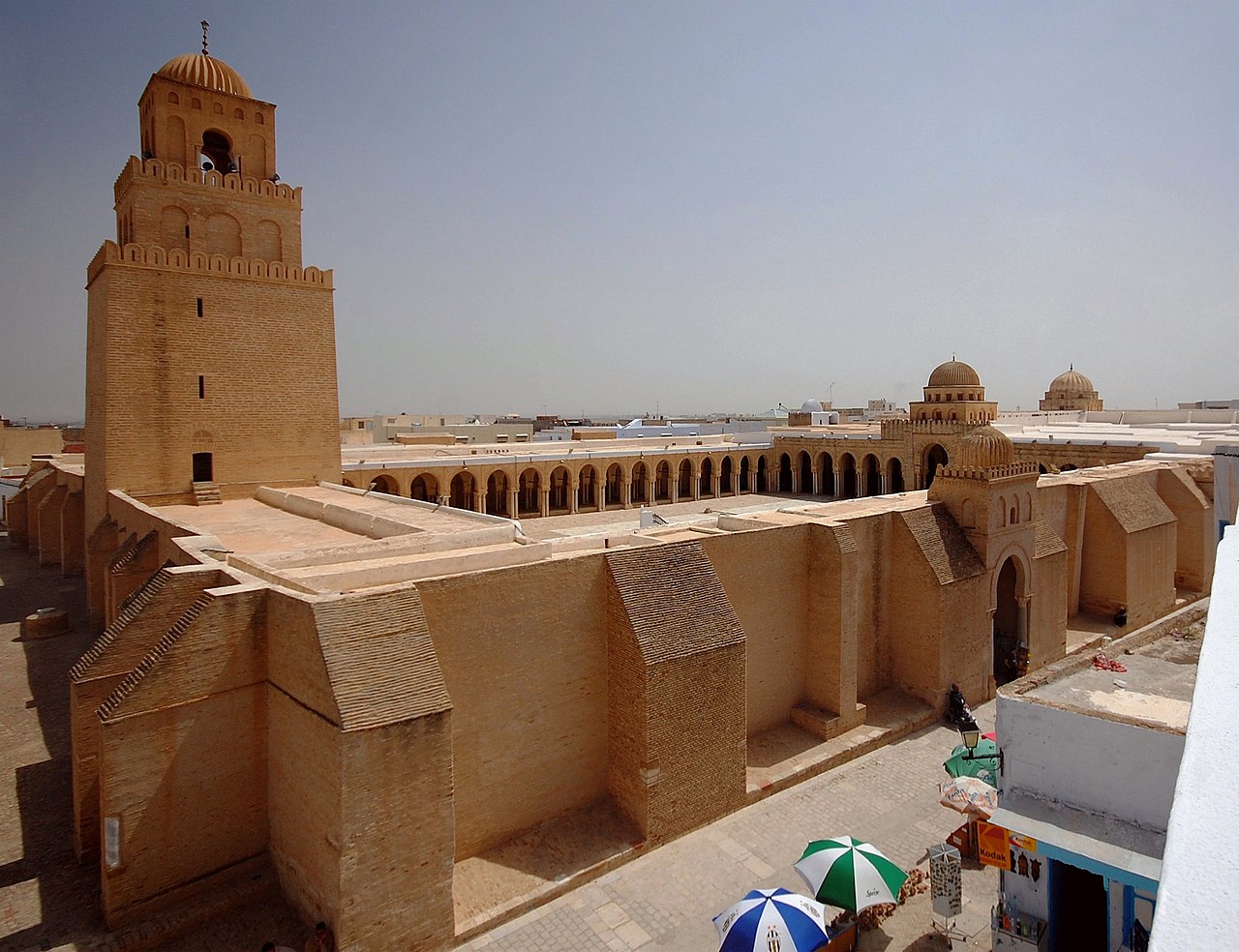
Great Mosque of Kairouan
The Mosque of Uqba (Great Mosque of Kairouan), founded by the Umayyad general Uqba Ibn Nafi in 670
Dome of the Rock Built in Jerusalem
Under the Umayyad caliph Abd al-Malik ibn Marwan, the Dome of the Rock was built in Jerusalem between 691 and 692 CE. This is where the word 'Islam' appears for the first time in an inscription. Abd al-Malik also played a major role in the reworking of the Quranic text and minted a new Islamic currency.

The Dome of Al Aqsa Mosque
The Al-Aqsa Mosque compound in Jerusalem
Battle of Sebastopolis and Islamic Currency Reform
In 692 CE, the Battle of Sebastopolis in Asia Minor resulted in a decisive defeat of the Byzantine Empire under Justinian II by Caliph Abd al-Malik, following the defection of a large contingent of Slavs. Following this victory, the Islamic currency was made the exclusive currency in the Muslim world. Abd al-Malik also made Arabic the state language and organized a regular postal service.

Pseudo-Byzantine coin
A Pseudo-Byzantine coin with depictions of Byzantine Emperor Constans II
Muhammad ibn al-Qasim Reaches the Indus Valley
Islamic armies under Muhammad ibn al-Qasim made it as far as the Indus Valley, marking the first significant Islamic conquest of the Indian subcontinent. Muhammad bin Qasim conquered Sindh, though this was a short-lived consolidation of Indian territory. This conquest opened the door for future Islamic expansion into South Asia.

Qutb Minar ruins
Qutub Minar, commenced by Qutb-ud-din Aybak of the Slave dynasty, 1st dynasty of the Delhi Sultanate
Muslim Conquest of the Iberian Peninsula Begins
In 711 CE, Arab forces under the Berber General Tariq ibn Ziyad crossed the Strait of Gibraltar (named after the general) and began the conquest of southern Spain (al-Andalus). The Visigothic king Roderic was defeated and killed on 19 July at the Battle of Guadalete. By 718 CE, Muslims dominated most of the Iberian Peninsula.

Alhambra interiors
The interiors of the Alhambra in Granada, Spain decorated with arabesque designs
Battle of Tours Halts Islamic Expansion into Europe
The Umayyad army's advance into France was stopped at the Battle of Tours (also known as the Battle of Poitiers), marking the farthest extent of Islamic control in Europe. The Iberian Peninsula remained under Muslim control, but further expansion northward was halted. This battle is considered a pivotal moment in European history.

Umayyad army invades France
Umayyad army invades France after conquering the Iberian Peninsula
Pāla Empire and Flourishing of Vajrayana Buddhism
The Pāla Empire (8th–12th centuries) in the Bengal region were staunch supporters of Buddhism, building several important Buddhist centers such as Vikramashila, Somapura and Odantapuri. At these great Buddhist centers, scholars developed the philosophies of Vajrayana, Abhidharma, Madhyamaka, Yogacara and Pramana. Under the Pālas, Vajrayana Buddhism flourished and spread to Tibet, Bhutan and Sikkim.
Abbasid Revolution Overthrows Umayyad Caliphate
The descendants of Muhammad's uncle Abbas ibn Abd al-Muttalib, rallying discontented mawali, poor Arabs, and Shia against the Umayyads, overthrew them with the help of general Abu Muslim in 750 CE. The Abbasid dynasty was inaugurated and the capital was moved to Baghdad. Almost the entire Umayyad dynasty was killed, except for prince Abd al-Rahman who escaped to the Iberian Peninsula.

Abbasid Caliphate in the 850s
Map of the Abbasid Caliphate at its height
Abd al-Rahman I Establishes Independent Caliphate in Spain
Abd al-Rahman I, a surviving member of the Umayyad family, escaped to the Iberian Peninsula and established an independent caliphate there in 756 CE. He proclaimed himself the al-Andalus emir after winning the Battle of Musarah. He began building the great mosque of Córdoba and died on 29 September 788 after a reign of thirty-four years.

The exterior of the Mezquita
The exterior of the Mezquita (Great Mosque) of Córdoba
Harun al-Rashid Rules the Abbasid Golden Age
Harun al-Rashid ruled the Abbasid Caliphate from 786 to 809 CE, a period marked by scientific, cultural, and religious prosperity. He established the library Bayt al-Hikma ('House of Wisdom'), and the arts and music flourished during his reign. His reign is considered part of the Islamic Golden Age.
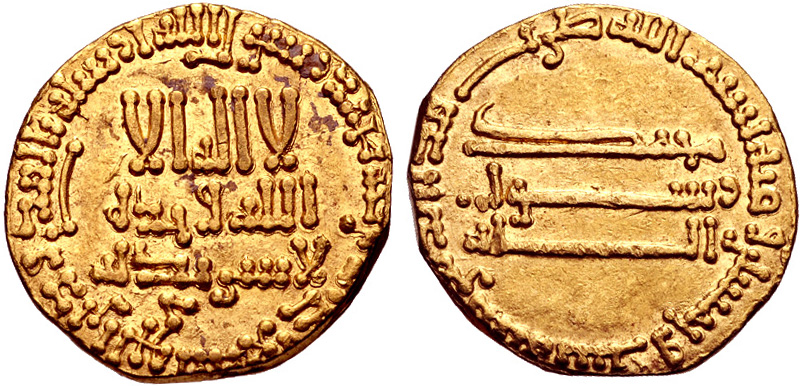
Gold dinar of Abbasid caliph Al-Mansur
Gold dinar of Abbasid caliph Al-Mansur, founder of Baghdad, patron of art and science
Idrisid Dynasty Founded in Morocco
The Idrisid dynasty, the first Arab rulers in the western Maghreb (Morocco), began ruling in 788 CE. The dynasty is named after its first sultan Idris I. They ruled until 985 CE and represented the establishment of an independent Islamic state in the far western Maghreb.
Founding of Kūkai's Shingon and Saichō's Tendai Schools in Japan
During the late Nara period, the key figures of Kūkai (774–835) and Saichō (767–822) founded the influential Japanese schools of Shingon and Tendai, respectively. An important doctrine for these schools was hongaku (innate awakening or original enlightenment), which was influential for all subsequent Japanese Buddhism. Buddhism also influenced the Japanese religion of Shinto, which incorporated Buddhist elements.
Borobudur Temple Complex Built in Java
The Mataram kingdom (732–1006) in Java promoted Mahayana Buddhist culture and is known for their monumental temple construction, especially the massive Borobudur, as well as Kalasan, Sewu, and Prambanan. Borobudur is one of the greatest Buddhist monuments in the world. This period represents the height of Buddhist culture in the Indonesian archipelago.
Charlemagne Crowned Emperor by Pope Leo III
In 800 CE, Pope Leo III crowned Charlemagne emperor, establishing the precedent that only a pope could crown a Western emperor. This enabled popes to claim that emperors derived their power from God through them. Charlemagne engaged in reforms that began the Carolingian Renaissance, a period of intellectual and cultural revival, and the Papacy became free from Byzantine control.
Abbasids Conquer Southern Italy
In 827 CE, the Abbasid dynasty conquered Southern Italy, initially having also conquered Mediterranean islands including the Balearics. This extended Islamic rule into the heart of Europe. The Muslim Moors would later be deported and enslaved from the Emirate of Sicily and elsewhere in southern Italy.
Cyril and Methodius Evangelize Eastern Europe
The ninth-century saints Cyril and Methodius brought Byzantine Christianity to Eastern Europe, which was integral to the formation of its modern states. The brothers developed the Glagolitic alphabet to translate the Bible into local languages, and their disciples developed the Cyrillic script. This spread literacy and became the cultural and religious foundation for all Slavic nations.

St. Cyril and St. Methodius monument on Mt. Radhošť
Monument commemorating Saints Cyril and Methodius, who evangelized Eastern Europe and created the Glagolitic alphabet.
Hamdanid Dynasty Founded
The Hamdanid dynasty was founded by Hamdan ibn Hamdun when he was appointed governor of Mardin in Anatolia by the Abbasid Caliphs in 890 CE. This was one of several regional dynasties that emerged as the Abbasid Caliphate fragmented. The Hamdanids would play a significant role in the politics of the region.
Fatimid Caliphate Founded
The Fatimid dynasty was founded in 909 CE by Abdullah al-Mahdi Billah in Ifriqiya (modern-day Tunisia and eastern Algeria). He legitimized his claim through descent from Muhammad by way of his daughter Fatima and her husband Ali ibn Abi Talib. The Fatimids would eventually conquer Egypt and establish Cairo as their capital.

Fatimid Caliphate in 1000
Map of the Fatimid Caliphate at its height around 1000 CE
Aghlabids Deposed by Fatimid Dynasty
The Aghlabid rule in the Maghreb was short-lived, and they were deposed by the Shiite Fatimid dynasty in 909 CE. The Fatimids had been appointed as virtually autonomous rulers by Harun al-Rashid. By around 960, the Fatimids had conquered Abbasid Egypt, building a capital there in 973 called 'al-Qahirah' (Cairo).
Abd al-Rahman III Takes Title of Caliph of Córdoba
By the end of the 10th century, the ruler Abd al-Rahman III took over the title of Caliph of Córdoba (912-961 CE). The Umayyads went on developing a strengthened state with its capital as Córdoba. His rule is known as the heyday of Muslim presence in the Iberian Peninsula.
The exterior of the Mezquita
The exterior of the Mezquita (Great Mosque) of Córdoba
Buyid Confederation Controls Baghdad
In the 930s, Ali ibn Buyah and his two younger brothers founded the Buyid confederation. By 945 CE, Central Iraq submitted to Buyid control, and the Buyids took control of Baghdad, reducing the Abbasid Caliph to a figurehead. The Buyids held Baghdad for over a century, during which the Caliphate was at its lowest ebb.

Regional powers from Abbasid fragmentation
Regional powers born out of the fragmentation of the Abbasid caliphate
Fatimids Conquer Egypt and Found Cairo
The Fatimid general Jawhar conquered Egypt in 969 CE and built a new palace city near Fustat, which he called al-Mansuriyya. Under Al-Muizz Lideenillah, the Fatimids founded a new capital at al-Qahira (Cairo) in 969 CE. Cairo was intended as a royal enclosure for the Fatimid caliph and his army.
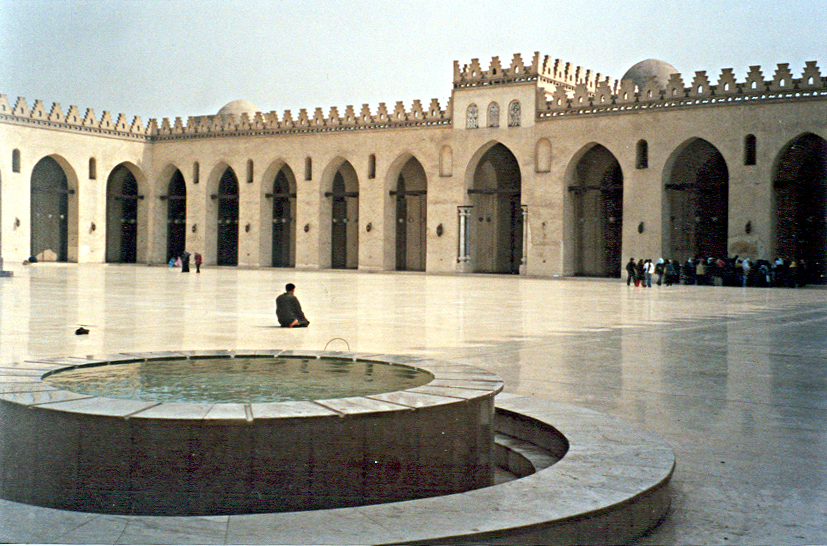
The Al-Hakim Mosque, Cairo
The Al-Hakim Mosque in Cairo, Egypt, built by Fatimid vizier Gawhar Al-Siqilli
Baptism of Vladimir of Kiev
The baptism of Vladimir of Kiev in 989 CE is traditionally associated with the conversion of the Kievan Rus'. This event marked the beginning of Orthodox Christianity in Russia and shaped the religious and cultural identity of the Russian people for centuries. The new religious structure included dukes maintaining control of a financially-dependent church.
1000 CE – 1499 CE
Umayyad Caliphate of Córdoba Collapses
The Umayyad Caliphate of Córdoba collapsed in 1031 CE due to political divisions and civil unrest during the rule of Hicham II. Al-Andalus then broke up into a number of states called taifa kingdoms. The decomposition of the Caliphate into petty kingdoms weakened the Muslims in the Iberian Peninsula vis-à-vis the Christian kingdoms of the north.
King Anawrahta Adopts Theravada Buddhism in Burma
King Anawrahta (1044–1078), the founder of the Pagan Empire, adopted the Theravādin Buddhist faith from Sri Lanka, building numerous Buddhist temples at his capital of Pagan. This marked the beginning of Theravada's dominance in Burma. After invasions from the Burmese and the Mongols weakened Theravada in this region, it had to be reintroduced from Sri Lanka.
East-West Schism
In 1054 CE, the church within the Byzantine Empire formally separated from the Western Catholic Church, forming Byzantine Eastern Orthodoxy. This schism had been building for centuries due to cultural differences, geopolitical disagreements, and theological disputes over papal authority. The Eastern church remained in communion with the Ecumenical Patriarchate of Constantinople rather than the Pope.
Seljuk Empire Absorbs Abbasid Influence
Abbasid influence had been consumed by the Great Seljuq Empire by 1055 CE, a Muslim Turkish clan which had migrated into mainland Persia. The Seljuks played an important role in the revival of Sunnism when Shia influence was increasing. The Seljuk military leader Alp Arslan (1063-1072) financially supported sciences and literature and established the Nezamiyeh university in Baghdad.
Pope Nicholas II Establishes College of Cardinals
In 1061, Pope Nicholas II moved to protect the papacy from secular control by establishing that popes could only be elected by a College of Cardinals. This was a significant step in asserting papal independence from secular rulers. However, both nobles and the church still claimed the right to appoint bishops, leading to the Investiture Controversy.
Gregorian Reform and Investiture Controversy
The reform of Pope Gregory VII (1073–1085) began a new period in church history by pressing for an end to simony, enforcement of clerical celibacy, and establishment of papal supremacy. The Investiture Controversy pitted Holy Roman Emperor Henry IV against Pope Gregory VII over the secular appointment of bishops. When Henry IV rejected papal decrees, he was excommunicated, contributing to a civil war.
First Crusade Called by Pope Urban II
In 1095 CE, Pope Urban II called for the First Crusade from Western Europe, inspired by the conquests in Spain by Christian forces and implored by the eastern Roman emperor to help defend Christianity in the East. The Crusade captured Edessa, Antioch, County of Tripoli, and Jerusalem. Jerusalem was captured by crusaders who massacred its inhabitants.
First Crusade
In 1095, Pope Urban II asked European Christians to go to the aid of their brethren in counterattack against Islamic inroads, following a request from Byzantine Emperor Alexios I Komnenos. Tens of thousands answered the call. Peter the Hermit led the People's Crusade to a disastrous end in 1096, while the main crusading army captured Jerusalem in 1099. Eight Crusades lasting from 1096 to 1272 had little overall military success.
Cistercian Movement and Monastic Reform
The Cistercian movement, beginning after 1098, was a wave of monastic reform that had significant technological and economic impact. Cistercians were among the best industrialists of the Middle Ages; nearly all of the 740 twelfth-century Cistercian monasteries possessed a water wheel used for innovative hydraulic engineering. They also taught advanced farming techniques and were skilled metallurgists.
Renaissance of the Twelfth Century
Between 1150 and 1200, monks searched the libraries left behind by fleeing Muslims in Sicily and Spain and found the works of Aristotle, Euclid, and other ancient writers. The West's rediscovery of the complete works of Aristotle led to the Renaissance of the twelfth century and created conflict between faith and reason, resolved by scholasticism. The scholastic writings of Thomas Aquinas impacted Catholic theology and influenced secular philosophy and law.

Gothic architecture of the Lady Chapel of Wells Cathedral
Gothic architecture, which began in the twelfth and thirteenth centuries, was intended to inspire contemplation of the divine.
Saladin Founds Ayyubid Dynasty and Reconquers Jerusalem
Saladin founded the Ayyubid dynasty centered in Egypt and in 1174 CE proclaimed himself Sultan, conquering the Near East region. After Shirkuh ended Fatimid rule in 1169, Saladin reconquered most of the area in 1187, leaving the Crusaders holding only a few ports. The Ayyubids ruled much of the Middle East during the 12th and 13th centuries.

Ayyubid empire
Map of the Ayyubid empire
Jayavarman VII Builds Mahayana Buddhist Structures at Angkor
One of the greatest Khmer kings, Jayavarman VII (1181–1219), built large Mahāyāna Buddhist structures at Bayon and Angkor Thom. Mahayana Buddhism and Hinduism were the main religions of the Khmer Empire (802–1431), which dominated most of the South-East Asian peninsula. Under the Khmer, numerous temples, both Hindu and Buddhist, were built in Cambodia and neighboring Thailand.
Medieval Inquisition Established
The Medieval Inquisition, lasting from 1184 to the 1230s, was initiated by Pope Innocent III in response to increasing concerns over heresy and public disorder. Between 8,000 and 40,000 people were brought to interrogation and sentencing, with death sentences being relatively rare. The Dominican Order held primary responsibility for conducting inquisitions, and the penalty imposed most often was an act of penance.
New Buddhist Schools Founded During Kamakura Period in Japan
During the Kamakura period (1185–1333), six new Buddhist schools were founded in Japan, known as 'New Buddhism' or Kamakura Buddhism. They include the influential Pure Land schools of Hōnen and Shinran, the Rinzai and Soto schools of Zen founded by Eisai and Dōgen, and the Lotus Sutra school of Nichiren. These schools competed with the older Nara schools and remain influential in Japanese Buddhism today.
File:Kamakura Budda Daibutsu front 1885.jpg
The Great Buddha of Kamakura, built during the Kamakura period, representing the flourishing of Buddhism in this era.
Destruction of Nālandā University by Turkic Raiders
A milestone in the decline of Indian Buddhism occurred in 1193 when Turkic Islamic raiders under Muhammad Khilji burnt Nālandā, the greatest Buddhist university in India. By the end of the 12th century, following the Islamic conquest of Buddhist strongholds in Bihar and Bengal by Muhammad bin Bakhtiyar Khalji, the practice of Buddhism retreated to the Himalayan foothills and Sri Lanka. This effectively ended Buddhism as a major religion in its homeland.
Delhi Sultanate Founded
Qutb-ud-din Aybak conquered Delhi in 1206 CE and began the reign of the Delhi Sultanate, a successive series of dynasties that synthesized Indian civilization with wider commercial and cultural networks. The Sultanate greatly increased demographic and economic growth in India and deterred Mongol incursion into the Indo-Gangetic plain. It also enthroned one of the few female Muslim rulers, Razia Sultana.
Qutb Minar
Qutub Minar, commenced by Qutb-ud-din Aybak of the Slave dynasty, 1st dynasty of the Delhi Sultanate
Albigensian Crusade Against Catharism
In 1209, Pope Innocent III and King Philip II of France initiated the Albigensian Crusade against Catharism in southern France. The campaign took a political turn when the king's army seized strategic lands of nobles. It ended in 1229 with a treaty bringing the region under French rule, creating southern France, while Catharism continued until 1350.
Fourth Lateran Council
The Fourth Lateran Council of 1215 made confession required for all Christians and empowered inquisitors to search out moral and religious crimes even without an accuser. It also formalized several fundamental doctrines including the seven sacraments. This council represented the height of medieval papal authority and had lasting impact on Catholic practice and doctrine.
Talmud Put on Trial
A turning point in Jewish-Christian relations occurred in 1239 when the Talmud was put 'on trial' by French King Louis IX and Pope Gregory IX because of contents that allegedly mocked central figures of Christianity. Talmudic Judaism came to be seen as so different from biblical Judaism that old Augustinian obligations to leave Jews alone no longer applied. This contributed to increasing anti-Jewish rhetoric and violence in medieval Europe.
Church of the East at Height of Expansion
At the height of its expansion in the thirteenth century, the Church of the East stretched from Syria to eastern China and from Siberia to southern India and southern Asia. It had become the principal Church in Asia in the Middle Ages, having evangelized all along the Silk Road and been instrumental in converting some Mongolic and Turkic peoples. This represented the greatest geographical extent of any Christian church in history.
Mamluk Sultanate Founded
In 1250 CE, the Ayyubid Egyptian dynasty was overthrown by slave regiments, and the Mamluk Sultanate was born. Military prestige was at the center of Mamluk society, and it played a key role in confrontations with the Mongol Empire. The Mamluks were slave-soldiers predominantly of Turkic, Caucasian, and Southeastern European origins.

Mamluk Sultanate map
Map of the Mamluk Sultanate (in red) and the Mongol Ilkhanate (in blue) (1250–1382)
Mongol Empire Ends Abbasid Dynasty
The Mongol Empire put an end to the Abbasid dynasty in 1258 CE when Mongol forces under Hulagu Khan sacked Baghdad and deposed the caliph. The Mongols had spread throughout Central Asia and Persia, with Isfahan falling by 1237. The Mamluk sultans and Syria later appointed a powerless Abbasid Caliph in Cairo.
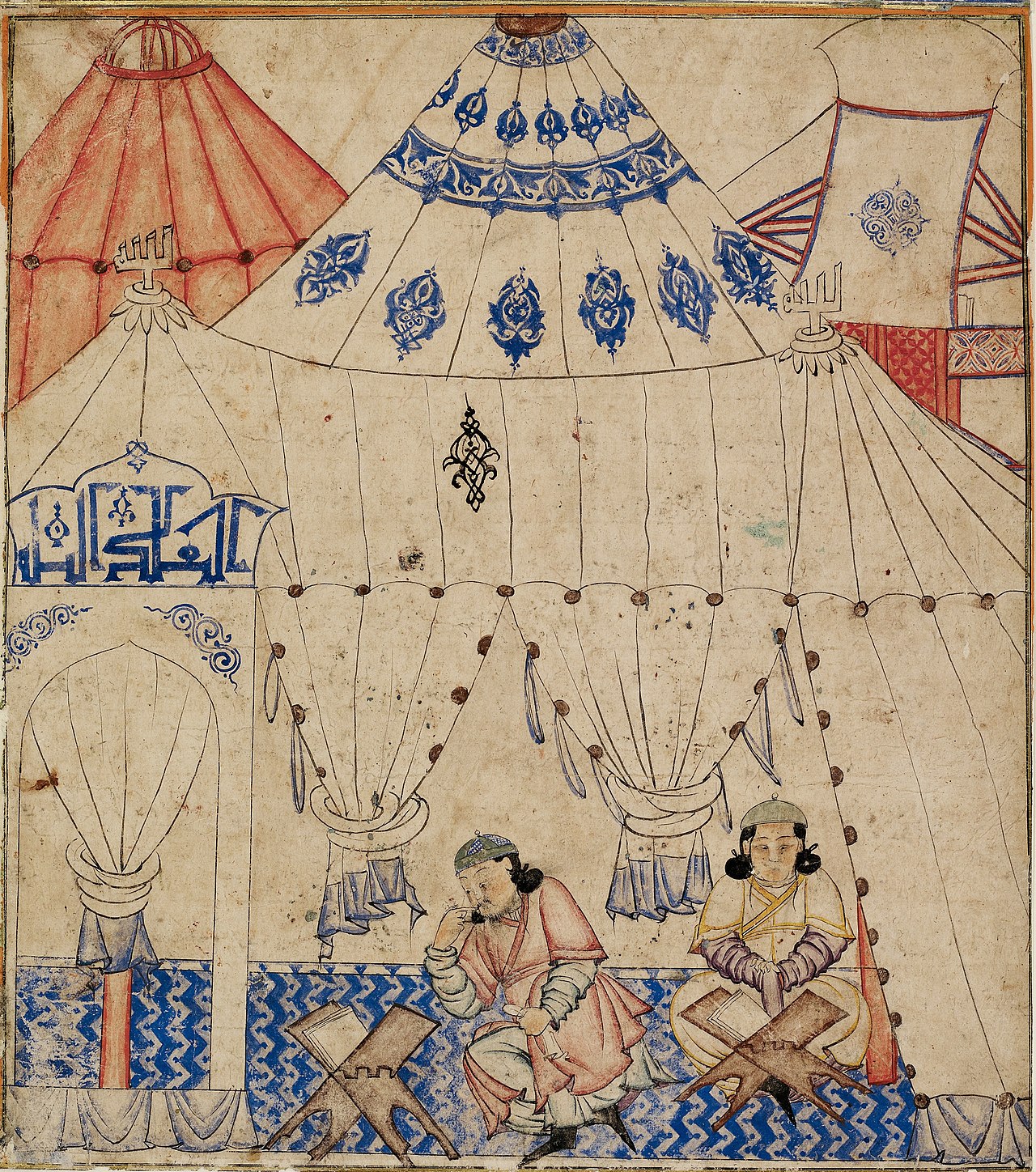
Mongol ruler Ghazan studying the Quran
The Mongol ruler Ghazan depicted studying the Quran inside a tent
Jalaluddin Rumi Writes the Masnavi
During the Mongol period, the Persian Sufi poet and mystic Jalaluddin Rumi (1207-1273) wrote his masterpiece, the Masnavi, which he believed to be 'sent down' from God and understood as the proper explanation of the Quran. Rumi's work represents the height of Persian Sufi literature and had a profound influence on Islamic mysticism. According to his biographer, the invading Mongols were impressed by Rumi's devotion to God.
Battle of Ain Jalut: Mamluks Stop Mongol Advance
In 1260 CE, the Mongol invaders were finally stopped by Egyptian Mamluks north of Jerusalem at the pivotal Battle of Ain Jalut. The Mongols were again defeated by the Mamluks at the Battle of Hims a few months later, and then driven out of Syria altogether. This was a turning point that preserved the Islamic heartland from Mongol conquest.
Kublai Khan Adopts Tibetan Buddhism and Yuan Dynasty
The emperors of the Yuan dynasty (1271–1368) converted to Tibetan Buddhism, with Kublai Khan inviting lama Drogön Chögyal Phagpa of the Sakya school to spread Buddhism throughout his realm. Buddhism became the de facto state religion of the Yuan dynasty. In 1269, Kublai Khan commissioned Phagpa lama to design the 'Phags-pa script to unify the writing systems of the multilingual empire.
Marco Polo Detects Islamic Kingdom in Sumatra
Marco Polo detected an Islamic kingdom in Perlak, Sumatra in 1292 CE. A powerful Islamic kingdom named Pasai was to grow from the north coast of Sumatra. This represents one of the earliest documented Islamic polities in Southeast Asia, marking the spread of Islam through trade routes.

Grand Mosque of Demak
Grand Mosque of Demak, the first Muslim state in Java
Avignon Papacy Begins
In 1309, Pope Clement V fled Rome's factional politics by moving to Avignon in southern France. This Avignon Papacy, consisting of seven successive popes, unintentionally diminished papal prestige and power by leaving Rome and the 'seat of Peter' behind. The papacy remained in Avignon until Pope Gregory XI returned to Rome in 1377.
Mansa Musa's Pilgrimage to Mecca
Mansa Musa, ruler of the Mali Empire, publicly demonstrated Mali's integration into the wider Islamic world through his pilgrimage to Mecca in 1324 CE. The Mali Empire incorporated Islamic institutions into its political system, where Islam functioned primarily as a court religion. This pilgrimage showcased the wealth and power of the Mali Empire to the wider Islamic world.
Gregory Palamas Defends Hesychasm
In 1341, St. Gregory Palamas defended hesychast spirituality and the Orthodox understanding of God against the criticisms of Barlaam, a Calabrian humanist philosopher, by writing his most influential work 'Triads.' This theological controversy was significant for Eastern Orthodox theology and its understanding of the nature of God and divine light. Palamas' victory in this debate shaped Orthodox theology for centuries.
Black Death Reaches Alexandria
The plague began in China and reached Alexandria in Egypt in 1347 CE, spreading over the following years to most Islamic areas. The Black Death may have killed one third of the population in the Middle East region. The combination of the plague and the Mongol wars left the Middle Eastern Islamic world in a seriously weakened position.
Timur Conquers Persia and Founds Timurid Empire
Timur (Tamerlane), himself a Muslim, conquered Persia in the 1360s and moved against the Delhi Sultanate in India and the Ottoman Turks in Anatolia. His ceaseless conquests were accompanied by displays of brutality matched only by Chinggis Khan. Samarqand, the cosmopolitan capital of Timur's empire, flourished under his rule as never before.

Tamerlane chess
Tamerlane chess, invented by Amir Timur
Timurid Renaissance
The Timurid Empire based in Central Asia saw a tremendous increase in the fields of arts and sciences. Remarkable achievements included the invention of Tamerlane Chess, reconstruction of Samarkand, and contributions by Sultan Shah Rukh's family including Gawhar Shad, polymath Ulugh Begh, and Sultan Husayn Bayqara in astronomy, mathematics, and architecture. The prosperity of Herat was said to have competed with Florence as a center of cultural rebirth.

Goharshad Mosque
Goharshad Mosque built by the Timurid Empire
Western Schism
After Pope Gregory XI returned to Rome and died in 1378, the papal conclave elected Urban VI, but French cardinals disapproved and elected Robert of Geneva instead. This began the Western Schism, during which there was more than one pope. In 1409, the Council of Pisa's attempted resolution resulted in a third pope, and the schism was finally resolved in 1417 with the election of Pope Martin V.
Wycliffe's Bible Published
In 1382, the first English translation of the Bible, known as Wycliffe's Bible, was published. John Wycliffe (1320–1384) had urged the church to embrace its original simplicity, give up its property and wealth, and deny papal authority. Though his teachings were condemned as heresy, he was allowed to live out his last years in his home parish, and his work influenced Jan Hus and later Protestant reformers.
Battle of Ankara: Timur Captures Bayezid I
Mongol warlord Timur (Tamerlane) captured Ottoman Sultan Bayezid I in the Battle of Ankara in 1402 CE, beginning the Ottoman Interregnum. This episode was characterized by the division of Ottoman territory amongst Bayezid I's sons, who submitted to Timurid authority. The empire recovered when Mehmed I reunited Asia Minor and declared himself sultan in 1413.
Jan Hus Burned at the Stake
Czech theologian Jan Hus (1369–1415), influenced by Wycliffe's teachings, spoke out against corruption in the church and was convicted of heresy and burned at the stake. His execution was the impetus for the Bohemian Reformation and led to the Hussite Wars. Hus became a martyr figure and his death demonstrated the church's willingness to use extreme measures against reformers.
Fall of Constantinople to the Ottoman Empire
The Fall of Constantinople to the Ottoman Empire in 1453 negated a reunion agreement between the Orthodox and Catholic churches signed in 1452 and sealed off Orthodoxy from the West for more than a century. Islamic law did not acknowledge the Byzantine church as an institution, but societal stability concerns allowed it to survive. The flight of Eastern Christians and the manuscripts they carried were important factors in stimulating literary renaissance in the West.
Ottoman Conquest of Constantinople
In 1453 CE, the Ottoman Turks under Mehmed II laid siege to Constantinople, the capital of Byzantium, using muskets and large cannons. The Byzantine fortress succumbed after 54 days of siege, ending the Byzantine Empire. This conquest marked a major turning point in world history and established the Ottomans as the dominant power in the region.

Osman I, founder of the Ottoman Empire
Ottoman miniature depicting Osman I, founder of the Ottoman Empire
Spanish Inquisition Established
Authorized by Pope Sixtus IV in 1478, the Spanish Inquisition was established to combat fears that Jewish converts were conspiring with Muslims to sabotage the new Spanish state. Five years later, a papal bull conceded control to Spanish monarchs, making it the first national, unified, centralized institution of the nascent Spanish state. The monarchy centralized state power by absorbing and adapting military orders, inquisitorial courts, and police organizations for political purposes.
Islam Introduced to the Philippines
By the late 15th century, Islam had been introduced to the Philippines via the southern island of Mindanao. The foremost socio-cultural Muslim entities that resulted were the Sultanate of Sulu and Sultanate of Maguindanao. Islamised kingdoms in northern Luzon, such as the Kingdom of Maynila and the Kingdom of Tondo, were later conquered and Christianised by Spanish colonisers beginning in the 16th century.
Reconquista Completed with Fall of Granada
The Christian Reconquista in Al-Andalus was eventually completed with the fall of Granada in 1492 CE. This ended nearly 800 years of Muslim rule in the Iberian Peninsula. The Reconquista had begun in the 8th century as Iberian Christian kingdoms sought to retake Al-Andalus from the Moors.
Alhambra interiors
The interiors of the Alhambra in Granada, Spain, the last Muslim stronghold in Iberia
1500 CE – 1999 CE
Safavid Dynasty Rises to Power in Persia
The Shiite Safavid dynasty rose to power in Tabriz in 1501 CE under Shah Ismail I, defeating the ruling Turcoman federation Aq Qoyunlu. Shah Ismail I made conversion to Twelver Shia Islam mandatory for the largely Sunni population of Iran to unite them against the Sunni Ottomans. This resulted in the Safavid conversion of Iran to Shia Islam, which profoundly shaped Iranian identity.
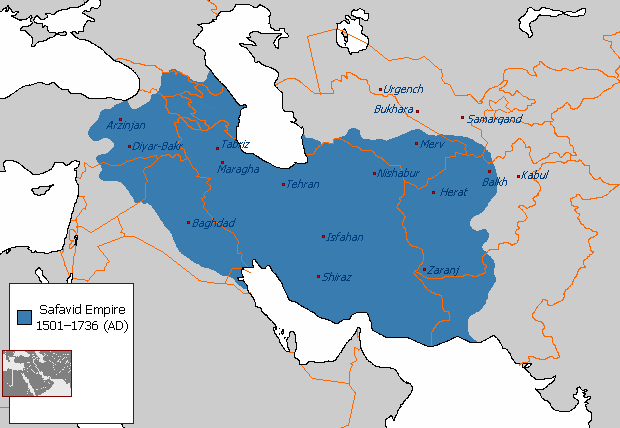
The Safavid Empire
The Safavid Empire at its greatest extent under Shah Ismail I (1501–1524)
Portuguese Capture Malacca
Portuguese forces captured Malacca in 1511 CE under naval general Afonso de Albuquerque. With Malacca subdued, the Aceh Sultanate and Bruneian Empire established themselves as centres of Islam in Southeast Asia. This marked the beginning of European colonial interference in the Muslim world of Southeast Asia.
Battle of Chaldiran: Ottomans Defeat Safavids
The Ottoman sultan Selim I challenged and defeated the Safavids at the Battle of Chaldiran in 1514 CE, seeking to repel Safavid expansion. This battle established the Ottoman-Safavid rivalry that would define Middle Eastern politics for centuries. Selim I also deposed the ruling Mamluks in Egypt, absorbing their territories in 1517.
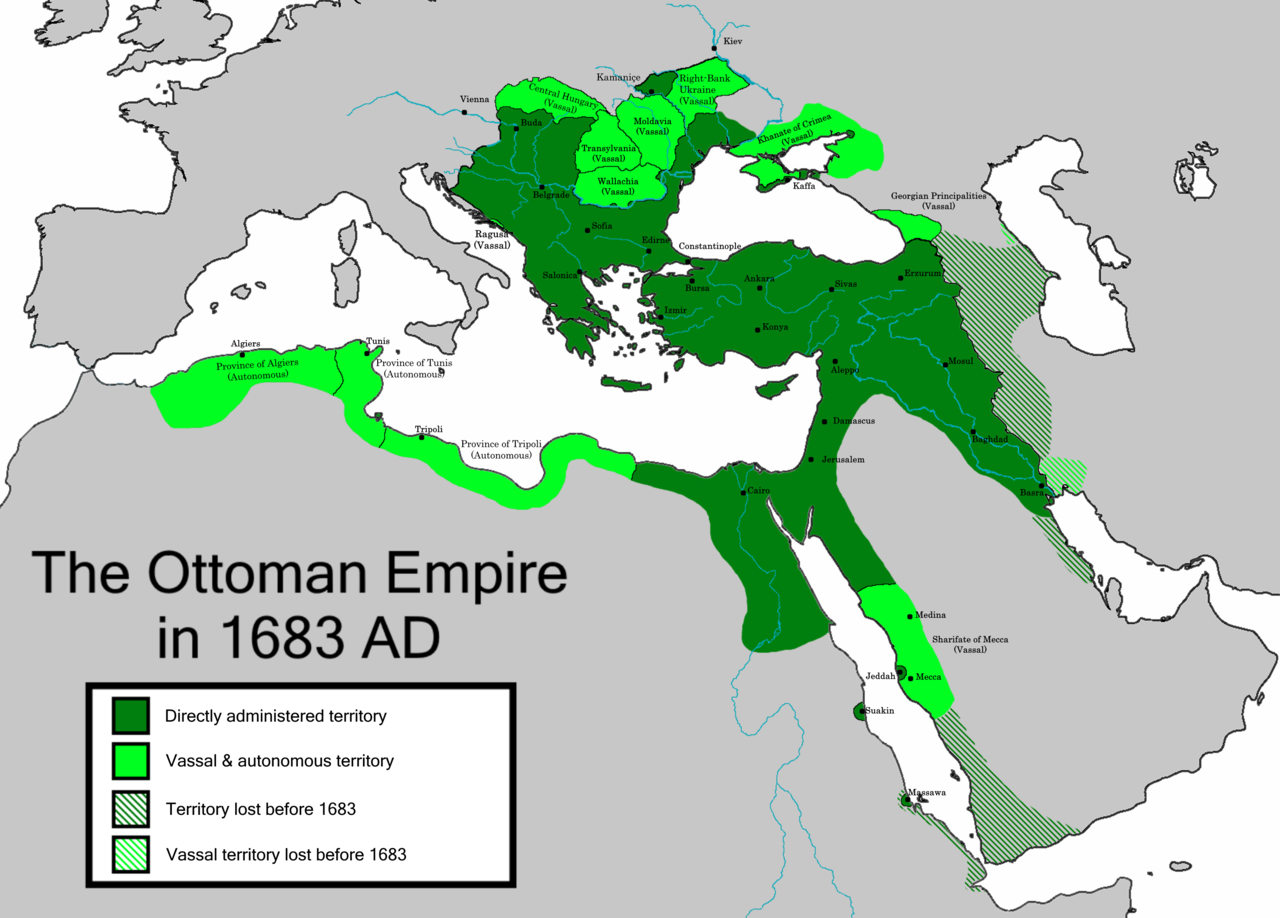
Ottoman Empire at its greatest extent
The Ottoman Empire and sphere of influence at its greatest extent (1683)
Protestant Reformation Begins
The Protestant Reformation began in 1517 when Catholic monk Martin Luther nailed his Ninety-five Theses to the church door in Wittenberg, challenging the church's role in society and its authority. Luther asserted there were two realms of human existence, the secular and the sacred, and that only secular authority had the right to use force. Edicts issued at the Diet of Worms in 1521 condemned Luther, but the Reformation spread rapidly across Europe.
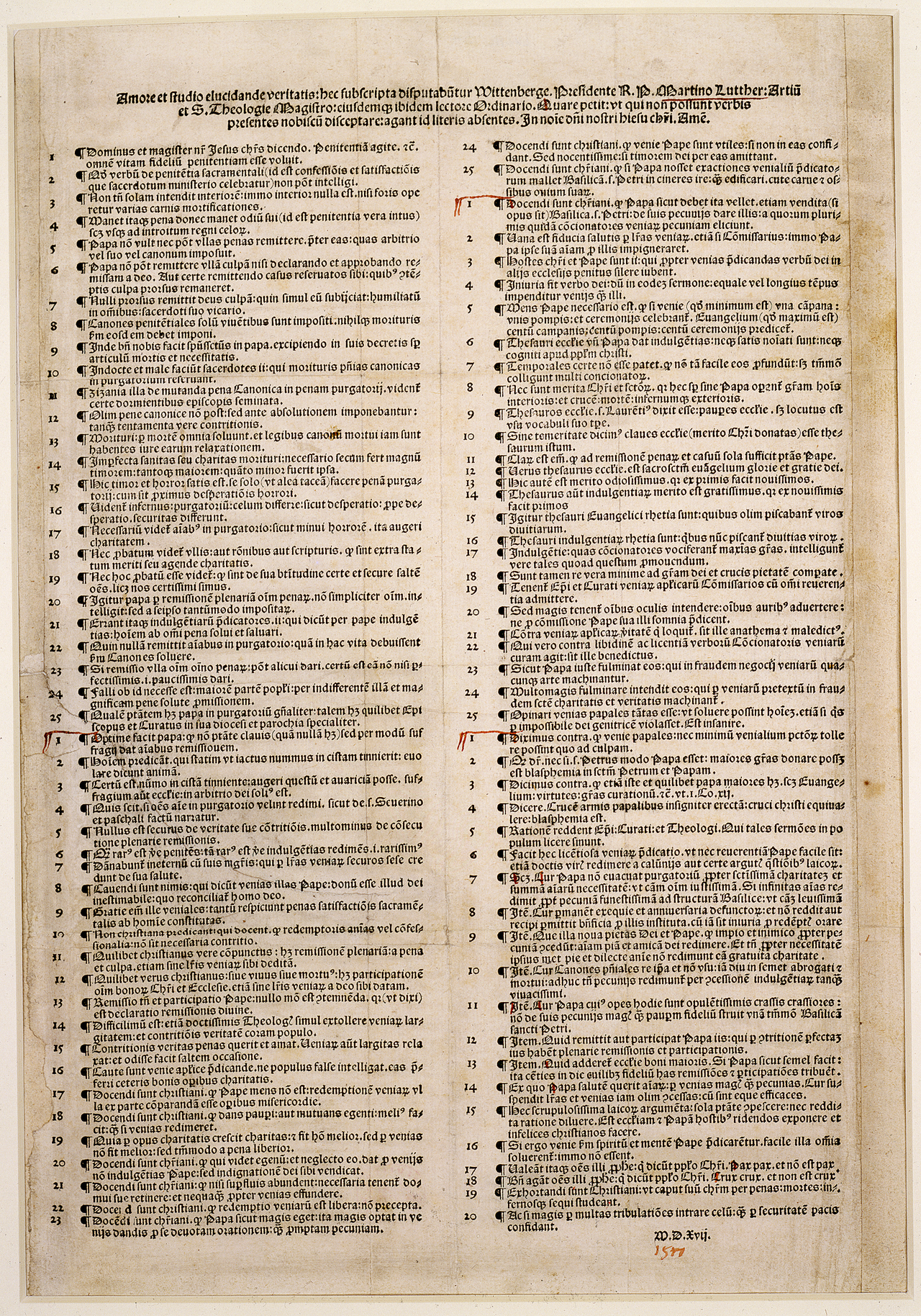
Luther's 95 Theses
Luther's 95 Theses, the document that sparked the Protestant Reformation.
Selim I Becomes Custodian of the Two Holy Mosques
In 1517 CE, Ottoman sultan Selim I became the 'Custodian of the Two Holy Mosques' in Mecca and Medina through the conquering and unification of Muslim lands, strengthening the Ottoman claim to the caliphate. He also defeated the Mamluk Sultanate and made Egypt part of the Ottoman Empire. This marked the Ottoman Empire's claim to leadership of the entire Muslim world.
Tyndale Bible Created
Between 1525 and 1534, William Tyndale used the Vulgate and Greek texts from Erasmus to create the Tyndale Bible, one of the first printed English translations of the Bible. This translation was significant for making scripture accessible to ordinary English speakers and influenced subsequent English Bible translations. It was later used as a source for the King James Version.
Mughal Empire Founded
The Mughal Empire was founded in 1526 CE when Babur defeated Ibrahim Lodi, the last ruler of the Delhi Sultanate, in the First Battle of Panipat. The empire was established by the Timurid dynasty with Turco-Mongol Chagatai roots from Central Asia. The Mughal Empire would eventually comprise almost all of South Asia and become one of the world's largest economies.

The Mughal Empire
Mughal India at its greatest extent
Suleiman the Magnificent Advances into Hungary
Suleiman I advanced deep into Hungary following the Battle of Mohács in 1526 CE, reaching as far as the gates of Vienna. He also signed a Franco-Ottoman alliance with Francis I of France against Charles V of the Holy Roman Empire. Suleiman I's rule (1520-1566) is often identified as the apex of Ottoman power.

Süleymaniye Mosque
The Süleymaniye Mosque in Istanbul, built on the order of sultan Suleiman the Magnificent
Council of Trent
The Council of Trent (1545–1563) was the Catholic Church's response to the Protestant Reformation, answering each Protestant claim and laying the foundation of modern Catholic policies. New monastic orders were formed, including the Society of Jesus (Jesuits), who adopted military-style discipline and strict loyalty to the Pope. The council defined Catholic doctrine on scripture, tradition, original sin, justification, and the sacraments.
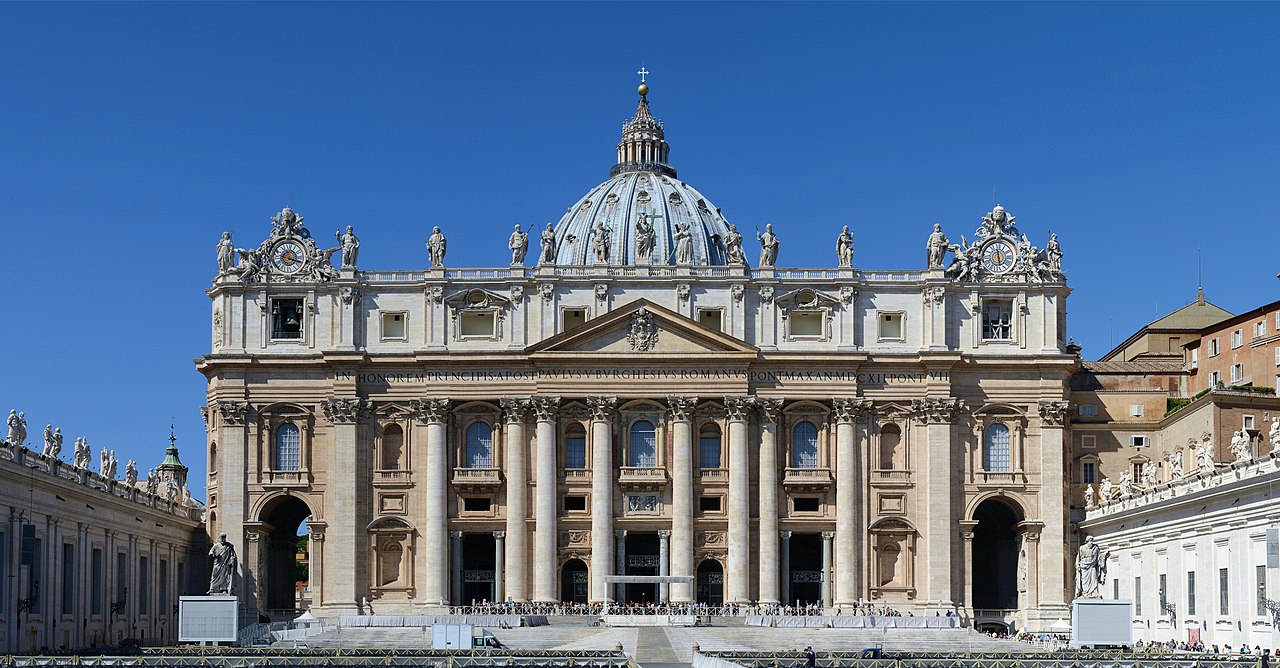
St. Peter's Basilica in the Vatican City
The Vatican, center of Catholic authority during the Counter-Reformation.
Akbar Becomes Mughal Emperor and Propounds Din-i Ilahi
The 'classic period' of the Mughal Empire began in 1556 CE with the ascension of Akbar to the throne. Akbar propounded a syncretic religion called Din-i Ilahi in the latter part of his life, as recorded in historical books like Ain-i-Akbari and Dabistan-i Mazahib. The Mughal Empire under Akbar did not try to intervene in native societies, co-opting and pacifying them through conciliatory administrative practices.
Altan Khan and the Title of Dalai Lama
In 1578, Altan Khan invited the 3rd Dalai Lama, head of the rising Gelug lineage, to a summit, forming an alliance that gave Altan Khan legitimacy and provided the Buddhist school with protection and patronage. Altan Khan recognized Sonam Gyatso as a reincarnation of Phagpa lama and gave him the title of Dalai Lama ('Ocean Lama'), which his successors still hold. This meeting established the Gelug school's dominance and the institution of the Dalai Lama.
King James Bible Published
King James commissioned the King James Version of the Bible in 1604, using all previous versions in Latin, Greek, and English as sources. It was published in 1611 and became one of the most influential books in the English language. The King James Bible shaped English literature, culture, and Protestant Christianity for centuries.
Thirty Years' War
The Thirty Years' War (1618–1648) was the largest and most destructive of the European wars of religion, centered in France and the Holy Roman Empire. While some scholars argue these wars were about religious liberty, most historians argue they were also about nationalistic state-building and economics. The war devastated Central Europe and reshaped the political and religious map of the continent.
Safavid Dynasty Toppled by Hotaki Dynasty
The Safavid dynasty was toppled in 1722 CE by the Hotaki dynasty, which ended their forceful conversion of Sunni areas to Twelver Shiism. The Safavid dynasty had ruled from 1501 to 1736 and had established Twelver Shiism as the official religion of Iran. Their fall marked the end of a major era in Iranian and Islamic history.
First Great Awakening
In reaction to rationalism, pietism began in Europe and spread to the Thirteen Colonies where it contributed to the First Great Awakening, a religious revival of the 1700s. Pietist Moravians came to Georgia in 1732 where they influenced John Wesley, an Anglican missionary. After returning to England, Wesley began preaching in open-air meetings, leading to the creation of the Methodist church.
Battle of Plassey: East India Company Overtakes Bengal
In 1757 CE, the East India Company overtook Bengal Subah at the Battle of Plassey, marking a turning point in the decline of Mughal power in India. By the mid-18th century, the Marathas had routed Mughal armies and won over several Mughal provinces from the Punjab to Bengal. This battle marked the beginning of British colonial rule in India.
Second Great Awakening
The Second Great Awakening, a religious revival of the 1800s–1830s, produced Mormonism, Restorationism, and the Holiness movement. This revival focused on evidencing conversion through active moral reform in areas such as women's rights, temperance, literacy, and the abolition of slavery. It had profound social and political consequences in America, contributing to the abolitionist movement and women's rights.
Sokoto Caliphate Founded by Uthman dan Fodio
In 1802 CE, Uthman dan Fodio, a Fulani scholar, led a major jihad in Hausaland that overthrew existing rulers and led to the creation of the Sokoto Caliphate. The new state centralized Muslim authority and introduced legal, educational, and administrative reforms based on Islamic principles. Dan Fodio's movement inspired subsequent jihads across West Africa.
Third Great Awakening and Missionary Zeal
The Third Great Awakening began in 1857 and took root throughout the world, especially in English-speaking countries, contributing to a surge of missionary zeal. Nineteenth-century Protestant missionaries, many of them women, played a significant role in shaping nations and societies by translating the Bible into local languages and establishing schools. According to historian Lamin Sanneh, Protestant missionaries stimulated the 'largest, most diverse and most vigorous movement of cultural renewal' in African history.
Indian Rebellion of 1857 and End of Mughal Empire
The last Mughal emperor, Bahadur Shah II, issued a firman supporting the Indian Rebellion of 1857. Following the rebellion's defeat, he was tried by the East India Company for treason, imprisoned, and exiled to Rangoon. The British parliament passed the Government of India Act to nationalize the East India Company and assume direct control of India as the British Raj.
5th Buddhist Council in Burma
King Mindon (r. 1853–1878) convened the 5th Buddhist council (1868–71) in Burma, where different editions of the Pali Canon were cross-checked and a final version was inscribed on 729 stone slabs, currently still the world's largest book. This council was a major effort to preserve and standardize the Theravada Buddhist canon. A new meditation movement called the Vipassana movement also arose in Burma during this period.
Panadura Debate and Buddhist Modernism
By 1865, Buddhist monks in British Ceylon began a counter movement against Christian attacks, printing pamphlets and debating Christians in public. The famous Panadura debate in 1873 saw the monk Gunananda win a debate in front of a crowd of 10,000. This period saw the rise of Buddhist modernism, which tended to see the Buddha from a humanist point of view and claimed that Buddhism was a rational and scientific religion.
Woman's Christian Temperance Union Founded
The Woman's Christian Temperance Union (WCTU) was founded in 1874, with many supporters going on to contribute to the women's rights movement. Women had been involved in temperance reform from the early 1800s, and the WCTU became one of the largest women's organizations in the United States. It used moral persuasion and political activism to effect social change.
Sir Edwin Arnold Publishes 'The Light of Asia'
Sir Edwin Arnold's book-length poem The Light of Asia (1879), a life of the Buddha, was a successful early publication on Buddhism that led to much interest among English-speaking middle classes. This work, along with the scholarship of Hermann Oldenberg, T. W. Rhys Davids and F. Max Müller, was influential in introducing Buddhism to western audiences. The late 19th century also saw the first-known modern western conversions to Buddhism.
Henry Steel Olcott and Helena Blavatsky Convert to Buddhism
The late 19th century saw the first-known modern western conversions to Buddhism, including leading Theosophists Henry Steel Olcott and Helena Blavatsky in 1880 in Sri Lanka. The Theosophical Society was very influential in popularizing Indian religions in the west. Olcott (1832–1907) and Anagarika Dharmapala (1864–1933) promoted Buddhist schools, lay organizations and the printing of newspapers.
Samori Touré Resists French Colonial Expansion
Samori Touré, a Mandinka military strategist and founder of the Wassoulou Empire, opposed French forces in West Africa until his capture in 1898 CE. His successors were defeated in 1901. These resistance movements were part of a broader pattern of Islamic resistance to European colonial expansion in West Africa during the 19th century.
Azusa Street Revival and Pentecostalism
The 1906 Azusa Street Revival typified the Pentecostal movement, which combined Restorationism with the goal of sanctification defined as a deeper spiritual experience. Pentecostalism grew to become one of the most significant movements in twentieth-century Christianity. By 2000, approximately one-quarter of all Christians worldwide were part of Pentecostalism and its associated movements.
Arab Revolt Against Ottoman Forces
During World War I, the Allies cooperated with Arab partisans against the Ottoman Empire during the Arab Revolt. The British, led by T. E. Lawrence ('Lawrence of Arabia'), cooperated with Arab guerillas against the Ottoman forces, eventually securing the withdrawal of all Ottoman troops from the region by 1918. Many Arabs were later dismayed by the Balfour Declaration, which contradicted the McMahon-Hussein Correspondence.
Ottoman Empire Defeated in World War I
The Ottoman Empire's decision to back Germany in World War I meant they shared the Central Powers' defeat. The defeat led to the overthrow of the Ottomans by Turkish nationalists led by Mustafa Kemal (Atatürk). Atatürk renegotiated the treaty of Sèvres (1920) and established the modern Republic of Turkey, recognized by the Allies in the Treaty of Lausanne (1923).

Ottoman army in World War I
Ottoman army in World War I
Nazi Rise to Power and German Church Response
Most leaders and members of the largest Protestant church in Germany, the German Evangelical Church, supported the Nazi Party when they came to power in 1933. About a third of German Protestants formed the Confessing Church which opposed Nazism; its members were harassed, arrested, and otherwise targeted. Pope Pius XI declared the irreconcilability of the Catholic position with totalitarian fascist states that placed the nation above God.
World Council of Churches Formed
In response to the profound impact of World War I on Christianity, the World Council of Churches (WCC) formed in 1938 to address social issues, create cooperation, and open a dialogue among Christians on a global scale. The WCC played an important role in the Universal Declaration of Human Rights in 1948. It represented a major step toward Christian ecumenism and global cooperation.
State of Israel Established
The State of Israel came into existence on 14 May 1948 as a polity to serve as the homeland for the Jewish people. It was defined in its declaration of independence as a 'Jewish state'. The establishment of Israel led to the displacement of the Palestinian people and the beginning of the Arab-Israeli conflict.
6th Buddhist Council in Burma
In 1956, Burmese politician U Nu presided over a sixth Buddhist council, which saw monks from various Theravada countries produce another new edition of the Pali Canon. This council was a major international effort to standardize and preserve the Theravada Buddhist canon. It represented a significant moment of cooperation among Theravada Buddhist nations.
B. R. Ambedkar and the Dalit Buddhist Movement
The lawyer B. R. Ambedkar (1891–1956), leader of the Dalit Buddhist movement, urged low caste Indian Dalits to convert to Buddhism, helping usher in a revival of Buddhism in India. This movement helped Buddhism become popular among some Indian intellectuals and marginalized communities. Ambedkar's conversion and advocacy represented a significant modern development in Indian Buddhism.
14th Dalai Lama Flees Tibet
Tibet remained a traditional theocratic state with the Dalai Lamas as heads of state from 1912 until the Chinese communist invasion in 1950. The 14th Dalai Lama fled the country in 1959, and a Tibetan exile community was established in India with its center at Dharamsala. The 14th Dalai Lama has become one of the most popular Buddhist leaders in the world today.

File:President Barack Obama greets His Holiness the Dalai Lama (27591124962).jpg
The 14th Dalai Lama meeting with U.S. President Barack Obama in 2016, illustrating his continued global influence after fleeing Tibet.
Christianity Declines in the West, Grows in Global South
In the twentieth century, Christianity declined in most of the Western world but grew dramatically in the Global South, particularly Southeast Asia and Sub-Saharan Africa. In 1900, about 6.5% of Africa's population were Christian; by 2005, this had grown to about half the continent's population. By 2060, more than forty percent of the world's Christians are projected to live in sub-Saharan Africa.

Global distribution of Christians based on 2011 Pew Research Center data
Map showing the worldwide distribution of Christians, illustrating the shift toward the Global South.
Second Vatican Council
The Second Vatican Council (Vatican II), from 1962–1965, brought about numerous reforms, liturgical changes, promoted the involvement of laypeople, and improved relations with other Christian denominations. It represented the most significant reform of the Catholic Church in centuries and opened the church to dialogue with the modern world. Vatican II's reforms reshaped Catholic practice and theology globally.
St. Peter's Basilica in the Vatican City
The Vatican, where the Second Vatican Council was held.
Chinese Communist Cultural Revolution Destroys Buddhist Institutions
The Communist Cultural Revolution (1966–76) led to the closing of all Buddhist monasteries in China and widespread destruction of Buddhist institutions. During the Red Guard period (1966–67), Chinese communists also destroyed around 6,000 monasteries in Tibet along with their art and books, in an attempt to wipe out Tibetan Buddhist culture. However, since 1977, there has been a general shift in policy and Buddhist activity has been renewed.
Six-Day War
The Six-Day War was fought between 5-10 June 1967 between Israel and the neighbouring states of Egypt, Jordan, and Syria. The Arab countries closed the Suez Canal following the war. These developments increased the importance of petroleum in Libya, which is a short shipping distance from Europe.
Yom Kippur War and 1973 Oil Embargo
In October 1973, a new war between Israel and its Muslim neighbours, known as the Yom Kippur War, broke out. In response to Western support for Israel, the Arab world imposed the 1973 oil embargo against the United States and Western Europe. Saudi Arabia agreed to use its oil wealth to finance the 'front-line states' bordering Israel in their struggle.
Founding of the Insight Meditation Society
Theravada vipassana meditation was established in the West through the founding of institutions like the Insight Meditation Society in 1975. This was part of a broader wave of Buddhist institutions being established in the Western world, including Tibetan Buddhist centers and Zen centers. The Thai forest tradition also established communities in the US and UK during this period.
Iranian Revolution
In 1979 CE, the Iranian revolution transformed Iran from a constitutional monarchy to a populist theocratic Islamic republic under the rule of Ayatollah Ruhollah Khomeini. A new constitution was approved and a referendum established the government, electing Ruhollah Khomeini as Supreme Leader. This revolution had profound effects on the Muslim world, intensifying Sunni-Shia tensions and contributing to the Iran-Iraq War.
Joint Declaration on the Doctrine of Justification
In 1992, the Catholic Church and the Lutheran World Federation signed the Joint Declaration on the Doctrine of Justification, resolving one of the central theological disputes of the Protestant Reformation. This represented a major step in Catholic-Lutheran ecumenism and acknowledged significant common ground on the doctrine of salvation. It was a landmark achievement in Christian reconciliation.
2000 CE – 2499 CE
Saffron Revolution in Burma
In 2007, Buddhist monks in Burma became involved in political protest movements in what became known as the Saffron Revolution. This represented a significant instance of Buddhist monks engaging in political activism in the modern era. The protests highlighted the ongoing role of Buddhism in Burmese society and politics.
Dalai Lama Meets U.S. President Barack Obama
The 14th Dalai Lama met with U.S. President Barack Obama in 2016, illustrating the global prominence of Tibetan Buddhism and the Dalai Lama's role as a world religious leader. This meeting reflects the broader integration of Buddhism into global political and cultural discourse in the modern era. The Dalai Lama has become one of the most recognized Buddhist figures in the world.
File:President Barack Obama greets His Holiness the Dalai Lama (27591124962).jpg
The Dalai Lama meeting with U.S. President Barack Obama in 2016.
Christianity Becomes World's Largest Religion
In 2017, PEW reported that Christianity is the world's largest religion with roughly 2.4 billion followers, equal to 31.2% of the world's population. In the twenty-first century, Christianity has become the most diverse and pluralistic of the world's religions, embracing over 3,000 of the world's languages. Most Christians now live outside North America and Western Europe.
Global distribution of Christians
Map showing the worldwide distribution of Christians, reflecting Christianity's status as the world's largest religion.