Comparing Timelines
Exploring the overlapping histories of "History of computing" and "Ottoman Empire".

History of computing
-2300 - 1999

Ottoman Empire
1299 - 1924
2300 BCE
Sumerian Abacus Invented
The earliest known tool used for computation, the Sumerian abacus, was invented in Babylon. Its original style of usage involved lines drawn in sand with pebbles, representing the first systematic approach to mechanical calculation.
771 BCE
South-Pointing Chariot Invented
Ancient China invented the south-pointing chariot, the first known geared mechanism to use a differential gear. This mechanical innovation would later become crucial in the development of analog computers.
150 BCE
Chinese Abacus Development
The Chinese developed a more sophisticated abacus around the 2nd century BC, improving upon the earlier Sumerian design. This tool became fundamental to mathematical computation in East Asia for centuries.
100 BCE
Antikythera Mechanism Created
The Antikythera mechanism was designed to calculate astronomical positions, believed to be the earliest known geared computing device. Discovered in 1901 in a Greek shipwreck, it demonstrates sophisticated ancient engineering.
1299 CE
Foundation of the Ottoman Beylik
Osman I establishes a small principality in northwestern Anatolia, founding what would become the Ottoman Empire. This beylik emerged from the fragmented Anatolian Beyliks following the decline of the Rum Sultanate. Osman's early followers consisted of Turkish tribal groups and Byzantine renegades.
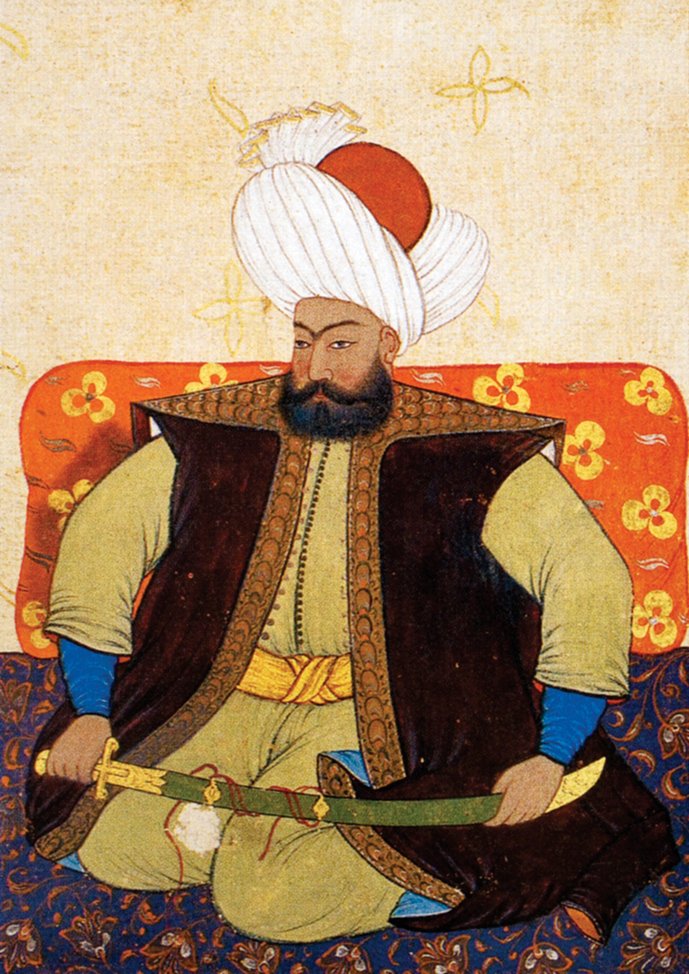
Sultan Uthman I
Portrait of Osman I, founder of the Ottoman Empire
1302 CE
Battle of Bapheus
Ottoman forces under Osman I defeat the Byzantines at Bapheus, marking a significant early victory that contributed to Osman's rise and Ottoman expansion into Byzantine territory. This battle demonstrated the military effectiveness of the early Ottoman forces.
1324 CE
Death of Osman I
Osman I, founder of the Ottoman Empire, dies and is succeeded by his son Orhan. Under Osman's leadership, the small beylik had begun its transformation from a tribal confederation into an organized state that would eventually become a major empire.
1326 CE
Capture of Bursa
Orhan, son of Osman I, captures the northwestern Anatolian city of Bursa from the Byzantines, making it the new Ottoman capital. This conquest marked a significant expansion of Ottoman territory and established their first major urban center, supplanting Byzantine control in the region.
1387 CE
Capture of Thessaloniki
Ottoman forces capture the important port city of Thessaloniki from the Venetians and sack it. This conquest demonstrated Ottoman naval capabilities and their expansion into strategically important Mediterranean ports, challenging Venetian commercial dominance.
1389 CE
Battle of Kosovo
Ottoman victory at Kosovo effectively marks the end of Serbian power in the region, paving the way for Ottoman expansion into Europe. This decisive battle established Ottoman dominance in the Balkans and opened the path for further European conquests.
1396 CE
Battle of Nicopolis
Ottoman forces defeat a large crusading army at Nicopolis, regarded as the last large-scale crusade of the Middle Ages. This victory failed to stop Ottoman advance and demonstrated their military superiority over European coalition forces, securing their position in the Balkans.
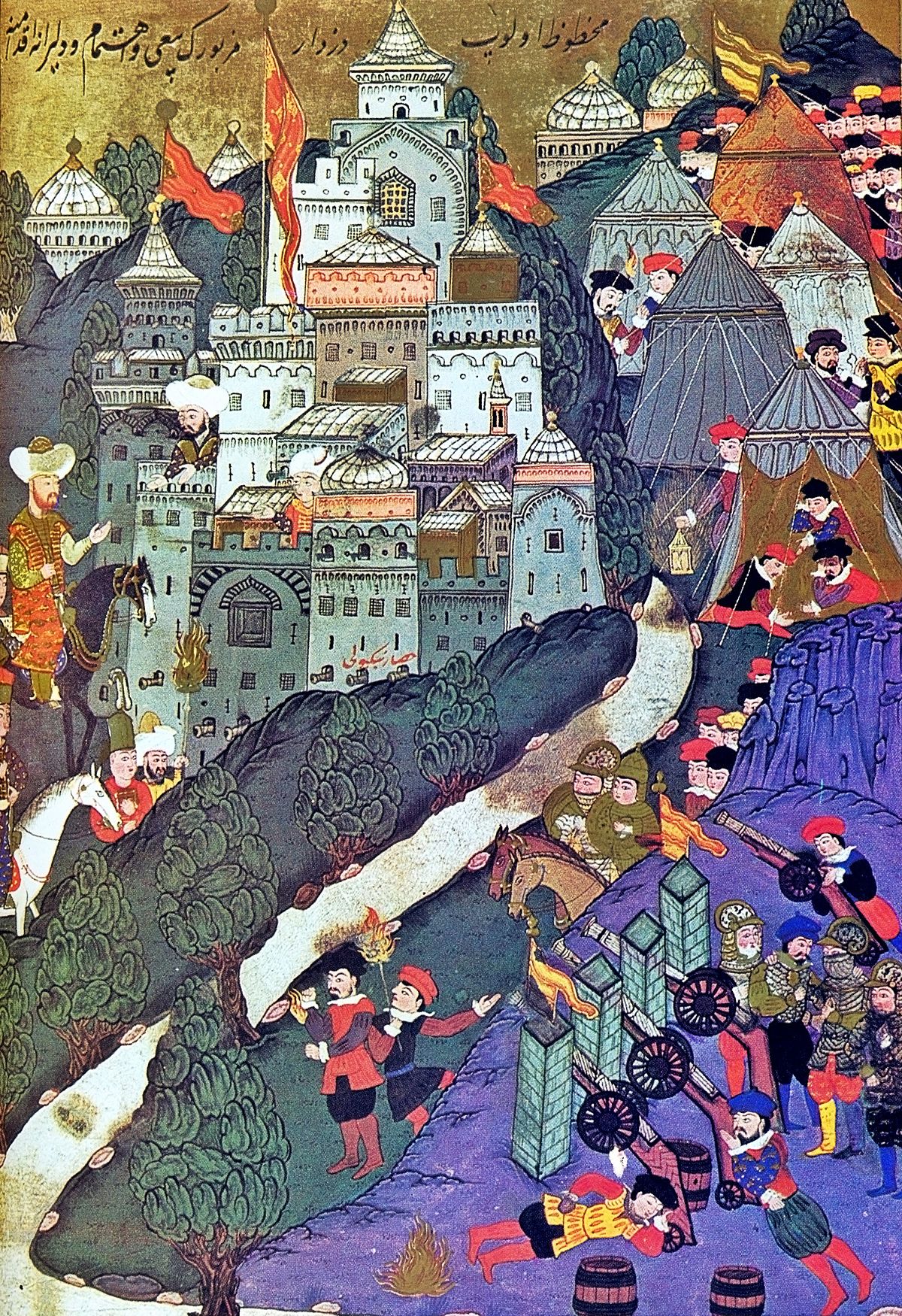
Battle of Nicopolis
The Battle of Nicopolis in 1396, as depicted in an Ottoman miniature from 1523
1402 CE
Battle of Ankara
Timur defeats Ottoman forces and captures Sultan Bayezid I, throwing the empire into disorder. This devastating defeat by the Timurid Empire temporarily relieved Byzantine pressure on Constantinople and led to a period of Ottoman civil war and fragmentation.
1413 CE
End of Ottoman Interregnum
The Ottoman civil war ends when Mehmed I emerges as sultan and restores Ottoman power. This period of succession struggle among Bayezid's sons lasted from 1402 to 1413, during which the empire was divided and weakened, but Mehmed's victory reunified the state.
1444 CE
Battle of Varna
Murad II repels the Crusade of Varna by defeating Hungarian, Polish, and Wallachian armies under Władysław III of Poland and John Hunyadi. This victory secured Ottoman control over the Balkans and ended the last major crusading effort against the empire.
1448 CE
Second Battle of Kosovo
John Hunyadi's second attempt to attack the Turks with Hungarian and Wallachian forces is defeated at Kosovo. This victory further consolidated Ottoman control over the Balkans and demonstrated the futility of European attempts to roll back Ottoman expansion.
1453 CE
Conquest of Constantinople
Sultan Mehmed the Conqueror captures Constantinople, ending the Byzantine Empire after over 1,000 years. This monumental achievement made the Ottomans masters of the strategic Bosphorus strait and established them as a major European power, with Constantinople becoming their new capital.
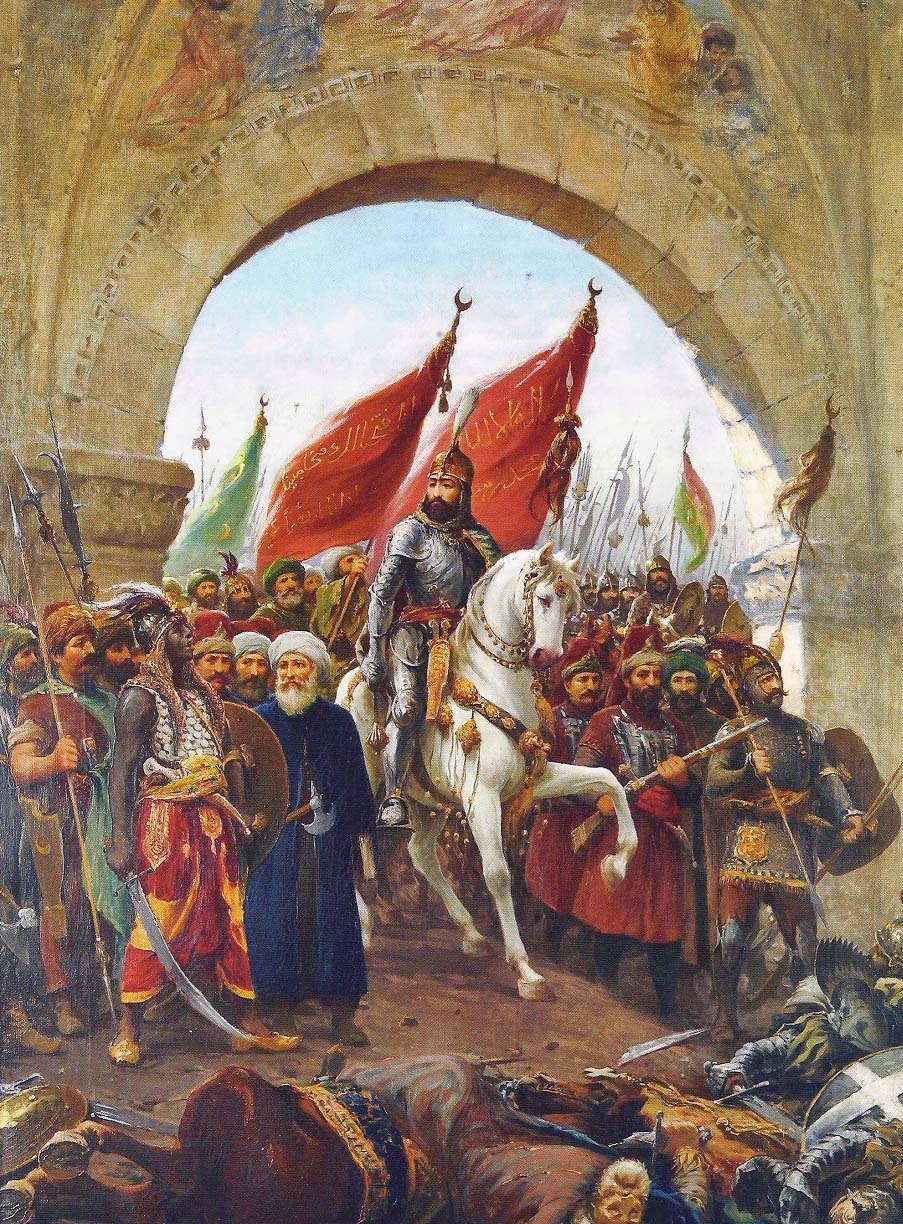
Sultan Mehmed the Conqueror's entry into Constantinople
Painting by Fausto Zonaro depicting Mehmed II's triumphant entry into Constantinople
1514 CE
Battle of Chaldiran
Sultan Selim I defeats Shah Ismail of Safavid Iran at Chaldiran, dramatically expanding Ottoman eastern and southern frontiers. This victory established Ottoman dominance over eastern Anatolia and northern Mesopotamia, while also securing the empire's eastern border against Persian expansion.
1517 CE
Ottoman Conquest of Egypt
Selim I defeats and annexes the Mamluk Sultanate of Egypt, establishing Ottoman rule in Egypt and creating a naval presence on the Red Sea. This conquest brought the wealthy province of Egypt under Ottoman control and positioned the empire to compete with Portuguese expansion in the Indian Ocean.
1521 CE
Capture of Belgrade
Suleiman the Magnificent captures Belgrade, opening the path for Ottoman expansion into Central Europe. This strategic victory removed a key Hungarian fortress and paved the way for the Ottoman conquest of much of the Kingdom of Hungary.
1526 CE
Battle of Mohács
Suleiman the Magnificent achieves a historic victory at Mohács, establishing Ottoman rule in the territory of present-day Hungary and other Central European territories. This decisive battle effectively ended Hungarian independence and opened Central Europe to Ottoman expansion.

Battle of Mohács
Ottoman miniature of the Battle of Mohács in 1526
1529 CE
First Siege of Vienna
Suleiman the Magnificent lays siege to Vienna but fails to take the city, marking the furthest extent of Ottoman expansion into Europe. This failure represented the first major check to Ottoman expansion and demonstrated the limits of their military reach into Central Europe.
1535 CE
Ottoman Conquest of Baghdad
Ottoman Turks take Baghdad from the Persians, establishing Ottoman rule in Iraq and gaining naval access to the Persian Gulf. This conquest extended Ottoman control over Mesopotamia and positioned the empire to challenge Portuguese dominance in the Indian Ocean trade routes.
1538 CE
Battle of Preveza
Ottoman admiral Barbarossa Hayreddin Pasha defeats the Holy League of Charles V under Andrea Doria at Preveza. This naval victory established Ottoman dominance in the Eastern Mediterranean and secured their control over key sea routes.

Battle of Preveza
Ottoman admiral Barbarossa Hayreddin Pasha defeated the Holy League of Charles V under the command of Andrea Doria at the Battle of Preveza in 1538
1566 CE
Death of Suleiman the Magnificent
Suleiman the Magnificent dies of natural causes during the siege of Szigetvár, ending the reign of the Ottoman Empire's most celebrated sultan. His death marked the end of the classical period of Ottoman expansion, with the empire spanning approximately three continents at its peak.
1571 CE
Battle of Lepanto
The Holy League consisting of Spanish and Venetian fleets wins a victory over the Ottoman fleet at Lepanto, off southwestern Greece. Catholic forces killed over 30,000 Turks and destroyed 200 ships, dealing a symbolic blow to Ottoman naval invincibility, though the empire quickly recovered.

Battle of Lepanto
Order of battle of the two fleets in the Battle of Lepanto, with an allegory of the three powers of the Holy League in the foreground, fresco by Giorgio Vasari
1639 CE
Treaty of Zuhab
The Treaty of Zuhab decisively divides the Caucasus and adjacent regions between the Ottoman and Safavid empires, confirming the territorial arrangements established in the 1555 Peace of Amasya. This treaty established lasting borders between the two empires in the region.
1669 CE
Conquest of Crete Completed
The Ottomans complete their conquest of Crete from Venice, ending a long campaign that began decades earlier. This victory extended Ottoman control over the Eastern Mediterranean and eliminated a major Venetian stronghold in the region.
1683 CE
Second Siege of Vienna
Grand Vizier Kara Mustafa Pasha leads a massive Ottoman army in a second attempt to capture Vienna, but the siege fails catastrophically. The Ottoman forces are swept away by allied Habsburg, German, and Polish forces led by Polish king John III Sobieski, marking the beginning of Ottoman decline in Europe.

Second Siege of Vienna
The Second Siege of Vienna in 1683, by Frans Geffels (1624–1694)
1697 CE
Battle of Zenta
Mustafa II leads a counterattack against the Habsburgs in Hungary but suffers a disastrous defeat at Zenta in modern Serbia. This crushing defeat further weakened Ottoman position in Europe and contributed to major territorial losses in subsequent peace negotiations.
1699 CE
Treaty of Karlowitz
The Treaty of Karlowitz ends the Great Turkish War, with the Ottomans surrendering control of significant territories, many permanently. This treaty marked the first major territorial losses for the Ottoman Empire and signaled the beginning of its long retreat from Europe.
1711 CE
Pruth River Campaign Victory
Ottoman forces achieve victory in the Pruth River Campaign against Russia in Moldavia, after Charles XII of Sweden persuaded Sultan Ahmed III to declare war on Russia. This victory temporarily restored Ottoman prestige after earlier defeats.
1717 CE
Austrian Capture of Belgrade
Austrian troops led by Prince Eugene of Savoy capture Belgrade from the Ottomans. Austrian control in Serbia lasted until the Turkish victory in the Austro-Russian–Turkish War, but this loss demonstrated continued Ottoman military weakness in Europe.

Austrian Capture of Belgrade
Austrian troops led by Prince Eugene of Savoy capture Belgrade in 1717
1729 CE
First Ottoman Printing Press
Ibrahim Muteferrika's printing press publishes its first book, marking the beginning of Ottoman printing. Despite initial religious opposition, this technological advancement represented an important step in Ottoman modernization and the spread of knowledge.
1739 CE
Treaty of Belgrade
The Treaty of Belgrade ends the Austro-Russian–Turkish War, resulting in Ottoman recovery of northern Bosnia, Habsburg Serbia (including Belgrade), Oltenia and southern parts of the Banat of Temeswar. However, the empire lost the port of Azov to the Russians.
1774 CE
Treaty of Küçük Kaynarca
The Treaty of Küçük Kaynarca ends the Russo-Turkish War of 1768–1774, providing freedom of worship for Christian citizens in Ottoman-controlled Wallachia and Moldavia. This treaty marked a significant Russian victory and increased Russian influence in Ottoman territories.
1804 CE
Serbian Revolution Begins
The Serbian revolution begins, marking the start of an era of national awakening in the Balkans during the Eastern Question. This uprising represented the first successful national liberation movement against Ottoman rule and inspired other Balkan peoples.
1821 CE
Greek War of Independence Begins
The Greeks declare war on the Sultan, beginning the Greek War of Independence. A rebellion that originated in Moldavia was followed by the main revolution in the Peloponnese, which became the first part of the Ottoman Empire to achieve independence in 1829.
1826 CE
Destruction of Janissary Corps
Sultan Mahmud II eliminates the Janissary corps in the Auspicious Incident, crushing their revolt and disbanding the powerful military organization. This dramatic reform removed a major obstacle to modernization and allowed for the creation of a modern Ottoman army.
1827 CE
Battle of Navarino
Muhammad Ali of Egypt loses his fleet at the Battle of Navarino during the Greek War of Independence. This naval defeat was costly for Muhammad Ali and contributed to the eventual Greek independence, while also weakening Ottoman naval power in the Mediterranean.
1830 CE
Greek Independence Achieved
Greece achieves formal independence from the Ottoman Empire, becoming the first Ottoman territory to successfully break away through nationalist revolution. This independence inspired other Balkan peoples and marked the beginning of the empire's territorial disintegration in Europe.
French Invasion of Algeria
The French invade the Deylik of Algiers, beginning the French conquest of Algeria. The campaign took 21 days and resulted in over 5,000 Algerian military casualties and about 2,600 French ones, marking the beginning of French colonial rule in North Africa.
1831 CE
First Egyptian-Ottoman War Begins
Muhammad Ali of Egypt revolts against Sultan Mahmud II, beginning the first Egyptian-Ottoman War. The French-trained Egyptian army under Ibrahim Pasha defeats Ottoman forces and advances deep into Anatolia, reaching within 320 km of Constantinople.
1833 CE
Convention of Kütahya
The Convention of Kütahya ends the first Egyptian-Ottoman War, with Muhammad Ali agreeing to abandon his campaign against the Sultan in exchange for governorship of several provinces including Crete, Aleppo, Tripoli, Damascus and Sidon, effectively gaining control of modern Syria and Lebanon.
1839 CE
Tanzimat Edict Issued
The Edict of Gülhane launches the Tanzimat period of Ottoman reforms, introducing constitutional changes that led to a modern conscripted army, banking system reforms, decriminalization of homosexuality, replacement of religious law with secular law, and modernization of various institutions.
1840 CE
Ottoman Ministry of Post Established
The Ottoman Ministry of Post is established in Istanbul, marking an important step in modernizing Ottoman communications and administration. This development was part of the broader Tanzimat reforms aimed at modernizing the empire's infrastructure.
1847 CE
Ottoman Telegraph Patent
American inventor Samuel Morse receives an Ottoman patent for the telegraph, issued by Sultan Abdülmecid who personally tested the invention. This technological adoption represented Ottoman efforts to modernize communications infrastructure during the Tanzimat period.
1853 CE
Crimean War Begins
The Crimean War begins as part of a long-running contest between major European powers for influence over territories of the declining Ottoman Empire. The financial burden of the war forces the Ottoman state to issue foreign loans amounting to 5 million pounds sterling.

Ottoman troops storming Fort Shefketil
Ottoman troops storming Fort Shefketil during the Crimean War of 1853–1856
1876 CE
Ottoman Constitution Proclaimed
The Ottoman Constitution, called the Kanûn-u Esâsî, is proclaimed, establishing the empire's First Constitutional Era. However, this constitutional period was short-lived, with the parliament surviving for only two years before the sultan suspended it.

First Ottoman Parliament
Opening ceremony of the First Ottoman Parliament at the Dolmabahçe Palace in 1876
1878 CE
Russo-Turkish War Ends
The Russo-Turkish War of 1877–1878 ends with a decisive victory for Russia. As a result, Ottoman holdings in Europe decline sharply: Bulgaria becomes an independent principality, Romania achieves full independence, and Serbia and Montenegro gain complete independence.
Austria-Hungary Occupies Bosnia-Herzegovina
Austria-Hungary unilaterally occupies the Ottoman provinces of Bosnia-Herzegovina and Novi Pazar, further reducing Ottoman territory in Europe. This occupation was formalized at the Congress of Berlin and represented another major territorial loss for the empire.
1882 CE
British Occupation of Egypt
Britain sends troops to Egypt to put down the Urabi Revolt, effectively gaining control of the territory. Sultan Abdul Hamid II was too paranoid to mobilize his own army, fearing it would result in a coup d'état, allowing British control to be established.
1886 CE
Charles Sanders Peirce Describes Electrical Logic
In a letter, Charles Sanders Peirce described how logical operations could be carried out by electrical switching circuits. He also showed that NOR gates alone could reproduce the functions of all other logic gates, laying groundwork for digital logic.
1894 CE
Hamidian Massacres Begin
Between 100,000 and 300,000 Armenians living throughout the empire are killed in what becomes known as the Hamidian massacres. These systematic killings represent a dark period in Ottoman history and foreshadow the later Armenian genocide during World War I.
1907 CE
Lee De Forest's Vacuum Tube Logic Gate
Lee De Forest's modification of the Fleming valve could be used as a logic gate, representing an early step toward electronic computing. This advancement would eventually lead to vacuum tube computers.
1908 CE
Young Turk Revolution
The Young Turk Revolution led by the Committee of Union and Progress reestablishes constitutional monarchy in the Ottoman Empire. This revolution restored the Constitution and brought in multi-party politics, offering hope for modernization and reform of the empire's institutions.

Young Turk Revolution Declaration
Declaration of the Young Turk Revolution by the leaders of the Ottoman millets in 1908
Austria-Hungary Annexes Bosnia-Herzegovina
Austria-Hungary officially annexes Bosnia and Herzegovina, taking advantage of the civil strife following the Young Turk Revolution. This annexation further reduced Ottoman territory and increased tensions in the Balkans leading up to World War I.
1911 CE
Italo-Turkish War
The Ottoman Empire loses its North African territories and the Dodecanese to Italy in the Italo-Turkish War. Despite military reforms that reconstituted the Ottoman Modern Army, the empire could not prevent this territorial loss to Italian colonial expansion.
1912 CE
First Balkan War
The Ottoman Empire loses almost all of its European territories in the First Balkan War, retaining only East Thrace (European Turkey). This devastating defeat resulted in around 400,000 Muslims fleeing with the retreating Ottoman armies, with many dying from cholera.
1913 CE
CUP Coup d'État
The Committee of Union and Progress leads a coup d'état that establishes a dictatorship in the Ottoman Empire. Following the disastrous Balkan Wars, the CUP became increasingly radicalized and nationalistic, abandoning constitutional government for authoritarian rule.
1914 CE
Ottoman Entry into World War I
The Ottoman Empire enters World War I on the side of the Central Powers with a combined German-Ottoman surprise attack on the Black Sea coast of the Russian Empire. This decision would prove catastrophic for the empire, leading to its eventual dissolution.

Admiral Wilhelm Souchon
Admiral Wilhelm Souchon, who commanded the Black Sea raid on 29 October 1914, and his officers in Ottoman naval uniforms
1915 CE
Armenian Genocide Begins
The Ottoman government and Kurdish tribes begin the systematic extermination of the ethnic Armenian population, resulting in the deaths of up to 1.5 million Armenians. The genocide was implemented through wholesale killing of men and deportation of women, children, and elderly on death marches to the Syrian desert.

Armenian Deportees
Column of deportees walking through Harput vilayet during the Armenian genocide
1916 CE
Arab Revolt Begins
The Arab Revolt begins with British support, officially initiated at Mecca. Based on the McMahon–Hussein Correspondence, the revolt aimed to create a single unified Arab state stretching from Aleppo to Aden, turning the tide against the Ottomans in the Middle East.
1918 CE
Armistice of Mudros
The defeated Ottoman Empire signs the Armistice of Mudros, effectively ending Ottoman participation in World War I. This armistice led to the occupation of Istanbul by combined British, French, Italian, and Greek forces and set the stage for the empire's partition.
1919 CE
Greek Occupation of Smyrna
Greece takes control of the area around Smyrna (now İzmir) as part of the post-war occupation of Ottoman territories. This occupation was part of the broader Allied partition of the Ottoman Empire and contributed to the rise of Turkish nationalist resistance.
1920 CE
Treaty of Sèvres
The partition of the Ottoman Empire is finalized under the terms of the Treaty of Sèvres. This treaty, designed in the Conference of London, allowed the Sultan to retain his position and title but severely reduced Ottoman territory and sovereignty.
1922 CE
Abolition of the Sultanate
The Ottoman sultanate is abolished by the Turkish nationalist movement led by Mustafa Kemal Atatürk. This marked the end of over 600 years of Ottoman rule and paved the way for the establishment of the Republic of Turkey.
Last Sultan Leaves Turkey
Mehmed VI, the last Sultan of the Ottoman Empire, leaves the country after the abolition of the Ottoman sultanate. His departure marked the definitive end of the Ottoman dynasty's rule and the complete transition to the new Turkish republic.

Mehmed VI Departure
Mehmed VI, the last Sultan of the Ottoman Empire, leaving the country after the abolition of the Ottoman sultanate, 17 November 1922
1923 CE
Republic of Turkey Established
The Republic of Turkey is established in the new capital city of Ankara, replacing the Ottoman Empire. This marked the complete transformation from a multi-ethnic empire to a modern nation-state under the leadership of Mustafa Kemal Atatürk.
1924 CE
First Electronic AND Gate
Walther Bothe invented the first modern electronic AND gate, a fundamental component of digital logic. This innovation earned him part of the 1954 Nobel Prize in physics for his contributions to electronic circuits.
Abolition of the Caliphate
The caliphate is abolished, ending the Ottoman claim to leadership of the Muslim world. This final act completed the dismantling of Ottoman institutions and marked the definitive end of the Ottoman Empire's religious and political authority.
1931 CE
Digital Electronics for Computing Proposed
C. E. Wynn-Williams published 'The Use of Thyratrons for High Speed Automatic Counting of Physical Phenomena,' the first recorded idea of using digital electronics for computing, marking a conceptual breakthrough.
1936 CE
Switching Circuit Theory Published
NEC engineer Akira Nakashima, Claude Shannon, and Victor Shestakov published papers introducing switching circuit theory, using digital electronics for Boolean algebraic operations. This work became fundamental to digital computer design.
Alan Turing's 'On Computable Numbers' Published
Alan Turing published his seminal paper 'On Computable Numbers, with an Application to the Entscheidungsproblem,' introducing the concept of the Universal Turing machine and establishing theoretical foundations for computation.
1939 CE
First Digital Electronic Computer Developed
Arthur Halsey Dickinson developed the first digital electronic computer at IBM Patent Department in Endicott, New York. This computer featured a keyboard, processor, and electronic output display, establishing key components of modern computers.
Atanasoff-Berry Computer Completed
John Atanasoff and Clifford Berry completed their experimental model of the Atanasoff-Berry computer (ABC), the first binary digital electronic computing device. Though not programmable, it executed addition and subtraction in binary code.
1941 CE
Z3 Computer Built
German inventor Konrad Zuse built the Z3 computer, the first programmable, fully automatic computing machine. Though not electronic, it demonstrated the feasibility of programmable computation and influenced future computer development.
1946 CE
ENIAC Announced
The ENIAC (Electronic Numerical Integrator And Computer) was announced to the public as the first electronic general-purpose computer. It was Turing-complete, digital, and capable of being reprogrammed to solve a full range of computing problems.
1947 CE
Transistor Invented
William Shockley, John Bardeen and Walter Brattain at Bell Labs invented the first working transistor, the point-contact transistor. This revolutionary device would eventually replace vacuum tubes and enable miniaturization of computers.
1948 CE
Manchester Baby First Program Run
The Manchester Baby, the first electronic stored-program computer, ran its first program. Built at Victoria University of Manchester by Frederic C. Williams, Tom Kilburn and Geoff Tootill, it demonstrated the stored-program concept.
1950 CE
First Computerized Weather Forecast
The first computerized weather forecast was performed by a team including American meteorologists Jule Charney, Philip Duncan Thompson, Larry Gates, Norwegian meteorologist Ragnar Fjørtoft, and mathematician John von Neumann using ENIAC.
1953 CE
First Transistorized Computer Built
At the University of Manchester, a team under Tom Kilburn designed and built the first transistorized computer, called the Transistor Computer. This machine used newly developed transistors instead of vacuum tubes, marking a major technological shift.
1964 CE
CDC 6600 Supercomputer Built
The Control Data Corporation (CDC) 6600, built by Seymour Cray, became the first widely acknowledged supercomputer. With a maximum speed of 40 MHz and 3 million FLOPS, it established the foundation for high-performance computing.
1968 CE
Silicon-Gate MOS Integrated Circuit Developed
Federico Faggin at Fairchild Semiconductor developed the silicon-gate MOS integrated circuit. This breakthrough technology enabled the creation of high-density integrated circuits and led directly to the development of microprocessors.
1970 CE
Intel 4004 Microprocessor Developed
The Intel 4004, the first single-chip microprocessor, was developed by Intel's Federico Faggin, Marcian Hoff, and Stanley Mazor, along with Busicom's Masatoshi Shima. This innovation launched the microcomputer revolution.
1976 CE
First 16-bit Microprocessor Released
Texas Instruments released the TMS9900 processor, the first fully 16-bit microprocessor. They used this advanced processor in the TI-99/4 and TI-99/4A computers, demonstrating increased processing capabilities.
1983 CE
Apple Lisa Released
Apple released the Lisa, one of the first personal computers with a graphical user interface (GUI) sold commercially. Running on the Motorola 68000 CPU with 1MB of RAM and dual floppy drives, it pioneered user-friendly computing interfaces.
1989 CE
Macintosh Portable Released
Apple released the Macintosh Portable, weighing 16 pounds and costing $7,300. Despite being one of the most powerful laptops available at launch, its high price and weight led to poor sales and discontinuation after two years.
1998 CE
First Linux Supercomputer Built
David Bader developed the first Linux supercomputer using commodity parts at the University of New Mexico. The prototype used eight dual 333 MHz Intel Pentium II computers, leading to the development of 'RoadRunner' for national scientific use.
1999 CE
RoadRunner Supercomputer Deployed
RoadRunner, the first Linux supercomputer for open use by the national science and engineering community, was put into production use. At deployment, it was considered one of the 100 fastest supercomputers in the world.