Roman Empire vs Han dynasty

5th Century BCE
Founding of the Roman Republic
Rome began expanding shortly after the founding of the Roman Republic in the 6th century BC. The Republic was governed by annually elected magistrates, including Roman consuls, in conjunction with the Senate. It was not a nation-state in the modern sense but a network of self-ruled towns and provinces administered by military commanders.
3rd Century BCE
Rome Expands Beyond the Italian Peninsula
Rome began expanding outside the Italian Peninsula in the 3rd century BC, growing from a regional power into a Mediterranean empire. This expansion was driven by military conquest and the incorporation of conquered peoples into the Roman system. The Republic organized conquered Italian communities to generate vast reservoirs of manpower for its army.
Founding of the Qin Dynasty
The Qin dynasty was established in 221 BC, unifying the Chinese Warring States by conquest. It was China's first imperial dynasty but became unstable after the death of the first emperor Qin Shi Huang. The dynasty collapsed within four years, setting the stage for the Han dynasty.
Battle of Gaixia and Liu Bang's Victory
Liu Bang defeated his rival Xiang Yu of Chu at the Battle of Gaixia in modern-day Anhui in 202 BC, ending the Chu–Han Contention. Following this victory, Liu Bang assumed the title of Emperor at the urging of his followers and is known posthumously as Emperor Gaozu. Chang'an (modern Xi'an) was chosen as the new capital of the reunified empire.

Han dynasty Kingdoms 195 BC
Map of the early Han dynasty showing commanderies and kingdoms established after Liu Bang's victory
2nd Century BCE
Xiongnu Defeat Han at Baideng
The Xiongnu, led by Modu Chanyu, invaded what is now Shanxi and defeated Han forces at Baideng in 200 BC. This humiliating defeat prompted the Han to negotiate the heqin agreement in 198 BC, which nominally held the leaders of the Xiongnu and Han as equal partners in a royal marriage alliance. The Han were forced to send large amounts of tribute including silk clothes, food, and wine to the Xiongnu.
Heqin Agreement with the Xiongnu
Following the defeat at Baideng, the Han negotiated the heqin agreement in 198 BC, establishing a nominal marriage alliance between the Han and Xiongnu leaders. Despite this agreement, many Xiongnu subordinates continued to raid Han territories south of the Great Wall. This policy of appeasement through tribute and marriage alliance defined early Han foreign policy toward the northern nomads.
Han Court Replaces Non-Liu Kings
By 196 BC, the Han court had replaced all non-Liu family kings with royal Liu family members, with the lone exception of Changsha. Emperor Gaozu had originally enfeoffed prominent commanders from the war with Chu as kings, but their loyalty was questioned. This consolidation of power under the Liu family was a crucial step in centralizing Han imperial authority.
Private Minting Abolished by Empress Dowager Lü Zhi
In 186 BC, Grand Empress Dowager Lü Zhi reversed Emperor Gaozu's policy of private coin minting by abolishing it entirely. In 182 BC, she issued a bronze coin much lighter than previous coins, causing widespread inflation. The inflation was not reduced until 175 BC when Emperor Wen allowed private minters to manufacture coins of a precise standard weight.

Gold coins from the Eastern Han
Han dynasty coins illustrating the importance of currency policy throughout the dynasty
Land Tax Reduced to One-Thirtieth
In 168 BC, the land tax rate was reduced from one-fifteenth of a farming household's crop yield to one-thirtieth. This was a significant economic reform aimed at supporting small landowner-cultivators who formed the majority of the Han tax base. The consequent loss of government revenue was compensated for by increasing property taxes.
Rebellion of the Seven States
The Rebellion of the Seven States in 154 BC was the largest insurrection by Han kings against the imperial court. Following this rebellion, the imperial court began enacting a series of reforms in 145 BC that limited the power of the semi-autonomous kingdoms. Kings were no longer able to appoint their own staff, and their former territories were divided into new commanderies under central control.
Emperor Jing Abolishes Private Minting
In 144 BC, Emperor Jing abolished private minting in favour of central-government and commandery-level minting, and introduced a new coin. This was part of a broader effort to centralize economic control under the Han imperial government. The move reflected the dynasty's ongoing struggle to regulate currency and prevent inflation.

Han wuzhu coin
A Han dynasty wuzhu coin, representing the standardized currency system developed during this period
Zhang Qian's Diplomatic Travels to Central Asia
Diplomat Zhang Qian traveled from 139 to 125 BC, establishing Chinese contacts with many surrounding civilizations including Dayuan (Fergana), Kangju (Sogdiana), and Daxia (Bactria). He also gathered information on Shendu (the Indus River valley) and Anxi (the Parthian Empire). These connections marked the beginning of the Silk Road trade network that extended to the Roman Empire.
Emperor Wu Establishes Confucian Patronage
In 136 BC, Emperor Wu abolished all academic chairs not concerned with the Five Classics, giving Confucianism exclusive patronage at the Han court. In 124 BC he established the Imperial University, encouraging nominees for office to receive a Confucian education. This synthesis of Confucianism with cosmology by Dong Zhongshu became the official state ideology and shaped Chinese governance for centuries.

Confucius fresco from Western Han tomb
Fresco of Confucius from a Western Han tomb, representing the Confucian ideology that Emperor Wu made the state religion
Emperor Wu Launches Military Campaigns Against Xiongnu
In 133 BC, Emperor Wu abandoned the heqin appeasement policy and launched a series of massive military invasions into Xiongnu territory. A court conference had convinced the majority that a limited engagement at Mayi involving the assassination of the Chanyu would throw the Xiongnu realm into chaos. When this plot failed, Emperor Wu initiated decades of aggressive military campaigns that fundamentally changed Han foreign policy.

Statue of a horse trampling a Xiongnu warrior
Statue at the mausoleum of Han general Huo Qubing, who fought in the Han-Xiongnu War initiated by Emperor Wu
Han Establishes Imperial University
In 124 BC, Emperor Wu established the Imperial University to provide Confucian education for nominees for government office. The student body grew to over 30,000 by the 2nd century AD. A Confucian-based education was also made available at commandery-level schools and private schools, fundamentally shaping Chinese intellectual and political culture.
Han Forces Expel Xiongnu from Hexi Corridor
In 121 BC, Han forces expelled the Xiongnu from a vast territory spanning the Hexi Corridor to Lop Nur. They repelled a joint Xiongnu-Qiang invasion of this northwestern territory in 111 BC. The Han court established four new frontier commanderies in this region: Jiuquan, Zhangyi, Dunhuang, and Wuwei, to consolidate their control.

Han Dynasty Granary west of Dunhuang
Ruins of a Han dynasty granary near Dunhuang, one of the four commanderies established to consolidate Han control of the Hexi Corridor
Emperor Wu Introduces Wuzhu Coin
Emperor Wu introduced a new coin in 120 BC, but a year later abandoned the ban liangs entirely in favour of the wuzhu coin. The wuzhu became China's standard coin until the Tang dynasty (618–907 AD). In 113 BC, the central government closed commandery mints and monopolized the issue of coinage to ensure consistent quality.
Han wuzhu coin
A Han dynasty wuzhu coin introduced by Emperor Wu that became China's standard currency for centuries
Battle of Mobei — Major Han Victory over Xiongnu
The assault against the Xiongnu culminated in 119 BC at the Battle of Mobei, when Han commanders Huo Qubing and Wei Qing forced the Xiongnu court to flee north of the Gobi Desert. Han forces reached as far north as Lake Baikal. This decisive victory fundamentally weakened the Xiongnu confederation and secured Han dominance over the northern steppe.
Statue of a horse trampling a Xiongnu warrior
Statue at the mausoleum of Han general Huo Qubing, one of the commanders at the decisive Battle of Mobei
Han Nationalizes Salt and Iron Industries
Emperor Wu nationalized the salt and iron industries in 117 BC, creating government monopolies to finance military campaigns and colonial expansion. Many of the former industrialists became officials administering the state monopolies. These monopolies were later repealed during the Eastern Han period, but represented a significant intervention in the private economy.

Iron ji polearm and iron dagger
Han dynasty iron weapons, representing the importance of iron production that Emperor Wu nationalized
Central Government Monopolizes Coinage
In 113 BC, the central government closed commandery mints and monopolized the issue of coinage, since commandery-issued coins were often of inferior quality and lighter weight. This central government issuance of coinage was overseen by the Superintendent of Waterways and Parks. The coinage minted by the central government in 119 BC remained the standard in China until the Tang dynasty.
Han Conquest of Nanyue
The naval conquest of Nanyue in 111 BC expanded the Han realm into what are now modern Guangdong, Guangxi, and northern Vietnam. This was part of Emperor Wu's broader southern expansion strategy. The same year, Han forces also repelled a joint Xiongnu-Qiang invasion of the northwestern territory.
Emperor Wu Interferes with Grain Trade
By 110 BC, Emperor Wu interfered with the profitable trade in grain by eliminating speculation, selling government stores of grain at a lower price than that demanded by merchants. The government also nationalized the liquor industry in 98 BC, though this was repealed in 81 BC. These interventions were part of the Modernist faction's policy of heavy government involvement in the private economy.
Han Conquest of Dian Kingdom
Yunnan was brought into the Han realm with the conquest of the Dian Kingdom in 109 BC. This was followed by parts of the Korean Peninsula with the Han conquest of Gojoseon and establishment of the Xuantu and Lelang commanderies in 108 BC. These conquests significantly expanded Han territory to the south and northeast.
Han Conquest of Gojoseon and Establishment of Korean Commanderies
Han forces conquered Gojoseon and established the Xuantu and Lelang commanderies in 108 BC, extending Han control into the northern Korean Peninsula. This was part of Emperor Wu's broader expansion strategy that also included conquests in the south. The Lelang commandery became an important center of Han culture and administration in the region.

Paintings on Lacquer Basket from Lelang
Chinese painted artwork on a lacquerware box excavated from a tomb of the Lelang Commandery on the Korean Peninsula
1st Century BCE
Rome Controls Most of the Mediterranean
By 100 BC, the city of Rome had expanded its rule from the Italian peninsula to most of the Mediterranean and beyond. However, this period was also marked by severe destabilization through civil wars and political conflicts. The Republic's success in conquest paradoxically sowed the seeds of its own transformation.
Assassination of Julius Caesar
In 44 BC, Julius Caesar was briefly perpetual dictator before being assassinated by a faction that opposed his concentration of power. This event triggered a new round of civil wars and political upheaval that would ultimately transform the Roman Republic into an empire. The assassins were driven from Rome and defeated at the Battle of Philippi in 42 BC.
Battle of Philippi
The faction that assassinated Julius Caesar was driven from Rome and defeated at the Battle of Philippi in 42 BC by Mark Antony and Caesar's adopted son Octavian. This victory consolidated power in the hands of the Second Triumvirate and set the stage for the eventual conflict between Antony and Octavian. The battle effectively ended the Republican cause.
Battle of Actium
Octavian's forces defeated those of Mark Antony and Cleopatra at the Battle of Actium in 31 BC, ending the last major challenge to Octavian's supremacy. This naval battle off the coast of Greece was the decisive confrontation of the Roman civil wars. The subsequent conquest of the Ptolemaic Kingdom in Egypt followed, making Octavian the undisputed master of the Roman world.
Augustus Establishes the Principate
In 27 BC, the Roman Senate granted Octavian the title Augustus ('venerated') and made him princeps ('foremost') with proconsular imperium, marking the beginning of the Principate and the first epoch of Roman imperial history. Although the republic stood in name, Augustus had all meaningful authority. This event is traditionally considered the founding of the Roman Empire.

File:Augustus of Prima Porta (inv. 2290).jpg
Augustus of Prima Porta, the first Roman Emperor
Augustus Establishes the Cursus Publicus
Augustus established the cursus publicus, the state mail and transport service, which relied on relay stations located along Roman roads every seven to twelve Roman miles. This infrastructure supported imperial administration and communication across the vast empire. Communities paid in-kind taxes that included the provision of personnel, animals, or vehicles for this service.

File:TabulaPeutingeriana Roma.jpg
The Tabula Peutingeriana, an itinerarium often assumed to be based on the Roman cursus publicus
Lex Fufia Caninia Limits Slave Manumission
In 2 BC, a law known as the Lex Fufia Caninia was passed that limited the number of slaves an owner was allowed to free in his will. This legislation reflected Augustus's concern about the rapid growth of the freedman class and its social implications. Manumission had become frequent enough that this legal restriction was deemed necessary.
Han Establishes Protectorate of the Western Regions
After years of fighting the Xiongnu over control of the oasis city-states in the Tarim Basin, the Han were eventually victorious and established the Protectorate of the Western Regions in 60 BC. This office dealt with the region's defence and foreign affairs. The establishment of this protectorate was crucial for securing and maintaining the Silk Road trade routes.
Jing Fang's Musical Scale Discovery
Jing Fang (78–37 BC) realized that 53 perfect fifths was approximate to 31 octaves and created a musical scale of 60 tones. He calculated the difference at 177147/176776, the same value of 53 equal temperament later discovered by the German mathematician Nicholas Mercator (1620–1687). This was a significant mathematical and musical achievement of the Han period.
Xiongnu Leader Huhanye Submits to Han
The Xiongnu leader Huhanye finally submitted to the Han as a tributary vassal in 51 BC, marking a major diplomatic victory for the Han dynasty. His rival claimant Zhizhi Chanyu was later killed by Han forces at the Battle of Zhizhi in modern Taraz, Kazakhstan. This effectively ended the Xiongnu as a major threat to Han China.
Wang Zhengjun Becomes Empress
Wang Zhengjun (71 BC–13 AD) was first empress, then empress dowager, and finally grand empress dowager during the reigns of Emperors Yuan, Cheng, and Ai. During this time, a succession of her male relatives held the title of regent. Her nephew Wang Mang would eventually use this family influence to usurp the Han throne.
Halley's Comet Recorded by Han Astronomers
Han dynasty astronomers made detailed records of comets that appeared in the night sky, including recording the appearance of the comet now known as Halley's Comet in 12 BC. They adopted a geocentric model of the universe and made significant astronomical observations. Han astronomers also theorized that the illumination of the Moon and planets was caused by sunlight.
1st Century
Battle of the Teutoburg Forest
In 9 AD, Germanic tribes wiped out three Roman legions in the Battle of the Teutoburg Forest, one of Rome's most catastrophic military defeats. As a result, the number of legions was increased from 25 to around 30. This battle effectively halted Roman expansion into Germania and established the Rhine as the northeastern frontier of the empire.
Death of Augustus and Succession of Tiberius
Upon Augustus's death, Tiberius succeeded him as the new de facto monarch, establishing the principle of dynastic succession in the Roman Empire. During his 40-year rule, Augustus had created a new constitutional order that made this transition possible. The Julio-Claudian dynasty would last for four more emperors after Augustus.
Year of the Four Emperors
In 69 AD, the Julio-Claudian dynasty yielded to the strife-torn Year of the Four Emperors, a period of civil war and political instability. From this conflict, Vespasian emerged as the victor and became the founder of the brief Flavian dynasty. This year demonstrated the fragility of imperial succession and the power of the military in determining Rome's rulers.
Siege of Jerusalem and Destruction of the Second Temple
The siege of Jerusalem in 70 AD led to the sacking of the Second Temple and the dispersal of Jewish political power, known as the Jewish diaspora. This event was the culmination of the Jewish-Roman wars, which resulted from both political and religious conflicts. The destruction of the Temple was a defining moment in Jewish history and transformed Judaism permanently.
Opening of the Colosseum by Titus
To mark the opening of the Colosseum (Flavian Amphitheatre), Emperor Titus presented 100 days of arena events, with 3,000 gladiators competing on a single day. The Colosseum became the regular arena for blood sports in Rome and a symbol of Roman power and entertainment culture. Roman fascination with gladiators is indicated by how widely they are depicted on mosaics, wall paintings, lamps, and in graffiti.
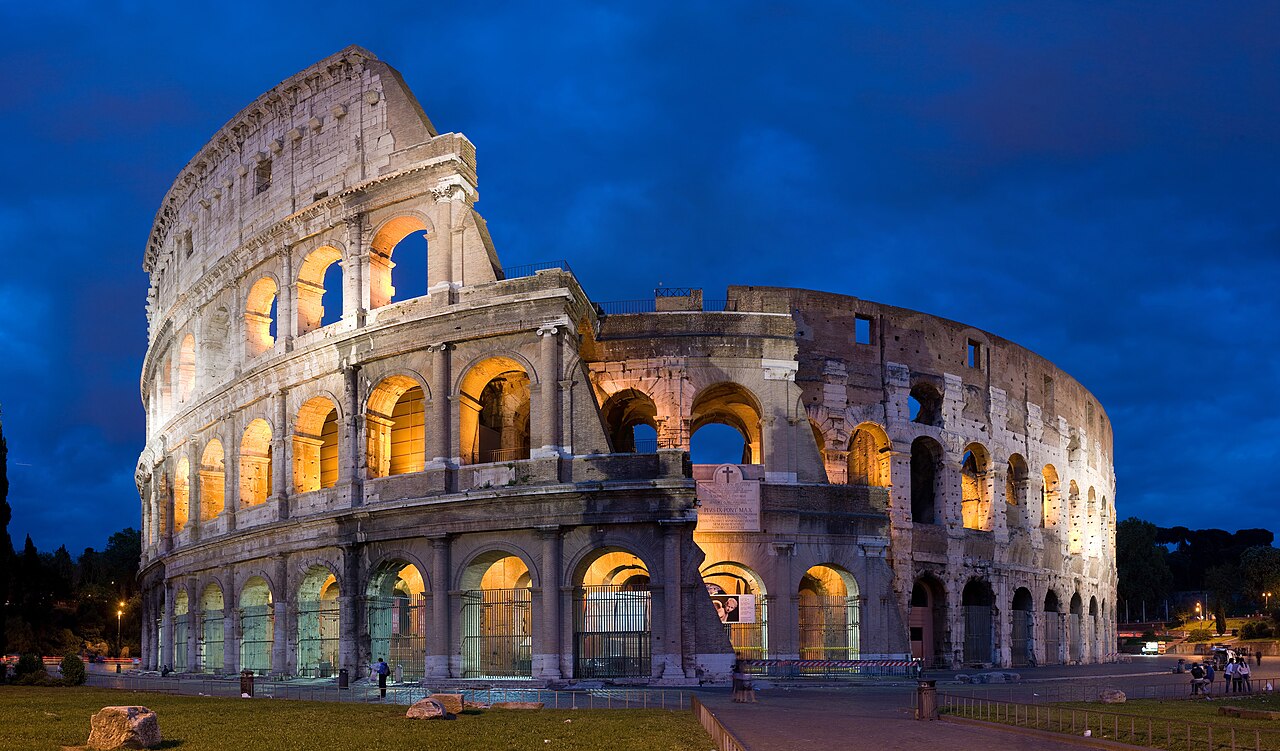
File:Colosseum in Rome, Italy - April 2007.jpg
The Flavian Amphitheatre, more commonly known as the Colosseum
Wang Mang Appointed Regent
Following the death of Emperor Ai, Wang Zhengjun's nephew Wang Mang (45 BC–23 AD) was appointed regent as Marshall of State on 16 August under Emperor Ping. When Ping died on 3 February 6 AD, Ruzi Ying was chosen as heir and Wang Mang was appointed to serve as acting emperor for the child. Wang promised to relinquish control once the child came of age.
First Nationwide Census in Chinese History
The first nationwide census in Chinese history was taken in 2 AD, registering the Han's total population as comprising 57,671,400 individuals across 12,366,470 households. This remarkable administrative achievement demonstrated the sophistication of Han bureaucratic organization. The census data provides invaluable historical information about the population of ancient China.
Wang Mang Founds the Xin Dynasty
On 10 January 9 AD, Wang Mang claimed that the divine Mandate of Heaven called for the end of the Han dynasty and the beginning of his own: the Xin dynasty (9–23 AD). Despite protests and revolts from the nobility, Wang Mang usurped the throne, interrupting the Han dynasty. He initiated a series of major reforms including outlawing slavery and nationalizing land, which were ultimately unsuccessful.
Han Dynasty Granary west of Dunhuang
Ruins built during the Western Han period, representing the era that Wang Mang brought to an end
Yellow River Floods Devastate Wang Mang's Regime
Massive floods in approximately 3 AD and 11 AD devastated Wang Mang's regime. Gradual silt build-up in the Yellow River had raised its water level and overwhelmed flood control works, causing the river to split into two new branches. The floods dislodged thousands of peasant farmers, many of whom joined roving bandit and rebel groups such as the Red Eyebrows.
Battle of Kunyang and Rise of Liu Xiu
Liu Xiu, known posthumously as Emperor Guangwu, distinguished himself at the Battle of Kunyang in 23 AD and was urged to succeed the Gengshi Emperor. The Gengshi Emperor had attempted to restore the Han dynasty but was overwhelmed by the Red Eyebrow rebels who deposed and assassinated him. Liu Xiu's victory at Kunyang was a pivotal moment in the restoration of the Han dynasty.
Eastern Han Dynasty Founded — Emperor Guangwu Establishes Luoyang as Capital
The Eastern Han formally began on 5 August 25 AD when Liu Xiu became Emperor Guangwu of Han. Guangwu made Luoyang his capital in 25 AD, marking the beginning of the Eastern Han period. By 27 AD, his officers Deng Yu and Feng Yi had forced the Red Eyebrows to surrender and executed their leaders for treason.
Han Reaffirms Control over Korean Commanderies
During the widespread rebellion against Wang Mang, the state of Goguryeo was free to raid Han's Korean commanderies. Han did not reaffirm its control over the region until 30 AD. This demonstrated the challenges the restored Han dynasty faced in reasserting authority over distant territories.
Trưng Sisters Rebellion in Vietnam
The Trưng Sisters of Vietnam rebelled against Han in 40 AD. Their rebellion was crushed by Han general Ma Yuan in a campaign from 42 to 43 AD. This rebellion represented one of the significant challenges to Han authority in its southern territories.
Southern Xiongnu Submits to Han
The Xiongnu leader Bi, a rival claimant to the throne against his cousin Punu, submitted to Han as a tributary vassal in 50 AD. This created two rival Xiongnu states: the Southern Xiongnu led by Bi as an ally of Han, and the Northern Xiongnu led by Punu as an enemy of Han. This division significantly weakened the Xiongnu confederation.

Bronze seal of a Xiongnu chieftain
Bronze seal conferred by the Eastern Han government on a Xiongnu chieftain who submitted to Han authority
Buddhism First Mentioned in China
Buddhism first entered Imperial China through the Silk Road during the Eastern Han, and was first mentioned in 65 AD. Liu Ying, a half-brother to Emperor Ming of Han, was one of its earliest Chinese adherents, though Chinese Buddhism at this point was heavily associated with Huang-Lao Taoism. China's first known Buddhist temple, the White Horse Temple, was constructed outside the wall of Luoyang during Emperor Ming's reign.
Northern Xiongnu Defeated at Battle of Yiwulu
Dou Gu defeated the Northern Xiongnu at the Battle of Yiwulu in 73 AD, evicting them from Turpan and chasing them as far as Lake Barkol before establishing a garrison at Hami. The Northern Xiongnu had conquered the Tarim Basin during Wang Mang's turbulent reign and used it as a base to invade the Hexi Corridor. This victory helped restore Han influence in Central Asia.
2nd Century
Roman Empire Reaches Greatest Territorial Extent Under Trajan
Rome reached its greatest territorial extent under Emperor Trajan, encompassing approximately 5 million km². The traditional population estimate of the empire accounted for between one-sixth and one-fourth of the world's total population. Trajan's expansionist policies represented the peak of Roman imperial power before a period of increasing consolidation and eventual decline.
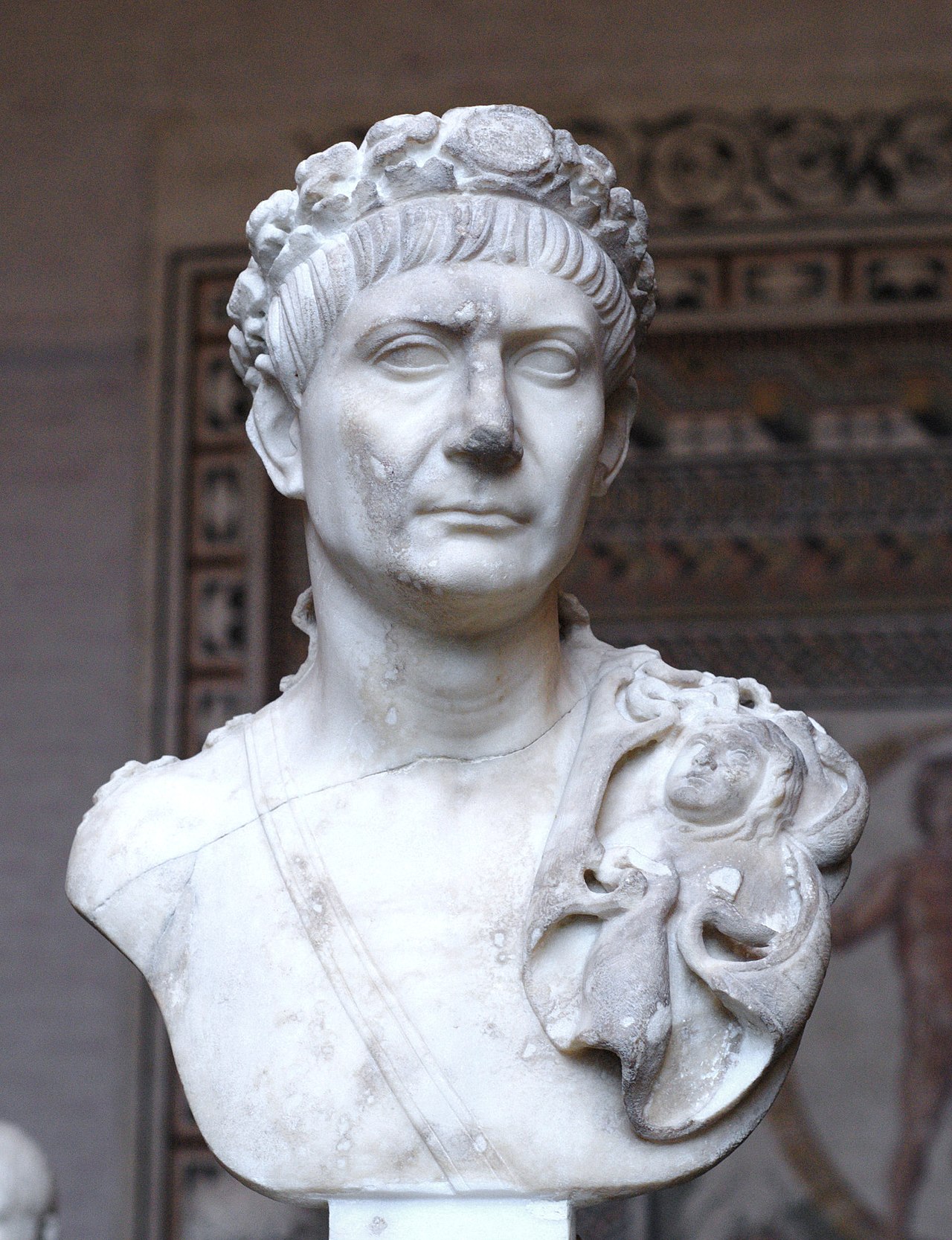
File:Traianus Glyptothek Munich 72.jpg
Bust of Emperor Trajan, under whom the Roman Empire reached its greatest territorial extent
Hadrian's Wall Constructed
Emperor Hadrian adopted a policy of maintaining rather than expanding the empire, and Hadrian's Wall was constructed to separate the Roman world from what was perceived as an ever-present barbarian threat in northern Britain. It is the primary surviving monument of Rome's frontier defense efforts. The wall represents the shift from expansionist to consolidationist imperial policy.
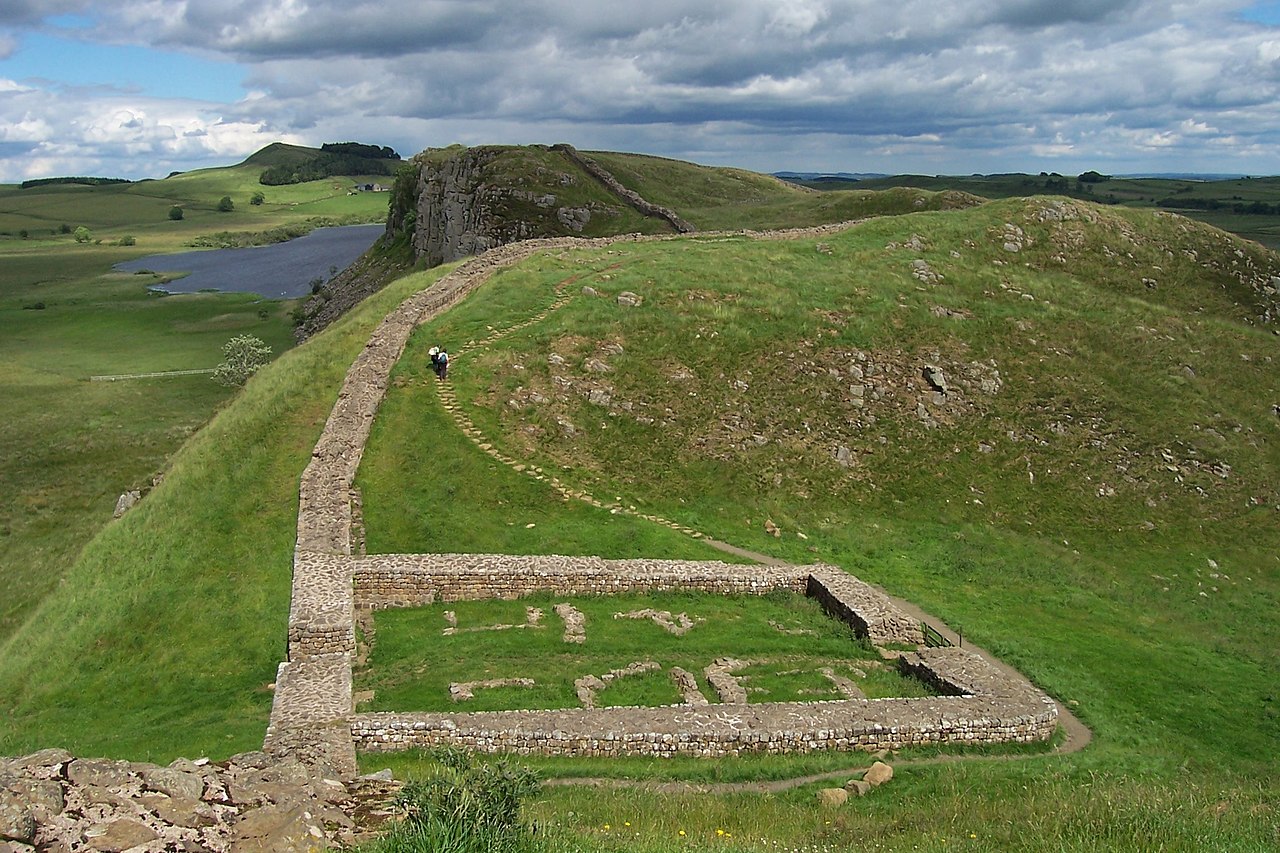
File:Milecastle 39 on Hadrian's Wall.jpg
A segment of the ruins of Hadrian's Wall in northern England, overlooking Crag Lough
Hadrian Visits Judaea and Refounds Jerusalem
Emperor Hadrian visited the region of Judaea in 129/130 AD and refounded Jerusalem as the Roman colony Aelia Capitolina, naming it after his family and the Capitoline Triad. The refoundation overlaid the destroyed Jewish city with a new Roman urban plan and included the construction of a Temple to Jupiter on the site of the former Jewish Temple. These measures, combined with restrictions on Jewish practices, helped spark the Bar Kokhba Revolt.

File:Bust Hadrian Musei Capitolini MC817.jpg
Bust of Emperor Hadrian, who refounded Jerusalem as Aelia Capitolina
Bar Kokhba Revolt
Hadrian's measures in Judaea, combined with restrictions on Jewish practices, helped spark the Bar Kokhba Revolt from 132 to 135 AD. After crushing the uprising, Roman forces expelled most Jews from Jerusalem, barring their entry except on certain days. This revolt was the last major Jewish uprising against Roman rule and resulted in the near-complete dispersal of the Jewish population from Judaea.
Reign of Marcus Aurelius and the Five Good Emperors
The Nerva-Antonine dynasty produced the 'Five Good Emperors': Nerva, Trajan, Hadrian, Antoninus Pius, and Marcus Aurelius, representing a period of stable and effective governance. Marcus Aurelius was the last of these emperors, and his reign is often considered the end of the Pax Romana. Only two of his fourteen children are known to have reached adulthood, illustrating the harsh realities of ancient life even for the elite.

File:(Toulouse) Buste cuirassé de Marc Aurèle agè - Musée Saint-Raymond Ra 61 b.jpg
Bust of Marcus Aurelius, the last of the Five Good Emperors
Accession of Commodus Marks Beginning of Decline
In 180 AD, the accession of Commodus marked what Greek historian Cassius Dio described as the descent 'from a kingdom of gold to one of rust and iron.' This comment led historians, notably Edward Gibbon, to take Commodus's reign as the beginning of the Empire's decline. The period of unprecedented stability and prosperity known as the Pax Romana effectively ended.
Cai Lun Invents Standard Papermaking Process
The standard papermaking process was invented by Cai Lun (AD 50–121) in 105 AD. The oldest known Chinese piece of hempen paper dates to the 2nd century BC, but Cai Lun's process standardized and improved paper production. The oldest known surviving piece of paper with writing on it was found in the ruins of a Han watchtower abandoned in 110 AD in Inner Mongolia.
Qiang Rebellion and Empress Deng Sui's Regency
After Emperor He's death, his wife Empress Deng Sui managed state affairs as the regent empress dowager during a turbulent financial crisis and widespread Qiang rebellion that lasted from 107 to 118 AD. This period demonstrated the increasing role of empress dowagers in Han governance. The Qiang rebellion was one of several challenges to Han authority in the northwest.
Zhang Heng Mechanically Rotates Armillary Sphere
Court Astronomer Zhang Heng (78–139 AD) used a water clock, waterwheel, and a series of gears to mechanically rotate his metal-ringed armillary sphere, a three-dimensional representation of movements in the celestial sphere. He was also the first in China to install an additional tank between the reservoir and inflow vessel to address slowed timekeeping in water clocks. Zhang also introduced grid references in cartography in the early 2nd century.
Zhang Heng Invents Seismometer
Court Astronomer Zhang Heng (78–139 AD) invented a device he termed an 'earthquake weathervane,' which the British sinologist Joseph Needham described as 'the ancestor of all seismographs.' This device was able to detect the exact cardinal or ordinal direction of earthquakes from hundreds of kilometres away using an inverted pendulum. On one occasion, the device detected an earthquake in Longxi Commandery (modern Gansu) without any observers feeling a disturbance.

A modern replica of Zhang Heng's seismometer
Modern replica of Zhang Heng's earthquake detection device, the world's first seismometer
Roman Embassy Reaches Han Court
A Roman embassy of Emperor Marcus Aurelius is recorded in the Weilüe and Book of Later Han to have reached the court of Emperor Huan of Han in 166 AD, though scholars suggest this was most likely a group of Roman merchants. Roman glasswares and coins have been found in China, and Roman medallions from the reign of Antoninus Pius and Marcus Aurelius were found at Óc Eo in Vietnam. This contact represented the distant connections facilitated by the Silk Road.
Partisan Prohibitions Begin
In 167 AD, the Grand Commandant Dou Wu convinced Emperor Huan to release the official Li Ying and his associates from the Imperial University who had been imprisoned on a dubious charge of treason. However, the emperor permanently barred Li Ying and his associates from serving in office, marking the beginning of the Partisan Prohibitions. This represented a major conflict between the gentry class and the palace eunuchs.
Ding Huan Invents Rotary Fan and Zoetrope Lamp
Around 180 AD, mechanical engineer and craftsman Ding Huan created a manually operated rotary fan used for air conditioning within palace buildings. Ding also used gimbals as pivotal supports for one of his incense burners and invented the world's first known zoetrope lamp. These inventions are mentioned in the Miscellaneous Notes on the Western Capital.
Yellow Turban Rebellion
The Yellow Turban Rebellion broke out in 184 AD, led by the Taoist faith healer Zhang Jue across eight provinces. The Partisan Prohibitions were repealed during this rebellion because the court did not want to continue alienating the gentry class who might otherwise join the rebellions. Although the Yellow Turbans were defeated within a year, many generals appointed during the crisis never disbanded their militias, using these troops to amass power outside of the collapsing imperial authority.
Dong Zhuo Takes Control of Luoyang
General Dong Zhuo found the young Emperor Shao and his brother Liu Xie wandering in the countryside after the massacre of the eunuchs. He escorted them back to the capital and was made Minister of Works, taking control of Luoyang and forcing Yuan Shao to flee. Dong Zhuo demoted Emperor Shao and promoted his brother Liu Xie as Emperor Xian, then burned Luoyang to the ground and resettled the court at Chang'an in May 191 AD.

Provinces and commanderies in 219 AD
Map showing the fragmented political landscape of the late Han dynasty, reflecting the warlord period initiated by Dong Zhuo's actions
Assassination of He Jin and Massacre of Eunuchs
The eunuchs assassinated General-in-chief He Jin on 22 September 189 AD after he plotted with Yuan Shao to overthrow them. Yuan Shao then besieged Luoyang's Northern Palace while his brother Yuan Shu besieged the Southern Palace. On September 25 both palaces were breached and approximately two thousand eunuchs were killed, effectively ending eunuch dominance at the Han court.
Cao Cao Moves Capital to Xuchang
Emperor Xian fled from Chang'an in 195 AD to the ruins of Luoyang. He was persuaded by Cao Cao (155–220 AD), then Governor of Yan Province, to move the capital to Xuchang in 196 AD. This effectively made Cao Cao the power behind the throne, as he controlled the emperor and used imperial authority to legitimize his own political and military actions.
3rd Century
Constitutio Antoniniana Grants Universal Citizenship
In 212 AD, during the reign of Caracalla, Roman citizenship was granted to all freeborn inhabitants of the empire through the Constitutio Antoniniana. This legal egalitarianism required a far-reaching revision of existing laws that distinguished between citizens and non-citizens. The extension of citizenship also seemed to increase the competitive urge among the upper classes to have their superiority affirmed within the justice system.
Crisis of the Third Century
The Empire was engulfed by the Crisis of the Third Century, a 49-year period of invasions, civil strife, economic disorder, and plague that threatened its very existence. The Gallic and Palmyrene empires broke away from the state, and a series of short-lived emperors led the Empire. This crisis sometimes marks the transition from classical to late antiquity in historical periodization.
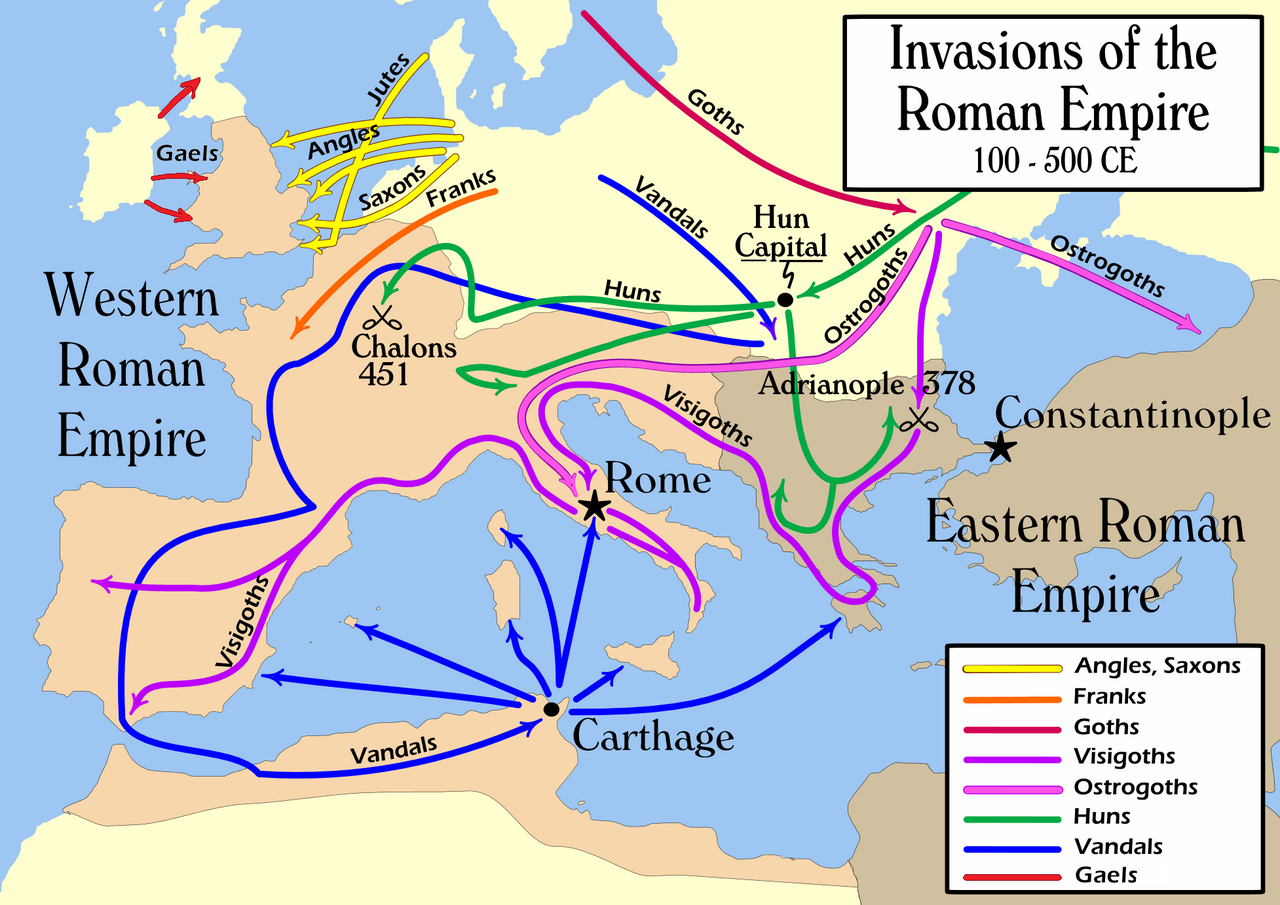
File:Invasions of the Roman Empire 1.png
Map of barbarian invasions that contributed to the Crisis of the Third Century
Aurelian Reunifies the Empire
Emperor Aurelian stabilized the empire militarily and reunified it after the breakaway of the Gallic and Palmyrene empires during the Crisis of the Third Century. His reign also saw general economic anxieties come to a head, with bankers losing confidence in coins despite Roman coinage having long been fiat money. Aurelian's military successes earned him the title 'Restorer of the World'.
Diocletian Reorganizes the Empire and Establishes the Tetrarchy
Diocletian reorganized and restored much of the empire in 285 AD, dividing it into four regions each ruled by a separate tetrarch in what became known as the Tetrarchy. His reign also brought the empire's most concerted effort against Christianity, known as the 'Great Persecution.' Diocletian's efforts to stabilize the Empire after the Crisis of the Third Century included two major compilations of law, the Codex Gregorianus and the Codex Hermogenianus.
Battle of Guandu — Cao Cao Defeats Yuan Shao
Yuan Shao challenged Cao Cao for control over the emperor, but his power was greatly diminished after Cao defeated him at the Battle of Guandu in 200 AD. After Yuan died, Cao Cao killed Yuan Shao's son Yuan Tan in 205 AD. Yuan Shang and Yuan Xi were killed in 207 AD by Gongsun Kang, who sent their heads to Cao Cao, consolidating Cao's dominance in the north.
Battle of Red Cliffs — China Divided into Three Spheres
After Cao Cao's defeat at the naval Battle of Red Cliffs in 208 AD, China was divided into three spheres of influence: Cao Cao dominating the north, Sun Quan (182–252 AD) dominating the south, and Liu Bei (161–223 AD) dominating the west. This division foreshadowed the Three Kingdoms period that would follow the Han dynasty. The battle was one of the most decisive naval engagements in Chinese history.
Five Pecks of Rice Rebellion Quelled
Zhang Lu's Five Pecks of Rice rebellion, in what is now northern Sichuan and southern Shaanxi, was not quelled until 215 AD. The rebellion had begun in 184 AD alongside the Yellow Turban Rebellion, both belonging to different hierarchical Taoist religious societies. The prolonged nature of this rebellion demonstrated the weakness of central Han authority in its final decades.
Fall of the Han Dynasty — Cao Pi Usurps the Throne
Cao Cao died in March 220 AD, and by December his son Cao Pi (187–226 AD) had Emperor Xian relinquish the throne to him. Cao Pi is known posthumously as Emperor Wen of Wei. This formally ended the Han dynasty and initiated an age of conflict between the Three Kingdoms: Cao Wei, Eastern Wu, and Shu Han.
Provinces and commanderies in 219 AD
Map of the Han dynasty in its penultimate year, showing the fragmented political landscape that led to its fall
4th Century
Diocletian's Great Persecution of Christians
From 303 to 311 AD, Diocletian undertook the most severe persecution of Christians in Roman history, known as the 'Great Persecution.' This represented the empire's most concerted effort against the perceived threat of Christianity. The persecution ultimately failed to suppress Christianity and may have strengthened Christian resolve and identity.
Constantine the Great Converts to Christianity
In the early 4th century, Constantine I became the first emperor to convert to Christianity, fundamentally transforming the relationship between the Roman state and the Christian religion. He supported the Church financially and made laws that favored it, though he never engaged in a purge of non-Christians. The new religion had already grown from less than 50,000 to over a million adherents between 150 and 250 AD.
Constantine Moves Imperial Seat to Constantinople
Constantine the Great moved the imperial seat from Rome to Byzantium in 330 AD and renamed it Constantinople. This decision shifted the center of imperial power to the east and established Constantinople as the new capital of the Eastern Empire. The city would remain the capital of the Byzantine Empire for over a thousand years.
Emperor Julian Attempts to Restore Traditional Religion
Emperor Julian, under the influence of his adviser Mardonius, attempted to restore Classical Roman and Hellenistic religion, only briefly interrupting the succession of Christian emperors. He banned Christians from teaching the classical curriculum and tried to revive traditional public sacrifice. Julian met Christian resistance and lack of popular support, and his reign was short-lived.
Theodosius I Makes Christianity the State Religion
Theodosius I, the last emperor to rule over both East and West, made Christianity the state religion before his death in 395 AD. He made multiple laws and acted against alternate forms of Christianity, and heretics were persecuted and killed by both the government and the church throughout late antiquity. This decision permanently transformed the religious character of the Roman Empire and its successors.
Roman Empire Divided into Eastern and Western Halves
During the decades of the Constantinian and Valentinian dynasties, the empire was divided along an east-west axis, with dual power centres in Constantinople and Rome. Theodosius I, the last emperor to rule over both East and West, died in 395 AD after making Christianity the state religion. After his death, the empire was permanently divided between his two sons.

File:The Roman Empire, AD 395.png
The administrative divisions of the Roman Empire in 395 AD
5th Century
Western Roman Empire Begins to Disintegrate
The Western Roman Empire began to disintegrate in the early 5th century as Germanic peoples of dubious loyalty to Rome caused the empire to start dismembering itself. The Romans fought off all invaders, most famously Attila the Hun, but could not maintain cohesion. The Migration Period, involving large invasions by Germanic peoples and by the Huns of Attila, led to the accelerating decline of the Western Roman Empire.
File:Invasions of the Roman Empire 1.png
Map of barbarian invasions that led to the fall of the Western Roman Empire
Fall of the Western Roman Empire
With the fall of Ravenna to the Germanic Herulians and the deposition of Romulus Augustus in 476 by Odoacer, the Western Empire finally collapsed. Odoacer ended the Western Empire by declaring Zeno sole emperor and placing himself as Zeno's nominal subordinate, while in reality ruling Italy alone. Most chronologies place the end of the Western Roman Empire in this year, marking the transition from antiquity to the Middle Ages.

File:Western and Eastern Roman Empires 476AD(3).svg
The Roman Empire by 476, noting western and eastern divisions at the time of the Western Empire's fall
6th Century
Nika Riots in Constantinople
The Nika riots of 532 were one of the most violent riots in the history of Constantinople, demonstrating how spectacles could quickly become sites of social and political protest. Emperors sometimes had to deploy force to put down crowd unrest, most notoriously at this event. The riots resulted in the deaths of tens of thousands and nearly toppled Emperor Justinian.
9th Century
Charlemagne Crowned as Roman Emperor
The Holy Roman Empire was established in 800 when Pope Leo III crowned Charlemagne as Roman emperor, claiming succession to the Roman imperial tradition in the West. This event represented one of several attempts by medieval states to claim the legacy of the Roman Empire. In the medieval West, 'Roman' came to mean the church and the Catholic Pope.
15th Century
Fall of Constantinople and End of the Byzantine Empire
The Byzantine (Eastern Roman) Empire survived for over a millennium after the fall of the Western Empire, until the city of Constantinople fell in 1453. Constantine XI Palaiologos, the last Roman emperor, died in battle against Mehmed II and his Ottoman forces during the siege of Constantinople. Mehmed II adopted the title of caesar in an attempt to claim a connection to the former Empire, and his claim was recognized by the Patriarchate of Constantinople.