Comparing Timelines
Exploring the overlapping histories of "Russian Revolution" and "Spanish flu".

Russian Revolution
1905 - 1923

Spanish flu
1918 - 1922
1905 CE
Bloody Sunday Massacre
Hundreds of unarmed protesters were shot by the Tsar's troops in St. Petersburg. This massacre triggered nationwide protests and soldier mutinies, becoming a major factor contributing to the 1917 revolutions. The event led to the creation of the St. Petersburg Soviet and laid groundwork for later revolutionary movements.

Soldiers blocking Narva Gate on Bloody Sunday
Soldiers blocking Narva Gate on Bloody Sunday
October Manifesto Issued
Following the Bloody Sunday massacre and subsequent general strike, Tsar Nicholas II issued the October Manifesto establishing a democratically elected parliament (the State Duma). This represented the first major constitutional concession by the Tsarist regime, though the Tsar later worked to limit these democratic reforms.
1914 CE
Battle of Tannenberg
Russia's first major battle of World War I ended in disaster with over 30,000 Russian troops killed or wounded and 90,000 captured, while Germany suffered only 12,000 casualties. This crushing defeat undermined confidence in Russian military leadership and contributed to growing war-weariness among the population.

Russian troops in trenches awaiting a German attack
Russian troops in trenches awaiting a German attack
1915 CE
Tsar Nicholas II Takes Personal Command of Army
Tsar Nicholas II assumed direct command of the Imperial Russian Army, leaving his German-born wife Alexandra in charge of the government. This decision proved disastrous as the Tsar became personally responsible for Russia's continuing military defeats, while Alexandra's rule was marked by corruption and the influence of Rasputin.
1916 CE
Assassination of Rasputin
A small group of nobles assassinated Grigori Rasputin, the controversial mystic who had gained significant influence over the Imperial family. His death removed a major source of scandal and corruption but came too late to save the monarchy's reputation among the Russian people.
1917 CE
Putilov Factory Strike Begins
Workers at the Putilov factory, Petrograd's largest industrial plant, went on strike. This strike marked the beginning of the February Revolution as it sparked a series of demonstrations and strikes that would ultimately lead to the collapse of the Tsarist regime.
International Women's Day Demonstrations
A series of meetings and rallies held for International Women's Day gradually turned into economic and political gatherings demanding bread. These demonstrations, supported by industrial workers, brought over 50,000 workers on strike and marked a crucial escalation in the revolutionary movement.
Revolutionaries protesting in February 1917
Revolutionaries protesting in February 1917
General Strike in Petrograd
Virtually every industrial enterprise in Petrograd was shut down, along with many commercial and service enterprises. Students, white-collar workers, and teachers joined the workers in the streets, creating a massive popular uprising that paralyzed the capital.
Military Mutiny Begins
When Tsar Nicholas II ordered the army to suppress the rioting by force, troops began to revolt instead of obeying orders. Many officers were shot or went into hiding, and the garrison's ability to maintain order collapsed, marking the point of no return for the Tsarist regime.

Soldiers marching in Petrograd, March 1917
Soldiers marching in Petrograd, March 1917
Formation of Petrograd Soviet
Socialist parties established the Petrograd Soviet to represent workers and soldiers, creating a rival power center to the emerging Provisional Government. This marked the beginning of the 'dual power' situation that would characterize Russian politics throughout 1917.

The Petrograd Soviet Assembly meeting in 1917
The Petrograd Soviet Assembly meeting in 1917
Abdication of Tsar Nicholas II
Tsar Nicholas II abdicated the throne on behalf of himself and his son, nominating his brother Grand Duke Michael to succeed him. However, Michael declined the crown the next day, effectively ending over 300 years of Romanov rule and the Russian monarchy.
Provisional Government Announced
A provisional government was announced and initially chaired by liberal aristocrat Prince Georgy Lvov. The center-left government competed with the Petrograd Soviet for power over Russia, establishing the complex political situation known as 'dual power' that would define the revolutionary period.

Provisional Government's volunteer soldiers secure Petrograd's Palace Square with the Austin Armoured Car, summer 1917.
Provisional Government's volunteer soldiers secure Petrograd's Palace Square with the Austin Armoured Car, summer 1917.
Lenin Returns to Russia
Vladimir Lenin arrived in Petrograd after traveling through Germany in a sealed train. German officials had arranged his passage hoping his activities would weaken Russia or lead to its withdrawal from the war. His return marked a crucial turning point for the Bolshevik movement.
Lenin Presents April Theses
Lenin outlined central Bolshevik policies in his April Theses, including the demand that Soviets take power and denouncing cooperation with the Provisional Government. These radical positions initially shocked even many Bolsheviks but gradually gained support as conditions deteriorated.
Failed June Offensive
The Provisional Government launched an attack against Germany that failed miserably. This military disaster further undermined the government's credibility and fueled anti-war sentiment among soldiers and workers, strengthening support for the Bolsheviks' peace platform.
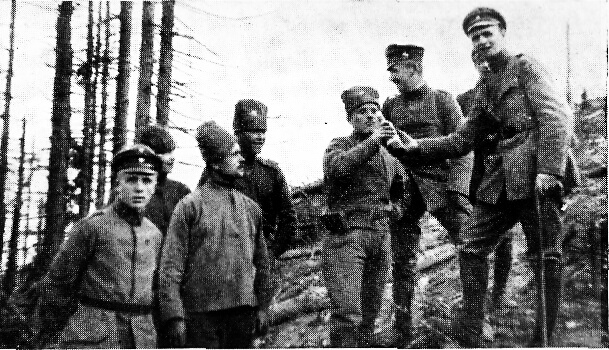
Russian troops meeting German troops in No Man's Land
Russian troops meeting German troops in No Man's Land
July Days Uprising
Sailors, soldiers, and Petrograd workers took to the streets in violent protest calling for 'all power to the Soviets.' The revolt was disowned by Lenin and Bolshevik leaders and dissipated within days, leading to Lenin fleeing to Finland and Trotsky's arrest, temporarily weakening Bolshevik influence.

Revolutionaries attacking the tsarist police in the early days of the February Revolution
Revolutionaries attacking the tsarist police in the early days of the February Revolution
Kornilov Affair
General Lavr Kornilov ordered troops to Petrograd believing the government had been captured by radicals. Kerensky had to ask for Bolshevik assistance to stop the coup attempt. The Bolsheviks' role in defeating Kornilov significantly strengthened their position and credibility among workers and soldiers.
Trotsky Becomes Chairman of Petrograd Soviet
Leon Trotsky became chairman of the Petrograd Soviet after the Bolsheviks gained a majority. This gave the Bolsheviks control of the most important revolutionary institution in the capital and positioned them to organize the October Revolution.
Bolshevik Central Committee Votes for Revolution
The Bolshevik Central Committee passed a resolution calling for the dissolution of the Provisional Government in favor of the Petrograd Soviet. The resolution passed 10-2, with Kamenev and Zinoviev dissenting, officially promoting what would become the October Revolution.
October Revolution Begins
The Bolshevik party organized an insurrection that began with the assault on Petrograd. Led by Trotsky's Revolutionary Military Committee, the initial stage occurred largely without casualties. This marked the beginning of Bolshevik seizure of power from the Provisional Government.

The 2nd Moscow Women Death Battalion protecting the Winter Palace as the last guards of the stronghold
The 2nd Moscow Women Death Battalion protecting the Winter Palace as the last guards of the stronghold
Russian Constituent Assembly Elections
Elections to the Russian Constituent Assembly took place with the Bolsheviks gaining 25% of the vote while the Socialist-Revolutionaries won 58%. When it became clear the Bolsheviks had little support outside industrialized areas, they began restricting non-Bolshevik participation in the Soviets.
1918 CE
Russian Civil War Begins
Liberal and monarchist forces organized into the White Army went to war against the Bolsheviks' Red Army. The civil war began with domestic anti-Bolshevik forces confronting the nascent Red Army, eventually involving foreign intervention and lasting until 1922.
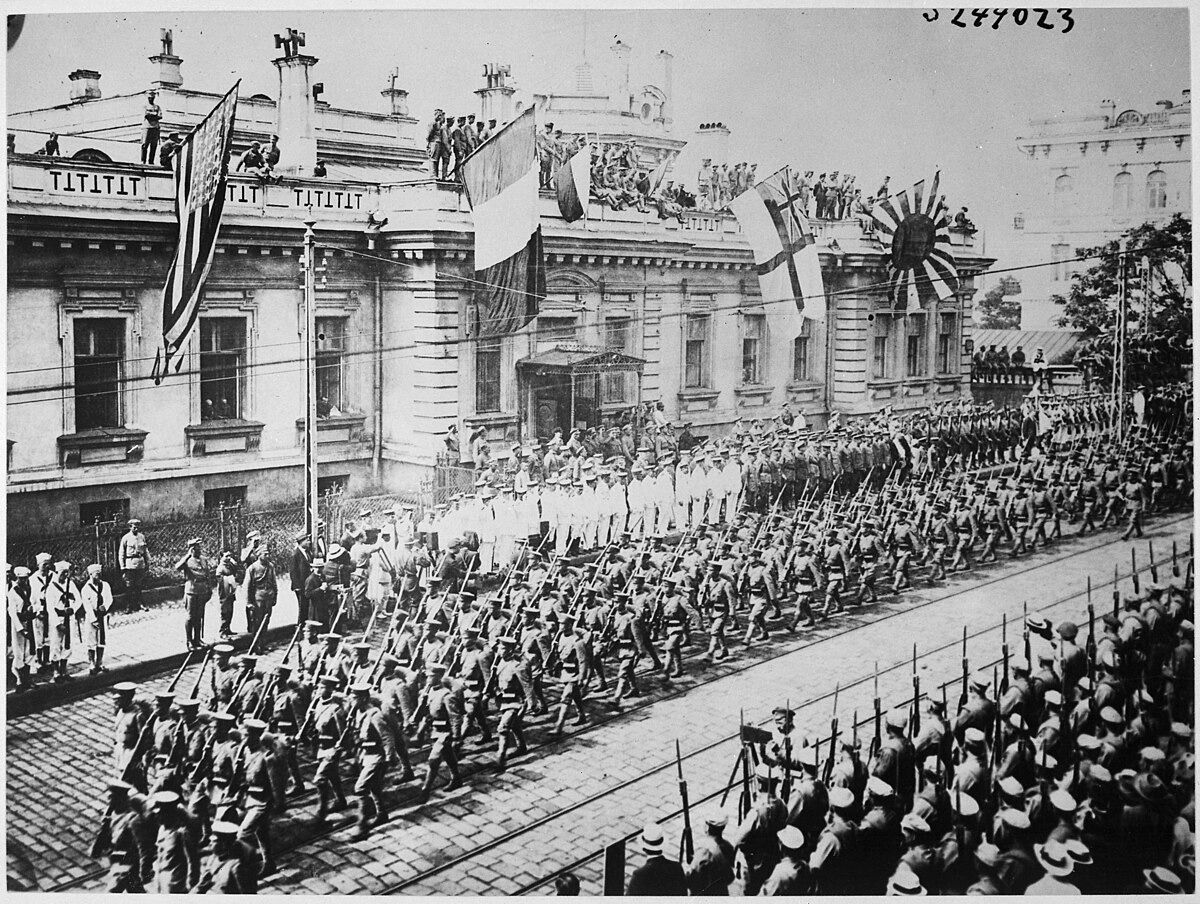
American, British, and Japanese Troops parade through Vladivostok in armed support to the White Army.
American, British, and Japanese Troops parade through Vladivostok in armed support to the White Army.
Dissolution of Constituent Assembly
The Bolsheviks dissolved the democratically elected Constituent Assembly after it became clear they lacked majority support. This action marked the end of Russia's brief experiment with parliamentary democracy and the beginning of one-party Bolshevik rule.

The dissolution of the Constituent Assembly on 6 January 1918. The Tauride Palace is locked and guarded by Trotsky, Sverdlov, Zinoviev and Lashevich.
The dissolution of the Constituent Assembly on 6 January 1918. The Tauride Palace is locked and guarded by Trotsky, Sverdlov, Zinoviev and Lashevich.
Treaty of Brest-Litovsk Signed
Bolshevik leaders signed the Treaty of Brest-Litovsk with Germany, fulfilling their promise to end Russia's participation in World War I. The treaty came at a heavy cost, with Russia losing significant territory, but allowed the Bolsheviks to focus on consolidating power domestically.
Murder of the Imperial Family
The Bolsheviks murdered Tsar Nicholas II and his entire family in Yekaterinburg. Nicholas, Alexandra, their children, their physician, and several servants were taken into the basement and shot, ending the Romanov dynasty and eliminating any possibility of monarchist restoration.
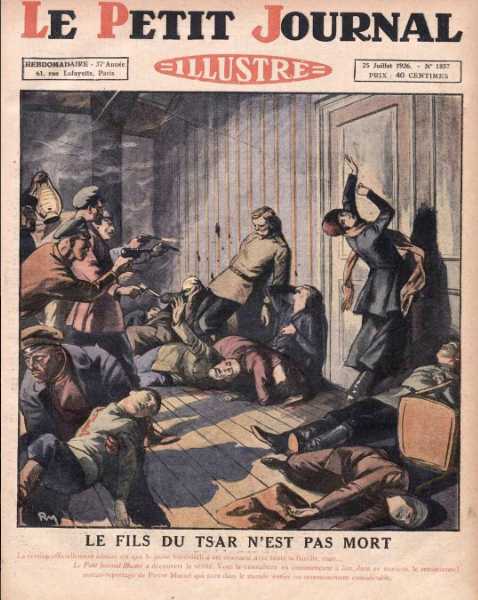
Murder of the Romanov family, Le Petit Journal
Murder of the Romanov family, Le Petit Journal
First documented cases in Haskell County, Kansas
The earliest documented cases of what would become the Spanish flu pandemic appeared in Haskell County, Kansas. Local doctor Loring Miner observed the disease and warned the U.S. Public Health Service. This rural outbreak would later spread to military camps and around the world.
Treaty of Brest-Litovsk spreads flu to Russia
After the signing of the Treaty of Brest-Litovsk in March 1918, Germany started releasing Russian prisoners of war, who brought the disease back to their country, facilitating the pandemic's spread to Russia.
Albert Gitchell case at Camp Funston marks pandemic beginning
The pandemic is conventionally marked as beginning with the recording of Albert Gitchell, an army cook at Camp Funston in Kansas. Within days, 522 men at the camp had reported sick, demonstrating the rapid spread in military facilities.
Virus reaches Queens, New York
By March 11, 1918, the influenza virus had spread from the military camps to reach Queens, New York, marking its arrival in major population centers on the East Coast.
Pandemic reaches Western Front and Europe
The flu became epidemic in the Midwest, East Coast, and French ports by April 1918, reaching the Western Front by mid-April. It then quickly spread to France, Great Britain, Italy, and Spain, severely impacting World War I military operations.
Pandemic reaches Asia and global spread
The flu reached North Africa, India, and Japan in May 1918, and soon after had likely gone around the world with recorded cases in Southeast Asia in April. This marked the truly global nature of the pandemic.
First Spanish newspaper reports appear
On May 21, 1918, El Liberal published likely the first account in Spain of the Spanish flu, titled 'Can One Live? The Fashionable Illness.' Spanish newspapers freely reported the outbreak due to wartime neutrality, leading to the 'Spanish flu' misnomer.

El Sol (Madrid), 28 May 1918: "The three-day fever – In Madrid 80,000 Are Infected – H.M. the King is sick"
Spanish newspaper coverage of the flu outbreak
The Times reports 'Spanish influenza' name
The Times of London reported that 'Everybody thinks of it as the Spanish influenza to-day,' marking the widespread adoption of the misleading name that would stick throughout history despite Spain not being the origin.

Front page of The Times (London), 25 June 1918: "The Spanish Influenza"
British newspaper coverage establishing the 'Spanish flu' name
Pandemic reaches Australia, first wave ends
After reaching Australia in July 1918, the first wave of the pandemic started to recede. This first wave was relatively mild with mortality rates not appreciably above normal, but it disrupted military operations significantly.
Deadly second wave begins
The second wave began in the second half of August 1918, probably spreading to Boston, Massachusetts and Freetown, Sierra Leone. This wave was much more deadly than the first, with October 1918 becoming the month with the highest fatality rate of the entire pandemic.

American Expeditionary Force flu patients at U.S. Army Camp Hospital no. 45 in Aix-les-Bains, France, 1918
Military hospital treating flu patients during the deadly second wave
New York City's first influenza fatality
On September 15, 1918, New York City saw its first fatality from influenza during the deadly second wave, marking the pandemic's lethal arrival in America's largest city.
Philadelphia Liberty Loans Parade disaster
The Philadelphia Liberty Loans Parade held on September 28, 1918, to promote government bonds for World War I, resulted in a massive outbreak causing 12,000 deaths. This became one of the most tragic examples of how public gatherings accelerated the pandemic's spread.
Peak mortality month of October 1918
October 1918 was the month with the highest fatality rate of the whole pandemic. In the United States alone, approximately 292,000 deaths were reported between September-December 1918, compared to only 26,000 during the same period in 1915.
Armistice celebrations cause new outbreaks
The celebrations of the Armistice of November 11, 1918, caused outbreaks in Lima and Nairobi, demonstrating how public gatherings continued to spread the disease even as the war ended.
Second wave mostly ends by December
By December 1918, the deadly second wave was mostly over, but the pandemic had already caused unprecedented mortality worldwide, fundamentally changing public health approaches and leaving lasting impacts on global society.
Seattle policemen wearing cloth face masks handed out by the American Red Cross during the Spanish flu pandemic, December 1918
Public health measures during the pandemic's peak
1919 CE
Third wave begins in 1919
Pandemic activity persisted into 1919 in many places. Cases began to rise again in some parts of the U.S. as early as late November 1918, with significant outbreaks occurring in cities including Los Angeles, New York City, Memphis, Nashville, San Francisco, and St. Louis.

London weekly deaths from influenza during 1918 and 1919
Statistical record showing the three waves of the pandemic
Australia experiences first outbreak
Influenza entered Australia for the first time in January 1919 after a strict maritime quarantine had successfully shielded the country through 1918. It assumed epidemic proportions first in Melbourne, peaking in mid-February.
European third wave peaks
A significant third wave developed in England and Wales by mid-February 1919, peaking in early March. France also experienced a significant wave that peaked in February, alongside the Netherlands, demonstrating the pandemic's continued global impact.
Fourth wave begins in Japan
In Japan, the flu broke out again in December 1919 and spread rapidly throughout the country. Between October 1919 and January 23, 1920, 780,000 cases were reported across the country, with at least 20,000 deaths recorded.

Japanese women in Tokyo during the Spanish flu pandemic, 1920
Japanese public health response during the fourth wave
1920 CE
Chicago outbreak begins fourth wave in US
Chicago experienced one of the first major outbreaks of the fourth wave beginning in mid-January 1920. The disease spread at an even faster rate than in winter 1919, though fewer were dying. The outbreak quickly spread outward from the center of the country.

American Red Cross nurses tend to flu patients in temporary wards set up inside the Oakland Municipal Auditorium
Medical response during the pandemic's later waves
Fourth wave peaks and subsides
The fourth wave in the United States reached a peak in early February 1920 and subsided as swiftly as it had appeared. According to data, this epidemic resulted in one third as many deaths as the 1918-1919 experience, but still caused significant mortality.
Pandemic declared largely over
By mid-1920, the pandemic was largely considered to be 'over' by the public as well as governments. Though parts of Chile experienced a third, milder wave between November 1920 and March 1921, the flu seemed mostly absent through the winter of 1920-1921.
1921 CE
Kronstadt Rebellion
Soviet Baltic sailors, former Red Army soldiers, and people of Kronstadt initiated a naval mutiny against Bolshevik economic policies. The rebellion raised 15 demands for Russian freedom but was brutally suppressed by the government, resulting in ten thousand casualties before the city fell.
Seasonal influenza returns
Seasonal influenza began to be reported again from many places in 1921. The winter of 1921-1922 was the first major reappearance of seasonal influenza in the Northern Hemisphere, marking the transition from pandemic to endemic flu.
1922 CE
End of Russian Civil War
The Russian Civil War concluded with the defeat of the White Army and separatist factions, leading to mass emigration from Russia. The victorious Bolshevik Party reconstituted itself into the All-Union Communist Party and established firm control over the former Russian Empire.
Major seasonal flu outbreak in Northern Hemisphere
The winter of 1921-1922 saw the first major reappearance of seasonal influenza in the Northern Hemisphere since the main pandemic. Northwestern Europe was particularly affected, with all-cause mortality in the Netherlands approximately doubling in January 1922 alone.
1923 CE
Final White Army Surrender
General Anatoly Pepelyayev capitulated in the Ayano-Maysky District, the last area controlled by the White Army. This surrender marked the end of all significant military campaigns against Bolshevik rule and completed the revolutionary period that had begun in 1917.