Comparing Timelines
Exploring the overlapping histories of "United Nations" and "The Holocaust".
United Nations
1920 - 2026

The Holocaust
1933 - 1948
1920 CE
League of Nations Formally Established
The League of Nations formally came into being when the Covenant of the League of Nations, ratified by 42 nations in 1919, took effect. The League Council acted as an executive body directing the Assembly's business, beginning with four permanent members—the United Kingdom, France, Italy, and Japan.
1933 CE
Nazi Party Seizes Power in Germany
Adolf Hitler was appointed chancellor of Germany in January 1933 through a backroom deal supported by right-wing politicians. Within months, all other political parties were banned, the regime seized control of media, and tens of thousands of political opponents were arrested. This marked the beginning of Nazi control that would lead to the Holocaust.
Anti-Jewish Laws Begin in Germany
In 1933, Jews were banned or restricted from several professions and the civil service. Various German government agencies, Nazi Party organizations, and local authorities instituted about 1,500 anti-Jewish laws. This systematic legal persecution laid the groundwork for later atrocities.
1935 CE
Nuremberg Laws Enacted
The regime passed the Nuremberg Laws in 1935, which reserved full citizenship rights for those of 'German or related blood', restricted Jews' economic activity, and criminalized new marriages and sexual relationships between Jews and non-Jewish Germans. These laws legally codified racial discrimination.
1938 CE
Kristallnacht - Night of Broken Glass
On November 9-10, 1938, the Nazis organized Kristallnacht, a nationwide pogrom. Over 7,500 Jewish shops were looted, more than 1,000 synagogues were damaged or destroyed, at least 90 Jews were murdered, and as many as 30,000 Jewish men were arrested. This marked a dramatic escalation in anti-Jewish violence.

View of the old synagogue in Aachen after its destruction during Kristallnacht
View of the old synagogue in Aachen after its destruction during Kristallnacht
1939 CE
First Nazi Ghettos Established
The first Nazi ghettos were established in the Wartheland and General Governorate in 1939 and 1940 on the initiative of local German administrators. The largest ghettos, such as Warsaw and Łódź, were established in existing residential neighborhoods and closed by fences or walls, concentrating Jewish populations for later deportation.
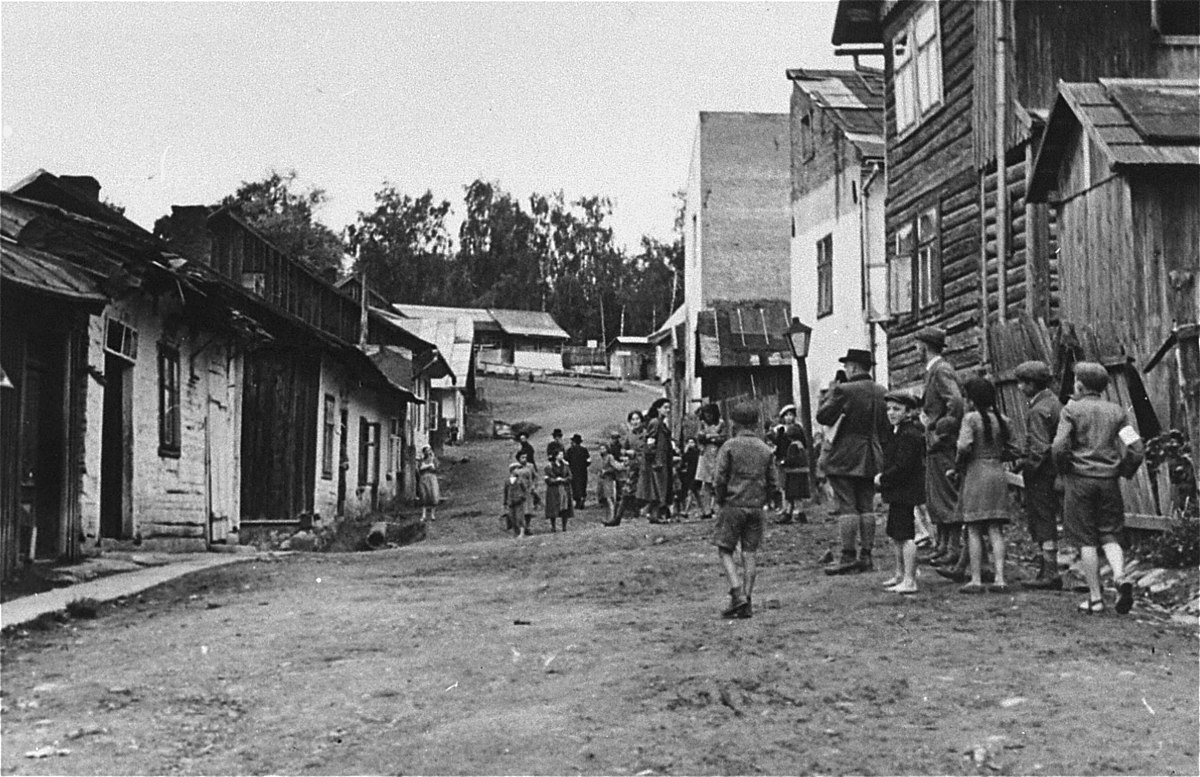
Unpaved street in the Frysztak Ghetto, Krakow District
Unpaved street in the Frysztak Ghetto, Krakow District
Germany Invades Poland - World War II Begins
The German Wehrmacht invaded Poland on September 1, 1939, triggering declarations of war from the United Kingdom and France. This invasion marked the beginning of World War II and brought millions of Polish Jews under Nazi control, setting the stage for the Holocaust's expansion.
1940 CE
Aktion T4 Euthanasia Program
The war provided cover for 'Aktion T4', the murder of around 70,000 institutionalized Germans with mental or physical disabilities at specialized killing centers using poison gas. The victims included all 4,000 to 5,000 institutionalized Jews. This program served as a testing ground for later mass murder techniques used in the Holocaust.
1941 CE
Declaration of St James's Palace
The first step towards the establishment of the United Nations was the Inter-Allied Conference in London that led to the Declaration of St James's Palace. This declaration marked the beginning of Allied cooperation that would eventually lead to the UN's formation.
Atlantic Charter Drafted
American president Franklin Roosevelt and British prime minister Winston Churchill drafted the Atlantic Charter, which defined goals for the post-war world. This document became a foundational text for the future United Nations organization.
Mass Shootings of Soviet Jews Begin
Following the June 1941 invasion of the Soviet Union, 1.5 to 2 million Jews were shot by German forces and local collaborators. The systematic murder of Jews began in the Soviet Union with Einsatzgruppen and other units conducting mass executions. This marked the transition from persecution to systematic extermination.

Original Nazi propaganda caption: "Too bad even for a bullet... The Jews shown here were shot at once." 28 June 1941 in Rozhanka, Belarus
Original Nazi propaganda caption: "Too bad even for a bullet... The Jews shown here were shot at once." 28 June 1941 in Rozhanka, Belarus
Germany Invades Soviet Union - Operation Barbarossa
Germany and its allies invaded the Soviet Union on June 22, 1941. This invasion was planned as a war of extermination with complete disregard for the laws of war. It brought millions more Jews under Nazi control and marked the beginning of systematic mass murder of Soviet Jews.
Chełmno Extermination Camp Opens
The first extermination camp was Chełmno in the Wartheland, established with Himmler's approval. It began operations in December 1941 using gas vans. This marked the beginning of the systematic use of purpose-built facilities for mass murder, representing a crucial escalation in the Holocaust.

Deportation to Chełmno
Deportation to Chełmno
Hitler's Declaration of War on United States
On December 11, 1941, Hitler declared war on the United States after Japan attacked Pearl Harbor. The next day, he told leading Nazi party officials, referring to his 1939 prophecy, 'The world war is here; the annihilation of the Jews must be the necessary consequence.' This marked a crucial escalation in genocidal intent.
1942 CE
Declaration by United Nations Signed
Roosevelt, Churchill, the Soviet Union's former Foreign Minister Maxim Litvinov, and the Chinese Premier T. V. Soong signed the 'Declaration by United Nations', with representatives of twenty-two other nations adding their signatures the next day. This marked the first official use of the term 'United Nations'.
Wannsee Conference
Reinhard Heydrich, head of the Reich Main Security Office, convened the Wannsee Conference on January 20, 1942. This high-level meeting was intended to coordinate anti-Jewish policy across Nazi-occupied Europe. It represented the bureaucratic organization of continent-wide genocide.
Belzec Extermination Camp Begins Operations
In March 1942, killings began in Belzec, targeting Jews from Lublin who were not capable of work. Belzec was the first purpose-built extermination camp to feature stationary gas chambers using carbon monoxide. This marked the beginning of Operation Reinhard, the systematic murder of Polish Jews.
Sobibor Extermination Camp Opens
Sobibor extermination camp began operations in May 1942 as part of Operation Reinhard. Located in the Lublin District, it used stationary gas chambers with engine exhaust to murder Jews. The camp was part of the systematic effort to eliminate the Jewish population of the General Governorate.
BBC Reports on Holocaust
On June 26, 1942, BBC services in all languages publicized a report by the Jewish Social-Democratic Bund and other resistance groups, transmitted by the Polish government-in-exile, documenting the killing of 700,000 Jews in Poland. This was one of the first major international reports on the systematic murder of Jews.
Peak of Holocaust Killings
The period from late July to early November 1942 saw the most intense killing phase of the Holocaust. Biologist Lewi Stone calculated that around 1.47 million Jews were murdered in Europe in just 100 days during this period. Over 3 million Jews were killed in 1942 alone, making it the deadliest year of the Holocaust.

Cumulative murders of Jews from the General Governorate at Belzec, Sobibor, and Treblinka from January 1942 to February 1943
Cumulative murders of Jews from the General Governorate at Belzec, Sobibor, and Treblinka from January 1942 to February 1943
Warsaw Ghetto Liquidation Begins
The Warsaw Ghetto was cleared between July 22 and September 12, 1942. Of the original population of 350,000 Jews, 250,000 were killed at Treblinka, representing one of the largest single deportation actions of the Holocaust. This marked the beginning of the systematic liquidation of Polish ghettos.
Allied Declaration on Holocaust
In December 1942, the Allies, then known as the United Nations, adopted a joint declaration condemning the systematic murder of Jews. This represented the first official international acknowledgment of the ongoing genocide, though it did not lead to immediate action to stop the killings.
1943 CE
Moscow Conference and Four Power Declaration
The October 1943 Moscow Conference resulted in the Moscow Declarations, including the Four Power Declaration on General Security. This was the first public announcement that a new international organization was being contemplated to replace the League of Nations.
Warsaw Ghetto Uprising
In 1943, larger uprisings occurred in Warsaw, Białystok, and Glubokoje, necessitating the use of heavy weapons by German forces. The Warsaw Ghetto uprising became significant as a symbol of Jewish resistance against the Nazis, though it ultimately failed to prevent the ghetto's destruction.
The Warsaw Ghetto uprising became significant as a symbol of Jewish resistance against the Nazis.
The Warsaw Ghetto uprising became significant as a symbol of Jewish resistance against the Nazis.
Operation Harvest Festival Massacre
On November 3, 1943, around 18,400 Jews were murdered at Majdanek over the course of nine hours, the largest number ever killed in a death camp on a single day. It was part of Operation Harvest Festival, the murder of some 43,000 Jews from November 3-4, 1943, the single largest massacre of Jews by German forces.
1944 CE
Dumbarton Oaks Conference
The new international organization was formulated and negotiated amongst the delegations from the Allied Big Four at the Dumbarton Oaks Conference. They agreed on proposals for the aims, structure and functioning of the new organization that would become the United Nations.
Death Marches Begin
Following Allied advances, the SS deported concentration camp prisoners to camps in Germany and Austria, starting in mid-1944 from the Baltics. Weak and sick prisoners were often killed, and others were forced to travel by rail or on foot with inadequate food. Those who could not keep up were shot.
German Occupation of Hungary
Germany occupied Hungary in March 1944, bringing the large Hungarian Jewish population under direct Nazi control. Until this occupation, the Hungarian government had not deported very many of its approximately 846,000 people considered Jewish, making them one of the largest surviving European Jewish populations.
Deportation of Hungarian Jews
Between March 1944 and July 9, 1944, 434,000 of the still 825,000 Hungarian Jews were deported on trains, mostly to Auschwitz where the great majority were murdered immediately. This represented the largest and fastest deportation action of the Holocaust's final phase.

Jews from Carpathian Ruthenia, annexed by Hungary in 1938, on the selection ramp at Auschwitz II in May or June 1944. Men are lined up to the right, women and children to the left. About 25 percent were selected for work and the rest gassed.
Jews from Carpathian Ruthenia, annexed by Hungary in 1938, on the selection ramp at Auschwitz II in May or June 1944. Men are lined up to the right, women and children to the left. About 25 percent were selected for work and the rest gassed.
Auschwitz Gas Chambers Shut Down
The gas chambers at Auschwitz were shut down and destroyed after October 1944 as Soviet forces approached. In January 1945, most of the remaining 67,000 Auschwitz prisoners were sent on a death march westwards. This marked the end of systematic killing at the largest extermination camp.
1945 CE
UN Conference on International Organization Opens
After months of planning, the UN Conference on International Organization opened in San Francisco. It was attended by 50 nations' governments and a number of non-governmental organizations, with the delegations of the Big Four chairing the plenary meetings.
UN Charter Signed
The Charter of the United Nations was signed by the representatives of the 50 countries after two months of drafting. This document established the legal foundation for the United Nations organization and its operations.
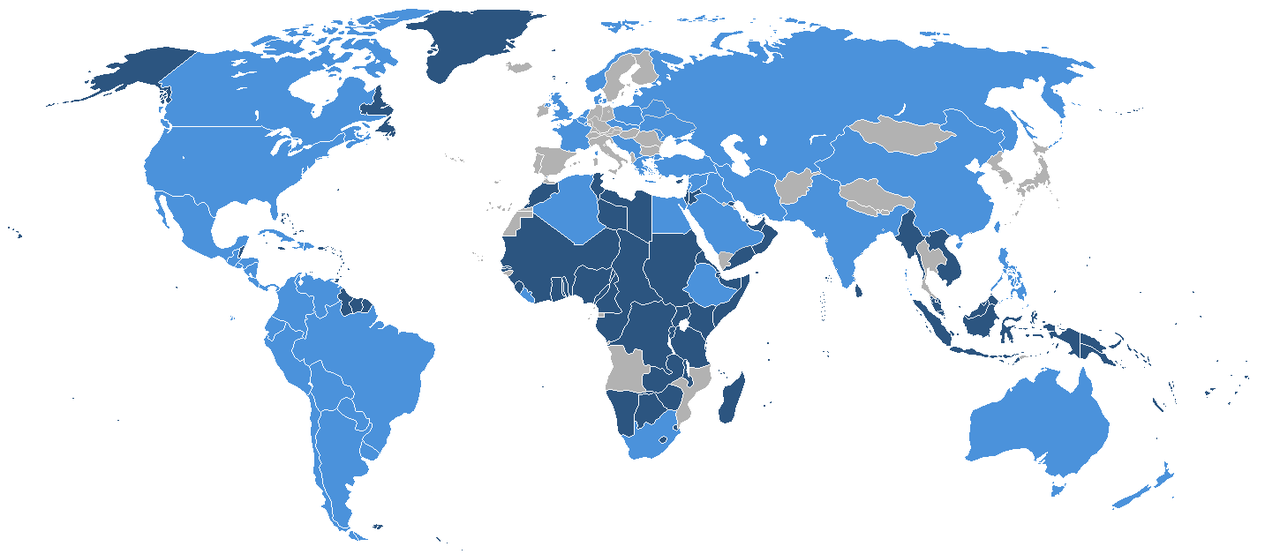
The UN in 1945: founding members in light blue, protectorates and territories of the founding members in dark blue
Map showing the founding members of the United Nations in 1945
United Nations Officially Established
The UN officially came into existence at 20:07 (UTC) upon ratification of the Charter by the five permanent members of the Security Council and by a majority of the other 46 nations. This marked the birth of the modern international organization system.
Liberation of Concentration Camps
Many concentration camps were liberated in 1945 during the Western Allied invasion of Germany and the Red Army's march westwards. The liberators found piles of corpses that they had to bulldoze into mass graves. Some survivors were freed at the camps while others had been liberated during the death marches.

A mass grave at Bergen-Belsen after the camp's liberation, April 1945
A mass grave at Bergen-Belsen after the camp's liberation, April 1945
Nuremberg Trials Begin
In 1945 and 1946, the International Military Tribunal tried 23 Nazi leaders primarily for waging wars of aggression. Although the prosecution initially focused on aggressive war as the root of Nazi criminality, the systematic murder of Jews came to take center stage during the proceedings.

alt=Rows of men sitting on benches
Defendants in the dock at the International Military Tribunal, November 1945
1946 CE
First UN General Assembly and Security Council Meetings
The first meetings of the General Assembly, with 51 nations represented, and the Security Council took place in London. Debates began at once, covering topical issues such as the presence of Russian troops in Iranian Azerbaijan and British forces in Greece.
1947 CE
UN General Assembly Resolution 181 - Palestine Partition Plan
The General Assembly approved Resolution 181, a proposal to partition British Mandatory Palestine into two states, a Jewish state and an Arab state, with Jerusalem placed under international status. The plan passed 33–13 with 10 abstentions, leading to civil war.
1948 CE
Universal Declaration of Human Rights Adopted
The General Assembly adopted the Universal Declaration of Human Rights, drafted by a committee headed by American diplomat and activist Eleanor Roosevelt. The document proclaimed basic civil, political and economic rights common to all human beings.

Eleanor Roosevelt with the Universal Declaration of Human Rights, 1949
Eleanor Roosevelt holding the Universal Declaration of Human Rights
UN Headquarters Construction Begins
Construction began on the UN headquarters in New York City after the General Assembly selected the city as the site for the headquarters. The facility would be completed on October 9, 1952, establishing the permanent home of the United Nations.
UN Genocide Convention
Nazi atrocities led to the United Nations' Genocide Convention in 1948, establishing genocide as an international crime. However, it was not used in Holocaust trials due to the non-retroactivity of criminal laws. This convention became a cornerstone of international human rights law.
Establishment of Israel
The establishment of Israel in 1948 provided a destination for many Holocaust survivors who had remained in displaced persons camps in Germany. Due to the reluctance of other countries to allow Jewish immigration, many survivors had remained in Germany until this point.
1950 CE
Korean War Authorization
A Security Council resolution authorized a US-led coalition to repel the North Korean invasion of South Korea. This resolution was passed in the absence of the Soviet Union, demonstrating how Cold War tensions affected UN operations.
1952 CE
UN Headquarters Completed
The UN headquarters facility in New York City was completed, providing a permanent home for the organization's operations. The building became an iconic symbol of international cooperation and diplomacy.
1953 CE
Korean Armistice Agreement Signed
The Korean Armistice Agreement was signed, ending active hostilities in the Korean War. This demonstrated the UN's role in conflict resolution and peacekeeping, though the war technically never ended with a peace treaty.
1956 CE
First UN Peacekeeping Force Established
The first UN peacekeeping force was established to end the Suez Crisis. However, the UN was unable to intervene against the Soviet Union's simultaneous invasion of Hungary, highlighting the limitations of UN action during the Cold War.
1960 CE
UN Operation in the Congo Established
The UN established the United Nations Operation in the Congo (UNOC), the largest military force of its early decades, to bring order to Katanga and restore it to the control of the Democratic Republic of the Congo. The operation lasted until May 11, 1964.
1961 CE
Dag Hammarskjöld Dies in Plane Crash
UN Secretary-General Dag Hammarskjöld, often named as one of the UN's most effective secretaries-general, died in a plane crash while travelling to meet rebel leader Moise Tshombe during the Congo conflict. He was posthumously awarded the Nobel Peace Prize months later.

Dag Hammarskjöld was a particularly active secretary-general from 1953 until he died in 1961.
Portrait of Dag Hammarskjöld, the second UN Secretary-General
1971 CE
People's Republic of China Joins UN Security Council
With opposition from the United States but support from many Third World nations, the People's Republic of China was given the Chinese seat on the Security Council in place of the Republic of China (Taiwan). The vote was widely seen as a sign of waning American influence in the organization.
1975 CE
Zionism Declared Form of Racism
A bloc comprising the Soviet Union and Third World nations passed a resolution, over strenuous American and Israeli opposition, declaring Zionism to be a form of racism. The resolution was later repealed on December 16, 1991, shortly after the end of the Cold War.
1980 CE
Smallpox Eradication Announced
The World Health Organization announced that the eradication of smallpox had been completed, marking one of the UN's greatest public health achievements. This demonstrated the effectiveness of coordinated international health efforts.
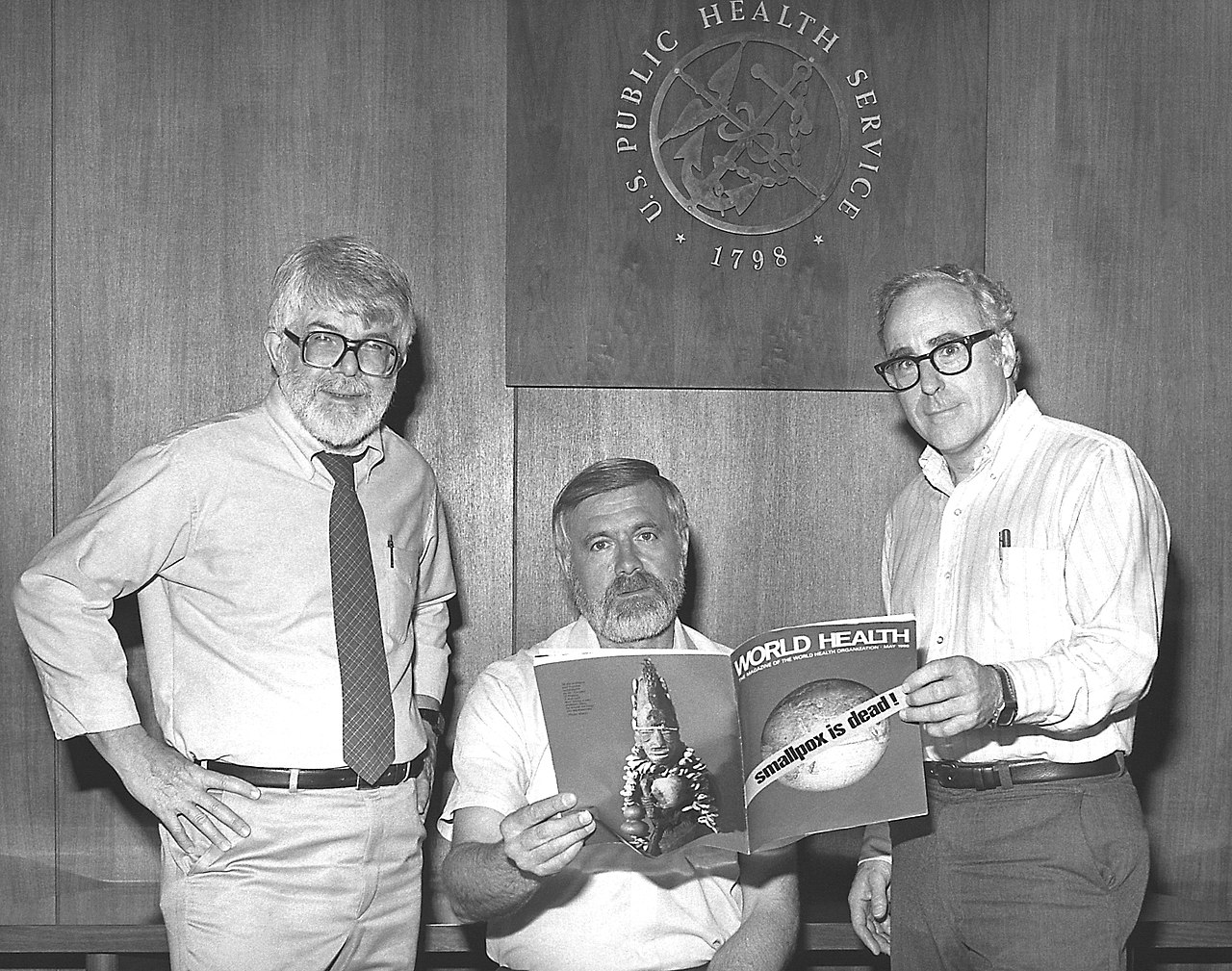
Three former directors of the Global Smallpox Eradication Programme reading the news that smallpox has been globally eradicated in 1980
Three directors celebrating the global eradication of smallpox
1991 CE
Gulf War Coalition Authorized
The UN authorized a US-led coalition that repulsed Iraq's invasion of Kuwait. This marked a significant post-Cold War use of UN authority to authorize military action against aggression.
Zionism-Racism Resolution Repealed
The controversial 1975 resolution declaring Zionism to be a form of racism was repealed, shortly after the end of the Cold War. This reflected changing geopolitical dynamics and improved relations between various UN member states.
1994 CE
Trusteeship Council Suspends Operations
The Trusteeship Council, one of the six principal organs established by the UN Charter, suspended its operations upon the independence of Palau, the last remaining UN trustee territory. This marked the end of the UN trusteeship system.
1999 CE
Kosovo Force Authorized
United Nations Security Council Resolution 1244 authorized the NATO-led Kosovo Force beginning in 1999. This represented a new form of international intervention in the post-Cold War era.
2000 CE
Millennium Summit and Development Goals
The Millennium Summit was held to discuss the UN's role in the 21st century. The three-day meeting was the largest gathering of world leaders in history, culminating in the adoption of the Millennium Development Goals (MDGs) by all member states.
2001 CE
UN and Kofi Annan Win Nobel Peace Prize
The UN as a whole was awarded the Nobel Peace Prize, sharing it with Secretary-General Kofi Annan. This recognition highlighted the organization's contributions to international peace and security.

The 2001 Nobel Peace Prize to the UN—diploma in the lobby of the UN Headquarters in New York City
Nobel Peace Prize diploma awarded to the United Nations in 2001
2010 CE
Haiti Earthquake Kills 101 UN Personnel
The organization suffered the worst loss of life in its history when 101 personnel died in the Haiti earthquake. This tragedy highlighted the risks faced by UN personnel in humanitarian operations.
2011 CE
South Sudan Joins UN
South Sudan joined the United Nations, becoming the most recent addition and bringing the total to 193 UN member states. This marked the end of a long process of independence and international recognition.
2015 CE
Sustainable Development Goals Launched
The Sustainable Development Goals (SDGs) were launched to succeed the Millennium Development Goals. These 17 goals represented a comprehensive agenda for global development and environmental sustainability through 2030.
2017 CE
António Guterres Becomes Secretary-General
Portuguese diplomat António Guterres, who had previously served as the UN High Commissioner for Refugees, became the ninth secretary-general. He emphasized diplomacy for preventing conflicts, more effective peacekeeping efforts, and streamlining the organization.

António Guterres, the current secretary-general
Portrait of António Guterres, the ninth UN Secretary-General
2019 CE
UN-World Economic Forum Partnership
The UN signed a Strategic Partnership Framework with the World Economic Forum to 'jointly accelerate' the implementation of the 2030 Agenda for Sustainable Development. This partnership aimed to leverage private sector engagement in global development goals.
2025 CE
UN Financial Crisis Deepens
The UN began facing a severe financial crisis resulting from delays in member state due payments and refusal to pay assessed amounts. Only 61 countries paid their dues on time and in full, causing massive budget cuts and putting millions of lives at risk.
2026 CE
Guterres Warns of 'Imminent Financial Collapse'
Secretary-General Guterres sent a letter to all members warning of an 'imminent financial collapse' of the UN. This represented the culmination of ongoing financial difficulties that had been building since 2020.