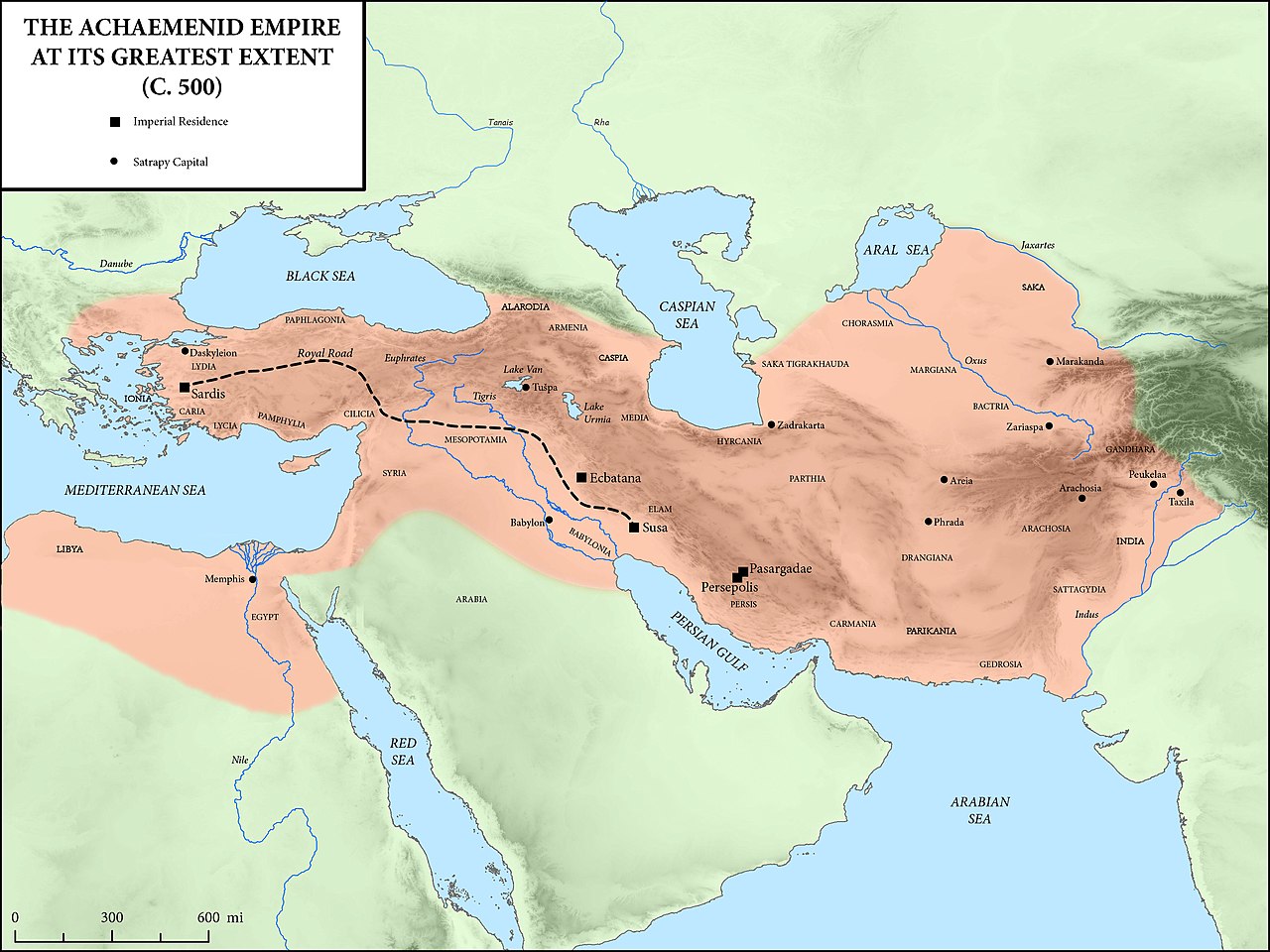
Achaemenid Empire at its greatest extent
The Persian Achaemenid Empire at its greatest extent represents one of the most significant ancient empires, symbolizing the scale and complexity of ancient political history covered in this timeline.
Ancient history
This timeline covers ancient history from prehistoric human migrations through late antiquity (approximately 1.8 million years ago to AD 651), encompassing the rise and fall of major civilizations across all inhabited continents. It traces the development of agriculture, writing, metallurgy, religion, and empire-building across Mesopotamia, Egypt, Asia, Europe, Africa, and the Americas.
Source: Wikipedia9500 BCE – 9001 BCE
Settlement at Göbekli Tepe Begins
Settlement at Göbekli Tepe in modern-day Turkey began around 9500 BC, making it potentially the world's oldest known temple complex. This site predates many other known monumental structures and suggests organized religious activity among early human communities. Its existence challenges earlier assumptions about the relationship between agriculture and monumental architecture.
9000 BCE – 8501 BCE
Agriculture Emerges in Eastern Turkey
Evidence for agriculture emerges around 9000 BC in what is now eastern Turkey, spreading through the Fertile Crescent. This Neolithic Revolution marked a fundamental shift in human society from nomadic hunter-gatherer lifestyles to settled farming communities. Sheep and goats were also domesticated around this time in the Fertile Crescent.
8000 BCE – 7501 BCE
Sorghum and Millet Cultivation in the Nile River Valley
The Nile River Valley shows evidence of sorghum and millet cultivation starting around 8000 BC. Agricultural use of yams in Western Africa may also date to this same period. These early agricultural developments in Africa were independent of those in the Fertile Crescent.
Halaf Culture Agricultural Communities in Mesopotamia
Agricultural communities emerged in Mesopotamia with the Halaf culture around 8000 BC. These early settlements laid the groundwork for the later urban civilizations that would arise in the region. Mesopotamia would go on to become the cradle of civilization, developing writing, law codes, and centralized government.
7000 BCE – 6501 BCE
Millet, Rice, and Legume Cultivation Begins in China
Cultivation of millet, rice, and legumes began around 7000 BC in China. Taro cultivation in New Guinea and squash cultivation in Mesoamerica also date to approximately this period. These independent agricultural developments across multiple continents demonstrate the widespread nature of the Neolithic Revolution.
Cattle and Water Buffalo Domesticated
Cattle and water buffalo were domesticated around 7000 BC, providing humans with additional food sources and labor animals. Agriculture also began in the Indus Valley around this time. These domesticated animals greatly increased human ability to do agricultural work and transport goods.
6000 BCE – 5501 BCE
Smelting of Copper Ores Begins
Smelting of copper ores began around 6000 BC in western Asia, independently developing in eastern Asia before 2000 BC. This technological breakthrough followed earlier use of hammered copper items and marked the beginning of metallurgy. Gold and silver use also dates to between 6000 and 5000 BC.
Simple Plough Invented
The invention of the simple plough by 6000 BC further increased agricultural efficiency, allowing farmers to cultivate larger areas of land. This technological innovation was a key driver of population growth and the development of surplus food production. Surplus food enabled the specialization of labor and the rise of complex societies.
Ubaid Period in Mesopotamia
Agricultural communities in Mesopotamia continued to expand through the Ubaid period around 6000 BC. This period saw the growth of settlements and the development of more complex social structures. The Ubaid period laid the foundation for the later urban revolution of the Uruk period.
5000 BCE – 4501 BCE
Longshan and Yangshao Neolithic Cultures in China
Neolithic cultures such as the Longshan and Yangshao dating to 5000 BC produced sophisticated pottery, cultivated millet, and likely produced clothes woven from hemp and silk in the Yellow River valley. Rice was also farmed and pigs and water buffalo were kept for food. These cultures preceded the formation of Chinese civilization.

Oracle bone script from the Shang dynasty
Oracle bone script representing early Chinese writing that developed from these Neolithic cultures
Potter's Wheel Invented
Sometime between 5000 and 4000 BC the potter's wheel was invented, revolutionizing the production of ceramic goods. By 3000 BC, the pottery wheel was adapted into wheeled vehicles which could be used to carry loads further and more easily than with human or animal power alone. This invention had profound implications for both craft production and transportation.
4000 BCE – 3501 BCE
Horses, Donkeys, and Camels Domesticated
Horses, donkeys, and camels were domesticated by about 4000 BC, greatly expanding human transportation and military capabilities. These animals were used not only for food but to carry and pull people and loads, greatly increasing human ability to do work. The domestication of horses in particular would have profound military implications in later centuries.
Maize Cultivation Begins in Mesoamerica
Around 4000 BC maize began to be grown in Mesoamerica, soon followed by tomatoes. Agricultural cultivation had begun around 8000 BC in Mesoamerica with avocados, beans, chili peppers, gourds, and squashes. Maize would become the staple crop of Mesoamerican civilizations and a cornerstone of their cultures.
Uruk Period: First Cities in Mesopotamia
Cities began in the Uruk period (4000–3100 BC) in Mesopotamia, representing one of humanity's first urban civilizations. The surplus of storable foodstuffs created by agriculture allowed the population to settle in one place instead of migrating after crops and herds. This organization led to the necessity of record keeping and the development of writing.
3500 BCE – 3001 BCE
Bronze Alloy Metallurgy Begins in Mesopotamia
Alloy metallurgy began with bronze in about 3500 BC in Mesopotamia, marking the beginning of the Bronze Age. Bronze was harder and more durable than copper, enabling the production of better tools and weapons. This technology was developed independently in China by 2000 BC.
Proto-Literate Cuneiform Spreads in the Middle East
By 3400 BC, proto-literate cuneiform spread in the Middle East, representing one of the earliest writing systems in human history. Writing developed separately in five different locations: Mesopotamia, Egypt, India, China, and Mesoamerica. The development of writing was a transformative moment in human history, enabling the recording and transmission of knowledge.
Egyptian Hieroglyphs Developed
Egypt developed its own system of hieroglyphs by about 3200 BC, one of the earliest writing systems in the world. This writing system would later develop into hieratic and other derived scripts. Egyptian hieroglyphs were used to record religious texts, administrative records, and historical accounts for thousands of years.

Egyptian artifact
Egyptian artifact representing the ancient Egyptian civilization that developed hieroglyphic writing
Unification of Egypt Under Menes
Ancient Egypt began with the incipient unification of Nile Valley polities around 3100 BC, traditionally under Menes. The Ta-Seti kingdom in Nubia to the south of Egypt was also conquered by Egyptian rulers around this time. This unification marked the beginning of one of history's longest-lasting civilizations, which would endure for over three millennia.
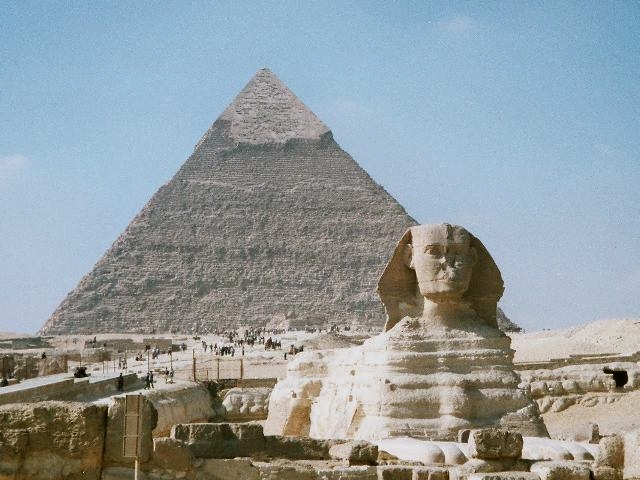
Great Sphinx of Giza
The Great Sphinx of Giza, a symbol of ancient Egyptian civilization that began with unification around 3100 BCE
Jemdet Nasr and Early Dynastic Periods in Mesopotamia
Cities expanded during the Jemdet Nasr (3100–2900 BC) and Early Dynastic (2900–2350 BC) periods in Mesopotamia. These periods saw the growth of urban centers and the development of more complex political and social structures. The Early Dynastic period saw the emergence of city-states with kings and organized armies.
3000 BCE – 2501 BCE
Indus Valley Civilisation Develops
The Indus Valley Civilisation developed around 3000 BC in the Indus and Ghaggar-Hakra river valleys of north-east Afghanistan, Pakistan, and western India. These communities created and traded jewelry, figurines, and seals that appear widely scattered throughout Mesopotamia, Afghanistan, and Iran. They developed their own writing system, the Indus Valley script, which is still mostly undeciphered.
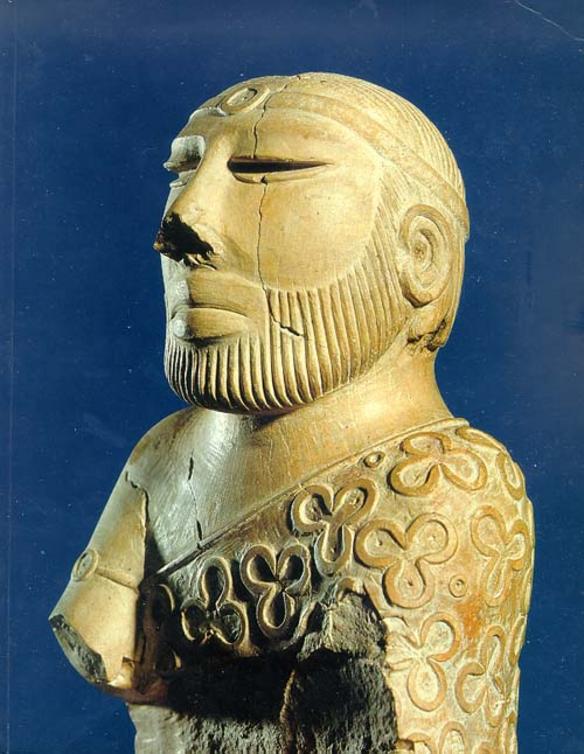
Mohenjo-daro Priest-King
Sculpture from Mohenjo-daro, one of the major cities of the Indus Valley Civilisation
Wheeled Vehicles Developed from Pottery Wheel
By 3000 BC, the pottery wheel was adapted into wheeled vehicles which could be used to carry loads further and easier than with human or animal power alone. This innovation transformed transportation and trade across the ancient world. Wheeled vehicles would later be adapted for military use as chariots.
Austronesian Expansion Begins from Taiwan
Around 3000 to 1500 BC, a large-scale migration of Austronesians known as the Austronesian expansion began from Taiwan, driven primarily by population growth. These first settlers settled in northern Luzon in the Philippines, intermingling with earlier Australo-Melanesian populations. Over the following millennia, Austronesian peoples would spread throughout Southeast Asia, the Pacific, and eventually to Madagascar.

Map showing the migration of the Austronesians from Taiwan
Map showing the chronological dispersal of Austronesian peoples across the Pacific
Indus Script Developed
By 2800 BC the Indus Valley Civilisation had developed its Indus script, which remains undeciphered to this day. This writing system was one of five independently developed writing systems in human history. The inability to decipher it means much about Indus Valley society remains unknown.
Old Kingdom Egypt and Pyramid Building
Ancient Egyptian history began with the Old Kingdom, which saw pyramid building on a large scale. The Great Sphinx of Giza was built during the 4th dynasty around 2500 BC. The Old Kingdom represented a period of great cultural and architectural achievement in ancient Egypt.
Khafre's Pyramid and Great Sphinx of Giza
The Great Sphinx of Giza, built during the Old Kingdom period of ancient Egypt
2500 BCE – 2001 BCE
Kingdom of Kush Founded in Nubia
By 2500 BC the Nubians had created a new kingdom further south, known as the Kingdom of Kush, centred on the upper Nile with a capital at Kerma. The Ta-Seti kingdom in Nubia had been conquered by Egyptian rulers around 3100 BC. The Kingdom of Kush would go on to have a complex relationship with Egypt, sometimes being conquered and sometimes conquering Egypt.

Pharaohs of Nubia
Rulers of Kush from the Kerma Museum, representing the Kingdom of Kush
Akkadian Empire at Height of Power
Akkad reached the height of its power between about 2330 and 2150 BC, following the conquests of King Sargon of Akkad. Through the spread of Sargon's empire, the Akkadian language spread and replaced the Sumerian language in Mesopotamia. By 1450 BC, Akkadian was the main language of diplomacy in the Near East.
Xia Dynasty in China
The Xia dynasty appears to have begun around 2200 BC and may have controlled parts of the Yangtze River valley. Little is yet known about the Xia, which was not considered historical by many scholars until the later 20th century. It was one of three ancient dynasties described in Chinese traditions that predated the unification under the Qin and Han dynasties.
2000 BCE – 1501 BCE
Dhar Tichitt Urban Centres in Mauritania
Dhar Tichitt and Oualata were prominent early urban centres dated to 2000 BC in present-day Mauritania. About 500 stone settlements littered the region in the former savannah of the Sahara, with inhabitants who fished and grew millet. These settlements are believed to have been constructed by the Soninke of the Mandé peoples.
Bantu Expansion Begins in Africa
Peoples speaking precursors to the modern-day Bantu languages began to spread throughout southern Africa, and by 2000 BC they were expanding past the Congo River and into the Great Lakes area. Iron metallurgy and agriculture spread along with these peoples, with the cultivation of millet, oil palms, sorghum, and yams. By AD 1000 these groups had spread throughout all of southern Africa south of the equator.
Maritime Jade Road Established in Southeast Asia
The Maritime Jade Road, a jade trade network in Southeast Asia, existed from 2000 BC to 1000 AD, established by links between the indigenous peoples of Taiwan and the Philippines. This trade network later included parts of Vietnam, Malaysia, Indonesia, Thailand, and other areas in Southeast Asia. It represents one of the earliest long-distance maritime trade networks in human history.
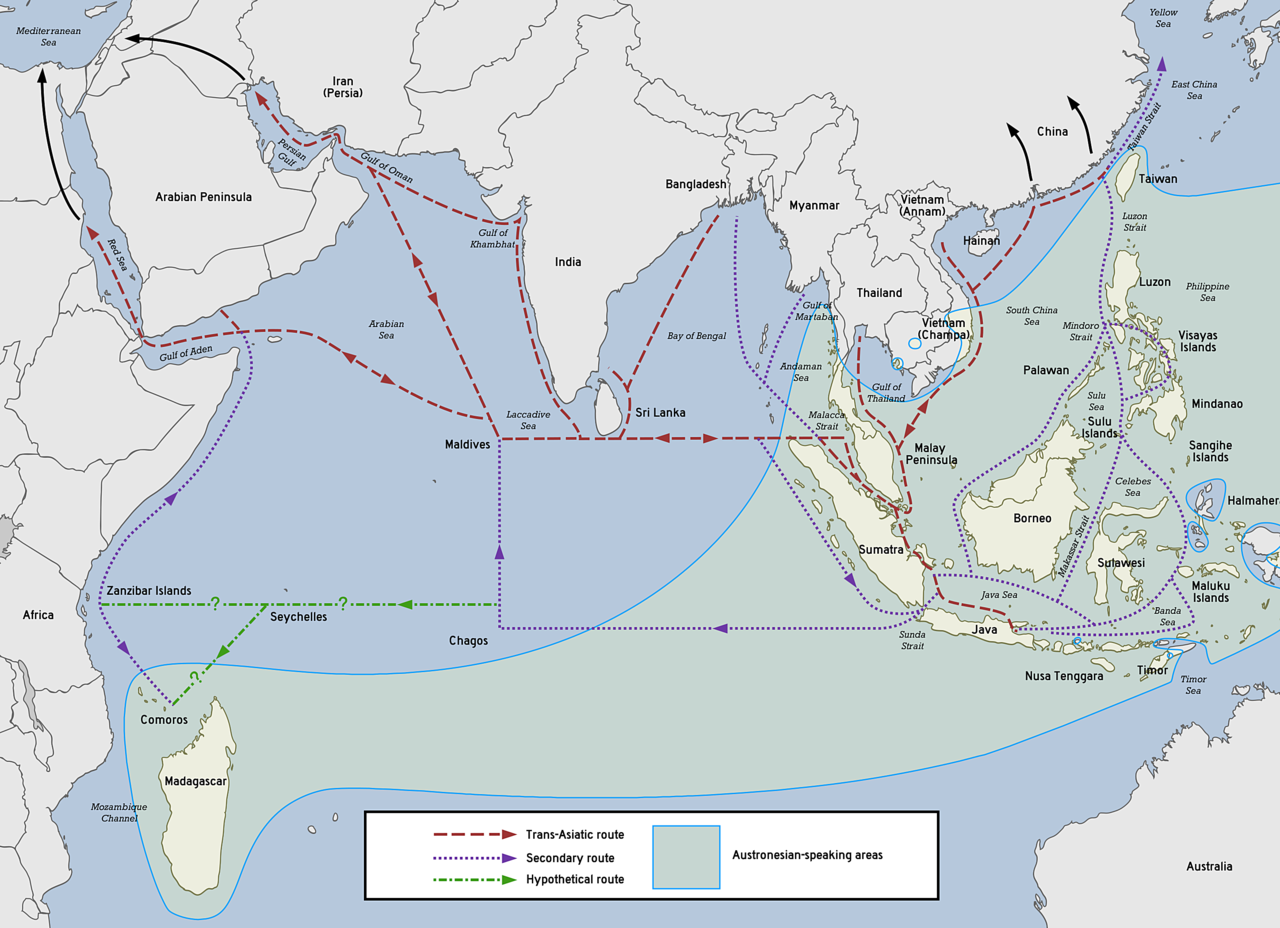
Austronesian maritime trade network in the Indian Ocean
Map of Austronesian maritime trade networks including the Maritime Jade Road
Middle Kingdom of Egypt
The Middle Kingdom began around 2000 BC with the reunification of Egypt under pharaohs ruling from Thebes, following the First Intermediate Period. This period saw Egypt expand its cultural and political influence. The Middle Kingdom ended with the conquest of northern Egypt by the Hyksos around 1650 BC.
Copper and Bronze Production in Southeast Asia
The earliest known evidence of copper and bronze production in Southeast Asia was found at Ban Chiang in north-east Thailand and among the Phùng Nguyên culture of northern Vietnam around 2000 BC. This metallurgical development was independent of Chinese or Indian influence. The Đông Sơn culture would later build on this tradition to create highly sophisticated bronze objects.

Đông Sơn drum
A Đông Sơn bronze drum, representing the sophisticated bronze production tradition of Southeast Asia
Hittites Arrive in Anatolia
The Hittites first came to Anatolia about 1900 BC and during the period 1600–1500 BC they expanded into Mesopotamia where they adopted the cuneiform script to their Indo-European language. By 1200 BC their empire stretched to Phoenicia and eastern Anatolia. The Hittites improved iron working and light chariots with spoked wheels, spreading these technologies widely.
Hyksos Conquer Northern Egypt
The Middle Kingdom ended with the conquest of northern Egypt by the Hyksos around 1650 BC. The Hyksos were eventually expelled from Egypt and the land was reunited in the New Kingdom around 1550 BC. This period of foreign rule had a significant impact on Egyptian military technology and culture.
Decline of Indus Valley Civilisation
By about 1600 BC, the Indus Valley culture had abandoned many of their cities, including Mohenjo-Daro. The exact reason for this decline is not known, though theories include climate change, flooding, and invasion. This marked the end of one of the ancient world's most sophisticated urban civilizations.
Mohenjo-daro Priest-King
Sculpture from Mohenjo-daro, one of the cities abandoned during the decline of the Indus Valley Civilisation
New Kingdom of Egypt
The Hyksos were expelled from Egypt and the land was reunited in the New Kingdom around 1550 BC. This period lasted until about 1000 BC and saw Egypt expand its borders into Palestine and Syria, reaching its greatest extent during the 2nd millennium BC. The New Kingdom is considered the height of ancient Egyptian power and cultural achievement.
Great Sphinx of Giza
Symbol of ancient Egyptian civilization during its New Kingdom period of greatest power
Phoenician Civilisation Flourishes
Phoenician civilisation was an enterprising maritime trading culture that spread across the Mediterranean between the period of 1550 to 300 BC. The Phoenicians invented the Phoenician alphabet, the forerunner of the modern alphabet still in use today. One Phoenician colony, Carthage, ruled an empire in the Western Mediterranean until being defeated by Rome in the Punic Wars.
1500 BCE – 1001 BCE
Mitanni Empire Founded
Mitanni was a Hurrian empire in northern Mesopotamia founded around 1500 BC. The Mitanians conquered and controlled Assyria until the 14th century BC while contending with Egypt for control of parts of modern Syria. Its capital was Washukanni, whose precise location has not been determined by archaeologists.
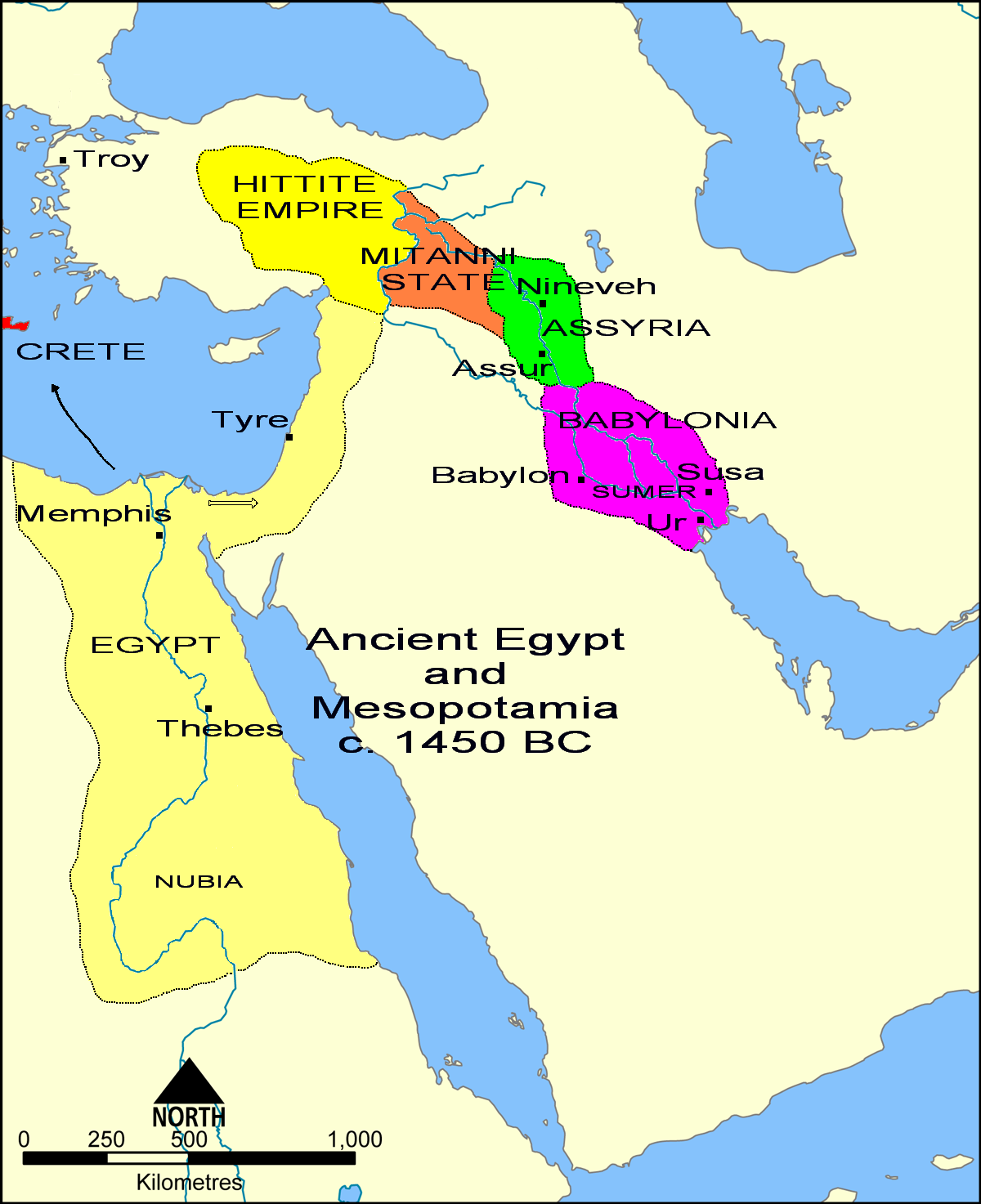
Ancient Egypt and Mesopotamia c. 1450 BC
Map showing the region including Mitanni, Assyria, and Babylonia around 1450 BC
Medes and Persians Appear on Iranian Plateau
The Medes and Persians were peoples who had appeared in the Iranian plateau around 1500 BC. Both peoples spoke Indo-European languages and were mostly pastoralists with a tradition of horse archery. These peoples would later go on to establish major empires that would shape the ancient world.
Indo-European Peoples Spread into India; Vedic Period Begins
Indo-European speaking peoples began to spread into India about 1500 BC, beginning the Vedic period. The Rigveda, in Sanskrit, dates to this period. Between 1500 and 500 BC these peoples spread throughout most of India and had begun to found small cities, with Vedic society characterized by the varna caste system.
Austronesians Colonize Northern Mariana Islands
Austronesians colonised the Northern Mariana Islands by 1500 BC or even earlier, becoming the first humans to reach Remote Oceania. The Chamorro migration was unique in that it was the only Austronesian migration to the Pacific Islands to successfully retain rice cultivation. This marked a major milestone in the human settlement of the Pacific.
Map showing the migration of the Austronesians from Taiwan
Map showing Austronesian migration routes including to the Northern Mariana Islands
Battle of Kadesh: Hittites vs. Egyptians
In 1274 BC the Hittites clashed with the Egyptians at the Battle of Kadesh, where both sides claimed victory. This was one of the largest chariot battles in history and resulted in one of the earliest known peace treaties. The battle demonstrated the military power of both the Hittite and Egyptian empires.
Israel First Mentioned in Merneptah Stele
The name Israel first appears in the stele of the Egyptian pharaoh Merneptah around 1209 BC. This 'Israel' was a cultural and probably political entity of the central highlands, well enough established to be perceived by the Egyptians as a possible challenge to their hegemony. This is the earliest known reference to Israel as a people.

The Iron Age Kingdom of Israel and Kingdom of Judah
Map of the Iron Age kingdoms of Israel and Judah
Hittite Empire Ends; Hattusa Sacked
In 1207 BC the Hittite capital of Hattusa was sacked, ending the Hittite Empire. This collapse was part of the broader Late Bronze Age collapse that affected many civilizations in the eastern Mediterranean around 1200 BC. The Mycenaean civilization also collapsed violently around this time.
Lapita Culture Spreads into Melanesia
The Lapita culture rapidly spread into the islands off the coast of northern New Guinea and into the Solomon Islands and other parts of coastal New Guinea and Island Melanesia by 1200 BC. They reached the islands of Fiji, Samoa, and Tonga by around 900 to 800 BC. This represented a major phase of human settlement in the Pacific.
Map showing the migration of the Austronesians from Taiwan
Map showing the spread of Lapita culture and Austronesian peoples through the Pacific
Mycenaean Civilization Collapses
The Mycenaean civilization, the first distinctively Greek civilization, collapsed violently around 1200 BC, along with several other civilizations in the eastern Mediterranean during the Late Bronze Age collapse. This ushered in a period known as the Greek Dark Ages, from which written records are absent. The collapse ended the first phase of Greek civilization.
First Olmec Centre of San Lorenzo Founded
Around 1200 BC the first Olmec centre of San Lorenzo was founded, which remained the centre of Olmec civilisation until around 800 BC when La Venta took over. The Olmecs erected large stone sculptures of human heads and other subjects, and their writing system and calendar influenced later Mesoamerican cultures. Jade jewelry and other Olmec objects are found throughout Mesoamerica, likely having travelled via trade networks.

Olmec colossal head
An Olmec colossal head, representing the monumental sculpture tradition of the Olmec civilization
Zhou Dynasty Overthrows Shang in China
Towards the end of the 2nd millennium BC, the Shang were overrun by the Zhou dynasty from the Wei River valley to the west. The Zhou rulers invoked the concept of the Mandate of Heaven to legitimize their rule, a concept that would be influential for almost every successive dynasty. The Zhou initially established their capital in the west near modern Xi'an.
New Kingdom of Kush with Capital at Napata
By 1100 BC a new kingdom of Kush had formed, with a capital at Napata. This kingdom would later conquer Egypt around 760 BC and retain control for about a century. The Kingdom of Kush represented a significant African civilization that interacted closely with ancient Egypt.
Pharaohs of Nubia
Rulers of Kush, representing the new Kingdom of Kush with its capital at Napata
1000 BCE – 501 BCE
Nok Culture Appears in Nigeria
The Nok culture appeared in Nigeria around 1000 BC and mysteriously vanished around AD 200. The Nok civilisation was considered to be the earliest sub-Saharan producer of life-sized terracotta sculptures discovered by archaeologists. The Nok also used iron smelting that may have been independently developed.

Nok sculpture of a seated person
A Nok terracotta sculpture, representing the earliest sub-Saharan producer of life-sized terracotta
Chavin Culture Emerges in the Andes
The Chavin culture, based around the Chavin cult, emerged around 1000 BC in the Andes and led to large temples and artworks as well as sophisticated textiles. Gold, silver, and copper were worked for jewelry and occasionally for small copper tools. This culture represented one of the earliest complex societies in South America.
Carthage Founded by Phoenician Settlers
Carthage was founded around 814 BC by Phoenician settlers. Ancient Carthage was a city-state that ruled an empire through alliances and trade influence that stretched throughout North Africa and modern Spain. At the height of the city's influence, its empire included most of the western Mediterranean.
Spring and Autumn Period in China
In the 8th century BC, power became decentralized during the Spring and Autumn period in China, named after the influential Spring and Autumn Annals. Local military leaders used by the Zhou began to assert their power and vie for hegemony. The Hundred Schools of Thought of Chinese philosophy blossomed during this period, including Confucianism, Taoism, Legalism, and Mohism.
Nubian Rulers Conquer Egypt
Nubian rulers conquered Egypt around 760 BC and retained control for about a century. This period saw Nubian pharaohs ruling over Egypt, representing a reversal of the earlier Egyptian domination of Nubia. The Nubian rulers of the 25th dynasty are sometimes called the 'Black Pharaohs.'
Pharaohs of Nubia
Nubian rulers who conquered and ruled Egypt for about a century
Assyria Conquers Israel
Israel came into conflict with the Assyrians, who conquered Israel in 722 BC. After the conquest, the Assyrian forces deported many of the inhabitants to other regions of their empire. This event is known as the Assyrian captivity and led to the dispersal of the ten northern tribes of Israel.
The Iron Age Kingdom of Israel and Kingdom of Judah
Map of the Iron Age kingdoms of Israel and Judah, showing the territories conquered by Assyria
Medes Defeat Neo-Assyrian Empire
The Medes established their own Median Empire by the 6th century BC, having defeated the Neo-Assyrian Empire with the Chaldeans in 614 BC. This marked the end of Assyrian dominance in the Near East. The fall of Assyria opened the way for the rise of the Persian Empire.
Writing in Mesoamerica: Zapotec Civilization
Writing in Mesoamerica dates to 600 BC with the Zapotec civilization. The Zapotecs began around 500 BC in the Oaxaca Valley at the site of Monte Alban. Like the Olmecs, they had a writing system and calendar that influenced later Mesoamerican cultures.
Neo-Babylonian Empire Conquers Judah
The Neo-Babylonian Empire conquered Judah in 586 BC under the reign of Nebuchadnezzar II. After the conquest, the Babylonian forces deported many of the inhabitants to other regions of their empire. This event is known as the Babylonian captivity and had a profound impact on Jewish religion and culture.
Siddhartha Gautama Born; Buddhism Founded
Siddhartha Gautama, born around 560 BC in northern India, went on to found a new religion based on his ascetic life – Buddhism. This faith spread throughout Eastern and Southeastern Asia after his death. Buddhism became one of the world's major religions and had a profound impact on Asian cultures.

Standing Buddha from Gandhara, 1st century AD
A standing Buddha from Gandhara, representing the Buddhist religion founded by Siddhartha Gautama
Cyrus the Great Founds Achaemenid Empire
The Achaemenid Empire was founded by Cyrus the Great, who first became king of the Persians, then conquered the Medes, Lydia, and Babylon by 539 BC. The empire built on earlier Mesopotamian systems of government to govern their large empire. Cyrus allowed the rebuilding of the temple at Jerusalem and permitted exiled peoples to return to their homelands.
The Persian Achaemenid Empire at its greatest extent
Map of the Achaemenid Empire at its greatest extent, founded by Cyrus the Great
Darius the Great Expands Persian Empire to Indus River
Darius the Great expanded the Achaemenid Empire to the Indus River, creating the largest empire in the world to that date. He also attempted to expand into Greece, with an expedition in 490 BC that ultimately failed at the Battle of Marathon. Darius built roads throughout the empire, improving both communication and military deployment.
The Persian Achaemenid Empire at its greatest extent
Map showing the Achaemenid Empire at its greatest extent under Darius the Great
500 BCE – 1 BCE
Đông Sơn Bronze Drums Produced in Southeast Asia
By about 500 BC, large and delicately decorated bronze drums of remarkable quality, weighing more than 100 kg, were produced in the laborious lost-wax casting process in Southeast Asia. This industry of highly sophisticated metal processing was developed independent of Chinese or Indian influence. The Đông Sơn culture established a tradition of bronze production and the manufacture of refined bronze and iron objects.
Đông Sơn drum
A Đông Sơn bronze drum, representing the sophisticated bronze production of Southeast Asia
Classical Greek Period: Athens and Sparta
The Classical Greek world was dominated throughout the 5th century BC by the major powers of Athens and Sparta. Through the Delian League, Athens was able to convert pan-hellenist sentiment and fear of the Persian threat into a powerful empire. The conflict between Sparta and Athens culminated in the Peloponnesian War.

The Parthenon
The Parthenon, a temple dedicated to Athena on the Acropolis in Athens, built during the Classical period
Zapotecs Build Monte Alban
The Zapotecs began around 500 BC in the Oaxaca Valley at the site of Monte Alban. Monte Alban grew to around 25,000 residents in the period around AD 200, with the city having large stone temples and an expansive stone plaza. By AD 900 Monte Alban was deserted for unknown reasons.
Persian Wars: Xerxes Invades Greece
Xerxes I attempted to expand the Persian Empire into Greece with an expedition in 480 BC that eventually failed. The Archaic Period in Greece is generally considered to have ended with the invasion by Xerxes in 480 BC. The Greek victory over Persia marked a turning point in Western history.
Warring States Period in China
After further political consolidation, seven prominent states remained by the end of the 5th century BC, and the years in which these few states battled each other is known as the Warring States period. Though there remained a nominal Zhou king until 256 BC, he was largely a figurehead. This period of conflict ultimately led to the unification of China under the Qin dynasty.
Alexander the Great Conquers Achaemenid Empire
The Achaemenid dynasty and empire fell to Alexander the Great by 330 BC. After Alexander's death, much of the area previously ruled by Cyrus and his successors was ruled by the Seleucid dynasty. Alexander's conquests spread Greek culture and philosophy throughout a vast area from Greece to India.
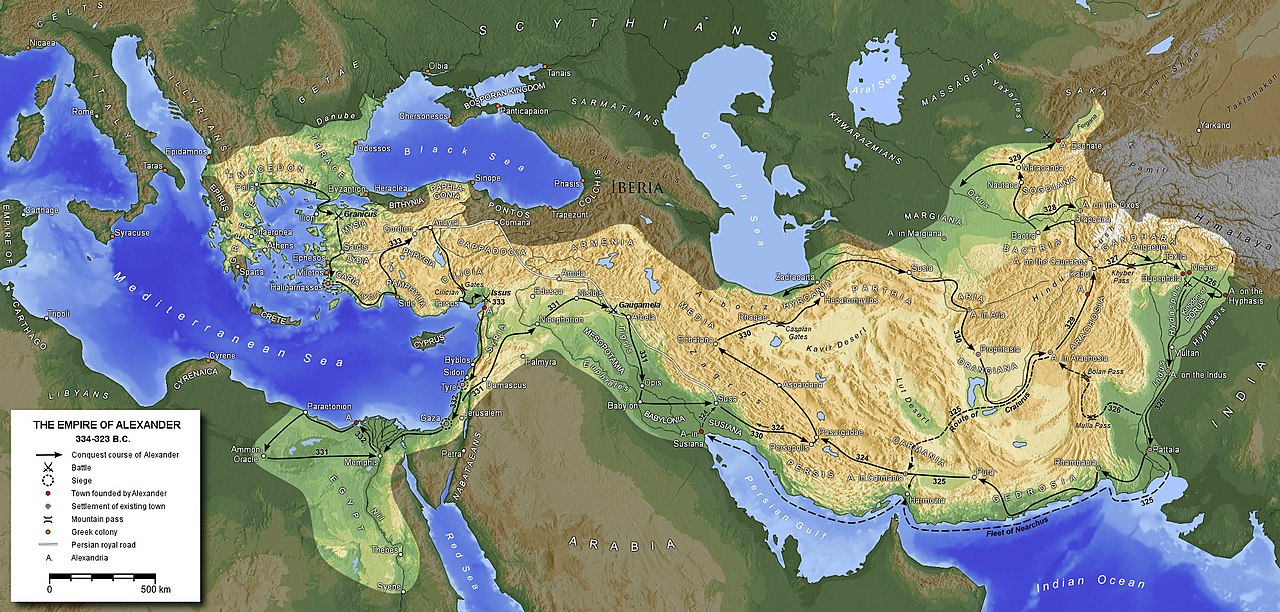
Map of Alexander's short-lived empire (334–323 BC)
Map of Alexander the Great's empire, showing his conquests including the Achaemenid Empire
Hellenistic Period Begins
The period in Greek history from the death of Alexander the Great until the rise of the Roman empire and its conquest of Egypt in 30 BC is known as the Hellenistic period. After Alexander's death, a series of wars between his successors eventually led to three large states: the Antigonids, the Seleucids, and the Ptolemies. These kingdoms spread Greek culture and lifestyles into Asia and Egypt.
Djenné-Djenno Occupied in Mali
The civilisation of Djenné-Djenno in the Niger River Valley in Mali is known to have been occupied from 250 BC to AD 900. It is considered to be among the oldest urbanised centres and the best-known archaeology site in sub-Saharan Africa. The site disproves earlier assumptions that advanced trade networks and complex societies did not exist in the region until the arrival of traders from Southwest Asia.
Ardiani Wars with Rome
The Ardiani Illyrian tribe were infamous for their piracy and wars against the Roman Empire, fighting Rome for the first time between 229–228 BC, then again during 220–219 BC, and for a third time during 168 BC. These conflicts were part of Rome's broader expansion into the Balkans. The Illyrian tribes were eventually subdued by Roman power.
Qin Shi Huangdi Unifies China
Ying Zheng, the king of Qin, unified the other six powers and further annexed territories to the south and southeast by 213 BC, enabling him to proclaim himself the First Emperor (Qin Shi Huangdi). In his reign, unified China created the first continuous Great Wall with the use of forced labour. The Qin period also saw the standardisation of the Chinese writing system and unified legal systems and units of measurement.
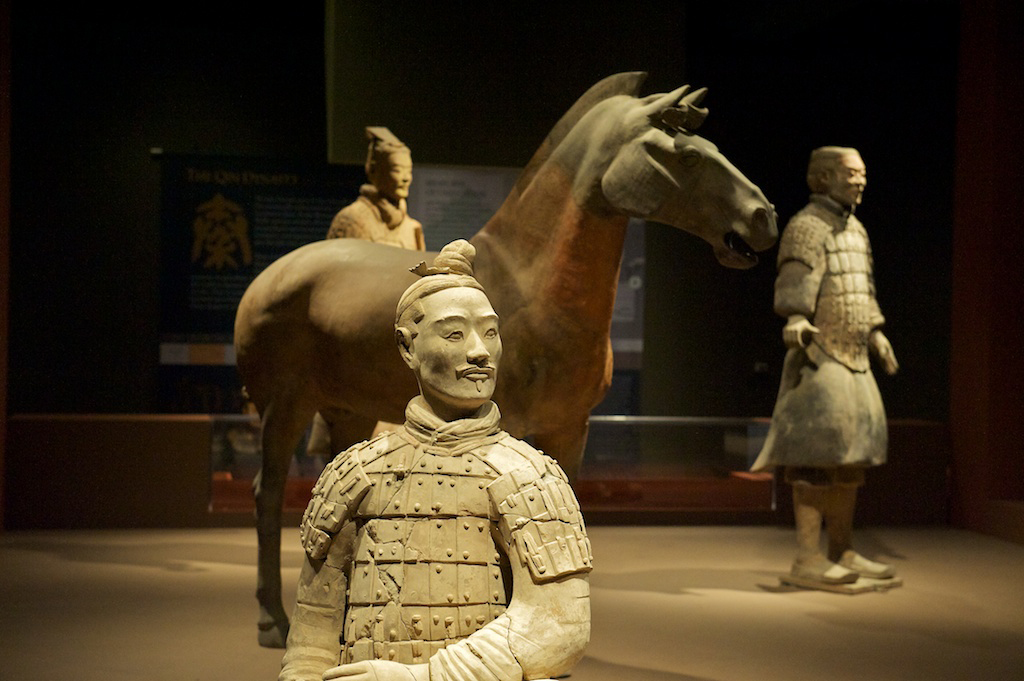
Terracotta Warriors from the time of Qin Shi Huang
The Terracotta Warriors, buried with Qin Shi Huangdi, the first emperor of unified China
Han Dynasty Rules China
The Han dynasty took power after the Qin period and ruled China for over four centuries with a brief interruption from AD 9 to 23. The Han dynasty promoted the spread of iron agricultural tools, which helped create a food surplus that led to large population growth. Silk production also increased and the manufacture of paper was invented during this period.
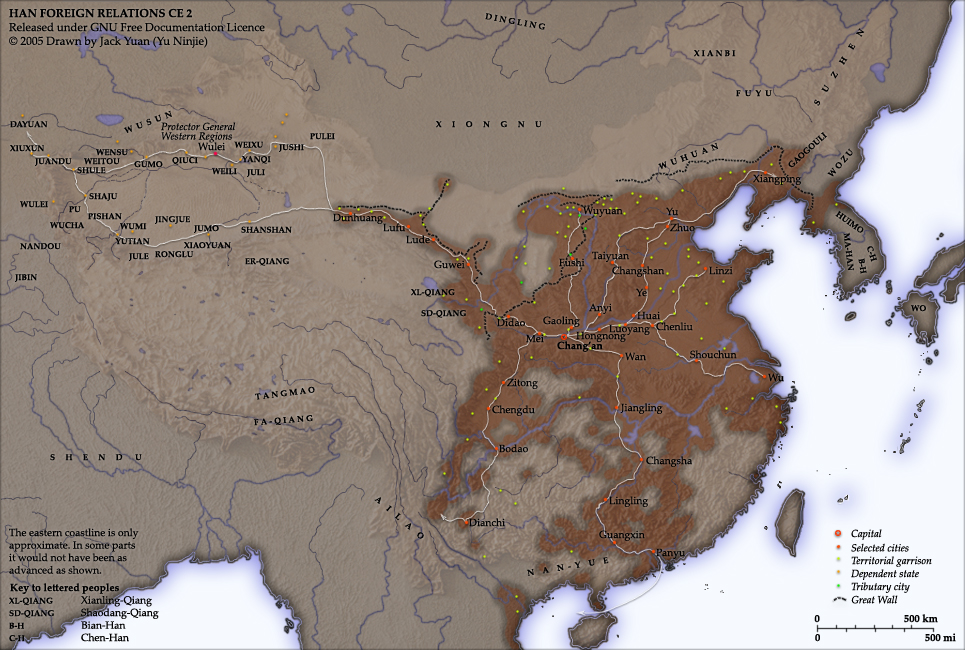
The Chinese Han dynasty dominated the East Asia region
Map of the Han dynasty's dominance in East Asia at the beginning of the first millennium AD
Austronesian Spice Trade Networks Established with India and Sri Lanka
The Austronesian spice trade networks were established by Islander Southeast Asians with Sri Lanka and Southern India by around 1000 to 600 BC. By around the 2nd century BC, these Neolithic Austronesian jade and spice trade networks connected with the maritime trade routes of South Asia, the Middle East, eastern Africa, and the Mediterranean, becoming what is now known as the Maritime Silk Road. This network allowed the exchange of goods from East and Southeast Asia all the way to Europe and eastern Africa.
Austronesian maritime trade network in the Indian Ocean
Map of Austronesian maritime trade networks in the Indian Ocean, including the Maritime Silk Road
Mithradates I Conquers Seleucid Empire; Parthian Empire Rises
The Parthian Empire was led by the Arsacid dynasty, which by around 155 BC under Mithradates I had mostly conquered the Seleucid Empire. Parthia's power was based on a combination of heavy cavalry and a decentralised governing structure. Parthia had many wars with the Romans, but it was rebellions within the empire that ended it in the 3rd century AD.
Rome Destroys Carthage; End of Punic Wars
After the third and final Punic War, Carthage was destroyed and then occupied by Roman forces in 146 BC. Nearly all of the territory held by Carthage fell into Roman hands. This marked the end of Carthaginian power and the beginning of Roman dominance in the western Mediterranean.
Han Dynasty Conquers Northern Korea
In 108 BC, the Han dynasty of China conquered much of northern Korea. This rule led to cultural influences on Korea for many centuries to come. When Han China began its decline, three kingdoms in Korea – Baekje, Goguryeo, and Silla – emerged and expelled the Chinese.
Roman Empire Established
A series of internal conflicts led the Roman republic to become an empire ruled by an emperor by the first century AD. Throughout the first and second centuries AD, the Empire grew slightly while spreading Roman culture throughout its boundaries. The Roman Empire became one of the most influential political entities in Western history.

Roman Empire AD 117
Map of the Roman Empire at its greatest extent in AD 117
0 CE – 499 CE
Kingdom of Aksum Rises in Northeast Africa
The Kingdom of Aksum was an important trading nation in northeastern Africa centred in present-day Eritrea and northern Ethiopia, existing from approximately AD 100 to 940. It grew from the Iron Age proto-Aksumite period around the 4th century BC to achieve prominence by the 1st century AD. At its height by the early 6th century AD, Aksum extended through much of modern Ethiopia and across the Red Sea to Arabia.

The Ezana Stone
The Ezana Stone records negus Ezana's conversion to Christianity and conquests, representing the Kingdom of Aksum
Teotihuacan Develops in Mesoamerica
Teotihuacan developed around AD 200 and centred on the city of Teotihuacan, which grew to perhaps as many as 200,000 inhabitants at its height. Teotihuacan lasted until around AD 700, when it was burned and vandalised. It was one of the largest cities in the ancient world.

The ruins of Mesoamerican city Teotihuacan
The Avenue of the Dead and Pyramid of the Sun at Teotihuacan
Sasanian Empire Founded
The Sasanian Empire began when the Parthian Empire ended in AD 224. Their rulers claimed the Achaemenids as ancestors and set up their capital at Ctesiphon in Mesopotamia. Their period of greatest military expansion occurred under Shapur I, who by the time of his death in AD 272 had defeated Roman imperial armies.
Shapur I Defeats Roman Imperial Armies
The Sasanian Empire's period of greatest military expansion occurred under Shapur I, who by the time of his death in AD 272 had defeated Roman imperial armies and set up buffer states between the Sasanians and Roman Empires. This represented a significant challenge to Roman power in the east. After Shapur, the Sasanians were under more pressure from the Kushans to their east as well as the Roman then Byzantine Empire to its west.
Mochica Culture Arises in the Andes
From about AD 300, the Mochica culture arose along the Moche River in the Andes. These people left painted pottery depicting their society and culture with a wide range of varied subjects. Besides the Mochica, there were a number of other large states in the Andes after about AD 100, including the Nazca culture.
Maya Classical Period
Maya culture began to emerge around AD 300 in the Yucatan Peninsula and modern-day Guatemala. During the 600 years of the Classical Maya period, more than 80 Mayan sites were built, with temples, pyramids, and palaces the focal point of each centre. The Mayan civilisation began to decline about AD 800, and most of its cities were deserted soon afterwards.
Constantine the Great Christianizes Roman Empire
Constantine the Great initiated the process of Christianisation of the Roman Empire and established a new capital at Constantinople. This transformation had profound and lasting effects on Western civilization. The resultant cultural fusion of Greco-Roman, Germanic and Christian traditions formed the cultural foundations of Europe.
Gupta Empire Unifies North India
Most of North India was reunited under the Gupta Empire beginning under Chandragupta I around AD 320. Under his successors the empire spread to include much of India except for the Deccan Plateau and the very south of the peninsula. This was a period of relative peace often called the Golden Age of India.

Mauryan Empire network model
Map of the Mauryan Empire, predecessor to the Gupta Empire in India
Huns Form Large State in Eastern Europe
The Huns were a nomadic people who formed a large state in Eastern Europe by about AD 400, and under their leader Attila, they fought against both sections of the Roman Empire. However, after Attila's death, the state fell apart and the Huns' influence in history disappeared. The Huns contributed to the destabilization of the Roman Empire.
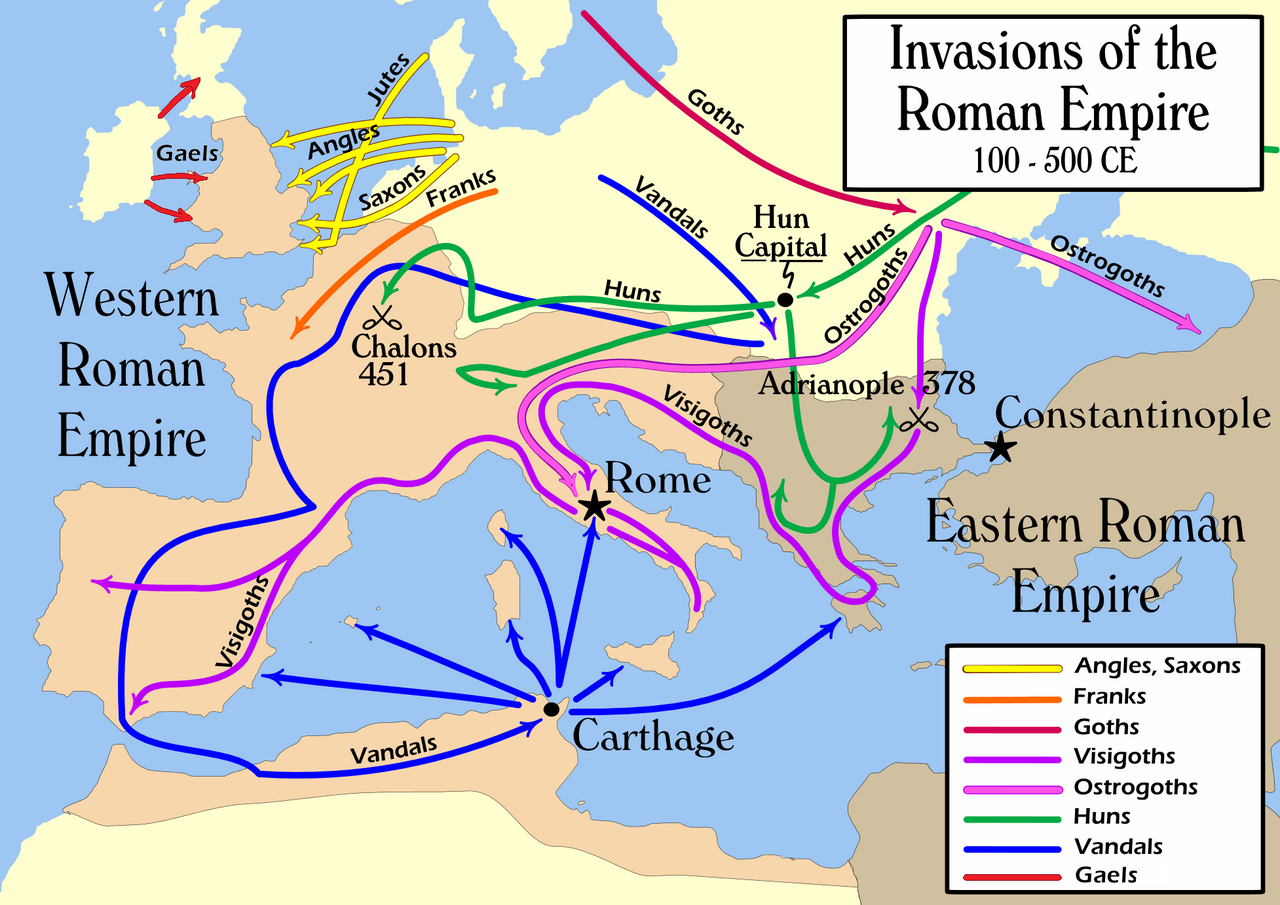
Age of Migrations in Europe
Map showing the invasions of the Roman Empire including by the Huns
Visigoths Settle in Spain
Groups of Goths migrated into western Europe, with the Visigoths settling in Spain and founding a kingdom that lasted until it was conquered by Islamic rulers in the AD 700s. The Ostrogoths eventually settled in Italy before being conquered by the Lombards. These Germanic migrations fundamentally transformed the former western Roman Empire.
Age of Migrations in Europe
Map showing the Germanic migrations including the Visigoths into Spain
Fall of Western Roman Empire
The western half of the Roman Empire, including Hispania, Gaul, and Italy, eventually broke into independent kingdoms in the 5th century AD. The Eastern Roman Empire, governed from Constantinople, is referred to as the Byzantine Empire after AD 476, the traditional date for the 'fall of Rome.' This event marked the end of ancient history and the beginning of the Middle Ages in Europe.
Age of Migrations in Europe
Map showing the Germanic migrations that contributed to the fall of the Western Roman Empire
Gupta Empire Weakened by Huna Raids
The Gupta Empire was weakened and ultimately ruined by the raids of Hunas (a branch of the Hephthalites emanating from Central Asia), and the empire broke up into smaller regional kingdoms by the end of the fifth century AD. India would remain fragmented into smaller states until the rise of the Mughal Empire in the 1500s. This marked the end of the classical period of Indian history.
500 CE – 999 CE
Last Sassanid Emperor Killed; Islamic Conquest of Persia
In AD 651, the last Sassanid emperor was killed by the expanding Islamic Arabs, ending the Sasanian Empire. The Sasanians had rebuilt and founded numerous cities and their merchants had introduced crops such as sugar, rice, and cotton into the Iranian plateau. This marked the end of pre-Islamic Persian civilization and the beginning of Islamic rule in Persia.
Silla Controls Korean Peninsula
Goguryeo and Baekje were eventually destroyed by a Tang dynasty and Silla alliance. Silla then drove out the Tang dynasty in 676 to control most of the Korean peninsula undisputed. This marked the unification of Korea under a single kingdom for the first time.
Srivijaya Empire Founded at Palembang
Srivijaya, an Austronesian polity founded at Palembang in 682 AD, rose to dominate the trade in the region around the straits of Malacca and Sunda and the South China Sea. It emerged through the conquest and subjugation of neighbouring thalassocracies including Melayu, Kedah, Tarumanagara, and Mataram. Srivijaya controlled the sea lanes in Southeast Asia and exploited the spice trade of the Spice Islands.

The thalassocratic Srivijaya empire
Map of the Srivijaya empire at its maximum extent, showing control of the straits of Malacca and Sunda
Austronesian Surge of Island Colonisation in Polynesia
Around 700 AD, there was another surge of Austronesian island colonisation in Polynesia. It reached the Cook Islands, Tahiti, and the Marquesas by 700 AD; Hawaii by 900 AD; Rapa Nui by 1000 AD; and New Zealand by 1200 AD. This represented the final phase of human settlement of the Pacific.
Map showing the migration of the Austronesians from Taiwan
Map showing the chronological dispersal of Austronesian peoples across the Pacific including the final colonisation of Polynesia