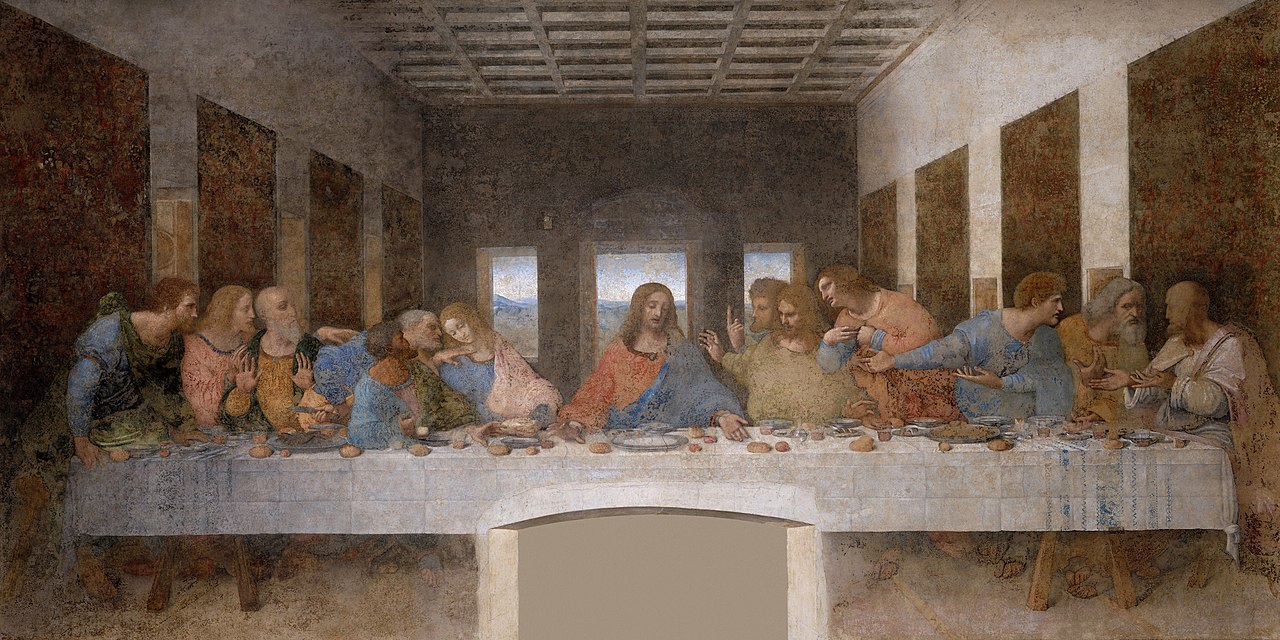
The Last Supper by Leonardo da Vinci
This iconic painting depicts the final meal of Jesus before his crucifixion, representing the foundational event from which Christianity originated.
History of Christianity
This timeline covers the history of Christianity from its origins with Jesus of Nazareth in the first century CE through the early twenty-first century. It traces the religion's spread, theological developments, institutional changes, schisms, reformations, and global growth across two millennia.
Source: Wikipedia1st Century
Ministry and Crucifixion of Jesus
Jesus of Nazareth, a Jewish itinerant preacher in Galilee and the Roman province of Judea, began his public ministry. His followers proclaimed him the Messiah and the incarnation of God. His crucifixion in Jerusalem is well attested historically and marks the founding moment of Christianity. His disciples believed he rose from the dead, forming the core of Christian faith.
The Last Supper by Leonardo da Vinci
Depicts the final meal before Jesus' crucifixion and death.

Christ Crucified by Diego Velázquez
Depicting the crucifixion of Jesus.
Council of Jerusalem
James, brother of Jesus, called the Council of Jerusalem to address disputes over whether Gentile converts needed to follow Jewish Law including circumcision. The council determined that converts should avoid idols, fornication, things strangled, and blood, but were not required to follow other aspects of Jewish Law. This decision was pivotal in separating Christianity from Judaism and enabling its spread among non-Jewish peoples.
Nero's Persecution of Christians
Emperor Nero conducted a persecution of Christians confined to the city of Rome during the mid-first century. This was among the earliest recorded state persecutions of Christians. While local and limited, it established a precedent of Roman hostility toward the new faith and produced early Christian martyrs.
2nd Century
Pauline Epistles Circulated
Letters sent by Paul the Apostle to Christian communities were circulating in collected form by the end of the first century. Paul, a Jewish Pharisee who had experienced a vision of Christ on the road to Damascus, became one of Christianity's most influential missionaries. His epistles formed a significant portion of what would become the New Testament and shaped Christian theology profoundly.
Christianity Reaches North Africa
By the second century, Christianity had spread to North Africa, establishing communities in major cities. The faith spread along trade and travel routes into the Jewish diaspora and beyond. North Africa would become a major center of Christian theology, producing influential Church Fathers such as Tertullian, Origen, and Augustine of Hippo.
3rd Century
Christianity Grows to Over 200,000 Adherents
By 200 CE, Christian numbers had grown to over 200,000 people, with communities averaging 500–1,000 people existing in approximately 200–400 towns. House churches were succeeded by buildings designed specifically as churches, complete with assembly rooms, classrooms, and dining rooms. A more formal church government developed, with bishops rising in power and influence.

Portrait from Die Malereien der Katakomben Roms
Early Christian art from the Roman catacombs, reflecting the growing Christian community.
4th Century
Kingdom of Armenia Adopts Christianity as State Religion
In 301 CE, the Kingdom of Armenia became the first nation in the world to adopt Christianity as its official state religion. This was a landmark moment in Christian history, predating the Roman Empire's embrace of Christianity. Armenia was soon followed by Caucasian Albania and the East African Kingdom of Aksum.
Diocletian's Persecution of Christians
Official Roman persecution of Christians reached its height under Emperor Diocletian from 303 to 311 CE. This was the most severe and systematic empire-wide persecution of Christians, targeting churches, scriptures, and clergy. The persecution ultimately failed to suppress Christianity and contributed to the religion's eventual legalization under Constantine.
Edict of Milan: Christianity Legalized
Emperor Constantine, a self-declared Christian, issued the Edict of Milan in 313 CE, expressing tolerance for all religions including Christianity. This ended the era of Roman persecution and marked a turning point in Christian history. Constantine subsequently supported Christianity by giving bishops judicial power, establishing them as legally equal to polytheistic priests, and funding church construction.
First Council of Nicaea and the Nicene Creed
The First Council of Nicaea in 325 CE attempted to resolve the Arian controversy over whether Jesus' divinity was equal to the Father's. The council produced the Nicene Creed, a foundational statement of Christian belief. While most accepted it, some refused, and the controversy continued to embroil the church for decades, weakening Christian communities along the Eastern Mediterranean.

First Council of Nicaea icon from Protatos Church, 1770
Icon depicting the First Council of Nicaea, where the Nicene Creed was formulated.
Basil the Great Founds the Basileias
In the 370s, Basil the Great founded the Basileias, a monastic community in Caesarea (Mazaca) which developed the first health care system for the poor. This institution is considered a forerunner of modern public hospitals. It represented the integration of Christian charity with organized social services, a model that would shape Western civilization.
Jerome Translates the Bible into Latin (Vulgate)
In the late fourth century, Jerome was commissioned to translate the Greek biblical texts into Latin, producing what became known as the Vulgate. This translation became the standard Bible of the Western Church for over a millennium. It made scripture accessible to the Latin-speaking world and had an enormous influence on Western Christianity, culture, and literature.
5th Century
Council of Ephesus Condemns Nestorius
The Council of Ephesus, the church's third ecumenical council held in 431 CE, condemned Nestorius who had declared Mary as the mother of Jesus' humanity but not his divinity. The Persian church refused to recognize the council's authority, leading to the first major East-West separation. This resulted in the formation of the Church of the East (Nestorian/Assyrian Church) and the Syrian Orthodox Church.
Council of Chalcedon
The fourth ecumenical council, the Council of Chalcedon in 451 CE, produced the Chalcedonian Definition emphasizing that the Son is 'one person in two natures.' While most of Christianity accepted this definition, those who found it too close to Nestorianism separated after 484 CE into Oriental Orthodoxy, which sees only 'One Nature of God the Incarnate Logos.' This created a lasting division in Eastern Christianity.
Fall of the Western Roman Empire
The Western Roman Empire ended in 476 CE, but its successor states and the Eastern Byzantine Empire remained Christian. For five centuries after the fall, Western culture and civilization were primarily preserved and passed on by monks. The church became the primary institution maintaining social order, literacy, and cultural continuity in the fragmented West.
6th Century
Clovis I Converts to Catholicism
The Frankish king Clovis I converted to Catholicism, and his kingdom became the dominant polity in the West in 507 CE. His conversion was a pivotal moment in European history, as the Frankish kingdom gradually converted into a Christian kingdom over the following centuries. This laid the foundation for the eventual Carolingian Empire and the Christianization of Western Europe.
Pope Gregory I Reforms the Papacy
Pope Gregory I gained prestige and power for the papacy by leading the response to the Lombard invasion in 592–593 CE, reforming the clergy, standardizing music in worship, sending out missionaries, and founding new monasteries. His actions significantly expanded papal influence and authority. Until 751, the Pope remained a subject of the Byzantine emperor, but Gregory's reforms laid the groundwork for greater papal independence.
7th Century
Islamic Conquests Devastate Christian Communities
Between 632 and 750 CE, Islamic caliphates conquered the Middle East, North Africa, and the Iberian Peninsula, devastating many Christian communities. Most urban Asian churches disappeared, though some Christian communities in remote areas survived. Christians in conquered territories were designated as dhimmi, a status guaranteeing protection but enforcing legal inferiority.
Church of the East Brings Christianity to China
In 635 CE, the Church of the East brought Christianity into China. Emperor Taizong decreed that the Christian faith was allowed, and its license was copied onto the Sianfu stele. Christianity spread into northwestern China, Khotan, Turfan, and south of Lake Balkash in southeastern Kazakhstan, though its growth was later halted in 845 by Emperor Wuzong of Tang.
9th Century
Charlemagne Crowned Emperor by Pope Leo III
In 800 CE, Pope Leo III crowned Charlemagne emperor, establishing the precedent that only a pope could crown a Western emperor. This enabled popes to claim that emperors derived their power from God through them. Charlemagne engaged in reforms that began the Carolingian Renaissance, a period of intellectual and cultural revival, and the Papacy became free from Byzantine control.
Cyril and Methodius Evangelize Eastern Europe
The ninth-century saints Cyril and Methodius brought Byzantine Christianity to Eastern Europe, which was integral to the formation of its modern states. The brothers developed the Glagolitic alphabet to translate the Bible into local languages, and their disciples developed the Cyrillic script. This spread literacy and became the cultural and religious foundation for all Slavic nations.

St. Cyril and St. Methodius monument on Mt. Radhošť
Monument commemorating Saints Cyril and Methodius, who evangelized Eastern Europe and created the Glagolitic alphabet.
10th Century
Baptism of Vladimir of Kiev
The baptism of Vladimir of Kiev in 989 CE is traditionally associated with the conversion of the Kievan Rus'. This event marked the beginning of Orthodox Christianity in Russia and shaped the religious and cultural identity of the Russian people for centuries. The new religious structure included dukes maintaining control of a financially-dependent church.
11th Century
East-West Schism
In 1054 CE, the church within the Byzantine Empire formally separated from the Western Catholic Church, forming Byzantine Eastern Orthodoxy. This schism had been building for centuries due to cultural differences, geopolitical disagreements, and theological disputes over papal authority. The Eastern church remained in communion with the Ecumenical Patriarchate of Constantinople rather than the Pope.
Pope Nicholas II Establishes College of Cardinals
In 1061, Pope Nicholas II moved to protect the papacy from secular control by establishing that popes could only be elected by a College of Cardinals. This was a significant step in asserting papal independence from secular rulers. However, both nobles and the church still claimed the right to appoint bishops, leading to the Investiture Controversy.
Gregorian Reform and Investiture Controversy
The reform of Pope Gregory VII (1073–1085) began a new period in church history by pressing for an end to simony, enforcement of clerical celibacy, and establishment of papal supremacy. The Investiture Controversy pitted Holy Roman Emperor Henry IV against Pope Gregory VII over the secular appointment of bishops. When Henry IV rejected papal decrees, he was excommunicated, contributing to a civil war.
First Crusade
In 1095, Pope Urban II asked European Christians to go to the aid of their brethren in counterattack against Islamic inroads, following a request from Byzantine Emperor Alexios I Komnenos. Tens of thousands answered the call. Peter the Hermit led the People's Crusade to a disastrous end in 1096, while the main crusading army captured Jerusalem in 1099. Eight Crusades lasting from 1096 to 1272 had little overall military success.
Cistercian Movement and Monastic Reform
The Cistercian movement, beginning after 1098, was a wave of monastic reform that had significant technological and economic impact. Cistercians were among the best industrialists of the Middle Ages; nearly all of the 740 twelfth-century Cistercian monasteries possessed a water wheel used for innovative hydraulic engineering. They also taught advanced farming techniques and were skilled metallurgists.
12th Century
Renaissance of the Twelfth Century
Between 1150 and 1200, monks searched the libraries left behind by fleeing Muslims in Sicily and Spain and found the works of Aristotle, Euclid, and other ancient writers. The West's rediscovery of the complete works of Aristotle led to the Renaissance of the twelfth century and created conflict between faith and reason, resolved by scholasticism. The scholastic writings of Thomas Aquinas impacted Catholic theology and influenced secular philosophy and law.

Gothic architecture of the Lady Chapel of Wells Cathedral
Gothic architecture, which began in the twelfth and thirteenth centuries, was intended to inspire contemplation of the divine.
Medieval Inquisition Established
The Medieval Inquisition, lasting from 1184 to the 1230s, was initiated by Pope Innocent III in response to increasing concerns over heresy and public disorder. Between 8,000 and 40,000 people were brought to interrogation and sentencing, with death sentences being relatively rare. The Dominican Order held primary responsibility for conducting inquisitions, and the penalty imposed most often was an act of penance.
13th Century
Albigensian Crusade Against Catharism
In 1209, Pope Innocent III and King Philip II of France initiated the Albigensian Crusade against Catharism in southern France. The campaign took a political turn when the king's army seized strategic lands of nobles. It ended in 1229 with a treaty bringing the region under French rule, creating southern France, while Catharism continued until 1350.
Fourth Lateran Council
The Fourth Lateran Council of 1215 made confession required for all Christians and empowered inquisitors to search out moral and religious crimes even without an accuser. It also formalized several fundamental doctrines including the seven sacraments. This council represented the height of medieval papal authority and had lasting impact on Catholic practice and doctrine.
Talmud Put on Trial
A turning point in Jewish-Christian relations occurred in 1239 when the Talmud was put 'on trial' by French King Louis IX and Pope Gregory IX because of contents that allegedly mocked central figures of Christianity. Talmudic Judaism came to be seen as so different from biblical Judaism that old Augustinian obligations to leave Jews alone no longer applied. This contributed to increasing anti-Jewish rhetoric and violence in medieval Europe.
Church of the East at Height of Expansion
At the height of its expansion in the thirteenth century, the Church of the East stretched from Syria to eastern China and from Siberia to southern India and southern Asia. It had become the principal Church in Asia in the Middle Ages, having evangelized all along the Silk Road and been instrumental in converting some Mongolic and Turkic peoples. This represented the greatest geographical extent of any Christian church in history.
14th Century
Avignon Papacy Begins
In 1309, Pope Clement V fled Rome's factional politics by moving to Avignon in southern France. This Avignon Papacy, consisting of seven successive popes, unintentionally diminished papal prestige and power by leaving Rome and the 'seat of Peter' behind. The papacy remained in Avignon until Pope Gregory XI returned to Rome in 1377.
Gregory Palamas Defends Hesychasm
In 1341, St. Gregory Palamas defended hesychast spirituality and the Orthodox understanding of God against the criticisms of Barlaam, a Calabrian humanist philosopher, by writing his most influential work 'Triads.' This theological controversy was significant for Eastern Orthodox theology and its understanding of the nature of God and divine light. Palamas' victory in this debate shaped Orthodox theology for centuries.
Western Schism
After Pope Gregory XI returned to Rome and died in 1378, the papal conclave elected Urban VI, but French cardinals disapproved and elected Robert of Geneva instead. This began the Western Schism, during which there was more than one pope. In 1409, the Council of Pisa's attempted resolution resulted in a third pope, and the schism was finally resolved in 1417 with the election of Pope Martin V.
Wycliffe's Bible Published
In 1382, the first English translation of the Bible, known as Wycliffe's Bible, was published. John Wycliffe (1320–1384) had urged the church to embrace its original simplicity, give up its property and wealth, and deny papal authority. Though his teachings were condemned as heresy, he was allowed to live out his last years in his home parish, and his work influenced Jan Hus and later Protestant reformers.
15th Century
Jan Hus Burned at the Stake
Czech theologian Jan Hus (1369–1415), influenced by Wycliffe's teachings, spoke out against corruption in the church and was convicted of heresy and burned at the stake. His execution was the impetus for the Bohemian Reformation and led to the Hussite Wars. Hus became a martyr figure and his death demonstrated the church's willingness to use extreme measures against reformers.
Fall of Constantinople to the Ottoman Empire
The Fall of Constantinople to the Ottoman Empire in 1453 negated a reunion agreement between the Orthodox and Catholic churches signed in 1452 and sealed off Orthodoxy from the West for more than a century. Islamic law did not acknowledge the Byzantine church as an institution, but societal stability concerns allowed it to survive. The flight of Eastern Christians and the manuscripts they carried were important factors in stimulating literary renaissance in the West.
Spanish Inquisition Established
Authorized by Pope Sixtus IV in 1478, the Spanish Inquisition was established to combat fears that Jewish converts were conspiring with Muslims to sabotage the new Spanish state. Five years later, a papal bull conceded control to Spanish monarchs, making it the first national, unified, centralized institution of the nascent Spanish state. The monarchy centralized state power by absorbing and adapting military orders, inquisitorial courts, and police organizations for political purposes.
16th Century
Protestant Reformation Begins
The Protestant Reformation began in 1517 when Catholic monk Martin Luther nailed his Ninety-five Theses to the church door in Wittenberg, challenging the church's role in society and its authority. Luther asserted there were two realms of human existence, the secular and the sacred, and that only secular authority had the right to use force. Edicts issued at the Diet of Worms in 1521 condemned Luther, but the Reformation spread rapidly across Europe.
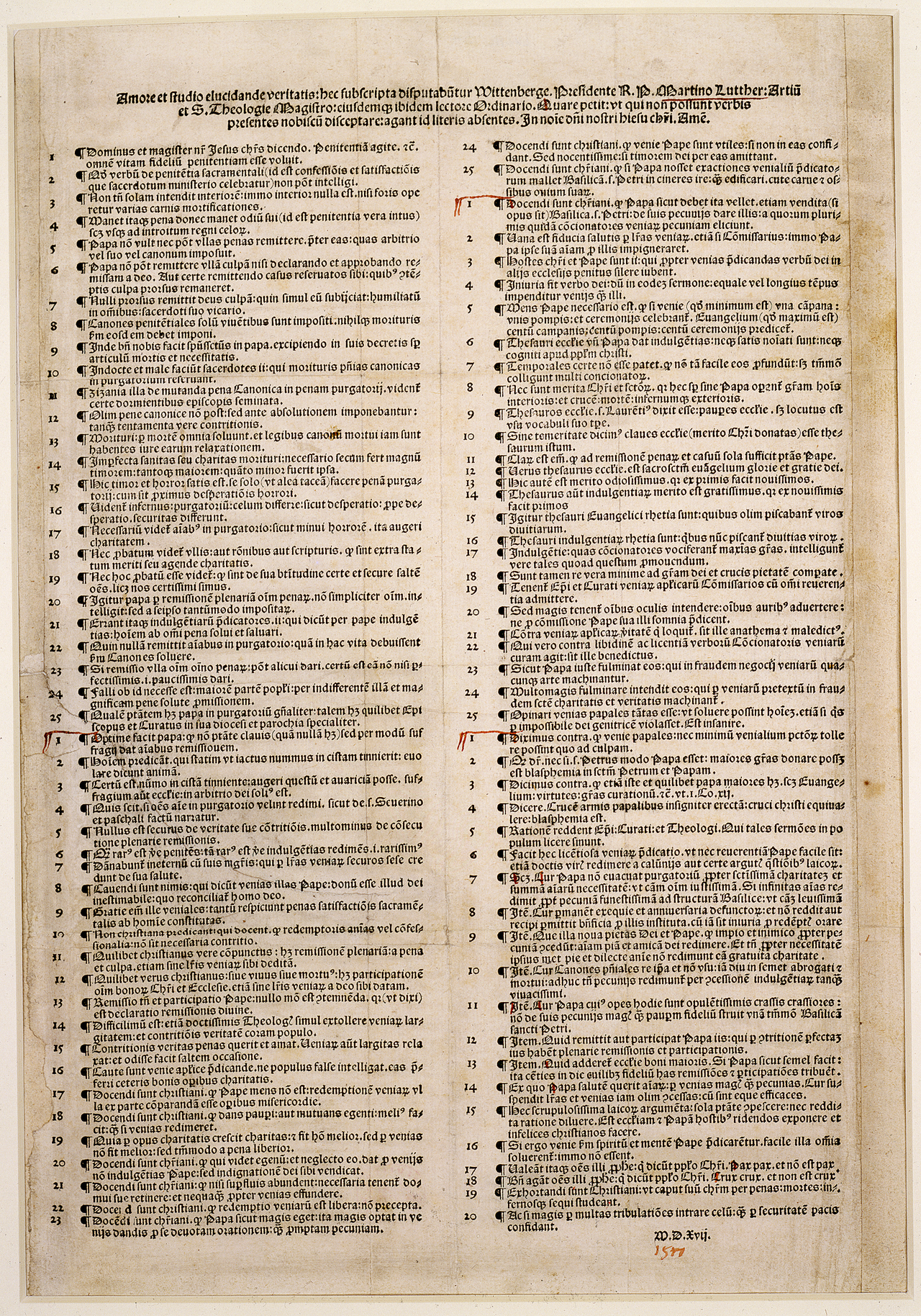
Luther's 95 Theses
Luther's 95 Theses, the document that sparked the Protestant Reformation.

Portrait of Martin Luther by Lucas Cranach
Portrait of Martin Luther, the founder of the Protestant Reformation.
Tyndale Bible Created
Between 1525 and 1534, William Tyndale used the Vulgate and Greek texts from Erasmus to create the Tyndale Bible, one of the first printed English translations of the Bible. This translation was significant for making scripture accessible to ordinary English speakers and influenced subsequent English Bible translations. It was later used as a source for the King James Version.
Council of Trent
The Council of Trent (1545–1563) was the Catholic Church's response to the Protestant Reformation, answering each Protestant claim and laying the foundation of modern Catholic policies. New monastic orders were formed, including the Society of Jesus (Jesuits), who adopted military-style discipline and strict loyalty to the Pope. The council defined Catholic doctrine on scripture, tradition, original sin, justification, and the sacraments.
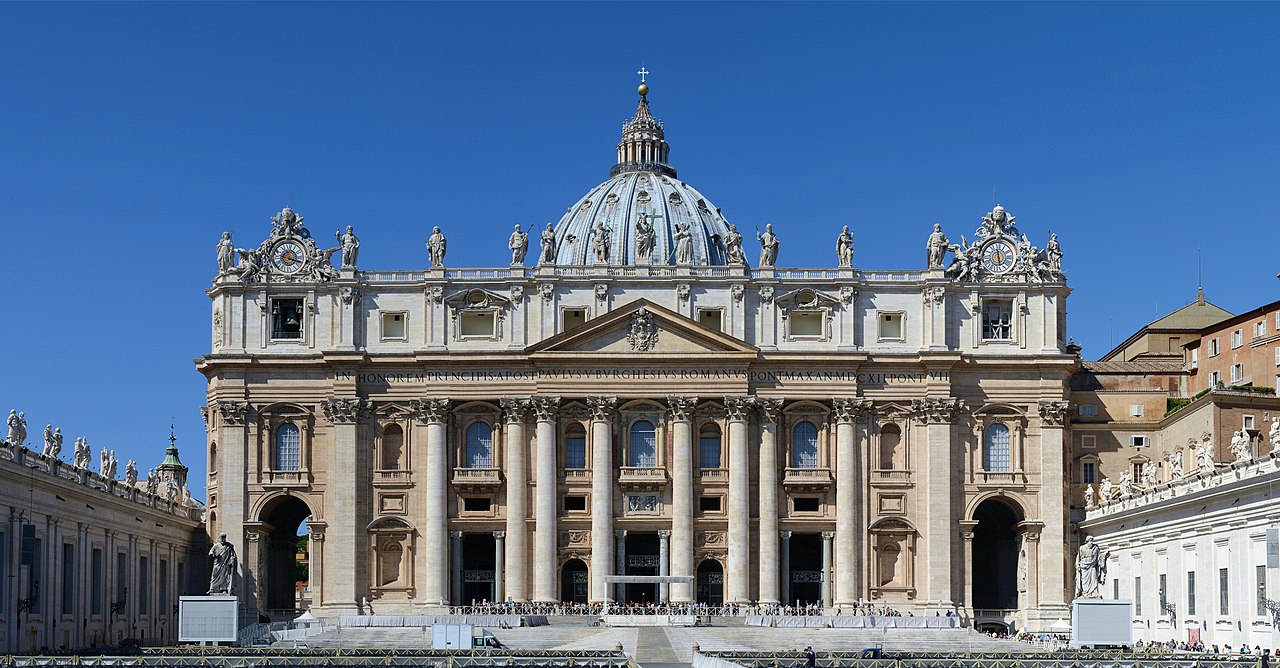
St. Peter's Basilica in the Vatican City
The Vatican, center of Catholic authority during the Counter-Reformation.
17th Century
King James Bible Published
King James commissioned the King James Version of the Bible in 1604, using all previous versions in Latin, Greek, and English as sources. It was published in 1611 and became one of the most influential books in the English language. The King James Bible shaped English literature, culture, and Protestant Christianity for centuries.
Thirty Years' War
The Thirty Years' War (1618–1648) was the largest and most destructive of the European wars of religion, centered in France and the Holy Roman Empire. While some scholars argue these wars were about religious liberty, most historians argue they were also about nationalistic state-building and economics. The war devastated Central Europe and reshaped the political and religious map of the continent.
18th Century
First Great Awakening
In reaction to rationalism, pietism began in Europe and spread to the Thirteen Colonies where it contributed to the First Great Awakening, a religious revival of the 1700s. Pietist Moravians came to Georgia in 1732 where they influenced John Wesley, an Anglican missionary. After returning to England, Wesley began preaching in open-air meetings, leading to the creation of the Methodist church.
19th Century
Second Great Awakening
The Second Great Awakening, a religious revival of the 1800s–1830s, produced Mormonism, Restorationism, and the Holiness movement. This revival focused on evidencing conversion through active moral reform in areas such as women's rights, temperance, literacy, and the abolition of slavery. It had profound social and political consequences in America, contributing to the abolitionist movement and women's rights.
Third Great Awakening and Missionary Zeal
The Third Great Awakening began in 1857 and took root throughout the world, especially in English-speaking countries, contributing to a surge of missionary zeal. Nineteenth-century Protestant missionaries, many of them women, played a significant role in shaping nations and societies by translating the Bible into local languages and establishing schools. According to historian Lamin Sanneh, Protestant missionaries stimulated the 'largest, most diverse and most vigorous movement of cultural renewal' in African history.
Woman's Christian Temperance Union Founded
The Woman's Christian Temperance Union (WCTU) was founded in 1874, with many supporters going on to contribute to the women's rights movement. Women had been involved in temperance reform from the early 1800s, and the WCTU became one of the largest women's organizations in the United States. It used moral persuasion and political activism to effect social change.
20th Century
Azusa Street Revival and Pentecostalism
The 1906 Azusa Street Revival typified the Pentecostal movement, which combined Restorationism with the goal of sanctification defined as a deeper spiritual experience. Pentecostalism grew to become one of the most significant movements in twentieth-century Christianity. By 2000, approximately one-quarter of all Christians worldwide were part of Pentecostalism and its associated movements.
Nazi Rise to Power and German Church Response
Most leaders and members of the largest Protestant church in Germany, the German Evangelical Church, supported the Nazi Party when they came to power in 1933. About a third of German Protestants formed the Confessing Church which opposed Nazism; its members were harassed, arrested, and otherwise targeted. Pope Pius XI declared the irreconcilability of the Catholic position with totalitarian fascist states that placed the nation above God.
World Council of Churches Formed
In response to the profound impact of World War I on Christianity, the World Council of Churches (WCC) formed in 1938 to address social issues, create cooperation, and open a dialogue among Christians on a global scale. The WCC played an important role in the Universal Declaration of Human Rights in 1948. It represented a major step toward Christian ecumenism and global cooperation.
Christianity Declines in the West, Grows in Global South
In the twentieth century, Christianity declined in most of the Western world but grew dramatically in the Global South, particularly Southeast Asia and Sub-Saharan Africa. In 1900, about 6.5% of Africa's population were Christian; by 2005, this had grown to about half the continent's population. By 2060, more than forty percent of the world's Christians are projected to live in sub-Saharan Africa.

Global distribution of Christians based on 2011 Pew Research Center data
Map showing the worldwide distribution of Christians, illustrating the shift toward the Global South.
Second Vatican Council
The Second Vatican Council (Vatican II), from 1962–1965, brought about numerous reforms, liturgical changes, promoted the involvement of laypeople, and improved relations with other Christian denominations. It represented the most significant reform of the Catholic Church in centuries and opened the church to dialogue with the modern world. Vatican II's reforms reshaped Catholic practice and theology globally.
St. Peter's Basilica in the Vatican City
The Vatican, where the Second Vatican Council was held.
Joint Declaration on the Doctrine of Justification
In 1992, the Catholic Church and the Lutheran World Federation signed the Joint Declaration on the Doctrine of Justification, resolving one of the central theological disputes of the Protestant Reformation. This represented a major step in Catholic-Lutheran ecumenism and acknowledged significant common ground on the doctrine of salvation. It was a landmark achievement in Christian reconciliation.
21st Century
Christianity Becomes World's Largest Religion
In 2017, PEW reported that Christianity is the world's largest religion with roughly 2.4 billion followers, equal to 31.2% of the world's population. In the twenty-first century, Christianity has become the most diverse and pluralistic of the world's religions, embracing over 3,000 of the world's languages. Most Christians now live outside North America and Western Europe.
Global distribution of Christians
Map showing the worldwide distribution of Christians, reflecting Christianity's status as the world's largest religion.