
The birth of Muhammad
A 16th-century depiction of the birth of Muhammad, representing the beginning of the timeline of his life.
Muhammad
This timeline covers the life of Muhammad, the founder of Islam, from his birth in Mecca around 570 CE to his death in 632 CE. It includes key events such as his first revelation, migration to Medina, military campaigns, and the establishment of the Islamic community.
Source: Wikipedia570 CE – 574 CE
Birth of Muhammad
Muhammad ibn Abdullah was born in Mecca, belonging to the Banu Hashim clan of the Quraysh tribe. His birth year is traditionally associated with the Year of the Elephant, when Abraha allegedly attempted to conquer Mecca. His father Abdullah had died around the time of his birth, making him an orphan from the start.
The birth of Muhammad
A 16th-century illustration depicting the birth of Muhammad from the Siyer-i Nebi.
575 CE – 579 CE
Death of Muhammad's Mother Amina
Muhammad's mother Amina died of illness when he was six years old, leaving him an orphan. He was then placed under the guardianship of his paternal grandfather, Abd al-Muttalib. This early loss shaped his upbringing and reliance on extended family.
Death of Grandfather Abd al-Muttalib
Muhammad's grandfather and guardian Abd al-Muttalib died when Muhammad was about eight years old. Muhammad then came under the care of his uncle Abu Talib, the new leader of the Banu Hashim clan. Abu Talib would remain a key protector of Muhammad for decades.
580 CE – 584 CE
Muhammad Meets the Monk Bahira
As a child, Muhammad accompanied his uncle Abu Talib on a trading trip to Syria, where he reportedly met a monk named Bahira who foretold his prophethood. Multiple versions of this story exist with contradictory details, and modern historians consider all accounts of this meeting to be fictitious.
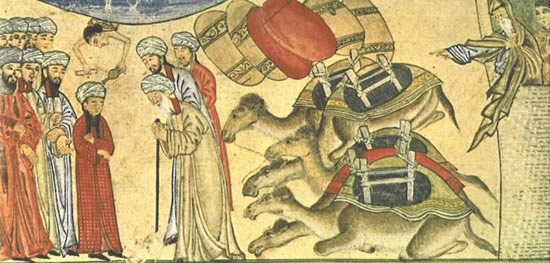
Young Muhammad meets the monk Bahira
A 1315 illustration from Jami' al-Tawarikh depicting the young Muhammad meeting the monk Bahira.
595 CE – 599 CE
Muhammad Marries Khadija
At the age of 25, Muhammad married Khadija, a wealthy 40-year-old businesswoman who had been impressed by his competence in leading one of her caravans to Syria. The marriage lasted 25 years and was described as a happy one; Muhammad remained monogamous with Khadija until her death. Khadija would later become the first person to believe in his prophethood.
605 CE – 609 CE
Muhammad Arbitrates the Black Stone Dispute
In 605, the Quraysh decided to rebuild the Kaaba and a dispute arose over which clan should have the privilege of replacing the Black Stone. Muhammad resolved the conflict by placing the stone on a cloak and having representatives of each clan jointly lift it into position, then personally securing it in the wall. This event demonstrated his reputation as a wise and trusted mediator.

Muhammad's role in re-setting the Black Stone
A miniature from Rashid al-Din Hamadani's work illustrating Muhammad's role in re-setting the Black Stone in 605 CE.
610 CE – 614 CE
First Revelation in the Cave of Hira
In 610, at the age of 40, Muhammad reported being visited by the angel Gabriel in the cave of Hira on Mount Jabal al-Nour, receiving his first revelation from God. Gabriel instructed him to read, and after Muhammad confessed his illiteracy, Gabriel recited verses that Muhammad memorized, later constituting Quran 96:1-5. This event marks the beginning of Muhammad's prophethood and the revelation of the Quran.
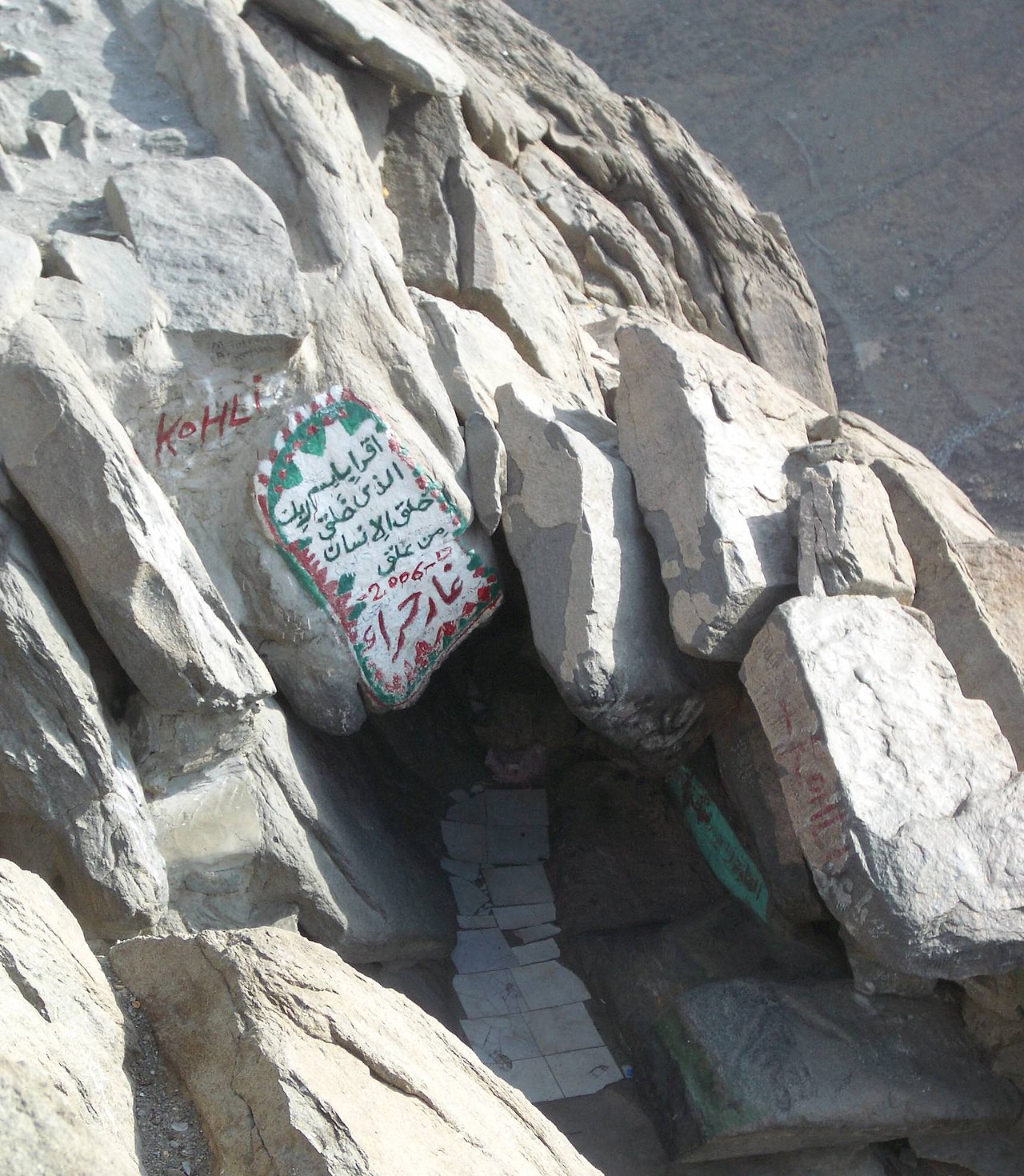
Cave Hira
The cave Hira in the mountain Jabal al-Nour where Muhammad received his first revelation.
Muhammad Begins Public Preaching
Around 613, Muhammad began preaching publicly in Mecca, proclaiming the oneness of God and his role as a prophet. His early followers included women, freedmen, servants, slaves, and members of the lower social class. He introduced rituals including prayer with physical postures and almsgiving as requirements of the Muslim community.
615 CE – 619 CE
Migration to Abyssinia
In 615, Muhammad sent some of his followers to emigrate to the Abyssinian Kingdom of Aksum, where they found protection under the Christian Ethiopian emperor Aṣḥama ibn Abjar. This was done to escape ongoing persecution by Meccan polytheists. According to Ibn Sa'd, there were two separate migrations to Abyssinia.
Social Exclusion of the Banu Hashim
In 616, an agreement was established among Quraysh clans to enforce a ban on the Banu Hashim, prohibiting trade and marriage with them. This was intended to pressure Muhammad and his clan into abandoning his religious mission. The ban was eventually lifted in 619 following a general consensus among sympathetic Quraysh factions.
Death of Khadija and Abu Talib
In 619, Muhammad suffered the loss of both his wife Khadija, his primary source of financial and emotional support, and his uncle and protector Abu Talib. This year became known as the 'Year of Sorrow.' Without Abu Talib's protection, Muhammad became increasingly vulnerable to Quraysh hostility.
Muhammad's Visit to Ta'if
In 619, Muhammad traveled to Ta'if to seek aid and protection against the Meccans, but was rejected and pelted with stones by the inhabitants. He sought refuge in the garden of Utbah ibn Rabi'ah, where he was offered grapes by a Christian slave named Addas. This episode marked a low point in Muhammad's mission before his eventual return to Mecca under the protection of Mut'im ibn 'Adiy.
620 CE – 624 CE
Isra and Mi'raj — Night Journey
Islamic tradition places the Isra and Mi'raj, Muhammad's miraculous night journey, at a low point in his life around 619–620. The Isra is believed to be Muhammad's journey from Mecca to Jerusalem, and the Mi'raj his ascent from Jerusalem to heaven. The event is referenced in Quran 17:1 and is commemorated annually by Muslims.

Dome of the Rock
The Dome of the Rock in Jerusalem, anachronistically associated with the Isra and Mi'raj, marking the place where Muhammad is believed to have ascended to heaven.
Pledges at Aqaba
In 621 and 622, delegations from Medina (Yathrib) met Muhammad at Aqaba near Mecca and pledged their loyalty to him. The second pledge in June 622 involved seventy-five individuals, including two women, who promised to protect Muhammad as they would their own families. These pledges paved the way for the migration to Medina.
Constitution of Medina
Muhammad drafted the Constitution of Medina, a legal covenant between Medina's Arab and Jewish tribes and the Muslim community. The document promised peaceful coexistence, freedom of religion for Jews, and mutual defense of the oasis. It helped Muhammad consolidate political authority in Medina.
Hijra — Migration to Medina
In 622, Muhammad and his followers migrated from Mecca to Medina (then known as Yathrib), an event known as the Hijra. Muhammad and Abu Bakr arrived in Medina on 4 September 622 after evading a Quraysh assassination plot. This event marks the beginning of the Islamic calendar, also known as the Hijri calendar.
Construction of the First Mosque in Medina
A few days after settling in Medina, Muhammad negotiated for land and began constructing a building that would serve as his residence and a community gathering place for prayer. The structure was completed after about seven months in April 623, becoming the first Muslim mosque. Its northern wall had a stone marking the direction of prayer toward Jerusalem.
Expulsion of the Banu Qaynuqa
Following the Battle of Badr, Muhammad besieged the Banu Qaynuqa, one of the three main Jewish tribes of Medina, regarded as the weakest and wealthiest. After roughly two weeks, the tribe surrendered without combat and was expelled from Medina, relinquishing their property to the Muslims. This was the first of three major Jewish tribes to be expelled from Medina.
Assassination of Ka'b ibn al-Ashraf
Ka'b ibn al-Ashraf, a wealthy half-Jewish man from Banu Nadir and critic of Muhammad, was assassinated by a group including his own foster brother after producing poetry mourning Quraysh deaths at Badr. Muhammad had asked his followers who would kill Ka'b, and Ibn Maslamah volunteered, using deception to carry out the act. This event marked an escalation in Muhammad's conflict with the Jewish tribes of Medina.
Change of Prayer Direction to Mecca
On 11 February 624, while praying in the Masjid al-Qiblatayn in Medina, Muhammad received a revelation that Muslims should face Mecca rather than Jerusalem during prayer. This change, known as the change of the Qibla, established Mecca as the spiritual center of Islam. Muhammad and his companions immediately adjusted their prayer direction.

The Kaaba in Mecca
The Kaaba in Mecca, which became the Muslim direction of prayer after the revelation of February 624 CE.
Battle of Badr
In March 624, Muhammad led approximately 300 warriors in a raid on a Meccan merchant caravan, resulting in the Battle of Badr. Despite being outnumbered more than three to one, the Muslims won, killing at least forty-five Meccans including Abu Jahl, with fourteen Muslim casualties. The victory significantly strengthened Muhammad's position in Medina and was seen as divine confirmation of his mission.
625 CE – 629 CE
Battle of Uhud
In 625, the Quraysh, led by Abu Sufyan, assembled an army to retaliate against Muhammad's attacks on their caravans. The Muslims initially held their ground at Mount Uhud but lost advantage when some archers disobeyed orders, and Muhammad was injured. The battle resulted in mass Muslim casualties, after which Muhammad received a revelation allowing Muslim men to have up to four wives, marking the beginning of polygyny in Islam.

The Prophet Muhammad and the Muslim Army at the Battle of Uhud
A 1595 illustration from the Siyer-i Nebi depicting Muhammad and the Muslim army at the Battle of Uhud.
Expulsion of the Banu Nadir
Muhammad besieged the Jewish tribe of Banu Nadir after claiming to have received a divine revelation of a planned assassination attempt against him by the tribe. After a fortnight, the Banu Nadir capitulated and were directed to vacate their land, permitted to carry only one camel-load of goods per three people. Muhammad claimed a fertile piece of land from the spoils.
Massacre of the Banu Qurayza
Following the Battle of the Trench, Muhammad besieged the Jewish tribe of Banu Qurayza for 25 days, accusing them of treachery for negotiating with Meccan forces. After their surrender, Sa'd ibn Mu'adh pronounced that all the men should be executed, their possessions distributed among Muslims, and their women and children taken as captives. According to Ibn Ishaq, 600–900 men of Banu Qurayza were executed.
Battle of the Trench
The siege of Medina began on 31 March 627, when Quraysh military leader Abu Sufyan mustered a force of 10,000 men with help from the exiled Banu Nadir. Muhammad adopted an innovative defense strategy by digging a trench wherever Medina lay open to cavalry attack, an idea credited to Salman the Persian. After two weeks, the coalition retreated, marking a significant loss of prestige for the Meccans.
Treaty of Hudaybiyya
Early in 628, Muhammad led a group of followers toward Mecca for pilgrimage but was stopped at Hudaybiyya by Quraysh emissaries. After lengthy negotiations, a ten-year truce was established, allowing Muslims to make the Umrah pilgrimage the following year. The treaty was seen as a significant diplomatic achievement that ultimately facilitated the eventual conquest of Mecca.
The Kaaba in Mecca
The Kaaba in Mecca, the destination of Muhammad's pilgrimage attempt that led to the Treaty of Hudaybiyya.
Invasion of Khaybar
Roughly ten weeks after returning from Hudaybiyya, Muhammad led an invasion of Khaybar, a flourishing oasis populated by Jews including those from the expelled Banu Nadir. After a strenuous battle lasting more than a month, the Muslims captured the city and distributed the spoils. The Jewish inhabitants were allowed to remain as tenant farmers, giving half their annual produce to the Muslims.
630 CE – 634 CE
Conquest of Mecca
In 630, Muhammad marched on Mecca with 10,000 Muslim converts after the Quraysh violated the Treaty of Hudaybiyya. The conquest went largely uncontested, and Muhammad seized the city with minimal casualties. He declared an amnesty for past offences, destroyed the statues of Arabian gods in and around the Kaaba, and most Meccans converted to Islam.

Muhammad advancing on Mecca
A depiction from the Siyer-i Nebi of Muhammad advancing on Mecca, with his face veiled, accompanied by angels.
Battle of Hunayn
After the fall of Mecca, the Banu Hawazin gathered their entire tribe to fight the Muslims. Muhammad led 12,000 soldiers but was surprised at the valley of Hunayn. The Muslims ultimately overpowered the Hawazin, taking their women, children, and animals as spoils. The victory led to the eventual conversion of the Hawazin and the submission of Taif.
Expedition to Tabuk
Roughly 10 months after capturing Mecca, Muhammad led his army to attack the wealthy border provinces of Byzantine Syria in the Expedition to Tabuk. When they arrived at Tabuk, there were no hostile forces present, but Muhammad was able to force some local chiefs to accept his rule and pay tribute. This expedition demonstrated the expanding reach of the Muslim state.

Conquests of Muhammad
Map showing the conquests of Muhammad (green lines) and the Rashidun caliphs (black lines).
Farewell Pilgrimage
During the 632 pilgrimage season, Muhammad personally led the ceremonies and gave a sermon that became known as the Farewell Sermon. Key points included the prohibition of usury and vendettas from the pre-Islamic era, the brotherhood of all Muslims, and the adoption of twelve lunar months without intercalation. This was Muhammad's final pilgrimage before his death.
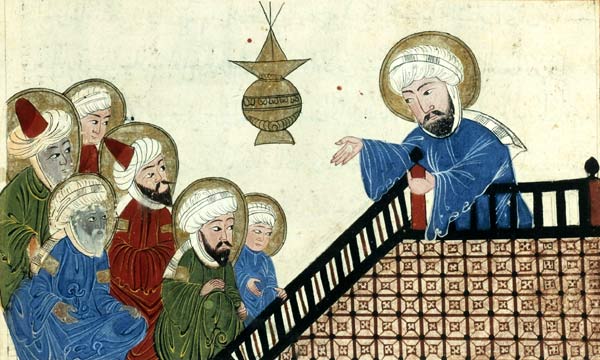
Muhammad prohibiting Nasī' during the Farewell Pilgrimage
An anonymous illustration from al-Biruni's The Remaining Signs of Past Centuries, depicting Muhammad prohibiting Nasī' during the Farewell Pilgrimage.
Succession Dispute and Abu Bakr Becomes First Caliph
Following Muhammad's death, a disagreement broke out over his successor. Umar ibn al-Khattab nominated Abu Bakr, Muhammad's close friend, who was confirmed as the first caliph. Some companions disputed this, holding that Ali ibn Abi Talib had been designated the successor by Muhammad at Ghadir Khumm, a dispute that would eventually lead to the Sunni-Shia split.

Expansion of the Caliphate
Map showing the expansion of the caliphate from 622 to 750 CE, beginning with the succession after Muhammad's death.
Death of Muhammad
On 8 June 632, Muhammad died after suffering a severe headache and illness, reportedly linked to the poisoned meal he had consumed at Khaybar. He spent his final days in the hut of his wife Aisha, unable to walk without assistance. By the time of his death, most of the Arabian Peninsula had converted to Islam.

The death of Muhammad
A depiction of the death of Muhammad from the Siyer-i Nebi.