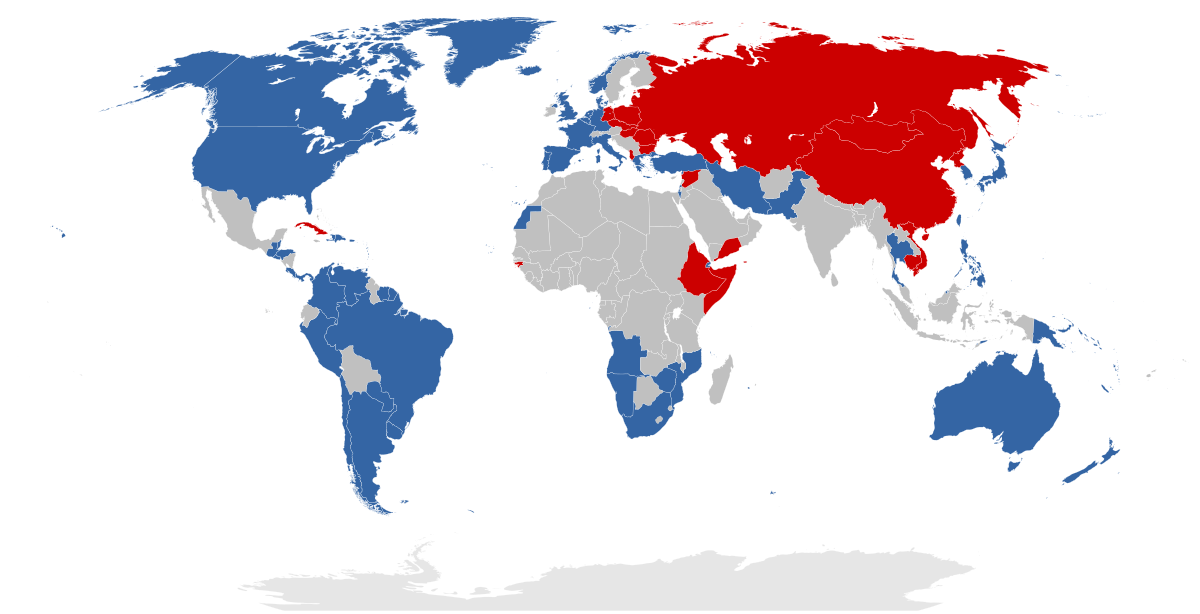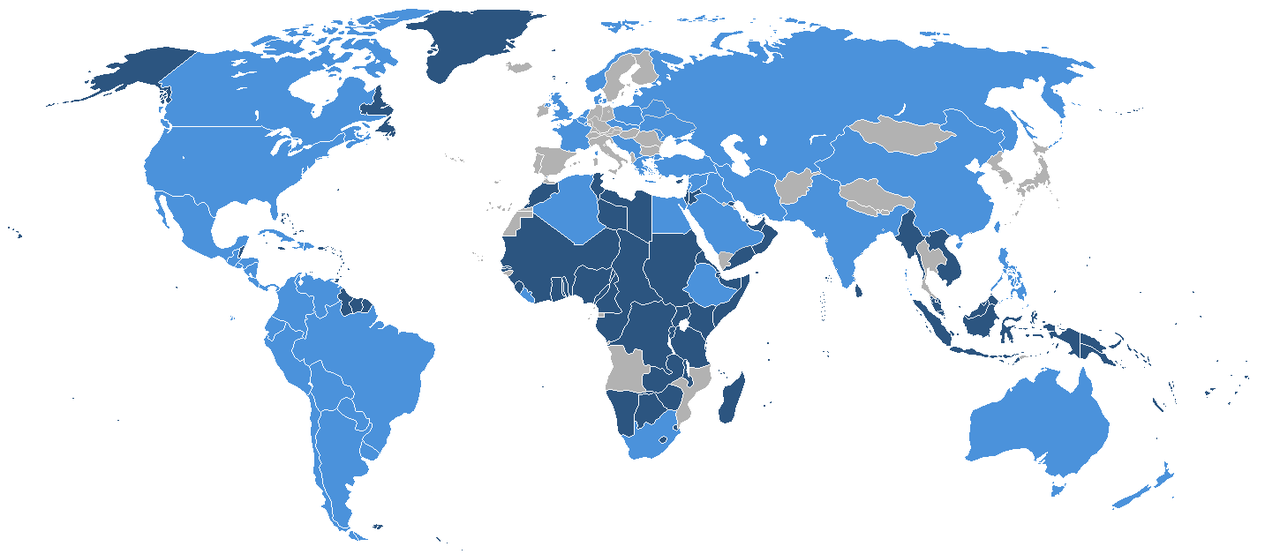
The UN in 1945: founding members in light blue, protectorates and territories of the founding members in dark blue
This map represents the founding moment of the United Nations, showing the original member states that established the organization in 1945.
United Nations
This timeline covers the history of the United Nations from its founding in 1945 to the present, including major peacekeeping operations, organizational changes, and global challenges addressed by the UN.
Source: Wikipedia1920 CE - 1925 CE
League of Nations Formally Established
The League of Nations formally came into being when the Covenant of the League of Nations, ratified by 42 nations in 1919, took effect. The League Council acted as an executive body directing the Assembly's business, beginning with four permanent members—the United Kingdom, France, Italy, and Japan.
1938 CE - 1943 CE
Declaration of St James's Palace
The first step towards the establishment of the United Nations was the Inter-Allied Conference in London that led to the Declaration of St James's Palace. This declaration marked the beginning of Allied cooperation that would eventually lead to the UN's formation.
Atlantic Charter Drafted
American president Franklin Roosevelt and British prime minister Winston Churchill drafted the Atlantic Charter, which defined goals for the post-war world. This document became a foundational text for the future United Nations organization.
Declaration by United Nations Signed
Roosevelt, Churchill, the Soviet Union's former Foreign Minister Maxim Litvinov, and the Chinese Premier T. V. Soong signed the 'Declaration by United Nations', with representatives of twenty-two other nations adding their signatures the next day. This marked the first official use of the term 'United Nations'.
Moscow Conference and Four Power Declaration
The October 1943 Moscow Conference resulted in the Moscow Declarations, including the Four Power Declaration on General Security. This was the first public announcement that a new international organization was being contemplated to replace the League of Nations.
1944 CE - 1949 CE
Dumbarton Oaks Conference
The new international organization was formulated and negotiated amongst the delegations from the Allied Big Four at the Dumbarton Oaks Conference. They agreed on proposals for the aims, structure and functioning of the new organization that would become the United Nations.
UN Conference on International Organization Opens
After months of planning, the UN Conference on International Organization opened in San Francisco. It was attended by 50 nations' governments and a number of non-governmental organizations, with the delegations of the Big Four chairing the plenary meetings.
UN Charter Signed
The Charter of the United Nations was signed by the representatives of the 50 countries after two months of drafting. This document established the legal foundation for the United Nations organization and its operations.
The UN in 1945: founding members in light blue, protectorates and territories of the founding members in dark blue
Map showing the founding members of the United Nations in 1945
United Nations Officially Established
The UN officially came into existence at 20:07 (UTC) upon ratification of the Charter by the five permanent members of the Security Council and by a majority of the other 46 nations. This marked the birth of the modern international organization system.
First UN General Assembly and Security Council Meetings
The first meetings of the General Assembly, with 51 nations represented, and the Security Council took place in London. Debates began at once, covering topical issues such as the presence of Russian troops in Iranian Azerbaijan and British forces in Greece.
UN General Assembly Resolution 181 - Palestine Partition Plan
The General Assembly approved Resolution 181, a proposal to partition British Mandatory Palestine into two states, a Jewish state and an Arab state, with Jerusalem placed under international status. The plan passed 33–13 with 10 abstentions, leading to civil war.
Universal Declaration of Human Rights Adopted
The General Assembly adopted the Universal Declaration of Human Rights, drafted by a committee headed by American diplomat and activist Eleanor Roosevelt. The document proclaimed basic civil, political and economic rights common to all human beings.

Eleanor Roosevelt with the Universal Declaration of Human Rights, 1949
Eleanor Roosevelt holding the Universal Declaration of Human Rights
UN Headquarters Construction Begins
Construction began on the UN headquarters in New York City after the General Assembly selected the city as the site for the headquarters. The facility would be completed on October 9, 1952, establishing the permanent home of the United Nations.
1950 CE - 1955 CE
Korean War Authorization
A Security Council resolution authorized a US-led coalition to repel the North Korean invasion of South Korea. This resolution was passed in the absence of the Soviet Union, demonstrating how Cold War tensions affected UN operations.
UN Headquarters Completed
The UN headquarters facility in New York City was completed, providing a permanent home for the organization's operations. The building became an iconic symbol of international cooperation and diplomacy.
Korean Armistice Agreement Signed
The Korean Armistice Agreement was signed, ending active hostilities in the Korean War. This demonstrated the UN's role in conflict resolution and peacekeeping, though the war technically never ended with a peace treaty.
1956 CE - 1961 CE
First UN Peacekeeping Force Established
The first UN peacekeeping force was established to end the Suez Crisis. However, the UN was unable to intervene against the Soviet Union's simultaneous invasion of Hungary, highlighting the limitations of UN action during the Cold War.
UN Operation in the Congo Established
The UN established the United Nations Operation in the Congo (UNOC), the largest military force of its early decades, to bring order to Katanga and restore it to the control of the Democratic Republic of the Congo. The operation lasted until May 11, 1964.
Dag Hammarskjöld Dies in Plane Crash
UN Secretary-General Dag Hammarskjöld, often named as one of the UN's most effective secretaries-general, died in a plane crash while travelling to meet rebel leader Moise Tshombe during the Congo conflict. He was posthumously awarded the Nobel Peace Prize months later.

Dag Hammarskjöld was a particularly active secretary-general from 1953 until he died in 1961.
Portrait of Dag Hammarskjöld, the second UN Secretary-General
1968 CE - 1973 CE
People's Republic of China Joins UN Security Council
With opposition from the United States but support from many Third World nations, the People's Republic of China was given the Chinese seat on the Security Council in place of the Republic of China (Taiwan). The vote was widely seen as a sign of waning American influence in the organization.
1974 CE - 1979 CE
Zionism Declared Form of Racism
A bloc comprising the Soviet Union and Third World nations passed a resolution, over strenuous American and Israeli opposition, declaring Zionism to be a form of racism. The resolution was later repealed on December 16, 1991, shortly after the end of the Cold War.
1980 CE - 1985 CE
Smallpox Eradication Announced
The World Health Organization announced that the eradication of smallpox had been completed, marking one of the UN's greatest public health achievements. This demonstrated the effectiveness of coordinated international health efforts.
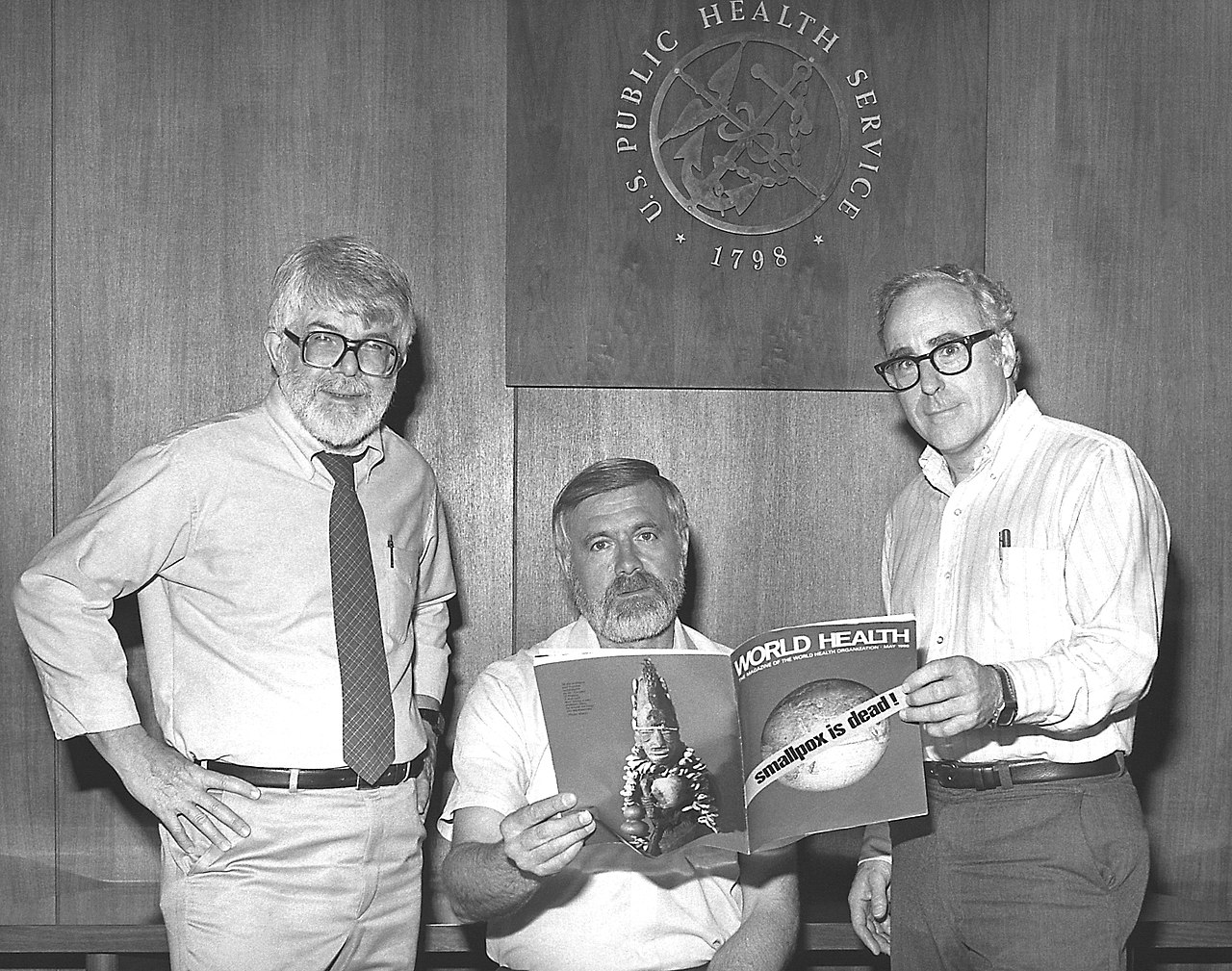
Three former directors of the Global Smallpox Eradication Programme reading the news that smallpox has been globally eradicated in 1980
Three directors celebrating the global eradication of smallpox
1986 CE - 1991 CE
Gulf War Coalition Authorized
The UN authorized a US-led coalition that repulsed Iraq's invasion of Kuwait. This marked a significant post-Cold War use of UN authority to authorize military action against aggression.
Zionism-Racism Resolution Repealed
The controversial 1975 resolution declaring Zionism to be a form of racism was repealed, shortly after the end of the Cold War. This reflected changing geopolitical dynamics and improved relations between various UN member states.
1992 CE - 1997 CE
Trusteeship Council Suspends Operations
The Trusteeship Council, one of the six principal organs established by the UN Charter, suspended its operations upon the independence of Palau, the last remaining UN trustee territory. This marked the end of the UN trusteeship system.
1998 CE - 2003 CE
Kosovo Force Authorized
United Nations Security Council Resolution 1244 authorized the NATO-led Kosovo Force beginning in 1999. This represented a new form of international intervention in the post-Cold War era.
Millennium Summit and Development Goals
The Millennium Summit was held to discuss the UN's role in the 21st century. The three-day meeting was the largest gathering of world leaders in history, culminating in the adoption of the Millennium Development Goals (MDGs) by all member states.
UN and Kofi Annan Win Nobel Peace Prize
The UN as a whole was awarded the Nobel Peace Prize, sharing it with Secretary-General Kofi Annan. This recognition highlighted the organization's contributions to international peace and security.

The 2001 Nobel Peace Prize to the UN—diploma in the lobby of the UN Headquarters in New York City
Nobel Peace Prize diploma awarded to the United Nations in 2001
2010 CE - 2015 CE
Haiti Earthquake Kills 101 UN Personnel
The organization suffered the worst loss of life in its history when 101 personnel died in the Haiti earthquake. This tragedy highlighted the risks faced by UN personnel in humanitarian operations.
South Sudan Joins UN
South Sudan joined the United Nations, becoming the most recent addition and bringing the total to 193 UN member states. This marked the end of a long process of independence and international recognition.
Sustainable Development Goals Launched
The Sustainable Development Goals (SDGs) were launched to succeed the Millennium Development Goals. These 17 goals represented a comprehensive agenda for global development and environmental sustainability through 2030.
2016 CE - 2021 CE
António Guterres Becomes Secretary-General
Portuguese diplomat António Guterres, who had previously served as the UN High Commissioner for Refugees, became the ninth secretary-general. He emphasized diplomacy for preventing conflicts, more effective peacekeeping efforts, and streamlining the organization.

António Guterres, the current secretary-general
Portrait of António Guterres, the ninth UN Secretary-General
UN-World Economic Forum Partnership
The UN signed a Strategic Partnership Framework with the World Economic Forum to 'jointly accelerate' the implementation of the 2030 Agenda for Sustainable Development. This partnership aimed to leverage private sector engagement in global development goals.
2022 CE - 2026 CE
UN Financial Crisis Deepens
The UN began facing a severe financial crisis resulting from delays in member state due payments and refusal to pay assessed amounts. Only 61 countries paid their dues on time and in full, causing massive budget cuts and putting millions of lives at risk.
Guterres Warns of 'Imminent Financial Collapse'
Secretary-General Guterres sent a letter to all members warning of an 'imminent financial collapse' of the UN. This represented the culmination of ongoing financial difficulties that had been building since 2020.