
Victorious PAVN troops at the Presidential Palace, Saigon
This image captures the defining moment of the war's end — PAVN troops at the Presidential Palace in Saigon on April 30, 1975, symbolizing North Vietnam's victory and the fall of South Vietnam.
Vietnam War
This timeline covers the Vietnam War (1955-1975), one of the most significant conflicts of the Cold War era, tracing events from French colonial rule through the fall of Saigon. It encompasses military campaigns, political developments, diplomatic negotiations, and the war's aftermath across Vietnam, Laos, and Cambodia.
Source: Wikipedia1940 CE – 1944 CE
Japan Invades French Indochina
In September 1940, Japan invaded French Indochina following France's capitulation to Nazi Germany. By 1941, Japan had gained full military access across Indochina and established a dual colonial rule that preserved Vichy French administration while facilitating Japanese military operations. This occupation would set the stage for the rise of the Viet Minh independence movement.
Ho Chi Minh Establishes the Viet Minh
Nguyen Sinh Cung, now known as Ho Chi Minh, returned from exile to establish the anti-Japanese Viet Minh movement in 1941. The US Office of Strategic Services (OSS) provided the Viet Minh with weapons and training from 1944 to fight the occupying Japanese. This movement would become the foundation for North Vietnam's communist government.

Viet Minh flag
The Viet Minh flag, which later became the flag of North Vietnam
1945 CE – 1949 CE
Japan Overthrows French Government in Indochina
In March 1945, Japan, losing the war, overthrew the French government in Indochina and established the Empire of Vietnam, maintaining Emperor Bảo Đại as a figurehead. This power vacuum accelerated Vietnamese nationalist movements and set the stage for the August Revolution by the Viet Minh.
Ho Chi Minh Declares Independence of the Democratic Republic of Vietnam
On 2 September 1945, following Japan's surrender, Ho Chi Minh declared the independence of the Democratic Republic of Vietnam (DRV) after the Viet Minh launched the August Revolution, overthrowing the Japanese-backed state. However, British and French forces soon arrived to reassert colonial control, and on September 23, the British supported a French coup that overthrew the DRV government in Saigon.

Bảo Đại and Ho Chi Minh
Bảo Đại as supreme advisor to Ho Chi Minh's government, September 1945
First Indochina War Begins
Tensions between the Viet Minh and French authorities erupted into full-scale war in December 1946, a conflict that would later become entangled with the Cold War. The Viet Minh had previously consolidated power by terrorizing and purging rival Vietnamese nationalist groups beginning in August 1945. This war would ultimately lead to French defeat and the partition of Vietnam.
Truman Doctrine Announced
The anticommunist Truman Doctrine was first announced by President Harry S. Truman in March 1947, pledging United States support to nations resisting 'attempted subjugation by armed minorities or by outside pressures.' This doctrine would shape US policy in Indochina and eventually lead to direct military involvement in Vietnam.
1950 CE – 1954 CE
US Recognizes State of Vietnam; China and USSR Recognize DRV
In February 1950, the US recognized the French-backed State of Vietnam, based in Saigon, as the legitimate government, after communist China and the Soviet Union recognized the Democratic Republic of Vietnam the month prior. The outbreak of the Korean War in June convinced Washington policymakers that the war in Indochina was another example of communist expansionism directed by the Soviet Union.
US Creates Military Assistance Advisory Group (MAAG)
In September 1950, the US created the Military Assistance Advisory Group (MAAG) to screen French aid requests, advise on strategy, and train Vietnamese soldiers. This marked the beginning of direct US military advisory involvement in Indochina. By 1954, the US had spent $1 billion in support of the French effort, shouldering 80% of the war costs.
North Vietnam Institutes Land Reform Executions
Between 1953 and 1956, the Northern government instituted agrarian reforms including rent reduction and land reform, which resulted in political oppression. North Vietnamese witnesses suggested a ratio of one execution for every 160 village residents, with scholars accepting approximately 50,000 executions in the Red River Delta. In 1956, leaders in Hanoi admitted to 'excesses' and restored much of the land to the original owners.
Geneva Conference Partitions Vietnam
At the 1954 Geneva Conference, Vietnam was temporarily partitioned at the 17th parallel, with the Viet Minh controlling North Vietnam and the US assuming financial and military support for South Vietnam under Ngo Dinh Diem. Elections were to be held in 1956 to establish a unified government, but these never took place. The conference also affirmed the independence of Cambodia and Laos.

The 1954 Geneva Conference
The Geneva Conference that partitioned Vietnam at the 17th parallel
Mass Migration Between North and South Vietnam
During the 300-day free movement period following the Geneva Accords, up to one million northerners, fearing persecution by the communists, moved south, including at least 500,000 Catholics. The exodus was coordinated by a US-funded $93 million relocation program involving the French Navy and US Seventh Fleet. Over 100,000 Viet Minh fighters went north for 'regroupment,' expecting to return south within two years.
Battle of Dien Bien Phu and French Defeat
In 1954, the French attempted to interdict Viet Minh supply lines at Dien Bien Phu near the Laotian border. Viet Minh forces under Võ Nguyên Giáp surrounded the French garrison and bombarded it with heavy artillery. In May 1954, the French garrison surrendered, marking the end of French military involvement in Indochina.
1955 CE – 1959 CE
Diem Launches 'Denounce the Communists' Campaign
In 1955, Diem launched the 'Denounce the Communists' campaign, during which suspected communists and other anti-government elements were imprisoned, tortured, or executed. He instituted the death penalty in 1956 against activity deemed communist. By 1959, 40,000 political prisoners had been jailed.
Diem Eliminates Political Opposition in South Vietnam
From April to June 1955, Diem eliminated political opposition in the south by launching operations against religious groups including the Cao Đài and Hòa Hảo, and defeating the Bình Xuyên organized crime group in a battle in Saigon in April. This consolidation of power established Diem's authoritarian rule over South Vietnam.

Anti-Bảo Đại revolutionists at Saigon city hall, May 1955
Anti-Bảo Đại revolutionists of the State of Vietnam at city hall, Saigon, May 1955
Diem Declares Republic of Vietnam
In a referendum on the future of the State of Vietnam in October 1955, Diem rigged the poll supervised by his brother Ngô Đình Nhu and was credited with 98% of the vote, including 133% in Saigon. He declared South Vietnam to be an independent state under the name Republic of Vietnam (ROV), with himself as president. This established the political framework that would define South Vietnam throughout the war.
Insurgency Assassination Campaign Begins in South Vietnam
In April 1957, insurgents launched an assassination campaign referred to as 'extermination of traitors,' targeting government officials and supporters. 17 people were killed in the Châu Đốc massacre at a bar in July. Douglas Pike estimated that insurgents carried out 2,000 abductions and 1,700 assassinations of officials, village chiefs, hospital workers, and teachers from 1957 to 1960.
Diem Visits the United States
In May 1957, Diem undertook a 10-day state visit to the US, where President Eisenhower pledged his continued support and a parade was held in Diem's honor. However, Secretary of State Dulles privately conceded Diem had to be backed because they could find no better alternative. This visit highlighted the US commitment to South Vietnam despite Diem's authoritarian tendencies.

Eisenhower and Diem in Washington
U.S. President Dwight D. Eisenhower and Secretary of State John Foster Dulles greet President Ngô Đình Diệm of South Vietnam in Washington, 8 May 1957
North Vietnam Invades Laos and Establishes Ho Chi Minh Trail
In 1958, North Vietnamese forces seized the transportation hub at Tchepone in Southern Laos near the demilitarized zone. North Vietnam established the Ho Chi Minh trail to supply the Viet Cong insurgency in the south. Group 559 was established in May 1959 to upgrade the trail, then a six-month mountain trek through Laos.

Ho Chi Minh Trail
Guerrillas assemble shells and rockets delivered along the Ho Chi Minh Trail
North Vietnam Approves 'People's War' on the South
The North Vietnamese Communist Party approved a 'people's war' on the South in January 1959. In May, Group 559 was established to upgrade the Ho Chi Minh trail. On 28 July, North Vietnamese and Pathet Lao forces invaded Laos, fighting the Royal Lao Army along the border.
1960 CE – 1964 CE
Kennedy Wins Presidential Election; Escalates Vietnam Involvement
In the 1960 US presidential election, John F. Kennedy defeated Richard Nixon. Kennedy increased US military advisors from 900 in 1960 to 16,000 by November 1963, and sent more aid to the Army of the Republic of Vietnam (ARVN). Kennedy was against the deployment of American combat troops but believed Vietnam was the place to demonstrate US credibility against communist expansion.

President Kennedy's news conference
President Kennedy's news conference of 23 March 1961
North Vietnam Formally Creates the Viet Cong
In December 1960, North Vietnam formally created the Viet Cong (VC) with the intent of uniting all anti-GVN insurgents, including non-communists. It was formed in Memot, Cambodia, and directed through COSVN. The VC placed emphasis on the withdrawal of American advisors, land reform, coalition government, and the neutralization of Vietnam.
Strategic Hamlet Program Initiated
The Strategic Hamlet Program was initiated in late 1961 and implemented in early 1962, involving forced relocation and segregation of rural South Vietnamese into new fortified communities to isolate them from the Viet Cong. The program was intended to provide security for peasants and strengthen ties between them and the central government. However, by November 1963 the program had waned and it ended in 1964.
Agent Orange: Chemical Defoliation and Long-term Health Effects
Between 1961 and 1971, 20 million gallons of toxic herbicides like Agent Orange were sprayed on 6 million acres of forests and crops in South Vietnam. The chemicals continue to cause diseases and birth defects, with the Vietnamese government estimating over 4,000,000 victims of dioxin poisoning. In 2012, the US and Vietnam cooperated in cleaning toxic chemicals on Da Nang International Airport, marking the first time Washington was involved in cleaning up Agent Orange in Vietnam.

US helicopter spraying chemical defoliants
US helicopter spraying chemical defoliants in the Mekong Delta, South Vietnam, 1969
International Agreement on the Neutrality of Laos Signed
In July 1962, 14 nations including China, South Vietnam, the Soviet Union, North Vietnam, and the US signed the International Agreement on the Neutrality of Laos. Despite this agreement, the conflict in Laos continued as North Vietnam used Laotian territory for the Ho Chi Minh Trail. The agreement reflected the complex international dimensions of the Indochina conflict.
Battle of Ap Bac: ARVN Defeated by Viet Cong
In January 1963, the Battle of Ap Bac exemplified the inept performance of the ARVN, as the Viet Cong won a battle against a much larger and better-equipped South Vietnamese force. The ARVN lost 83 soldiers and 5 US helicopters, while the VC lost only 18 soldiers. This defeat convinced Washington policymakers that Diem was incapable of defeating the communists.
Buddhist Crisis and Huế Phật Đản Shootings
Discontent with Diem's policies exploded in May 1963 following the Huế Phật Đản shootings of 9 Buddhists protesting the ban on displaying the Buddhist flag on Vesak. This resulted in mass protests — the Buddhist crisis — against discriminatory policies that gave privileges to Catholics over the Buddhist majority. In August 1963, ARVN Special Forces loyal to Diem's brother raided pagodas, causing destruction and hundreds of deaths.
Diem Overthrown and Assassinated in US-Backed Coup
Diem was overthrown and executed, along with his brother Ngô Đình Nhu, on 2 November 1963 in a US-backed ARVN military coup. When Kennedy was informed, he rushed from the room with a look of shock and dismay, as he had not anticipated Diem's murder. The coup added to South Vietnam's growing political instability, as Hanoi took advantage and increased its support for the VC.

ARVN forces capture a Viet Cong
ARVN forces in action during the Vietnam War
Kennedy Assassinated; Johnson Takes Office
President Kennedy was assassinated on 22 November 1963, and Vice President Lyndon B. Johnson immediately assumed the presidency. Johnson quickly focused on Vietnam, declaring on 24 November that 'the battle against communism must be joined with strength and determination.' Johnson inherited a deteriorating situation in South Vietnam and adhered to the domino theory for defending the South.
US Bombing of Laos
Between 1964 and 1973, the US dropped two million tons of bombs on Laos, similar to the 2.1 million tons of bombs it dropped on Europe and Asia during World War II, making Laos the most heavily bombed country in history. The bombing targeted the Ho Chi Minh Trail and Pathet Lao forces. Unexploded ordnance continues to kill people in Laos, with 80 million unexploded bombs remaining.
Gulf of Tonkin Incident
On 2 August 1964, the USS Maddox, on an intelligence mission along North Vietnam's coast, fired upon and damaged torpedo boats in the Gulf of Tonkin. A second attack was reported two days later, though an NSA publication declassified in 2005 revealed there was no attack on 4 August. The incidents led Congress to approve the Gulf of Tonkin Resolution on 7 August, granting the president broad authority to expand the war.

Bombing in Vietnam
US aircraft dropping bombs on North Vietnam during Operation Rolling Thunder
Gulf of Tonkin Resolution Passed
Congress approved the Gulf of Tonkin Resolution on 7 August 1964, granting the president power 'to take all necessary measures to repel any armed attack against the forces of the United States and to prevent further aggression.' Johnson relied on this as giving him authority to expand the war without a formal declaration of war. This resolution became the legal basis for massive US military escalation in Vietnam.
Battle of Bình Giã: VC Defeats ARVN in Conventional Battle
In December 1964, ARVN forces suffered significant losses at the Battle of Bình Giã, which both sides viewed as a watershed moment. Previously, the VC had utilized hit-and-run guerrilla tactics, but at Binh Gia they defeated a strong ARVN force in a conventional battle and remained in the field for four days. This demonstrated the growing military capability of the Viet Cong.
1965 CE – 1969 CE
Soviet Air Defense Instructors Arrive in Vietnam
In the spring of 1965, Soviet air defense instructors began training North Vietnamese crewmen at an air defense training center in Vietnam. Soviet crews fired Soviet-made surface-to-air missiles at US aircraft in 1965. The Soviet Union supplied North Vietnam with medical supplies, arms, tanks, planes, helicopters, artillery, anti-aircraft missiles, and other military equipment throughout the war.

Soviet air defense instructors in Vietnam
Soviet air defense instructors and North Vietnamese crewmen in the spring of 1965 at an air defense training center in Vietnam
Operation Rolling Thunder Begins
Following an attack on a US Army base in February 1965, airstrikes were initiated while Soviet Premier Alexei Kosygin was on a state visit to North Vietnam. Operation Rolling Thunder and Operation Arc Light expanded aerial bombardment and ground support operations. The bombing campaign, which lasted three years, was intended to force North Vietnam to cease support for the VC by threatening to destroy North Vietnamese air defenses and infrastructure.
Bombing in Vietnam
US B-66 Destroyer and F-105 Thunderchiefs dropping bombs on North Vietnam during Operation Rolling Thunder
US Marines Land at Da Nang: Ground War Begins
On 8 March 1965, 3,500 US Marines were landed near Da Nang, South Vietnam, marking the beginning of America's ground war. US public opinion overwhelmingly supported the deployment, and the Marines' initial assignment was defense of Da Nang Air Base. The first deployment was increased to nearly 200,000 by December 1965.

Marine landing at Da Nang
A young Marine private waits on the beach during the Marine landing, Da Nang, 3 August 1965
Battle of Ia Drang: First Major US-PAVN Engagement
In November 1965, the US engaged in its first major battle with the PAVN at the Battle of Ia Drang. The operation was the first large-scale helicopter air assault by the US and the first to employ Boeing B-52 Stratofortress bombers. This battle established the tactical patterns that would define much of the American ground war in Vietnam.
1967 March on the Pentagon Anti-War Demonstration
In October 1967, the Vietnam Moratorium attracted millions of protesters, and the 1967 March on the Pentagon was organized by the National Mobilization Committee to End the War in Vietnam. By January 1967, 32% of Americans thought the US had made a mistake in sending troops, and opinion steadily turned following 1967. By 1970, 60% believed the US had made a mistake.

1967 March on the Pentagon
A female demonstrator offers a flower to military police during the 1967 March on the Pentagon anti-war demonstration
My Lai Massacre
In 1968, a US Army unit raped and killed civilians in the My Lai massacre, one of the most notorious war crimes of the Vietnam War. The Vietnam War Crimes Working Group, established by the Pentagon in the wake of My Lai, found that 320 incidents had a factual basis, including seven massacres between 1967 and 1971 in which at least 137 civilians were killed. The massacre provoked widespread outrage and strengthened the anti-war movement.
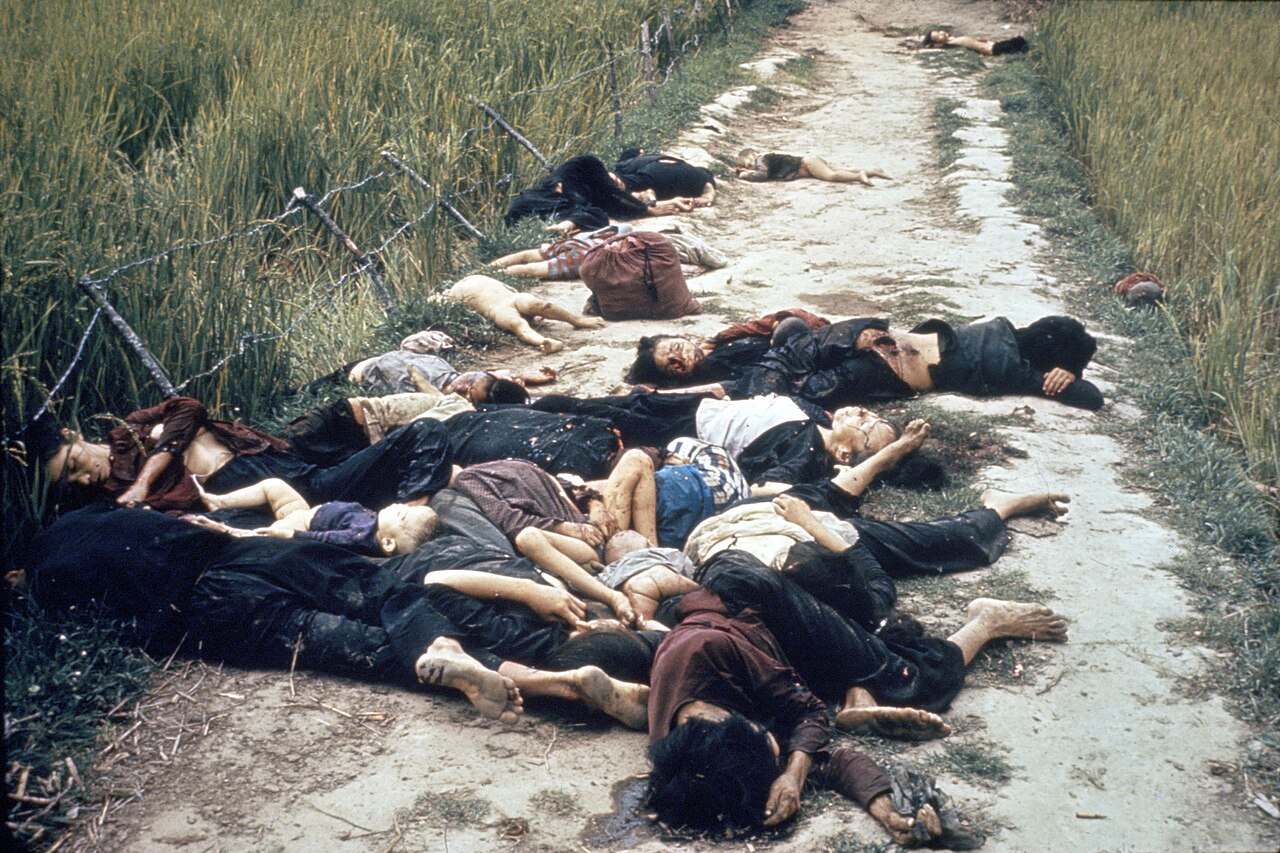
My Lai massacre victims
Victims of the My Lai massacre
Tet Offensive Launched
The Tet Offensive began in January 1968, as over 100 cities were attacked by over 85,000 VC/PAVN troops, including assaults on military installations, headquarters, government buildings, and the US Embassy in Saigon. US and South Vietnamese forces were shocked by the scale and intensity of the offensive, which constituted an intelligence failure on the scale of Pearl Harbor. Although a tactical defeat for the communists, the offensive convinced many Americans the war could not be won.

Viet Cong before Tet Offensive
Viet Cong before departing to participate in the Tet Offensive around Saigon-Gia Dinh
Battle of Huế During Tet Offensive
During the Tet Offensive, PAVN/VC troops held the former imperial capital Huế for 26 days. They executed approximately 2,800 unarmed Huế civilians and foreigners they considered spies in what became known as the Huế Massacre. American forces employed massive firepower to retake the city, leaving 80% of it in ruins.
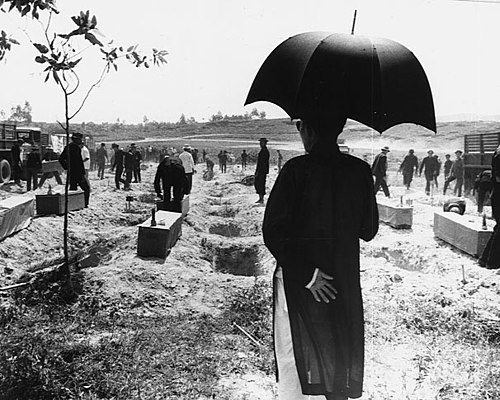
Huế Massacre interment
Interment of victims of the Huế Massacre
Johnson Declines Re-election; Nixon Wins Presidency
Johnson declined to run for re-election as his approval rating slumped from 48% to 36%, with his escalation of the war having divided Americans and cost 30,000 American lives. Vietnam was a major issue during the 1968 US presidential election, which was won by Republican Richard Nixon who claimed to have a secret plan to end the war. Nixon's election marked a significant shift in US Vietnam policy toward 'Vietnamization.'
Paris Peace Talks Begin
On 10 May 1968, peace talks began between the US and North Vietnam in Paris. Negotiations stagnated for five months until Johnson halted the bombing of North Vietnam. Hanoi realized it could not achieve a 'total victory' and employed a strategy known as 'talking while fighting, fighting while talking,' in which offensives occurred concurrently with negotiations.
Nixon Begins 'Vietnamization' Policy
Nixon began troop withdrawals in 1969, and his plan to build up the ARVN so it could take over defense of South Vietnam became known as 'Vietnamization.' As the PAVN/VC recovered from their 1968 losses and avoided contact, General Abrams conducted operations aimed at disrupting logistics with better use of firepower and more cooperation with the ARVN. This policy represented a fundamental shift in US strategy from direct combat to advisory and support roles.

ARVN and US Special Forces
ARVN and US Special Forces, 1968
Ho Chi Minh Dies
On 2 September 1969, Ho Chi Minh died. His death caused a shift in Hanoi's war strategy, with the Giáp-Chinh 'Northern-First' faction regaining control over military affairs from the Lê Duẩn-Hoàng Văn Thái 'Southern-First' faction. An unconventional victory was sidelined in favor of conventional conquest through large-scale military operations.
1970 CE – 1974 CE
Cambodian Coup and US-ARVN Invasion
In March 1970, Sihanouk was deposed by his pro-American prime minister Lon Nol, who demanded North Vietnamese troops leave Cambodia. In April–May 1970, North Vietnam invaded Cambodia at the request of the Khmer Rouge, and US and ARVN forces launched the Cambodian campaign to attack PAVN/VC bases. The US incursion into Cambodia sparked widespread protests in the US as Nixon had promised to deescalate involvement.

Viet Cong interrogation near Cambodian border
An alleged Viet Cong captured during an attack on an American outpost near the Cambodian border is interrogated
Kent State University Shootings
Students were killed by National Guardsmen in May 1970 at a Kent State University protest against Nixon's expansion of the war into Cambodia. The administration's reaction was seen as callous, reinvigorating the anti-war movement. The fatal shooting of students provoked nationwide university protests and further eroded public support for the war.
Pentagon Papers Leaked
In 1971, the Pentagon Papers were leaked to The New York Times. The secret history of US involvement, commissioned by the Department of Defense, detailed public deceptions by the government regarding the Vietnam War. The Supreme Court ruled publication legal, further damaging public trust in the government's handling of the war.
Operation Lam Son 719: ARVN Invades Laos
In February 1971, the ARVN was tasked with Operation Lam Son 719, the first major ground operation to attack the Ho Chi Minh Trail in Laos. The first few days were a success, but momentum slowed after fierce resistance, and Thiệu halted the general advance. During the withdrawal, the PAVN counterattack forced a panicked rout, with half of the ARVN troops either captured or killed, demonstrating serious operational deficiencies within the ARVN.
Easter Offensive: PAVN Invades South Vietnam
Vietnamization was tested by the Easter Offensive of 1972, a conventional PAVN invasion of South Vietnam in which the PAVN overran the northern provinces and attacked from Cambodia, threatening to cut the country in half. US troop withdrawals continued, but American airpower responded with Operation Linebacker, and the offensive was halted. The US Navy also initiated Operation Pocket Money, an aerial mining campaign in Haiphong Harbor.

Soviet advisers inspecting downed B-52
Soviet advisers inspecting the debris of a B-52 downed in the vicinity of Hanoi
Operation Linebacker II: Christmas Bombing of Hanoi
To show support for South Vietnam and force Hanoi back to the negotiating table, Nixon ordered Operation Linebacker II, a bombing of Hanoi and Haiphong in December 1972. Nixon pressured Thiệu to accept the peace agreement or face military action. The bombing campaign was intended to break the negotiating deadlock and secure a peace agreement.
B-52 downed near Hanoi
Soviet advisers inspecting the debris of a B-52 downed in the vicinity of Hanoi during Operation Linebacker II
US Combat Activities Suspended
On 15 January 1973, all US combat activities were suspended, preceding the formal signing of the Paris Peace Accords. There was a 60-day period for the withdrawal of US forces, and all US forces personnel were withdrawn by March 1973. The Nobel Peace Prize was awarded to Kissinger and Thọ, but Thọ declined, saying peace did not yet exist.
Paris Peace Accords Signed
On 27 January 1973, Lê Đức Thọ and Henry Kissinger, along with the PRG Foreign Minister Nguyễn Thị Bình and a reluctant Thiệu, signed the Paris Peace Accords. The accords ended direct US involvement in the war, created a ceasefire between North Vietnam/PRG and South Vietnam, and agreed to a POW exchange. All US forces personnel were withdrawn by March 1973.

American POWs released from North Vietnamese prison camps
American POWs recently released from North Vietnamese prison camps, 1973
Case-Church Amendment Prohibits US Military Intervention
On 15 March 1973, Nixon implied the US would intervene militarily if the North launched a full offensive, but public and congressional reaction was unfavorable. The Senate passed the Case–Church Amendment to prohibit intervention. This effectively removed the threat of US military re-engagement in Vietnam.
Thiệu Announces War Has Restarted
After clashes that left 55 ARVN soldiers dead, Thiệu announced in January 1974 that the war had restarted and the Peace Accords were no longer in effect. There were over 25,000 South Vietnamese casualties during the ceasefire period. Gerald Ford took over as US president in August 1974, and Congress cut financial aid to South Vietnam from $1 billion a year to $700 million.
PAVN Attacks Phước Long Province
On 13 December 1974, PAVN forces attacked Phước Long province as a limited offensive from Cambodia. Phuoc Binh fell on 6 January 1975, and Ford desperately asked Congress for funds to assist and re-supply the South before it was overrun, but Congress refused. The fall of Phuoc Binh and lack of American response left the South Vietnamese elite demoralized.

Victory in the Central Highlands
Memorial commemorating the 1974 Buon Me Thuot campaign, depicting a Montagnard, NVA soldier and T-54 tank
1975 CE – 1979 CE
Indochina Refugee Crisis Begins
Over 3 million people left Vietnam, Laos, and Cambodia in the Indochina refugee crisis after 1975. Most Asian countries were unwilling to accept them, and many fled by boat, becoming known as 'boat people.' Between 1975 and 1998, an estimated 1.2 million refugees from Vietnam and other Southeast Asian countries resettled in the US, while according to the UNHCR, between 200,000 and 250,000 boat people died at sea.

Vietnamese refugees fleeing Vietnam
Vietnamese refugees fleeing Vietnam, 1984
Cambodian Genocide Under Khmer Rouge
By 1975, the North Vietnamese had lost influence over the Khmer Rouge, and Phnom Penh fell to the Khmer Rouge. Under Pol Pot, the Khmer Rouge killed 1–3 million Cambodians from a population of 8 million. The Documentation Center of Cambodia has mapped some 23,745 mass graves containing approximately 1.3 million suspected victims of execution.
Campaign 275: PAVN Launches Central Highlands Offensive
On 10 March 1975, General Dũng launched Campaign 275, a limited offensive into the Central Highlands supported by tanks and heavy artillery, targeting Ban Ma Thuột. The ARVN proved incapable of resisting and its forces collapsed. Hanoi was surprised by the speed of its success, and Dung urged the Politburo to allow him to seize Pleiku immediately.

The capture of Hue, March 1975
PAVN forces capturing Hue during the Spring Offensive of 1975
PAVN Captures Huế and Da Nang
On 22 March 1975, the PAVN attacked Huế, and as resistance collapsed, PAVN rockets rained down on Da Nang and its airport. By 28 March, 35,000 PAVN troops were poised to attack the suburbs, and by 30 March, 100,000 leaderless ARVN troops surrendered as the PAVN marched through Da Nang. With the fall of the city, the defense of the Central Highlands and Northern provinces ended.
The capture of Hue, March 1975
PAVN forces capturing Hue during the Spring Offensive of 1975
Battle of Xuân Lộc: Last ARVN Stand
On 7 April 1975, three PAVN divisions attacked Xuân Lộc, northeast of Saigon, where ARVN defenders made a last stand to block PAVN advance. On 21 April, the exhausted garrison was ordered to withdraw towards Saigon. An embittered and tearful Thiệu resigned, declaring that the US had betrayed South Vietnam, and transferred power to Trần Văn Hương before leaving for Taiwan.

South Vietnamese soldiers at Xuân Lộc
South Vietnamese soldiers during the battle of Xuân Lộc, April 1975
Ford Declares End of War; Thiệu Resigns
After having appealed unsuccessfully to Congress for $722 million in emergency aid for South Vietnam, President Ford gave a televised speech on 23 April 1975, declaring an end to the war and US aid. Thiệu had already resigned on 21 April, declaring that the US had betrayed South Vietnam. By 27 April, 100,000 PAVN troops encircled Saigon.
Operation Frequent Wind: Evacuation of Saigon
Operation Frequent Wind, the largest helicopter evacuation in history, began on 29 April 1975 in an atmosphere of desperation, as hysterical crowds of Vietnamese vied for limited space. American helicopters evacuated South Vietnamese, US, and foreign nationals from Tan Son Nhut and the embassy compound. In the morning of 30 April, the last US Marines evacuated the embassy by helicopter as civilians swamped the perimeter.
Fall of Saigon: South Vietnam Surrenders
On 30 April 1975, PAVN troops entered Saigon and overcame all resistance, capturing key buildings and installations. Tanks from the 2nd Corps crashed through the gates of the Independence Palace and the VC flag was raised above it. President Dương Văn Minh surrendered to Lieutenant Colonel Bùi Văn Tùng, and the statement was on air at 2:30 pm, marking the end of the Vietnam War.
Victorious PAVN troops at the Presidential Palace, Saigon
PAVN troops at the Presidential Palace in Saigon on April 30, 1975, marking the end of the Vietnam War
Vietnam Officially Reunified
In July 1976, North and South Vietnam were merged to form the Socialist Republic of Vietnam. Despite speculation the victorious North Vietnamese would massacre civilians, no mass executions happened, though many South Vietnamese were sent to re-education camps where they endured torture, starvation, and disease. Between 1975 and 1980, more than 1 million northerners migrated south to regions formerly in the Republic of Vietnam.
Vietnam Invades Cambodia; China Invades Vietnam
After failed attempts to negotiate, Vietnam invaded Democratic Kampuchea in 1978 and ousted the Khmer Rouge in the Cambodian–Vietnamese War. In response, China invaded Vietnam in 1979, beginning the Sino-Vietnamese War. From 1978 to 1979, some 450,000 ethnic Chinese left Vietnam by boat as refugees or were deported.