
Cheering crowds in London and Paris on the day war was declared
This image captures the initial enthusiasm and patriotic fervor that marked the beginning of World War I across Europe
World War I
A comprehensive timeline of World War I from 1914-1918, covering the assassination of Archduke Franz Ferdinand through the armistice and peace treaties that ended the Great War.
Source: Wikipedia1914 CE - 1915 CE
Assassination of Archduke Franz Ferdinand
Archduke Franz Ferdinand of Austria, heir to the Austro-Hungarian throne, was assassinated in Sarajevo by Gavrilo Princip, a Bosnian Serb nationalist. This event triggered the July Crisis and ultimately led to the outbreak of World War I. The assassination was carried out by members of the Young Bosnia movement, supplied with arms by the Serbian Black Hand organization.

Traditionally thought to show the arrest of Gavrilo Princip (right), this photo is now believed by historians to depict an innocent bystander, Ferdinand Behr, on 28 June 1914
Historical photograph from the day of the assassination
Anti-Serb Riots in Sarajevo
Following the assassination, Austro-Hungarian authorities encouraged anti-Serb riots in Sarajevo and other cities. Approximately 5,500 prominent Serbs were imprisoned, with 700 to 2,200 dying in prison. A further 460 Serbs were sentenced to death, and a Bosniak militia called the Schutzkorps was established to persecute Serbs.

Crowds on the streets in the aftermath of the anti-Serb riots in Sarajevo, 29 June 1914
Aftermath of ethnic violence following the assassination
Austrian Ultimatum to Serbia
Austria-Hungary delivered an ultimatum to Serbia with ten demands made intentionally unacceptable to provide an excuse for starting hostilities. The ultimatum was designed to be rejected, giving Austria-Hungary justification for war against Serbia.
Serbian General Mobilization
Serbia ordered general mobilization but accepted all terms of the Austrian ultimatum except those empowering Austrian representatives to suppress 'subversive elements' inside Serbia. Austria claimed this amounted to rejection and broke off diplomatic relations.
Austria-Hungary Declares War on Serbia
Austria-Hungary declared war on Serbia and began shelling Belgrade, marking the official beginning of World War I. This declaration triggered the alliance system that would draw the major European powers into the conflict.
Russian General Mobilization
Russia ordered general mobilization in support of Serbia, escalating the conflict beyond the Balkans. This mobilization triggered Germany's war plans and brought the major European powers closer to full-scale war.
Germany Declares War on Russia
After the Russian government refused to cease war measures against Germany and Austria-Hungary within 12 hours, Germany declared war on Russia. This marked Germany's entry into the conflict and activated the Schlieffen Plan.
Germany Occupies Luxembourg
Germany occupied Luxembourg and exchanged fire with French units when German patrols entered French territory. This marked the beginning of German military operations in Western Europe.
Germany Invades Belgium, Britain Declares War
Germany invaded Belgium, prompting King Albert I to call for assistance under the Treaty of London. Britain sent Germany an ultimatum demanding withdrawal from Belgium, and when it expired at midnight without response, Britain declared war on Germany.
Battle of the Cer Begins
Austrian and Serbian forces clashed at the Battle of the Cer, marking the first major battle of World War I. Over the next two weeks, Austrian attacks were repulsed with heavy losses, forcing Austria to keep sizeable forces on the Serbian front.

Serbian Army Blériot XI "Oluj", 1915
Serbian military aircraft used during the campaign
Russian Armies Enter East Prussia
Two Russian armies entered East Prussia without many of their support elements, ten days before the Germans had anticipated. This forced Germany to divert troops from the Western Front but led to Russian defeats at Tannenberg and the Masurian Lakes.
New Zealand Occupies German Samoa
New Zealand occupied German Samoa, marking one of the first Allied victories in the Pacific theater. This was part of the broader Allied effort to seize German colonies worldwide.
Australian Forces Land in German New Guinea
The Australian Naval and Military Expeditionary Force landed on the island of New Britain, then part of German New Guinea. This was part of the Allied strategy to eliminate German presence in the Pacific.
Bulgaria Declares War on Serbia
Bulgaria declared war on Serbia and joined the attack by the Austro-Hungarian army. This marked a significant expansion of the Central Powers and put additional pressure on Serbia from multiple fronts.

Bulgarian soldiers in a trench, preparing to fire against an incoming aeroplane
Bulgarian forces during the Balkan campaign
1916 CE - 1917 CE
Battle of Verdun Begins
Germany launched a massive offensive against French defensive positions at Verdun, beginning one of the longest and bloodiest battles of World War I. The battle would last until December 1916, with casualties between 700,000 to 975,000 for both sides combined.

"They shall not pass", a phrase typically associated with the defence of Verdun
Symbolic representation of French determination at Verdun
Arab Revolt Begins
The Arab Revolt began with the Battle of Mecca, led by Sharif Hussein and instigated by the British Foreign Office. The Sharif declared the independence of the Kingdom of Hejaz and, with British assistance, conquered much of Ottoman-held Arabia.
Battle of the Somme Begins
The Battle of the Somme began as an Anglo-French offensive. The opening day on July 1st was the bloodiest single day in British Army history, with 57,500 casualties including 19,200 dead. The battle would continue until November with massive casualties on all sides.

German casualties at the Somme, 1916
The devastating human cost of the Somme offensive
Romania Enters the War
Romania joined the Entente and attacked Transylvania under the Treaty of Bucharest. Despite initial success, Romanian forces were eventually driven back by the German 9th Army led by Erich von Falkenhayn, and Bucharest fell to the Central Powers in December.
Russian Revolution - Tsar Nicholas II Abdicates
Tsar Nicholas II was forced to abdicate after troops refused to fire on striking crowds in Petrograd. The Russian Provisional Government was established, confirming Russia's willingness to continue the war despite growing internal chaos.
United States Declares War on Germany
Congress declared war on Germany as an 'Associated Power' of the Allies, following Germany's resumption of unrestricted submarine warfare. President Wilson went to war to ensure the US played a leading role in shaping the peace.

President Wilson asking Congress to declare war on Germany, 2 April 1917
Wilson's historic address to Congress requesting a declaration of war
Nivelle Offensive Begins
The French launched the Nivelle Offensive in Champagne as part of a joint Franco-British operation. Despite initial gains, the offensive was halted by strong German defenses, resulting in nearly 135,000 French casualties and triggering widespread mutinies in the French Army.

Canadian Corps troops at the Battle of Vimy Ridge, 1917
Canadian forces during the concurrent Arras offensive
Lenin Returns to Russia
Vladimir Lenin was ushered from Switzerland into Russia with German help. His return strengthened the Bolshevik Party, which demanded an immediate end to the war and would eventually seize power in the October Revolution.
October Revolution in Russia
The Bolsheviks seized power in Russia in the October Revolution, leading to Russia's eventual withdrawal from the war. This revolution fundamentally changed the nature of the Eastern Front and freed up German troops for the Western Front.
Armistice Between Russia and Central Powers
Soviet Russia signed an armistice with the Central Powers in December, effectively ending Russian participation in World War I. This would be followed by the Treaty of Brest-Litovsk in March 1918.
1918 CE - 1919 CE
Treaty of Brest-Litovsk
Soviet Russia signed the Treaty of Brest-Litovsk with the Central Powers, ceding vast territories including Finland, Estonia, Latvia, Lithuania, and parts of Poland and Ukraine. This formally ended Russian participation in World War I.
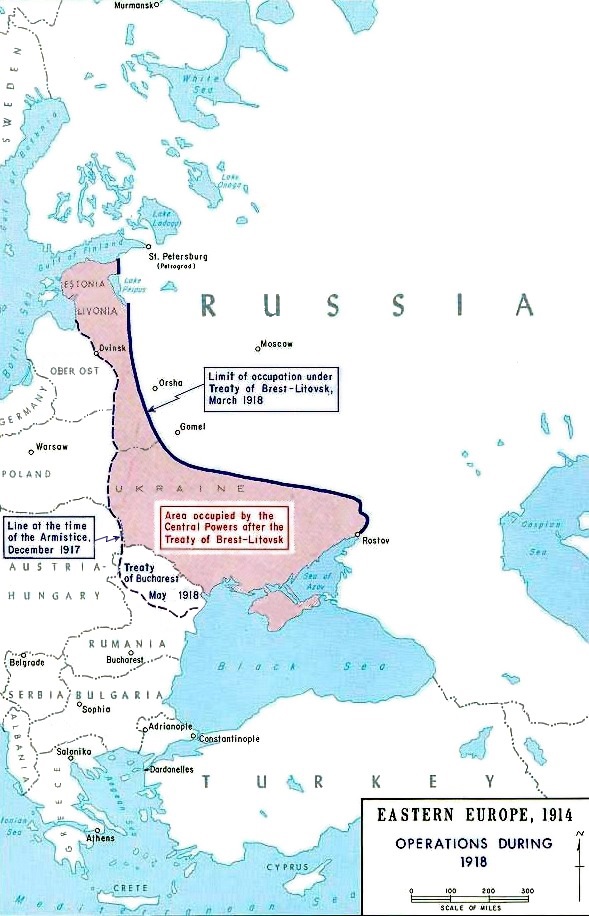
Territory lost by Russia under the 1918 Treaty of Brest-Litovsk
Map showing the massive territorial losses imposed on Russia
German Spring Offensive Begins
Germany launched Operation Michael, its spring offensive on the Western Front, achieving an unprecedented advance of 60 kilometers. Despite initial success, the offensive ultimately left the German Army exhausted and demoralized.
Allied Hundred Days Offensive Begins
The Allied Hundred Days Offensive began, marking the final phase of World War I. This coordinated Allied attack caused a collapse of the German front line and led directly to Germany's request for an armistice.

American soldiers firing on German entrenched positions during the Meuse-Argonne offensive, 1918
American forces during the final Allied offensive
Vardar Offensive Begins
Allied forces started the Vardar offensive at Dobro Pole and near Dojran Lake. The Serbian and French armies achieved a breakthrough after a three-day battle, leading to Bulgaria's collapse and armistice.

Bulgarian major Ivanov with white flag surrendering to Serbian 7th Danube regiment near Kumanovo
Bulgarian surrender during the Vardar offensive
Bulgaria Signs Armistice
Bulgaria signed the Armistice of Salonica, becoming the first Central Power to surrender. Kaiser Wilhelm II described the situation as 'Disgraceful! 62,000 Serbs decided the war!' The German Supreme Army Command informed Wilhelm that Germany's military situation was hopeless.
Battle of Vittorio Veneto Begins
Italy launched the Battle of Vittorio Veneto, which rapidly recovered territory lost after Caporetto and marked the end of the Austro-Hungarian Army as an effective fighting force. The offensive triggered the disintegration of the Austro-Hungarian Empire.

Italian troops reach Trento during the Battle of Vittorio Veneto, 1918
Italian forces advancing during their final victorious offensive
Ottoman Empire Signs Armistice
The Ottoman Empire capitulated and signed the Armistice of Mudros, effectively ending Ottoman participation in World War I. This marked the beginning of the end for the Ottoman Empire.
Austria-Hungary Signs Armistice
Austria-Hungary signed the Armistice of Villa Giusti, ending hostilities with Italy. The Austro-Hungarian Empire was disintegrating, with declarations of independence made in Budapest, Prague, and Zagreb during the last week of October.
Kaiser Wilhelm II Abdicates
Facing revolution at home and military collapse, Kaiser Wilhelm II abdicated. The German Revolution had begun with naval mutinies and spread across the country, leading to the proclamation of a republic.
Armistice of Compiègne - End of World War I
The Armistice of Compiègne was signed, ending World War I at 11 AM on November 11, 1918. The war had lasted over four years and resulted in unprecedented casualties and destruction across Europe and beyond.
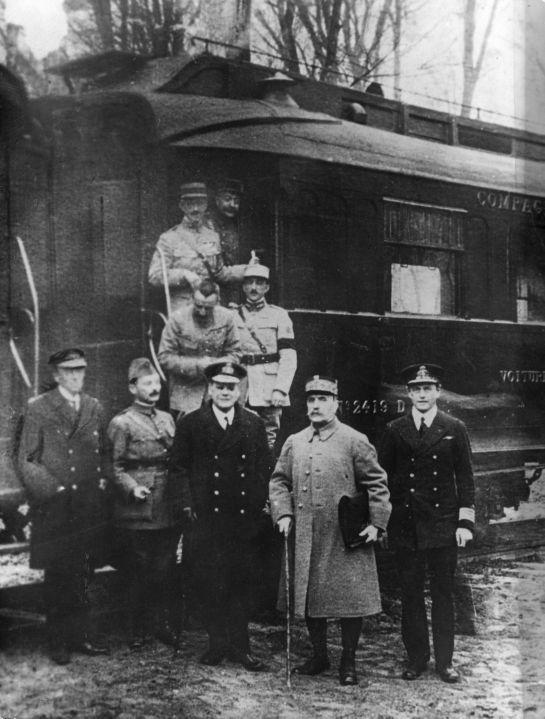
Ferdinand Foch (second from right) pictured outside the carriage in Compiègne after agreeing to the armistice that ended the war there
Historic moment of the armistice signing that ended the Great War
Treaty of Versailles Signed
The Treaty of Versailles was signed with Germany, formally ending the state of war. The treaty imposed harsh terms on Germany, including territorial losses, disarmament, and massive reparations. It also established the League of Nations.

The signing of the Treaty of Versailles in the Hall of Mirrors, Versailles, 28 June 1919, by Sir William Orpen
The formal end of World War I with Germany
1920 CE - 1921 CE
Knox-Porter Resolution
The United States formally ended its involvement in World War I when President Warren G. Harding signed the Knox-Porter Resolution. The US Senate had not ratified the Treaty of Versailles despite public support for it.

